

Purity is one of the most essential foundations of worship in Islam. It is the key to prayer and many other acts of devotion. Among the most important forms of purification is how to do a Ghusl, which Islam has prescribed not only for physical cleanliness, but also for spiritual renewal. Ghusl is an act of worship that prepares the heart and body to stand before Allah with complete humility. In this article, we will explore the meaning of Ghusl, its purpose, when it is required, and how to perform it correctly according to the Quran and the Sunnah.
The Meaning and Purpose of Ghusl in Islam
In Arabic, the word “ghusl” literally means washing or cleansing, and it encompasses external purification. However, in Islam, it’s not just about what’s visible on the outside, but rather what’s within. Ghusl in Islam is primarily about inner purification before physical cleansing. This profound transformation occurs when a Muslim makes the intention “Niyyah” to purify themselves and then follows the prescribed steps for performing ghusl.
Purpose of Ghusl in Islam
Our Islamic religion has mandated ghusl and purification in the Quran and Sunnah in numerous instances due to its great importance.
- Allah Almighty says in the Holy Quran:
“لا يَمَسُّهُ إِلَّا الْمُطَهَّرُونَ”
This means that it is not permissible for Muslims or others who are in a state of impurity to touch the Book of Allah until they have completed their ghusl and purification.
- The Prophet Muhammad (peace and blessings be upon him) said:
“لا يَقْبَلُ اللَّهُ صَلاةً بِغَيْرِ طُهُورٍ”
This means that ghusl and purification are essential conditions for performing prayer, and without them, the prayer will not be accepted.
Ghusl’s importance in Islam
The importance of ghusl in Islam lies in its spiritual impact on Muslims, in terms of:
- Achieving complete devotion and obedience to the command of Allah Almighty.
- Following the Sunnah of the Prophet Muhammad (peace and blessings be upon him).
- Performing religious duties such as prayer, fasting, and reading the Quran.
- Maintaining personal hygiene and presenting a positive image of a Muslim are encouraged by Islam.
When Is Ghusl Required in Islam?
Since ghusl and purification are the essential gateway to increasing spiritual devotion and to performing and having one’s religious duties accepted, by God’s will, it is obligatory for every Muslim man and woman to know how to do a ghusl and the times when ritual washing is required.
Read about: How to get forgiveness from Allah
Situations That Make Ghusl Obligatory
- After sexual intercourse or ejaculation (janabah).
- For women After the end of menstruation.
- After postpartum bleeding (nifas).
- Upon accepting Islam as recommended According to most scholars.
- strongly recommended Sunnah Before Jumuah.
Ghusl for Men and Women
Ghusl is obligatory for all Muslims, both men and women, as they must perform ghusl after sexual intercourse. Women have additional specific requirements for washing, such as after menstruation and nifas.
- Join Alwaleed Academy and learn Islamic Studies Course under the guidance of expert teachers.
How to Do a Ghusl Step by Step
The steps for how to do a ghusl are not difficult, but they require a few simple steps to transform it from just a regular shower into a complete purification and preparation for performing religious duties.
- From the intention to perform ghusl for the sake of purity, and the intention is in the heart, it is not required to verbalize it with the tongue.
- Start by washing your hands three times, making sure the water gets between your fingers and under your nails.
- Wash both your mouth and nose thoroughly three times with clean water.
- Wash the entire face area, extending from the forehead to the chin and from ear to ear.
- Begin by washing your arms, starting with the right arm, and make sure the water reaches your elbows.
- After that, perform the usual Wudu as if you were going to pray, and you are allowed to postpone washing your feet until the end.
- Pour water over your head three times, making sure it penetrates all of your hair and reaches your scalp.
- Begin by thoroughly washing the rest of your body, starting with the right side and then the left, pouring water over each side three times to ensure that the water reaches all parts of the body.
- Wash your feet, making sure the water gets between your toes and under your nails.
Never forget to:
- Make sure to search for pure and clean water.
- Women should completely remove nail polish before ghusl.
Maybe you interst about: How to Perform Wudu
Learn Quran, Arabic, and Islamic Studies with certified teachers in fun, interactive, and personalized sessions. Join thousands of students around the world and begin your path today!
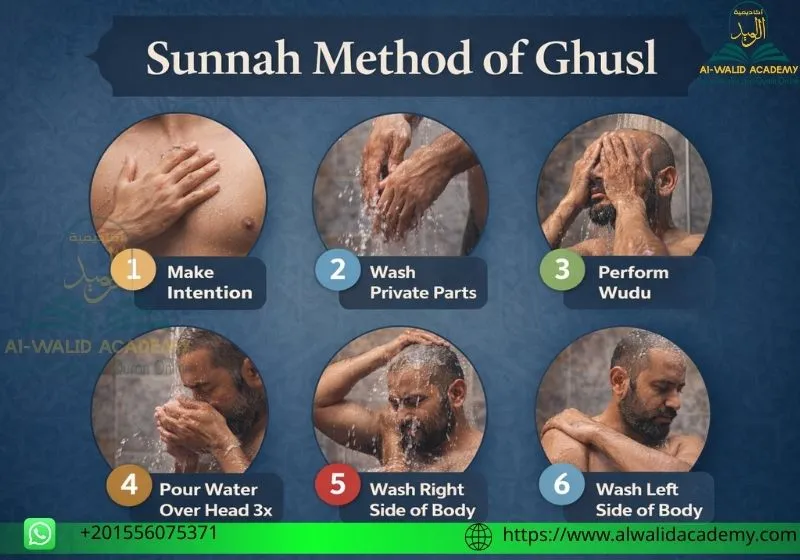
Sunnah Method of Ghusl
There is no more perfect way to perform acts of worship than the way the Prophet Muhammad (peace and blessings be upon him) did. Therefore, following the Prophet’s Sunnah makes acts of worship more likely to be accepted by Allah Almighty.
How the Prophet Performed Ghusl
The steps of how to do a ghusl are the same, but the Prophet Muhammad (peace and blessings be upon him) used to do it in a specific way includes:
- Start with saying Bismillah.
- Wash both hands three times.
- Washing the private parts first before starting.
- Performing complete wudu inside ghusl.
- Washing the right side before the left.
- Repeat each wash three times.
Obligatory Acts of Ghusl
As Ghusl is the fundamental element of purification, it is essential to know the important elements without which the washing is invalid and fails to achieve its purpose of purification.
What Makes Ghusl Valid
The basic steps and elements that must be ensured are properly completed during washing are:
- Nasal Inhalation.
- Rinsing the mouth.
- washing the body properly and making sure there is no part of the body dry
Any failure to perform these steps will invalidate the ghusl.
Common Mistakes During Ghusl
There are many mistakes that some people make during the ghusl itself that invalidate its purpose and consequently affect the performance of acts of worship and religious obligations.
Actions That Invalidate Ghusl
- Not forming the intention to perform ghusl before starting.
- There is uncertainty about whether the water reaches all parts and folds of the body.
- Not performing Wudhu while the body is unclean.
- The belief is that ghusl is only for men, but it is also for women.
Can You Do Ghusl Without Washing Hair?
Washing the hair thoroughly and ensuring that water reaches and penetrates all parts of the hair is important and necessary; without it, the ghusl will not be effective.
Rules for Short Hair, Long Hair, and Braids
In case of:
Short Hair
When washing short hair, it’s not necessary to massage the scalp vigorously, as long as the water reaches all parts of the hair easily.
Long Hair
When washing long hair, make sure that the water reaches all parts of the hair and scalp, and massage it multiple times.
Braids
The Prophet (peace and blessings be upon him) permitted women to perform ghusl while keeping their braids intact, as long as they were not tied so tightly as to prevent water from reaching the rest of the hair and scalp.
Ghusl After Janabah
Performing ghusl after sexual defilement is obligatory in order to be able to perform prayers, fast, and recite the Quran, and one should not delay in doing so because it is not permissible according to the Islamic religion.
Specific Guidelines and Tips
Ghusl after sexual intercourse or discharge becomes obligatory immediately after it is completed.
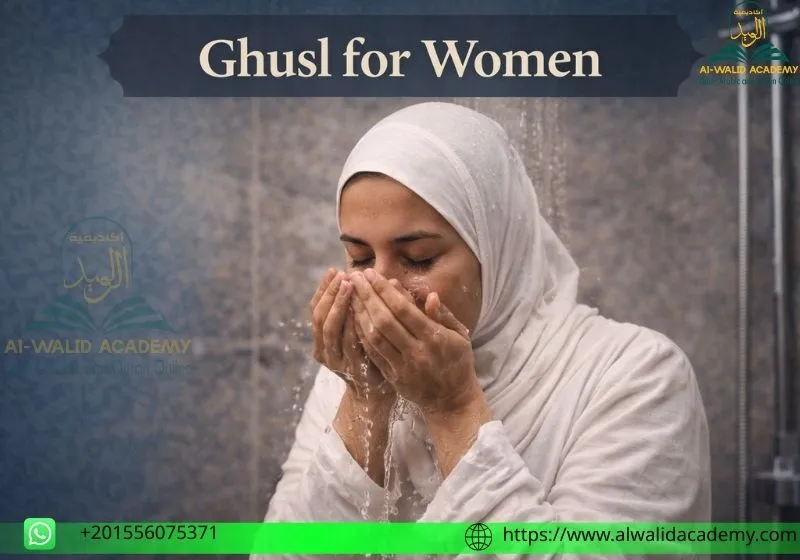
Ghusl for Women
For women, purification and ghusl are required in several situations, and this is important for maintaining purity and performing religious duties.
Menstruation and Postnatal Bleeding
- After a Muslim woman finishes her monthly menstrual period, she must purify herself by performing ghusl, and it is recommended to apply perfume or musk.
- Once the postpartum bleeding, which is the blood that a woman experiences after childbirth, has stopped, she must perform ghusl
- and purify herself immediately, even if the bleeding stops before the 40-day period is over.
Ghusl and Wudu
Both Ghusl and Wudu are religious acts of worship and obligatory duties in our Islamic religion, and they must be performed correctly to ensure that subsequent acts of worship, such as prayer, fasting, and reading the Quran, are also performed correctly.
Does Ghusl Replace Wudu?
Yes, ghusl can substitute for Wudu if the intention is purification. However, if it is a recommended act, such as ghusl on Friday, then it does not suffice as a substitute for Wudu.
Can Ghusl Be Done in the Shower?
The primary purpose of ghusl is to achieve complete purity in order to perform religious duties such as prayer, fasting, and reading the Quran.
Using Modern Bathrooms for Ghusl
There is nothing in the Quran or Sunnah that indicates that ghusl in modern bathrooms is forbidden. The fundamental principle of bathing is that water reaches all parts of the body to ensure purity and cleanliness, and the technologies used in modern bathrooms greatly facilitate this.
What to Say Before and After Ghusl
The fundamental principle of ghusl and purification is forming the intention, which resides in the heart, and reciting “In the name of God, the Most Gracious, the Most Merciful.” However, there is a recommended supplication to be recited after completion.
Duas Related to Purification
- “أشهد أن لا إله إلا الله وحده لا شريك له له الملك وله الحمد يحيى ويميت وهو على كل شئ قدير وأشهد أن محمدا عبده ورسوله”.
- ” اللهم اجعلني من التوابين واجعلني من المتطهرين”.
- “سبحانك اللهم وبحمدك أشهد أن لا إله إلا انت استغفرك واتوب اليك”.
- “I bear witness that there is no god but Allah alone, with no partner. His is the dominion and His is all praise. He gives life and causes death, and He has power over all things. And I bear witness that Muhammad is His servant and His Messenger”.
- “Allah, make me among those who constantly repent, and make me among those who purify themselves”.
- “Glory is to You, Allah, and all praise is Yours. I bear witness that there is no god but You. I seek Your forgiveness and turn to You in repentance”.
Al-Walid Academy provides Islamic Classes To explain the teachings of Islam step by step.
How Long Does Ghusl Take?
Some people think that ghusl takes a long time and a lot of effort, but in reality, it only takes a few minutes.
Practical Timing for Busy People
This topic might seem burdensome for some people who work long hours or have tight schedules due to studies or other commitments. However, performing the basic steps, making the intention, washing the entire body, and ensuring that water reaches all parts of the body is sufficient to guarantee purity and complete ghusl. Therefore, How to do a ghusl and maintain purity does not pose any obstacle or disruption during the day.
Key Points to Remember About Ghusl
Performing ghusl correctly and completely is a religious obligation that requires diligent effort to learn and master, as many other acts of worship depend on its validity. Therefore, ensuring its correctness is of utmost importance.
Simple Summary for Quick Reference
- Start with saying Bismillah.
- Form the intention to perform ghusl for the sake of purity.
- Washing private parts firstly before starting.
- Start by washing your hands three times.
- Wash both your mouth and nose thoroughly three times with clean water.
- Wash the entire face area, extending from the forehead to the chin and from ear to ear.
- wash your arms, starting with the right arm.
- perform the usual Wudu as if you were going to pray.
- Pour water over your head three times.
- washing the rest of your body.
- Wash your feet.
Why Al-Walid Academy is the Best for Islamic Classes?
- Trusted experts in Fiqh Islamic Jurisprudence.
- A comprehensive study plan and curriculum suitable for all ages and levels.
- Flexibility in learning, combining on-campus attendance and online education.
- Regular and continuous monitoring to correct errors and track progress.
- Providing a supportive and encouraging environment that fosters progress and prosperity.
Conclusion
Islam remains a religion of beauty and purity, where cleanliness is not merely a habit, but an act of worship through which a servant draws closer to their Lord. Because ritual washing has a profound effect on the purity of the body and the serenity of the soul, God has made it fundamental to many acts of worship and a key to attaining His pleasure. Therefore, every Muslim should learn how to do a ghusl, hoping to earn the love of God, who loves those who repent and those who purify themselves.
FAQs
Can I do ghusl without showering?
Yes you can depend on pouring water from a container, but make sure water reaches the whole of your body.
Can I just wet my hair for ghusl?
When doing ghusl from janaabah you have to wash the entire body, including the hair, So It is essential to pour water on the hair and make it reach what is beneath the hair.
Is it necessary to wear clothes during ghusl?
It is preferable not to wear clothes while bathing, but if necessary, for example, if the place is exposed, you can wrap a towel around your waist.
When is Ghusl required?
Ghusl is required after:
-
Sexual intercourse
-
Ejaculation
-
Completion of menstruation or postnatal bleeding
What is the correct intention (niyyah) for Ghusl?
The intention is made in the heart before starting Ghusl, intending to purify oneself for worship. It does not need to be spoken aloud.
Is wudu required after Ghusl?
If wudu is performed during Ghusl and not broken, there is no need to repeat it afterward.
Can I perform Ghusl under a shower?
Yes, Ghusl can be performed under a shower as long as the intention is made and water reaches the entire body.
Do I need to wash my hair completely during Ghusl?
Yes, water must reach the roots of the hair. It is not required to undo braids unless water cannot reach the scalp.
Is Ghusl different for men and women?
The steps of Ghusl are the same for men and women, with minor considerations related to hair and menstruation.
Can I pray immediately after Ghusl?
Yes, once Ghusl is completed correctly, you may pray immediately if wudu was included.