Learning the Arabic alphabet during childhood is a fundamental and highly significant step, the true value of which becomes apparent over time. A sound command of Arabic is essential for memorising and reading the Holy Quran and performing prayers. It is also important for interacting with Arabs and understanding the Arabic language in general; therefore, parents should be aware of How to teach Arabic letters to kids? .
Why Teaching Arabic Letters Early Matters
Learning Arabic at an early age is both enjoyable and extremely important
Arabic Letters Are the Gateway to Reading the Quran
Learning Arabic is the first step towards studying the Holy Quran and being able to memorise it, which in turn has an impact on other acts of worship, such as prayer, which is an obligation that must not be neglected.
How Early Language Learning Shapes a Child’s Brain
Learning Early second language has a significant impact on a child’s brain in terms of :
- Attention and reaction times
- Enhances memory and problem-solving skills.
- Children who speak more than one language often demonstrate creativity and the ability to come up with out-of-the-box solutions.
We provide Quran lessons for Kids online at AL-Walid Academy, so your children can learn Quran meannings.
Why Muslim Families in the West Are Prioritizing Arabic Earlier
Given the diversity of religious and social cultures, we must work from the outset to connect children with our Islamic and Arab communities. Knowing how to teach Arabic letters to kids? helps to:
- Develop an attachment to the language, understand it and master it, thereby fostering a connection between the child and their Arab homeland.
- The ability to practise religious rituals from a young age and become accustomed to them from childhood, This helps the child feel more connected to their faith and better equipped to deal with the differences they may encounter as they grow up.
- The ability to communicate with Arab Muslims there and make friends with them.
The Difference Between Learning Arabic for Language vs. Learning It for the Quran
Although the letters are similar, there is a significant difference between the approach to learning Arabic for Language and the Arabic of the Qur’an
Arabic for Language |
Arabic for the Quran |
|
The aim |
Learning to communicate with people, studying, keeping up with the news, and being able to read various books and magazines | The aim to be able s to read and memorise the Holy Quran and to understand its meanings |
Type of vocabulary |
The vocabulary is simple, combining Modern Standard Arabic with spoken Arabic | They are characterised by depth and eloquence, and are rich in meaning; sometimes they require clarification and interpretation, even for native speakers of Arabic themselves |
Pronunciation |
Pronunciation depends mainly on the local accent, but generally speaking it is easier and depends largely on practice. | Pronunciation is extremely precise, and the correct rules must be followed, as even the slightest alteration can lead to a distortion of meaning, which is not permissible. |
Grammar rules |
One can be flexible with grammatical rules and grasp the general meaning without being overly concerned with the grammatical correctness of the sentence. | A thorough understanding of grammatical rules and their correct application is essential when studying the Arabic of the Qur’an, as even the slightest error can prevent the meaning from being conveyed accurately. |
Don’t miss out Learning Arabic for Beginners Using the best methods under the supervision of experts from Al-Walid Academy
At what age should kids start learning Arabic Letters?
Children should start learning Arabic at an early age. Here are the learning objectives for each age group:
Ages 3–5: Recognition and Sound Awareness
This early stage is more about encouragement than formal education, as it combines play with learning. For example, songs and stories are used to aid learning.
At this stage, children are expected to be able to recognise common sounds and words, such as the names of animals and colours.
Ages 6–9: The Ideal Window for Systematic Learning
Children at this stage are able to concentrate better and can therefore learn the shapes of letters and sounds. They are also able to form short sentences and understand everyday conversations.
Ages 10 and Above: It Is Never Too Late
At this stage, the child is able to write and read short sentences, hold brief conversations and has a good grasp of the basics of grammar.
Signs Your Child Is Ready to Start
- They develop the ability to repeat the words they hear, whether from everyday conversations, the Holy Quran or children’s songs.
- They have strong listening skills and are able to concentrate and respond to what they hear.
- The ability to distinguish between letters, shapes and colours, indicating that they are ready to start learning.
Read: Best Place to Learn Arabic Online
Start Your Journey with Al-Walid Academy
Learn Quran, Arabic, and Islamic Studies with certified teachers in fun,
interactive, and personalized sessions. Join thousands of students around
the world and begin your path today!
What Makes Arabic Letters Challenging for Kids
The Arabic language and How to teach Arabic letters to kids? is considered to be rich and, at times, difficult, and there are several challenges involved in teaching it to children
Challenge 1 — Letters That Look Almost Identical
Most Arabic letters look very similar, and are distinguished by the use of dots, for example baa letter “ ب” and taa letter “ ت”.
To overcome this
- Take sufficient time to familiarise kids with each letter.
- Use flashcards and colourful pictures to help memorise the letters through an image or distinctive mark.
- Constant repetition helps to reinforce the subtle differences.
Challenge 2 — Each Letter Has Four Different Shapes
Each letter has four different forms, depending on whether it appears at the beginning or end of a word, and whether it is joined to another letter or stands alone. This often confuses children, particularly when they are first learning to read.
To overcome this
This is overcome by using incremental learning and ensuring that each step is fully mastered before moving on to the next.
Challenge 3 — Arabic Is Written Right to Left
In Arabic, writing proceeds from right to left, which is the opposite of most languages and often causes some confusion at first.
To overcome this
This can be overcome through consistent practice and by teaching the child to follow the direction of the letters whilst writing; with repetition and continued learning, it eventually becomes second nature.
Challenge 4 — Short Vowels (Harakaat) Are Often Invisible in Text
The letters in Arabic script can be confusing, which poses a significant challenge, particularly at the beginning.
To overcome this problem about How to teach Arabic letters to kids?
This can be overcome by initially practising with fully formed texts and then gradually simplifying them, whilst learning the basics of grammar, which helps with accurate interpretation.
Challenge 5 — Parents Who Do Not Speak Arabic Themselves
This may, to some extent, hinder the ability to practise at home and receive personal guidance from parents
To overcome this
However, overcoming this has become easier thanks to interactive programmes and apps that help with effective practice.
Step-by-Step Method to Teach Arabic Letters at Home
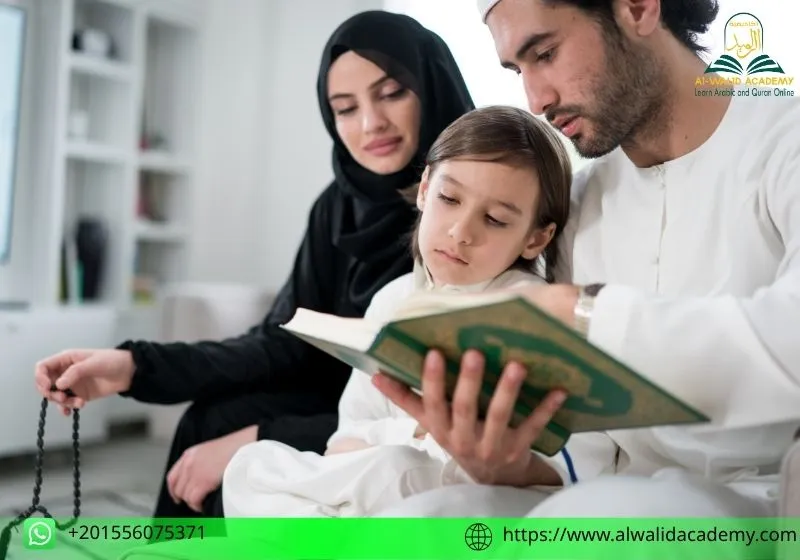
Teaching children Arabic at home isn’t difficult as long as we follow a clear plan and curriculum
Step 1 — Start With Letter Recognition Before Writing
Start by familiarising yourself with the shapes of the letters first, as the Arabic language relies heavily on memorising the shapes of the letters and their pronunciation; consequently, starting with writing makes the process more complicated and prolongs the learning journey
Step 2 — Group Letters by Shape, Not by Alphabet Order
The Arabic language consists of 28 letters, but in practice, you don’t need to learn all 28 individually, as some letters are grouped together because they look similar and are distinguished by dots, for example:
- Group of letters” ba, taa, thaa, noon” “ ب، ت، ث، ن” all of them have the same shape and differ in the dot position.
- Group of letters “ Geem, haa, khaa”” ج, ح, خ” all of them have the same shape and differ in the dot position.
So you don’t need to memorise each letter individually; it’s enough just to know the basic shapes and practise distinguishing between them using the dots in different positions
Step 3 — Teach the Sounds Before the Names
The Arabic language relies primarily on sounds and vowel marks; each letter has a specific way of being pronounced, and with proper practice, this makes pronunciation and speaking much easier.
Furthermore, the Arabic language contains certain letters whose pronunciation is unique and has no equivalent in other languages; for example, the letters ḍād “ ض”, ʿayn “ ع”, ghayn “ غ”and khāʾ “ خ”.
Therefore, intensive practice is required to master their pronunciation; simply knowing their form is not enough. In such cases, it is helpful to seek assistance from native speakers of the language.
Step 4 — Introduce the Four Positions of Each Letter
Each letter has four forms, depending on its position in the sentence and whether it stands alone or is joined to the following letter; for example, letter “ ha” “ ه”
- In the beginning of the word is written like in this word
“ هدية” which means a present. - In the end of the word is written like in this word
“ له” for him. - If it is detached it is written like in this word:
“ هذه” which is a Feminine singular demonstrative pronoun. - If it is attached it is written like in this word:
“ هرة,” which means a cat.
Step 5 — Add Short Vowels (Harakaat) Once Letters Are Solid
Once we have fully mastered the letters, their forms, and how they are written in different positions within a word, we move on to studying the vowel marks: fathah, kasrah, dammah, and sukun.
We also cover the basics of grammatical rules, which explain when to use each vowel mark and how to pronounce the letter with each different mark.
Step 6 — Move to Simple Words Then Short Quranic Phrases
The process should be approached gradually. To begin with, focus on simple words from everyday life, such as colours and letters, and then move on to forming short and longer sentences. Once a certain level of proficiency has been achieved, verses from the Qur’an can be introduced, starting with short verses from the shorter surahs and gradually increasing in length.
Read: How to Teach Noorani Qaida to Kids
Fun Activities to Teach Arabic Letters That Actually Work
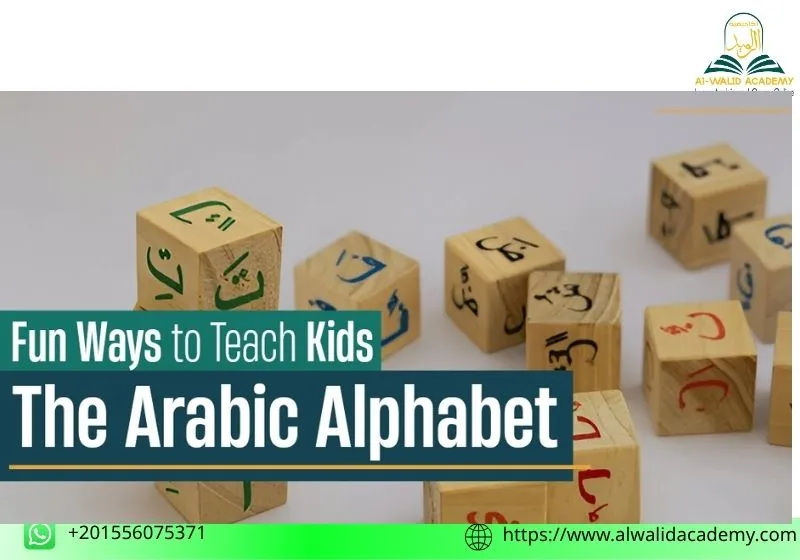
Combining play and ways of teaching Arabic letters to kids is one of the most effective ways to achieve good results, particularly when learning Arabic
Flashcard Games for Letter Recognition
Letter cards are a very effective way of helping children quickly recognise letter shapes, as they can be used in simple games such as matching or guessing.
This activity helps to develop visual memory and associate the letter with its sound or a related word.
Tracing Sheets, Sand Trays, and Playdough Letters
This method engages multiple senses, such as moulding letters in clay, drawing in the sand or using paper, to effectively embed the shape and writing of the letter in the child’s memory and help them master it in a variety of ways
Arabic Alphabet Songs and Rhymes
Learning the alphabet through songs is one of the most effective methods, as it helps children associate the shape of a letter with its correct pronunciation and helps them memorise the letters without getting bored
Letter Sorting Games by Shape Group
This type of game is considered advanced, as it helps children develop a high level of discernment and differentiation by grouping letters that look similar, which in turn helps to reinforce their memory of the letters.
Drawing and Coloring Arabic Letters
Colouring is a fun and beneficial activity for children, helping them to engage with and recognise the shapes of letters. It also features pictures of words containing that letter, which helps children associate the letter with the word it represents.
Apps Worth Using With Your Child at Home
Educational games and apps offer a significant advantage in helping children engage with and learn the alphabet more effectively; however, care must be taken to choose an app that is appropriate for the child’s stage of learning, and this should be done under parental supervision.
How to Teach Arabic Letters Specifically for Quran Reading
Learning Arabic in order to master the recitation of the Holy Quran requires a well-thought-out and carefully planned approach in order to achieve this noble goal
The Letters That Need Special Attention for Tajweed (ع ح خ غ ق ض)
These sounds are considered heavy guttural sounds, which have no equivalent in English; therefore, they require a great deal of listening practice, combined with continuous training in correct pronunciation.
What Is Makhraj and Why It Matters From Day One
Makhraj refers to the specific locations and correct manner in which each letter is pronounced; even if some letters share the same articulation point, each letter has its own distinct pronunciation.
It is essential to master these, as they affect clarity and the conveyance of meaning in the Arabic language in general, and in the Qur’an in particular.
How the Noorani Qaida Builds the Right Foundation
In Arabic, even slight differences in pronunciation can have a major impact on the meaning.
For example,
If someone pronounces the word ‘qalb’ as ‘kalb’, this causes a significant distortion of the meaning: ‘qalb’ means ‘heart’, whereas ‘kalb’ means ‘dog’.
Learning the Noorani Qaida also helps to
- speed up the process of memorising the Qur’an, as it establishes a firm and clear foundation for pronunciation that can be relied upon from the outset, rather than having to repeatedly correct mistakes whilst memorising.
- Building a strong foundation facilitates the understanding of the rules of tajweed later on when studying them.
- It helps in understanding and reflecting on the Holy Quran by ensuring the meaning is conveyed correctly and clearly
The Difference Between a Child Who Learns Arabic and One Who Learns Quranic Arabic
Children learning Arabic: The primary focus is on speaking, listening, reading and writing skills, with the aim of enabling them to understand others and express themselves easily in various situations.
Children learning Qur’anic Arabic: The aim is to enable them to recite and memorise the Qur’an correctly; consequently, the focus here is on understanding the rules of tajweed and correct pronunciation, as well as grasping the profound meanings of the Qur’an.
How to Keep Your Child Motivated During the Learning Journey

Short Daily Sessions Beat Long Weekly Ones
- Children get bored quickly, so studying for long periods will never be effective; it is better to set aside a short time each day than to have just one session a week.
- Keep each session to no more than half an hour and vary the activities between listening, speaking and other educational exercises.
- End each session with a fun activity to encourage the child to look forward to the next lesson, rather than just being glad that the lesson is over.
Celebrate Small Wins and Track Progress Visibly
- Children should be consistently encouraged for every achievement, big or small.
- Offering small rewards from time to time and creating little charts to track their progress helps children feel a sense of achievement.
Make It a Family Habit, Not Just a Lesson
- A child’s true role models are their father and mother, and support from home is the foundation of progress. Therefore, it is essential to:
- Involve the child fully in their educational journey, particularly for children under the age of five.
- Set aside time for all family members to do meaningful activities that foster a supportive family environment for learning.
- Always maintain a positive atmosphere free from stress.
What to Do When Your Child Loses Interest
- Stop quickly so that the child does not lose interest completely.
- Start again after finding another effective method that yields better results.
- Try to identify the reasons why the child has lost interest.
- Reduce the difficulty of the tasks to a minimum and then gradually increase it once the child is keen to learn again.
- Introduce elements of challenge and encouragement, such as studying with a sibling, a family member or a friend, to create a supportive, competitive environment.
Common Mistakes Parents Make When Teaching Arabic Letters
There are certain mistakes that parents overlook and make during the journey of How to teach Arabic letters to kids?, which have a significant negative impact on a child’s learning
Teaching All 28 Letters at Once
Learning any new language takes time and requires a relatively slow start, particularly Arabic, as it is a rich language. Consequently, rushing into it and attempting to teach a child the alphabet in a short space of time can have significant negative consequences and cause the child considerable confusion.
It is therefore important to start with simple steps and not move on from one stage to the next until the previous one has been fully mastered.
Relying Only on English Transliteration
You should never rely on English transcriptions when learning Arabic, given the significant differences in the pronunciation of letters and the fact that some Arabic letters have no equivalent in English. This leads to mispronunciation and a loss of meaning.
Skipping Pronunciation and Focusing Only on Shapes
Language is a combination of reading and writing; therefore, focusing on recognising the shapes of letters without practising pronunciation or linking them to sentences and words means that a child is able to recognise the shape of a letter without being able to use it in reading and writing
Switching Methods Too Quickly
Constant switching between different teaching methods confuses children and makes them unable to follow a particular method or approach; therefore, if there is a desire to develop a teaching method, this should be done gradually and in a well-considered manner.
Expecting Results Without a Structured Curriculum
It is the clear, steady steps you take along a path that lead you to the end; therefore, taking haphazard and imprecise steps ultimately leads to randomness and a loss of focus.
So, before you begin, you must set clear goals and draw up a plan for gradual progress so that the child can acquire learning skills in the right way.
How Al Walid Academy Helps Your Child Master Arabic Letters the Right Way
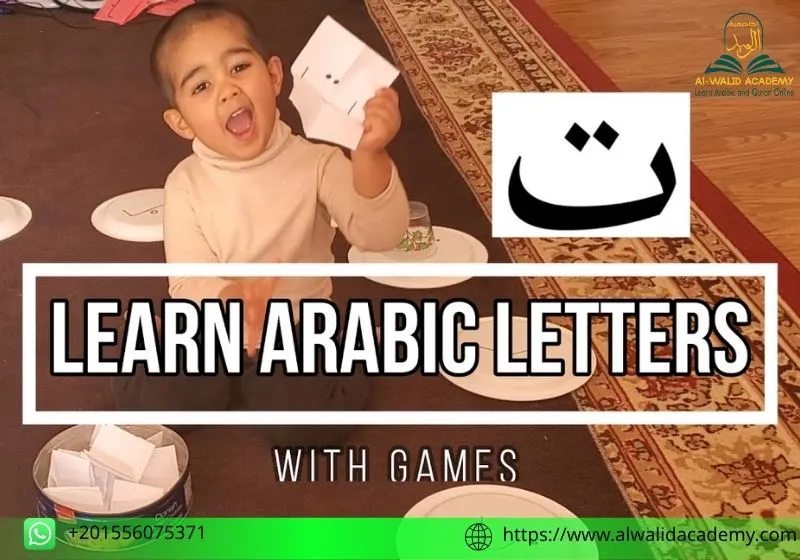
Al-Walid Academy is the ideal choice if you want to teach your children the Arabic alphabet and see tangible results as quickly as possible
Native Arabic and Quran Teachers With Tajweed Expertise
- We have specialist teachers who hold accredited qualifications in the Qur’an, tajweed and various religious studies.
- Possess extensive experience in working with children and employing effective, scientific and practical methods to engage with them.
A Structured Path From Letters to Full Quran Recitation
We have developed systematic learning plans, covering everything from learning the alphabet to reciting the Qur’an.
In delivering these plans, we take into account the:
- Child’s age.
- Their ability to comprehend.
- Their familiarity with the Arabic language.
One-on-One Sessions Designed for Kids in the USA, UK, and Canada
We offer one-to-one tuition, which is:
- An effective way to achieve quick results.
- It allows for greater learning efficiency and better correction of mistakes due to the focus on a single child.
- Our timetable is structured and tailored to the child’s learning abilities and free time.
Flexible Scheduling That Fits Busy Family Routines
Because we understand how busy parents are with work and children with their studies, we offer a flexible timetable that fits in with work and study schedules and can be intensified at weekends and during the summer holidays.
Start With a Free Trial Class — No Commitment Needed
Before you begin the actual registration process, we offer free trial sessions to:
- Assess the compatibility between the child and the tutor.
- This helps us identify the child’s abilities and the starting point for their learning journey.
- We also outline the study plan to be followed and estimate the time required to achieve the desired results.
Conclusion
How to teach Arabic letters to kids? remains a task that warrants considerable effort, as it is a long-term investment in their religious and linguistic future. It requires patience, consistency and the selection of methods appropriate to each age group. By adhering to a clear plan and relying on positive interaction and constant encouragement, the dream becomes a reality.
Frequently Asked Questions
How many letters are in the Arabic alphabet?
The Arabic alphabet consists of 28 letters, starting with alif and ending with ya.
Should I teach Arabic letters before starting the Quran?
Yes, it is strongly recommended; learning the Arabic alphabet and mastering the articulation and pronunciation of each letter in all contexts is an essential step before beginning to read the Qur’an, to ensure correct pronunciation and understanding of the meaning.
Can my child learn Arabic online if I do not speak Arabic myself?
Yes, but you should enrol your child at a highly reputable academy such as Al-Walid Academy, where they will be taught by specialist teachers. Parents can monitor their child’s progress through the academy to ensure an effective education.
What is the best starting point — Noorani Qaida or the Arabic alphabet?
It is recommended to start with the Noorani Qaida, as it teaches the letters correctly in terms of their shapes, points of articulation, and pronunciation; it also provides a solid foundation for beginning to learn the science of tajweed.