Sometimes, light emerges from the deepest darkness. That Arabian Peninsula, with its scorching heat and isolation due to the surrounding mountains, and the prevalence of harmful customs such as social stratification, raids, and idol worship, was the very place where the greatest of men, the noblest of creation, and the most beloved of God Almighty was born. He was born to bear the heaviest of burdens and suffered greatly in spreading God’s message until God took him, having fulfilled his trust. The place where did islam start is Mecca. The place from which the first ray of Islam emerged, illuminating the entire world.
Where Did Islam Start
Islam originated in the Arabian Peninsula, specifically in Mecca, where the Prophet Muhammad (peace be upon him) was born and received divine revelation.
The Beginning of Islam in Mecca
Islam originated in Mecca, a city in the Arabian Peninsula, in 610 CE. The Prophet Muhammad (peace and blessings be upon him) received divine revelation from the Angel Gabriel. The teachings of Islam emphasized monotheism, the worship of the one and only God, and the rejection of idol worship.
The call to Islam began secretly at first due to the weakness and small number of Muslims, until God Almighty commanded them to openly proclaim their faith and migrate to Medina.
Why Mecca Is the Birthplace of Islam
Mecca is considered the cradle of divine revelation, and where did islam start to spread because of:
- Its great religious significance predates Islam, due to the presence of the Holy Kaaba, which was built by the prophets Ibrahim and Ishmael.
- Mecca held a significant and important commercial position, and merchants from various tribes and neighboring countries would come to it, which later on helped in spreading Islam.
- Despite the prevalence of idol worship, there were some Christians, Jews, and followers of Ibrahim’s faith, which helped create a natural receptiveness to accepting the message.
Role of Arabia in The Early Islamic Message
Arabia Helped strongly in spreading of Islam due to:
- Its central location between the world’s continents has increased its connection to the outside world.
- Its encirclement by mountains on all sides made it safe from raids and wars that could affect the spread of the message, especially in the beginning.
- The ingenuity of its people in trade gave it a global commercial standing, which also helped in spreading the Islamic religion.
- The presence of the Holy Kaaba in Mecca has given it great religious and social significance.
- The attempt to demolish the Kaaba, which ended with the failure of Abraha the Abyssinian and his armies, drew the attention of the surrounding world to the prestige and sanctity of this place.
The First Revelation of Islam
Upon reaching the age of forty, the Prophet Muhammad experienced a momentous and profound event that changed the lives of many nations: the moment of divine revelation, the moment when the Angel Gabriel met with the Prophet of God and the Seal of His Messengers, the truthful and trustworthy Muhammad, peace and blessings be upon him.
Revelation to Prophet Muhammad in Cave Hira
God Almighty has always protected His messengers and prophets from the sins that other human beings commit. The Prophet Muhammad always possessed a constant awareness of the existence of one God, without partners, and therefore he never accepted the worship of idols and never bowed down to an idol.
The Prophet Muhammad (peace and blessings be upon him) used to go regularly to the Cave of Hira for solitude and contemplation of the universe and creation. He would take with him only a small amount of provisions to sustain him during his stay, which could last up to a month.
The meeting between the Prophet Muhammad and the Angel Gabriel (peace be upon them).
One night, as the Prophet was sitting as usual, he heard a voice saying, “O Muhammad, raise your head.” The Prophet looked up and saw Gabriel, peace be upon him, in his true form, a mighty angel with 600 wings, each wing stretching across the horizon. Gabriel embraced the Prophet Muhammad so tightly that the Prophet thought he would die, and he began to sweat profusely.
Then the Angel Gabriel left him and said, “Read!” The Prophet Muhammad (peace and blessings be upon him) replied, “I cannot read.” Gabriel repeated this command three times, and the Prophet gave the same answer each time. After that, Gabriel continued by reciting verses from the Holy Quran,
“ٱقۡرَأۡ بِٱسۡمِ رَبِّكَ ٱلَّذِي خَلَقَ”
“Read in the name of your Lord who created”.
Then Gabriel (peace be upon him) left him, and the Prophet (peace and blessings be upon him) rushed to his house out of fear, saying” “زملوني..زملوني” , “ دثروني دثروني”, This means asking them to cover him.
The following night, Gabriel came to him again, but this time it was clear that he was a messenger from the Lord of the Worlds, and he informed Muhammad that he was the next prophet who would carry the divine message.
The Start of Islam With the Quran
Islam began with the Quran, in the verses recited by the Angel Gabriel to the Prophet Muhammad. The revelations continued until the complete descent of God’s book, which contains:
- Divine law and the concept of monotheism.
- The most precise laws and regulations that guarantee peaceful coexistence and the preservation of rights.
- Descriptions of Paradise and Hell
- Lessons from previous nations
- Rewards bestowed upon believers for their worship and patience.
Join AL-Walid Academy and Learn Quran Tafseer Online With the help of a select group of tafsir scholars.
How did Islam spread
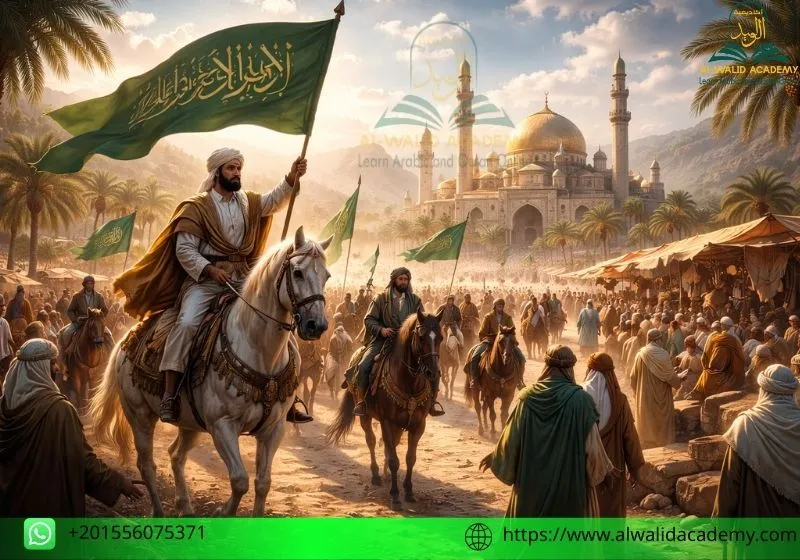
The spread of Islam went through several stages; initially it was slow, but then it accelerated until it reached the entire world.
First Phase
The Prophet, peace and blessings be upon him, was known among his people for his honesty and trustworthiness; he never lied. The Prophet began spreading his message among his family and friends, who believed him wholeheartedly. However, the real struggle began when he called upon his people to embrace Islam.
- Some believed him, mostly the poor.
- While the wealthy, despite being convinced of his prophethood and truthfulness, refused to accept his message because they rejected the idea of equality between themselves and the poor and the slaves.
Deployment phase
- Islam began to spread among Muslims in the Arabian Peninsula during the lifetime of the Prophet Muhammad (peace and blessings be upon him).
- And continued to spread after his death at the hands of the caliphs and companions, until the Islamic state became a vast entity stretching from east to west.
The First Muslims in Mecca
Although many companions and followers embraced Islam, the first person to believe in the Prophet remains unique and holds a special place in the sight of God Almighty and among Muslims.
- The first man to embrace Islam was Abu Bakr al-Siddiq, may God be pleased with him.
- The first woman to embrace Islam was Khadija, may God be pleased with her.
- The first boy to embrace Islam was Ali ibn Abi Talib (may God be pleased with him).
- The first of the freed slaves to embrace Islam was Zayd ibn Haritha.
Early Challenges Faced by Muslims
The Quraysh initially rejected the message of Islam with great force because it threatened their social and economic status, which led to the Prophet and the early Muslims suffering the most severe forms of torture.
- The Muslims were severely tortured, most notably Bilal ibn Rabah, the Abyssinian, whom the disbelievers would strip naked and leave in the scorching desert sand with a heavy stone placed on top of him, forcing him to renounce his religion. But he remained steadfast, repeatedly saying, “One God, One God.” ” أحد.. أحد”.
- The Muslims suffered from the economic blockade and starvation.
- They were flogged and burned to death.
- Those among the leaders of Quraysh who embraced Islam were disowned by their families and left to face torture.
- The Prophet was subjected to persecution, and in addition to that, he lost his wife Khadija and his uncle Abu Talib, who were the main supporters among his family.
Despite the various forms of torture, God bestowed His tranquility upon the believers, supported them with patience and strength, granted them victory in this world, and prepared for them gardens of bliss in the hereafter.
The Hijrah and the Growth of Islam
The Prophet Muhammad (peace and blessings be upon him) preached to the people of Mecca for thirteen years, during which he called them solely to monotheism and to abandon idol worship. No other acts of worship had yet been prescribed.
However, during this period, he and his companions faced nothing but rejection and persecution, until God Almighty commanded him to emigrate to Medina to continue his preaching and spread Islam there.
Migration From Mecca to Medina
The migration to Medina was a momentous event and marked the beginning of a new era for the spread of Islam. The Prophet Muhammad (peace and blessings be upon him) migrated with his companion, Abu Bakr, after the Quraysh tribe conspired to kill him. The Quraysh infidels pursued them during their journey, but they hid in the Cave of Thawr for three days before continuing their journey until they reached Medina. There, they were met with a warm welcome, and they settled there, beginning the spread of Islam in the city.
Medina as the First Islamic Society
The people of Medina were known as the Ansar (the Helpers), because they were the ones who supported the Prophet, peace and blessings be upon him, and the Muslims, and provided them with protection with all the strength they possessed.
Medina represented a complete Islamic society due to what the Prophet did:
- The Prophet’s Mosque was built to be a center of worship, education, and consultation.
- The brotherhood between the Muhajireen and the Ansar was established to strengthen their relationship and promote mutual material and social support.
- They drafted the City Charter, which regulated the relationship between Muslims and non-Muslims.
Life in the city transformed into a life governed by the values of justice, tolerance, and cooperation.
Islam’s Foundations in the Arabian Peninsula
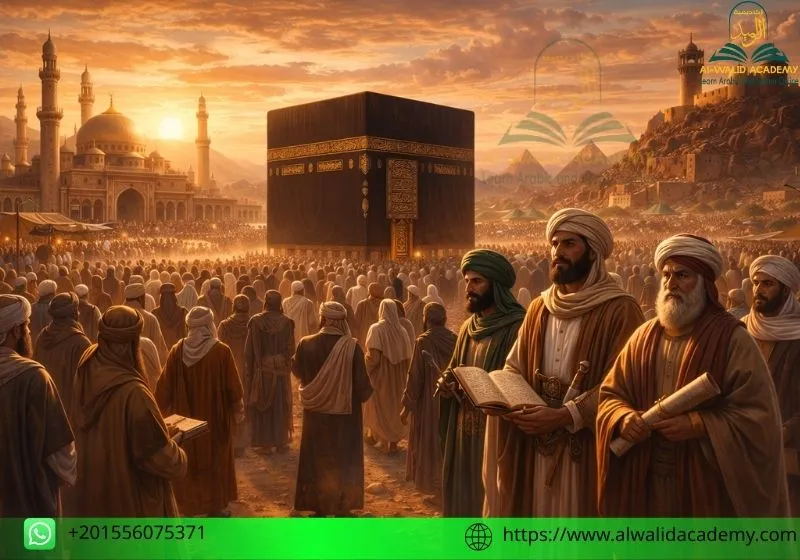
Islam spread throughout the Arabian Peninsula, and the teachings of the Islamic religion were firmly established among the people of the peninsula, transforming their lives and eliminating many of the bad customs they practiced.
Unifying Tribes Through Islam
Islam united the Arab tribes under the banner of truth. After they had been killing each other for power and dominance, they began competing to please God Almighty and serve the Islamic religion.
Preventing female infanticide
The Arabs preferred having sons to help them in trade, herding, and defending the tribe. Therefore, if an Arab man had a daughter, he would be filled with anger and sadness, believing that she would bring poverty and shame. Islam came and honored women, forbidding their killing and dispelling the negative superstitions associated with having daughters.
Learning Islamic History Through Quran and Sunnah
There is no better source than the Book of God and the Sunnah of His Prophet for reliable information and a comprehensive explanation of the beginning of the spread of Islam and other events in the life of the Prophet and his companions.
The Holy Quran describes the journey of revelation from its very beginning
Many surahs and verses describe the suffering of the Prophet and the Muslims, the hardships they went through, and the victory they ultimately achieved.
- Starting with the first encounter between the Angel Gabriel and the Prophet Muhammad, when Surah “Iqra” (اقرأ) was revealed.
- It also includes Surah Al-Fath (الفتح), which was revealed after the Treaty of Hudaybiyyah and contained good tidings for the Muslims regarding the conquest of Mecca.
- Surah Quraysh “ قريش”, which described their journeys in the summer and winter and the blessings God bestowed upon them, which they had become so accustomed to that they forgot to thank God for them.
- There is Surah At-Tawbah (التوبة), which exposed the affairs of the polytheists and their failure to participate in the fighting in the battle of Yarmouk.
At Al-Walid Academy, we provide Quran Classes For Adults. Don’t miss them.
Through Sunnah
The Sunnah is the practical application of the Quran’s teachings. It shows us how the Prophet Muhammad (peace and blessings be upon him) lived out Islamic teachings in his daily life, and how he interacted with people in times of peace and war, in hardship and prosperity.
Join our Fiqh Islamic Jurisprudence course To learn the correct way to perform acts of worship.
Understanding the Origins of Islam Clearly
When you read the Quran and the Sunnah and realize the immense suffering endured by the Prophet Muhammad (peace and blessings be upon him) and his companions.
And realise the heavy burden of the message they carried, you should hold even more firmly to your religion and defend it, even if it costs you your life, and protect it from temptations and from being distorted by the enemies of Islam.
What the Beginning of Islam Teaches Muslims
We learned from the beginnings of Islam and its spread many, many values that, if we understand them, will benefit us in this world and the hereafter.
- patience: God is with those who are patient “ إِنَّ اللهَ مَعَ الصَابِرِين” Patience in the face of adversity and submitting to God’s will is a test after which you will see all the doors of goodness open.
- Steadfastness in the truth: The early Muslims were subjected to countless forms of harm and persecution, but they were certain that they were on the right path and remained steadfast, and God granted them victory, even if it was after some time.
- The number is not what matters: The Islamic religion was initially followed by only a small number of people, but because of their sincerity and unwavering faith, each one of them was like an entire nation protecting and defending the religion.
- Adhering to the morals of Islam: Some enemies of Islam falsely claim that Islam spread by the sword, but this is a slander. Muslims have coexisted with others, and their relationships have been characterized by tolerance and forgiveness, as God Almighty has commanded us.
Learn Islamic Foundations With AL-Walid Academy for Quranic Studies
Learning the fundamentals of the Islamic religion is an obligation for every Muslim man and woman. It clarifies for us the religious duties and how to perform them according to the Quran and Sunnah, and it introduces us to stories from the lives of the Prophet and his companions so that we may understand the extent of their struggles to preserve the religion and emulate them in various acts of worship.
Study the Origins of Islam With Structured Learning
At Al-Walid Academy, we take you on a challenging yet rewarding academic journey about the beginnings of Islam, the Seerah of the Prophet Muhammad (peace and blessings be upon him), and his companions, based on the Quran and Sunnah.
The educational structure of Quranic studies at Al-Waleed Academy is based on:
- The approach Islamic Studies Course relies on a tiered educational structure starting with learning the fundamentals of creed, Sunnah, and the Quran, then moving on to higher levels that include the principles of interpretation, understanding the Sunnah, and the principles of Islamic law.
- The curriculum is based on a structured study methodology divided into sections with clear learning objectives, specific learning outcomes, and practical activities that help the student understand the material through application rather than just memorization.
- The academy relies on an interactive teaching method, through discussions, exercises, small projects, and individual follow-up with each student.
- The academy offers flexible online learning options, with recordings that can be accessed at any time, and regular tests to measure progress.
- The academy provides students with a comprehensive educational experience that combines religious knowledge, academic structure, and modern technologies in an environment that encourages continuity and excellence.
Learn Quran, Arabic, and Islamic Studies with certified teachers in fun, interactive, and personalized sessions. Join thousands of students around the world and begin your path today!
Conclusion
Searching the answer of the question where did islam start is not merely a recounting of past historical events, but rather a spiritual journey that teaches us patience, perseverance, reliance on God, and unwavering faith in His support. The Prophet Muhammad (peace and blessings be upon him) and his companions carried the trust of the message under extremely difficult circumstances, and through it, they built the greatest civilization known to history.
FAQs
Which is older, Christianity or Islam?
Christianity developed in the 1st century CE. Islam developed in the 7th century CE, SO Christianity is older than Islam.
Why did Muslims convert to Islam?
They found in it tolerance, spirituality, rules governing rights and duties, and miracles in the Book of God that prove it is the truth.
What was the situation of the Arabs before Islam?
The Arabs possessed many admirable qualities such as generosity, courage, and a strong sense of honor, but many bad customs were also prevalent, which Islam came to change, such as idol worship, adultery, excessive revenge, and raiding.
Where did the first revelation of Islam occur
The first revelation occurred in the Cave of Hira near Mecca when Angel Jibreel revealed the opening verses of Surah Al-‘Alaq.
What role did the Hijrah play in the beginning of Islam
The Hijrah marked a turning point by allowing Muslims to practice Islam freely and establish an Islamic society in Medina.
Why is Mecca important in Islamic history
Mecca is important because it is the birthplace of Islam, the location of the Kaaba, and the site of the first revelation.
How did early Muslims practice Islam in Mecca
Early Muslims practiced Islam secretly at first due to persecution, focusing on faith, prayer, and patience.
What lessons do Muslims learn from the beginning of Islam
Muslims learn patience, perseverance, trust in Allah, and commitment to faith despite hardship.