

If you want to master Arabic Language Grammar Rules that turn ordinary words into pulsing poetry, this exclusive gateway is your secret weapon no one else knows.
No more boring rule-reading— these are lightning secrets unlocking the Arabic language world.
What Are Arabic Language Grammar Rules?
Arabic grammar rules, or Arabic Language Grammar Rules, are the foundation that helps you understand sentences and form them correctly without confusion.
They organize how words are arranged and explain the role and ending of each word in a sentence, which makes the meaning clear and accurate.
Once you understand them in a simple way, reading and understanding Arabic becomes much easier—whether in the Quran or everyday language, or even while studying through Quran courses online.
Looking deeper, grammar isn’t as complicated as many people think. It’s actually a system that keeps the language structured and meaningful.
You can think of it as the framework that holds the sentence together, since even a small change in word endings can completely change the meaning.
That’s why starting with basics like sentence structure and word endings makes learning smoother and even enjoyable over time.
Why Arabic Grammar Is Important for Learners
Grammar becomes essential when you move beyond memorizing words to actually using the language.
Without it, you might read a lot but still not understand why sentences are formed in a certain way or how to create your own. But once you understand grammar, meanings become clearer and connections between words make more sense.
Grammar also helps you avoid common mistakes that can change meanings entirely, and it gives you more confidence in writing and speaking.
If you’re learning the Quran through a Quran Memorization Course, grammar allows you to appreciate the precision and beauty of how words are arranged.
In short, grammar helps you:
- Understand texts deeply, not just on the surface.
- Use the language correctly in writing and speaking.
- Build accurate sentences with confidence.
That’s what makes learning Arabic truly effective.
The Difference Between Nahw and Sarf
Understanding the difference between Nahw and Sarf is very important, but it’s actually quite simple, here’s the difference:
- Nahw (syntax) focuses on the role of a word within a sentence—whether it’s a subject, object, etc., and what its ending should be.
- Sarf (morphology) focuses on the structure of the word itself—its root, forms, and how it changes.
Simply:
- Nahw determines the function of the word in a sentence.
- Sarf explains how the word is formed.
Example:
- “The boy wrote the lesson” → Nahw identifies “the boy” as the subject and “the lesson” as the object.
- “write – writes – writing” → this is Sarf, showing how the word changes form.
When you understand both, Arabic becomes much easier to use and understand—and with Quran Classes For Adults, you can apply these concepts step by step while improving your recitation and overall understanding of the language in a practical and guided way.
How Grammar Helps You Read, Write, and Speak Arabic
Grammar plays a key role in improving all your language skills.
In reading, it helps you quickly identify parts of a sentence and understand the meaning without confusion.
In writing, it allows you to form clear and correct sentences without mistakes.
When speaking, grammar gives you the confidence to express yourself clearly and correctly.
For example: Instead of saying “I went school,” you’ll be able to say “I went to school” correctly.
To improve practically:
- Read sentences and try to understand their structure.
- Write simple sentences and review them.
- Practice speaking using what you learn.
Over time, you’ll notice a big improvement because you’re actively using Arabic Language Grammar Rules, not just memorizing them, and you can strengthen this even more by joining a Quran Recitation Course, where you apply grammar naturally while reading and reciting with proper guidance.
Learn Quran, Arabic, and Islamic Studies with certified teachers in fun, interactive, and personalized sessions. Join thousands of students around the world and begin your path today!
Arabic Language Grammar Rules for Beginners

To understand Arabic Language Grammar Rules in an easy way without complication, the solution is to go slowly and begin with the basics only.
Grammar is not made to make the language difficult for you, but it helps you understand and express better. Once you get the foundation right, you will find yourself reading and understanding sentences much more clearly.
At the beginning, grammar is just simple concepts that show you how a sentence works as:
- You will get to know the different types of words, and you will understand that each word has a specific role inside the sentence.
- You will also notice that the form of the word changes depending on its position, and this appears in the endings like dhamma, fatha, and kasra.
With practice, you will discover that the Arabic language is very well organized, and everything follows a clear system, especially when you apply what you learn to real examples that fix the information in your mind.
Learn about: Classical Arabic Course Online
The First Grammar Concepts Every Beginner Should Learn
If you’re just starting your journey in Learning Arabic for Beginners, the first thing you need to start with is distinguishing between types of words.
- There are words that refer to people or things, and these are called nouns.
- There are words that describe actions, and there are also small words that connect speech together.
After that, comes the step of understanding the word ending according to its role in the sentence.
- When the word is the one doing the action, it has a certain form.
- And when it is affected by the action, it has another form.
- If it comes after a connector like a preposition, its form changes as well.
A simple example to clarify the idea:
“The boy read the book”
The first word indicates who did the action, and the last word is the thing the action happened to, and this affects the form of each word.
When you practice on similar sentences regularly, you will start to understand the rule without feeling that you are memorizing it.
Why Arabic Grammar Feels Difficult at First
Feeling that grammar is difficult at the beginning is very normal, especially when you’re starting to learn Modern Standard Arabic, because you are dealing with a new system different from what you are used to.
- The Arabic language has details that appear at the end of words, and this needs some time to get used to.
- Also, verbs can change depending on the speaker or the number, and this makes the same word have more than one form.
- And the idea that words have roots from which many forms come out might be new to you.
But with time, you will find that all of this is organized in a logical way, and nothing is random.
The more you practice, the more you will feel that grammar has become clearer and easier, and not as difficult as it seemed at the beginning.
How to Learn Arabic Grammar Step by Step
The best way to learn grammar is to follow simple and clear steps as follows:
- Start first by understanding the basics such as types of words and the role of each word in the sentence, and take your time in this stage.
- After that, try to notice how words change in different sentences, and start applying by yourself even if in a simple way.
- Write short sentences, and try to use the words you have learned, and with time you will get used to the correct form of the sentence.
- It is also important to review continuously, because repetition helps you fix the information.
- And with continuous reading and listening, you will find yourself understanding grammar automatically.
If you follow this method, you will find that learning Arabic Language Grammar Rules has become much easier, and you will be able to use the language with confidence in a short time. Here to learn Arabic in America !
Arabic Language Grammar Rules with Examples

Learning Arabic Language Grammar Rules with Examples becomes much easier when you see each rule applied in real examples, whether from daily life or from the Quran, learning through Quran Classes for Ladies focus on practical application.
These examples help you understand how words change and behave depending on their position in the sentence, and they allow you to use the rules confidently in writing and speaking.
Start by reading the examples aloud, and focus on the word endings so the grammatical case sticks in your mind, and you’ll notice Arabic becomes enjoyable rather than difficult.
Simple Examples of Arabic Nouns, Verbs, and Particles
In this table, you will see clear examples for each type of word, with the grammatical case and simple explanation:
| Type | Example | Case / Function | Note |
| Noun | بَيْتٌ جَمِيلٌ | Nominative | Subject in a nominal sentence |
| رَأَيْتُ رَجُلاً طَوِيلاً | Accusative | Object after a verb | |
| كِتَابُ الطَّالِبِ | Genitive | Possessive construction | |
| الرَّحْمَنِ الرَّحِيمِ | Genitive | Quranic example from Basmala | |
| Verb | كَتَبَ الْوَلَدُ | Past | Verb and subject |
| يَكْتُبُ الْوَلَدُ | Present | Present tense verb and subject | |
| اكْتُبْ يَا وَلَدُ | Imperative | Command form | |
| اقْرَأْ بِاسْمِ رَبِّكَ | Imperative | Quranic command example | |
| Particle | فِي الْبَيْتِ | Preposition | Shows location |
| مِنَ الْمَدْرَسَةِ | Preposition | Shows origin | |
| بِالْقَلَمِ | Preposition | Additional particle |
Basic Sentence Examples in Arabic Grammar
Sentences are what show the order of words and their relationship to each other. This table shows easy examples with an explanation of each component:
| Sentence Type | Example | Analysis | Note |
| Nominal sentence | الْبَيْتُ كَبِيرٌ | Subject (nominative), predicate (nominative) | Sentence starts with a noun |
| هُوَ اللَّهُ أَحَدٌ | Subject and predicate | Clear Quranic example | |
| Verbal sentence | يَلْعَبُ الْوَلَدُ كُرَةً | Present verb, subject, object | Word order: verb + subject + object |
| ذَهَبَ الْأَبُ إِلَى السُّوقِ | Past verb, subject, prepositional phrase | Practical example with preposition | |
| Conditional sentence | إِنْ تَدْرُسْ تَنْجَحْ | Conditional present and result | Shows cause-effect relation |
| وَمَنْ يَعْمَلْ مِنَ الصَّالِحَاتِ وَهُوَ مُؤْمِنٌ | Conditional and result | Quranic example for analysis | |
| Negative sentence | لَمْ يَذْهَبْ | Past negation | Example of negating past |
| لَا تَأْكُلْ | Prohibition | Example of command negation | |
| Adverbial phrase / Circumstantial clause | جِئْتُ سَعِيداً | Accusative (adverbial) | Describes the state of subject during action |
| الْبَنَاتُ يَرْضُعْنَ أَطْفَالَهُنَّ صَغَارًا | Longer example | Adverbial clause showing condition or manner |
Examples of Common Grammar Patterns in Arabic
In Arabic, there are recurring patterns; if you master them, they will make reading and writing easier for you:
| Pattern | Example | Note |
| Idafa (possessive construction) | سَيْفُ الْمَلِكِ الْحَادِّ | Subject + possessor |
| بَابُ الْمَدْرَسَةِ الْكَبِيرَةِ | Another practical example | |
| رَبُّ الْعَالَمِينَ | Quranic example | |
| Plural forms | مُعَلِّمُونَ | Sound masculine plural |
| طَالِبَاتٌ | Sound feminine plural | |
| رِجَالٌ، كُتُبٌ | Broken plural | |
| Emphasis / Tawkid | اللَّهُ هُوَ اللَّهُ | Subject emphasis |
| لَقَدْ جِئْتُ | Verb emphasis | |
| لَا إِلَٰهَ إِلَّا هُوَ | Quranic emphasis example | |
| Adverbial / Circumstantial (Hal) | جِئْتُ سَعِيداً | Accusative |
| الْبَنَاتُ يَرْضُعْنَ أَطْفَالَهُنَّ صَغَارًا | Longer example |
Famous Quranic Examples of Grammar Rules
The Quran provides highly accurate and practical examples of grammar rules, which help learners understand Arabic at a deep level:
- Surah Al-Fatiha: “الْحَمْدُ لِلَّهِ رَبِّ الْعَالَمِينَ” – shows possessive construction (Idafa) and genitive case.
- Surah Al-Ikhlas: “قُلْ هُوَ اللَّهُ أَحَدٌ” – demonstrates subject and predicate.
- Surah Al-LAYL: “وَاللَّيْلِ إِذَا يَغْشَى” – example of verbal sentence with adverbial phrase.
Analyzing Quranic verses daily will help you connect theory to practical use and reinforce grammar rules in your mind quickly.
For more details and best practices, join our Quranic Arabic Course.
Practical Exercises to Reinforce the Examples
Here are some exercises to practice and reinforce what you’ve learned, with example answers included:
- Write 3 sentences using Idafa (possessive construction).
- Example answers:
- كِتَابُ الطَّالِبِ
- بَيْتُ الْمُعَلِّمِ
- سَيَّارَةُ الْوَلَدِ
- Example answers:
- Conjugate the verb “قرأ” (to read) in past, present, and imperative with pronouns.
- Example answers:
- Past: قَرَأتُ، قَرَأْتَ، قَرَأَتْ، قَرَأُوا
- Present: أَقْرَأُ، تَقْرَأُ، تَقْرَأِينَ، يَقْرَأُونَ
- Imperative: اِقْرَأْ، اِقْرَئِي، اِقْرَؤُوا
- Example answers:
- Analyze 3 Quranic sentences: identify subject, predicate, verb, object, and adverbial.
- Example answers:
- “الْحَمْدُ لِلَّهِ رَبِّ الْعَالَمِينَ” → Subject: الْحَمْدُ, Predicate: لِلَّهِ رَبِّ الْعَالَمِينَ
- “قُلْ هُوَ اللَّهُ أَحَدٌ” → Verb: قُلْ, Subject: هُوَ, Predicate: أَحَدٌ
- “وَاللَّيْلِ إِذَا يَغْشَى” → Verb: يَغْشَى, Subject: اللَّيْلِ
- Example answers:
- Write a nominal and verbal sentence using a preposition or circumstantial clause.
- Example answers:
- Nominal: الْكِتَابُ فِي الْمَدْرَسَةِ
- Verbal: ذَهَبَ الْوَلَدُ إِلَى الْبَيْتِ
- Example answers:
- Keep a daily notebook for examples and review weekly.
Example: Write every new sentence you see or create in Arabic, label its grammatical components, and check for errors.
You can find more in our Arabic language Course!
The Main Parts of Speech in Arabic Grammar

The main parts of speech in Arabic grammar focus on three essential elements: the noun, the verb, and the particle. These are what form any sentence and determine its meaning accurately.
Unlike English, which has many parts of speech, Arabic is simple but rich in meanings and structures. When you understand these three well, you can grasp most of the rules easily, as if you’re watching the main players in a team working together harmoniously.
By adding examples from the Quran and daily life, you will see how all the words work together logically and smoothly.
Nouns in Arabic Grammar
Nouns are words that represent a person, place, thing, or adjective. For example:
- بَيْتٌ → a place
- رَجُلٌ → a person
- جَمِيلٌ → an adjective
Nouns change depending on their position in the sentence:
- Nominative (مرفوع): with a ḍammah → Example: الْكِتَابُ على الطاولة (The book is on the table).
- Accusative (منصوب): with a fatḥah → Example: رأيتُ الْكِتَابَ (I saw the book).
- Genitive (مجرور): with a kasrah → Example: القلم على الْكِتَابِ (The pen is on the book).
Types of nouns:
- Definite: like الْبَابُ (the door)
- Indefinite: like بَابٌ (a door)
- Construct (Idafa): like بَابُ الْبَيْتِ (the door of the house)
Quranic example: الرَّحْمَٰنُ الرَّحِيمُ → nominative
Daily life example: شَرِبْتُ مَاءً بَارِدًا → accusative
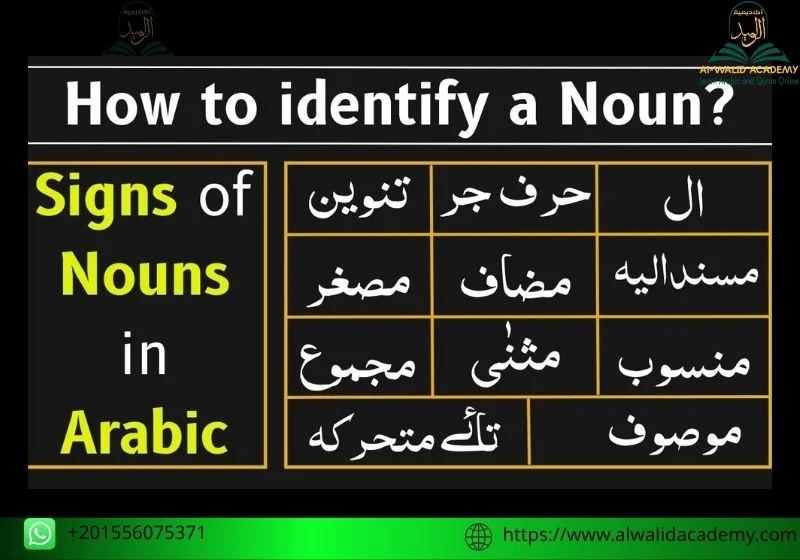
To quickly identify the type, look for the Alif-Lam or What Is Tanween, which are clear markers.
Verbs in Arabic Grammar
Verbs indicate an action or state in a sentence, and they are divided by tense:
- Past: like كَتَبَ → indicates completed action
- Present: like يَكْتُبُ → indicates ongoing or habitual action
- Imperative: like اكْتُبْ → indicates commands or instructions
Verbs also change according to the subject:
- First person: أَكْتُبُ (I write)
- Third person masculine singular: يَكْتُبُ (He writes)
- Third person masculine plural: يَكْتُبُونَ (They write)
Most verbs have a three-letter root, like كتب, and change depending on form or pronoun.
Quranic examples:
- اقْرَأْ → imperative
- آمَنَ → past
Daily example: ذَهَبَ الْأَطْفَالُ إِلَى الْمَلْعَبِ → past plural
To conjugate verbs easily, start with the root and add the appropriate letters for tense and subject, and practice with simple daily sentences.
Learn more about: What are the forms of verbs in Arabic?
Particles in Arabic Grammar
Particles are words that connect nouns and verbs or modify the meaning of a sentence, but they do not conjugate or decline.
Examples:
- فِي → indicates place, the following noun is in the genitive → Example: فِي الْبَيْتِ
- مِنْ → origin → Example: جِئْتُ مِنَ السُّوقِ (I came from the market)
- بِ → instrument or preposition → Example: جِئْتُ بِالْفَاكِهَةِ (I brought the fruit)
- لَ → emphasis
Types of particles:
- Prepositions: like عَلَى, فِي, مِنْ
- Negation particles: like لَمْ (past negation), لَا (prohibition)
- Conditional particles: like إِنْ
Quranic examples:
-
- بِسْمِ اللَّهِ → genitive
- لَمْ يَArabic Nouns and Their Grammar Rules
Daily example: جِئْتُ مِنَ السُّوقِ بِالْفَاكِهَةِ (I came from the market with the fruit)Particles are usually short but very powerful and critical for understanding the meaning of sentences.
If you understand them well, you can analyze any sentence easily, whether in the Quran or daily texts.
Read more about: How Long Does It Take to Become Fluent in Arabic
Learn Quran, Arabic, and Islamic Studies with certified teachers in fun, interactive, and personalized sessions. Join thousands of students around the world and begin your path today!
Arabic Nouns and Their Grammar Rules
Nouns in Arabic grammar and their basic rules determine the form of the word according to gender, number, and case, so that the sentence becomes correct and expressive.
They are not just words; they are the essential elements that give meaning to the language, and their endings change according to their role, whether with a:
- Damma for nominative
- FatHa for accusative.
- Kasra for genitive.
The key to dealing with them is focusing on tanween (nunation) and idafa (construct phrase) first. After that, you will be able to apply the rules easily in daily speech and Quranic texts and avoid common mistakes.
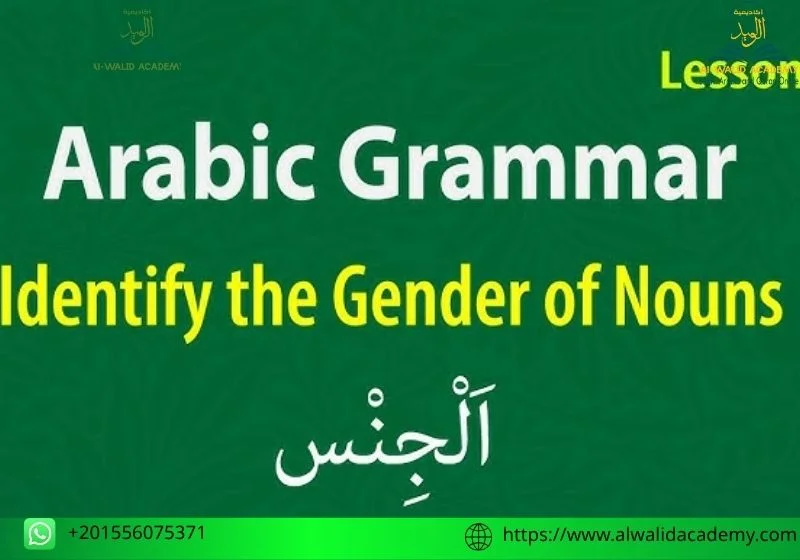
Masculine and Feminine Nouns in Arabic
Nouns in Arabic are divided into masculine and feminine:
- Masculine: usually without special markers, like “رَجُلٌ” (man) or “بَيْتٌ” (house).
- Feminine: usually ends with “ـة” like “بِنْتٌ” (girl), or “اء” like “سَمَاءٌ” (sky), or with feminine tanween like “صَاحِبَةٌ” (female owner). Not every word ending in “ـة” is feminine, like “سُنَّةٌ” (Sunnah).
Quranic examples:
- السَّمَاوَاتُ وَالْأَرْضُ → masculine plural
- نِسَاءٌ → broken feminine plural
Daily examples:
الْوَلَدُ يَلْعَبُ وَالْبِنْتُ تَقْرَأُ (The boy plays and the girl reads)
Try to classify around 10 words daily by gender to become faster in distinguishing masculine from feminine.
Learn more about: How to start learning Arabic Language
Singular, Dual, and Plural Forms
Nouns change according to number: singular, dual, and plural.
- Singular: one word, like “طَالِبٌ” (student).
- Dual: add “ان” for nominative like “طَالِبَانِ”, and “ين” for accusative and genitive like “طَالِبَيْنِ”.
- Plural:
- Sound masculine plural: “طُلَّابٌ”
- Sound feminine plural: “طَالِبَاتٌ”
- Broken plural: “رِجَالٌ” (men), “كُتُبٌ” (books)
Quranic examples:
- الْمَلَائِكَةُ → broken plural
- الْإِنْسَانُ → singular
Daily examples:
- Singular: طَالِبٌ يَدْرُسُ (A student studies)
- Dual: طَالِبَانِ يَلْعَبَانِ (Two students play)
- Plural: طُلَّابٌ يَقْرَأُونَ (Students read)
You can use simple tables and review them with short Quranic verses to memorize faster.
Definite and Indefinite Nouns in Arabic
Nouns are divided into definite and indefinite:
- Definite: specific and known, like “الْبَيْتُ” (the house) or with idafa like “بَيْتُ رَسُولِ اللَّهِ” (house of the Messenger of Allah).
- Indefinite: general and unspecified, usually with tanween, like “بَيْتٌ كَبِيرٌ” (a big house).
Quranic examples:
- Definite: رَبُّ الْعَالَمِينَ (Lord of the worlds)
- Indefinite: أَحَدٌ (One)
Daily examples:
- Indefinite: رَأَيْتُ رَجُلاً (I saw a man)
- Definite: وَالْمَلِكَ (and the king)
Understanding the difference is important because it changes the meaning from specificity to generality. Practicing transforming sentences from indefinite to definite or vice versa strengthens your grammar skills.
Special Plural Forms in Arabic Nouns
Arabic has different types of plurals:
- Broken plural: like “رَجُل → رِجَالٌ” (man → men), or examples like “عُلَمَاءُ” (scholars), “فِرَاشٌ” (beds).
- Sound plural: masculine like “مُسْلِمُونَ” (Muslims), feminine like “طَالِبَاتٌ” (female students).
Proper understanding of plural forms helps you match verbs and adjectives with the noun correctly.
Common Mistakes in Nouns and How to Fix Them
Many mistakes happen in nouns, such as matching the adjective with the noun:
- Wrong: بنت كبير
- Correct: بِنْتٌ كَبِيرَةٌ
Tip: Practice correcting your sentences alone or with a friend. Focus on endings, tanween, and agreement between nouns and adjectives to improve your writing and speaking significantly.
Read about: Best Place to Learn Arabic Online
Comprehensive Noun Table – Practical Reference
Before we look at the table, this is a practical and comprehensive reference for all types of nouns in the Arabic language.
It includes daily and Quranic examples, with full grammatical case (i‘rab) for each word, so you can easily understand masculine and feminine, singular, dual, and plural, definite and indefinite nouns, and review it daily without any difficulty.
| Type of Noun | Example Daily | Example Quranic | Case (I‘rab) | Notes |
| Masculine Singular | رَجُلٌ (a man) | الْإِنْسَانُ | Damma (رفع) | Basic masculine form |
| Feminine Singular | بِنْتٌ (a girl) | نِسَاءٌ | Damma/Nasb/Kasra | Usually ends with “ـة” |
| Masculine Dual | طَالِبَانِ (two students) | — | Damma | Add “ان” for nominative |
| Feminine Dual | طَالِبَتَانِ (two female students) | — | Damma | Add “تان” for nominative |
| Masculine Sound Plural | مُعَلِّمُونَ (teachers) | — | Damma | Regular masculine plural |
| Feminine Sound Plural | طَالِبَاتٌ (female students) | — | Damma | Regular feminine plural |
| Broken Plural | رِجَالٌ (men) | الْمَلَائِكَةُ | Damma | Irregular plural pattern |
| Definite | الْبَيْتُ (the house) | رَبُّ الْعَالَمِينَ | Damma | Uses “الـ” |
| Indefinite | بَيْتٌ كَبِيرٌ (a big house) | أَحَدٌ | Tanween | No “الـ”, general meaning |
Arabic Language Grammar Rules for Gender and Number Agreement
The gender and number agreement rules in the Arabic language ensure that all words match each other smoothly, like a team where every player knows their role, so the sentence comes out coherent and correct.
When the noun, adjective, and verb are aligned in gender (masculine or feminine) and number (singular, dual, plural), the sentence is clear and correct. If there is a mismatch, the meaning becomes confusing, and the sentence is hard to understand.
With simple everyday examples and Quranic examples, you will learn how to apply the rules correctly and avoid any confusion.
How Adjectives Agree with Nouns
Adjectives must match the noun in gender, number, and case so the sentence is correct:
- Singular masculine: بَيْتٌ كَبِيرٌ → the noun is masculine and the adjective is nominative.
- Singular feminine: بِنْتٌ جَمِيلَةٌ → the noun is feminine and the adjective is nominative.
- Dual: بَيْتَانِ كَبِيرَانِ → the noun and adjective are dual and matching.
- Plural: بُيُوتٌ كَبِيرَةٌ → the noun is plural and the adjective matches the number.
Quranic examples:
- Singular masculine: رَبٌّ غَفُورٌ رَحِيمٌ
- Plural feminine: سَمَاوَاتٌ مُنِيرَاتٌ
Every day practical example:
- Correct: الْكَلْبُ الْأَسْوَدُ يَنْبَحُ
- Incorrect: الْكَلْبُ السَّوْدَاءُ يَنْبَحُ
To identify the adjective easily, focus on its ending and make sure it exactly matches the noun.
How Verbs Agree with Gender and Number
The verb must also match the subject in gender and number:
- Present tense singular masculine: يَقْرَأُ الْوَلَدُ
- Present tense singular feminine: تَقْرَأُ الْبِنْتُ
- Present tense plural masculine: يَقْرَؤُونَ الْوُلْدَانُ
- Present tense plural feminine: يَقْرَأْنَ الْبَنَاتُ
- Past tense:
- Masculine: قَرَأَ
- Feminine: قَرَأَتْ
Quranic examples:
- Singular: آمَنَ الرَّسُولُ
- Plural: آمَنُوا الَّذِينَ اتَّبَعُوهُ
Everyday example:
- Correct: الْأَطْفَالُ يَلْعَبُونَ
- Incorrect if they were girls: الْأَطْفَالُ يَلْعَب → correct: يَلْعَبْنَ
For the dual: use the correct verb form: يَلْعَبَانِ الْوَلْدَانِ.
Common Agreement Mistakes in Arabic
Common mistakes in agreement between noun, adjective, or verb include:
- Using a feminine adjective with a masculine noun:
- Wrong: الْبَابُ الْجَمِيلَةُ → Correct: الْبَابُ الْجَمِيلُ
- Using a verb that does not match the plural:
- Wrong: الْبَنَاتُ يَلْعَبْ → Correct: الْبَنَاتُ يَلْعَبْنَ
- Confusion in broken plurals:
- Wrong: رِجَالٌ تَقْرَأْ → Correct: رِجَالٌ يَقْرَؤُونَ
Quranic note: Sometimes there is confusion between الْمُؤْمِنُونَ وَالْمُؤْمِنَاتُ.
To avoid mistakes: read the sentence aloud, if it feels strange, correct it immediately, and review your list of mistakes daily.
Arabic Sentence Structure Rules
If you want to know how the arrangement of words in an Arabic sentence makes the speech connected and clear, these rules will be your main guide.
Sentence construction in Arabic is divided into two main types:
- Nominal, which starts with a noun.
- Verbal, which starts with a verb.
It is known that the order is somewhat flexible, but there are fixed rules you must know, like the order of the subject and object.
If you understand these rules well, you will be able to write texts or interpret verses without any confusion, and you will see how word order changes the meaning and determines the focus.
Nominal Sentences in Arabic
The nominal sentence is suitable when you want to express a state or a fixed description. It begins with a raised subject (mubtada’) followed by a predicate (khabar) that clarifies the subject.
- Practical example: الْبَيْتُ كَبِيرٌ → subject “الْبَيْتُ”, predicate “كَبِيرٌ”.
You can add details to the predicate: الْبَيْتُ كَبِيرٌ وَجَمِيلٌ. - Quranic example: هُوَ اللَّهُ أَحَدٌ → subject and indefinite predicate.
Try converting verbal sentences into nominal ones, and focus on the difference between expressing a fixed state and an event.
Verbal Sentences in Arabic
The verbal sentence is suitable when you want to indicate an action or an event that happened or will happen. It begins with a verb, followed by a subject, and sometimes an object.
- Example: كَتَبَ الْوَلَدُ الْحِرْفَ → past verb, raised subject, object in accusative.
- Present tense: يَكْتُبُ الْوَلَدُ رِسَالَةً.
- Quranic example: اقْرَأْ بِاسْمِ رَبِّكَ الَّذِي خَلَقَ → imperative verb followed by past verb.
If the subject is not mentioned, the verb indicates it: كَتَبُوا (plural).
Practical example: لَعِبَ الْأَطْفَالُ فِي الْحَدِيقَةِ طَوِيلًا.
Practice each type of verb (past, present, imperative) with masculine, feminine, dual, and plural subjects to get used to proper agreement.
Basic Word Order in Arabic Sentences
The basic order of an Arabic sentence: subject → verb → object, like: الْمُعَلِّمُ يُدَرِّسُ الْعِلْمَ.
But Arabic is flexible; you can start with the verb for emphasis: يُدَرِّسُ الْمُعَلِّمُ الْعِلْمَ. The adverbial phrase usually comes before the verb: جَاءَ الْوَلَدُ رَاصِدًا.
Quranic example: خَلَقَ السَّمَاوَاتِ وَالْأَرْضَ → past verb followed by two objects.
Important tips:
- In poetry and rhetoric, the word order can change for rhythm or emphasis.
- For practice: take separate words like “reads, the student, the book” and arrange them into a correct sentence.
| Sentence Type | Word Order | Example (Daily) | Example (Quranic) | Notes & Grammar Details |
| Nominal Sentence (جملة اسمية) | Subject (مبتدأ) + Predicate (خبر) | الْبَيْتُ كَبِيرٌ → “The house is big” | هُوَ اللَّهُ أَحَدٌ → “He is Allah, the One” | Subject is raised (ضمة), predicate agrees in gender/number |
| Nominal with Extended Predicate | Subject + Predicate + Additional Info | الْبَيْتُ كَبِيرٌ وَجَمِيلٌ → “The house is big and beautiful” | نَفْسٌ وَمَا سَوَّاهَا → “By the soul and He who shaped it” | Multiple adjectives agree with subject in gender/number |
| Verbal Sentence (جملة فعلية) | Verb + Subject + Object | كَتَبَ الْوَلَدُ الرِّسَالَةَ → “The boy wrote the letter” | اقْرَأْ بِاسْمِ رَبِّكَ الَّذِي خَلَقَ → “Read in the name of your Lord who created” | Past tense verb, subject raised (ضمة), object accusative (فتحة) |
| Verbal Sentence (Present) | Subject + Verb + Object / Verb + Subject + Object | الْوَلَدُ يَكْتُبُ الرِّسَالَةَ → “The boy writes the letter” | يَنظُرُ الَّذِينَ كَفَرُوا → “Those who disbelieve look” | Present verb agreement with subject in gender/number |
| Verbal Sentence (Imperative) | Verb + Subject (implied) | اكْتُبْ أَنْتَ الرِّسَالَةَ → “Write the letter” | اقْرَأْ بِاسْمِ رَبِّكَ → “Read in the name of your Lord” | Imperative verb indicates the subject, usually second person |
| Sentence with Prepositional Phrase | Preposition + Object + Verb + Subject | فِي الْبَيْتِ يَلْعَبُ الْوَلَدُ → “In the house, the boy plays” | فِي السَّمَاءِ رَفَعَهَا → “He raised it in the sky” | Prepositional phrase causes object to be in genitive (كسرة) |
| Nominal with Adverbs / Adverbial Phrases | Subject + Adverb + Predicate | الْوَلَدُ سَرِيعًا يَجْرِي → “The boy runs quickly” | جَاءَ الْوَلَدُ رَاصِدًا → “The boy came observing” | Adverb typically comes before verb, agrees in meaning |
| Dual Form | Subject Dual + Verb Dual + Object Dual | الطَّالِبَانِ يَكْتُبَانِ الدَّرْسَ → “The two students write the lesson” | الَّذَانِ آمَنَا بِهِمَا → “Those two whom we believed in” | Verb and adjective must agree in number (dual) |
| Plural Form | Subject Plural + Verb Plural + Object Plural | الطُّلَّابُ يَقْرَأُونَ الكُتُبَ → “The students read the books” | الَّذِينَ آمَنُوا وَعَمِلُوا الصَّالِحَاتِ → “Those who believed and did righteous deeds” | Agreement with masculine/feminine, sound plural or broken plural |
| Nominal with Condition / Conditional | Conditional Particle + Verb + Subject + Object | إِنْ تَدْرُسْ تَنْجَحْ → “If you study, you succeed” | وَمَنْ يَعْمَلْ مِنَ الصَّالِحَاتِ → “Whoever does righteous deeds” | Conditional sentence; verb in subjunctive (منصوب) for result |
Arabic Verb Rules for Beginners
If you want to start speaking and writing proper Arabic correctly, you need to understand verb conjugation first.
Verbs in Arabic change according to tense, person, number, and gender, and this determines the meaning of the sentence and makes the speech clear and correct. Most verbs have three-letter roots like “كتب” (write), and they are simple but need continuous practice to be memorized.
With Quranic and daily examples, you will learn how to conjugate any verb, distinguish between singular, dual, and plural, as well as masculine and feminine, giving you a strong foundation for any proper writing or reading, especially when you practice through Online Arabic Conversation Classes, where you apply these rules in real conversations.
Past Tense Verbs in Arabic
Past tense verbs express a completed action, and their conjugation depends on the person and number:
- I: كَتَبْتُ (I wrote)
- You (male): كَتَبْتَ (You wrote)
- He: كَتَبَ (He wrote)
- She: كَتَبَتْ (She wrote)
- We: كَتَبْنَا (We wrote)
- They (male): كَتَبُوا (They wrote)
- Quranic example: “خَلَقَ اللَّهُ السَّمَاوَاتِ” – “خَلَقَ” is past tense, “اللَّهُ” is the subject (nominative).
- Daily example: “ذَهَبْتُ لِلْمَدْرَسَةِ” (I went to school), “لَعِبَ الْأَطْفَالُ فِي الْحَدِيقَةِ” (The children played in the garden).
If the verb is jussive in negation like “لَمْ يَكْتُبْ”, follow the same rule but with the negation particle.
Read about: Best Way to Learn to Speak Arabic
Present Tense Verbs in Arabic
The present tense expresses a current or future action, and its conjugation changes according to the person:
- I: أَكْتُبُ (I write)
- You (male): تَكْتُبُ (You write)
- He: يَكْتُبُ (He writes)
- She: تَكْتُبُ (She writes)
- We: نَكْتُبُ (We write)
- They (male): يَكْتُبُونَ (They write)
- They (female): يَكْتُبْنَ (They write)
For negation: use “لَا” like “لَا تَلْعَبْ” (Do not play). Try to start with a complete conjugation table and apply each form in daily sentences; this helps fix the present tense easily.
Imperative Verbs in Arabic
The imperative is used for commands or prohibitions addressed to the listener directly:
- Masculine singular: اكْتُبْ (Write!)
- Feminine singular: اكْتُبِي (Write!)
- Masculine plural: اكْتُبُوا (Write!)
- Feminine plural: اكْتُبْنَ (Write!)
- Dual: اكْتُبَا (Write!)
Quranic example: “اقْرَأْ بِاسْمِ رَبِّكَ” (Read in the name of your Lord), “اسْجُدْ وَاقْتَرِبْ” (Prostrate and come near). Daily example: “ادْرُسْ يَا وَلَدِي” (Study, my son), “لَا تَدْرُسِي هُنَا” (Do not study here).
Take the present tense, adjust the ending to form the imperative, and practice daily commands like “Eat!” or “Drink!”. This will help you memorize all verb forms quickly.
Arabic Verb Conjugation Rules
The rules of verb conjugation in Arabic change the form of the verb according to the person, gender, and number, so that it exactly matches the subject and makes the sentence correct.
The root is fixed like “كتب” (to write), but the added letters change, and this is what makes the language precise. If you are a beginner, start with a simple verb like “فعل” (to do), and you will understand the logic.
How Arabic Verbs Change with Person
Verb conjugation changes according to the person performing the action:
Present tense:
- First person singular: أنا → أَفْعَلُ, example: أَكْتُبُ
- First person plural: نحن → نَفْعَلُ, example: نَكْتُبُ
- Second person singular masculine: أنتَ → تَفْعَلُ, example: تَكْتُبُ
- Second person plural: أنتم → تَفْعَلُونَ, example: تَكْتُبُونَ
- Third person singular masculine: هو → يَفْعَلُ, example: يَكْتُبُ
- Third person plural masculine: هم → يَفْعَلُونَ, example: يَكْتُبُونَ
Past tense:
- أنا → فَعَلْتُ
- أنتَ → فَعَلْتَ
- هو → فَعَلَ
- هم → فَعَلُوا
Quranic examples:
- “نَقُولُ” → we
- “تَقُولُونَ” → you (plural)
Daily example: “أَدْرُسُ أنا”, “تَدْرُسُ أنتَ”.
For imperative, usually used with the second person: “اُفْعَلْ” (masculine), “اُفْعَلِي” (feminine).
Learn about: How To Combine Pronouns And Verbs In Arabic
How Arabic Verbs Change with Gender
Masculine and feminine affect the verb clearly:
Present tense:
- Masculine singular: يَفْعَلُ → example: يَكْتُبُ
- Feminine singular: تَفْعَلُ → example: تَكْتُبُ
- Feminine plural: يَفْعَلْنَ → example: يَكْتُبْنَ
Past tense:
- Masculine singular: فَعَلَ → wrote
- Feminine singular: فَعَلَتْ → wrote
- Feminine plural: فَعَلْنَ → wrote
Quranic examples:
- “تَأْتُونَ” → masculine plural
- “آمَنَتْ” → feminine singular
Practical example: “الولد يلعب” → the boy plays, “البنت تلعب” → the girl plays, “البنات يلعبن” → the girls play.
For feminine singular, add a past tense تاء or modify the present tense ending. Practice with mixed-gender sentences.
How Arabic Verbs Change with Number
The number of subjects changes the verb conjugation whether singular, dual, or plural:
Present tense:
- Singular: يَفْعَلُ → example: يَكْتُبُ
- Dual masculine: يَفْعَلَانِ → يَكْتُبَانِ
- Dual feminine: تَفْعَلَانِ → تَكْتُبَانِ
- Plural masculine: يَفْعَلُونَ → يَكْتُبُونَ
- Plural feminine: يَفْعَلْنَ → يَكْتُبْنَ
Past tense:
- Singular: فَعَلَ → wrote
- Dual: فَعَلَا → wrote (two)
- Plural masculine: فَعَلُوا → wrote
- Plural feminine: فَعَلْنَ → wrote
Quranic examples:
- “يَخْرُجُونَ” → masculine plural
- “تَخْرُجْنَ” → feminine plural
Practical example: “الولد يقرأ” → the boy reads, “الولدان يقرآن” → the two boys read, “الولدان يقرأون” → the boys read. For dual jussive: remove the nun → “لَا يَقْرَآ”.
Read about: The Grammar of Using Arabic Numbers
Arabic Pronouns and Their Grammar Rules
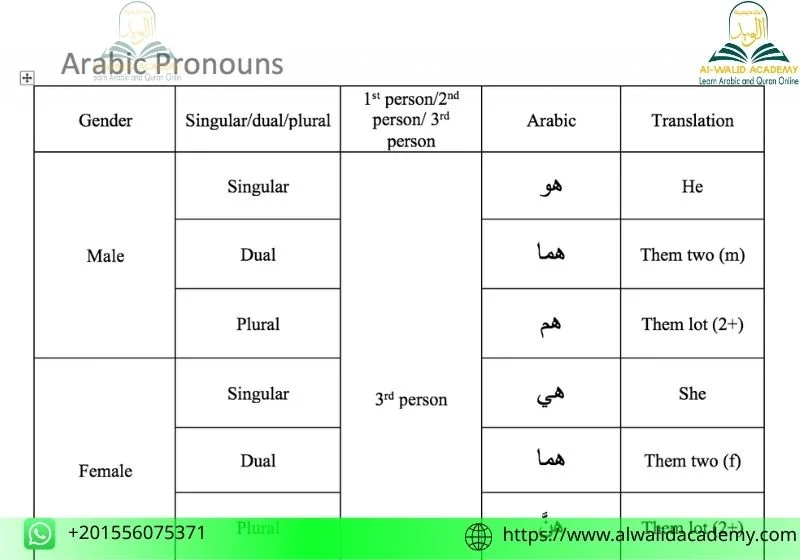
Pronouns in the Arabic language are tools used instead of nouns so that the sentence becomes shorter and clearer, and they change according to person, number, and gender.
Pronouns give the sentence smoothness and flexibility, whether in daily speech or in Quranic texts. They are of two types:
- Independent separate pronouns like “أَنَا” (I).
- Attached pronouns that follow the verb or the noun.
When you know how to use them correctly, you can speak in formal Arabic easily without repeating words, and with clear examples and tables, you can apply the rule without common mistakes like mixing up attached pronouns.
Read about: Demonstrative Pronouns in the Arabic Language
Subject Pronouns in Arabic
Separate pronouns act as an independent subject in the sentence and indicate who performs the action:
- أَنَا → I
- أَنْتَ → you (masculine)
- أَنْتِ → you (feminine)
- هُوَ → he
- هِيَ → she
- نَحْنُ → we
- أَنْتُمَا → you dual (masculine or feminine)
- هُمَا → they (masculine or feminine depending on context)
- أَنْتُمْ → you plural masculine
- هُنَّ → they plural feminine
- هُمْ → they plural masculine
Quranic example: “إِنَّا نَحْنُ نَزَّلْنَا الذِّكْرَ” → “Indeed, We have sent down the Reminder.” Practical example: “أَنَا أَدْرُسُ وَهُوَ يَلْعَبُ” → “I study, and he plays.”
Use them at the beginning of a sentence or for emphasis, and practice forming personal sentences daily to reinforce the rule.
Attached Pronouns in Arabic
Attached pronouns follow the verb or the noun and indicate possession or object relation:
- يَ → he
- تِ → she
- نِي → me / my
- كَ → you masculine
- كِ → you feminine
- هُ → him / his
- هَا → her / hers
- نَا → us / our
- كُمَا → you dual
- هُمَا → them dual
- كُمْ → you plural
- هُنَّ → them plural feminine
- هُمْ → them plural masculine
Practical example:
- “كَتَبْتُهُ” → “I wrote it”
- “الْكِتَابُ لِي” → “The book is mine”
Quranic example: “رَبَّنَا آتِنَا مِنْ لَدُنْكَ رَحْمَةً” → “Our Lord, give us from Yourself mercy.”
The pronoun attaches at the end of the verb in the past tense or before the noun in an iḍāfa (possessive construct). Make a small table of attached pronouns like: I → -ni/-y, you → -ka, to make memorization easier.
Read also about: Detached Pronouns in Arabic
Possessive Pronouns in Arabic
Possessive pronouns indicate ownership and attach with “لـ” (for) or in the iḍāfa structure:
- لِي → mine / for me
- لَكَ → yours (masculine) / for you
- لَهُ → his / for him
- لَنَا → ours / for us
- لَهُمْ → theirs / for them
Practical example:
- “بَيْتِي” → “my house”
- “سَيْفُكَ” → “your sword”
- “كُتُبُكُمْ” → “your books” (plural)
Quranic example: “رَبَّنَا” → “Our Lord”
Use possessive pronouns to shorten sentences and clarify the relationship between words. Practice by adding possession to five words daily like “عَيْنِي” → “my eye”, “كِتَابِي” → “my book”, “بَيْتُنَا” → “our house” to reinforce the rule practically.
Arabic Adjectives and Their Grammar Rules
If you want to know how to describe any noun in Arabic correctly and make the sentence clear, the most important thing is to understand that the adjective must match the noun after it in gender, number, and definiteness or indefiniteness.
Adjectives give additional meaning to the sentence like color, size, shape, or condition, and this makes texts, whether daily or Quranic, easy to understand.
The basic rule: the adjective follows the noun in everything, and this makes the sentence cohesive and understandable.
Adjective Agreement in Gender and Number
The thing most people get confused about is how to make the adjective suitable for the noun. In Arabic, the adjective must match the noun in three ways:
- Gender: masculine or feminine
- Number: singular, dual, or plural
- Definiteness or indefiniteness: definite with “al-” or indefinite
Practical examples:
- Singular masculine: رَجُلٌ طَوِيلٌ (a tall man)
- Singular feminine: امْرَأَةٌ طَوِيلَةٌ (a tall woman)
- Dual masculine: رَجُلَانِ طَوِيلَانِ (two tall men)
- Dual feminine: امْرَأَتَانِ طَوِيلَتَانِ (two tall women)
- Plural masculine: رِجَالٌ طِوَالٌ (tall men)
- Plural feminine: نِسَاءٌ طَوِيلَاتٌ (tall women)
If the noun is definite with “al-“, the adjective is definite: الْبَيْتُ الْكَبِيرُ (the big house). If the noun is indefinite, the adjective is indefinite: بَيْتٌ كَبِيرٌ (a big house).
The Position of Adjectives in Arabic
The adjective usually comes after the noun it describes, which is the opposite of many other languages. This order is not just for formality; it is part of Arabic rules and makes the meaning of the sentence clear from the first word.
Examples:
- البَابُ الجَمِيلُ (the beautiful door)
- الطَالِبُ المُجْتَهِدُ (the diligent student)
- الطَّعَامُ اللَّذِيذُ (the delicious food)
Additional notes:
- Sometimes in poetry or rhetoric, the adjective can come before the noun for stylistic purposes
- You should distinguish between a real adjective and a causative adjective: “رَجُلٌ كَرِيمٌ أَبُوهُ” → the adjective describes the man, but indirectly describes his father
Understanding the position of the adjective helps you read the sentence quickly and understand it without confusion.
Examples of Correct Adjective Usage
Practicing correct examples makes the rule stick faster in your mind:
Short examples:
- بَيْتٌ كَبِيرٌ (a big house)
- مَدْرَسَةٌ جَدِيدَةٌ (a new school)
- طَالِبَانِ مُجْتَهِدَانِ (two diligent students)
- فَتَيَاتٌ نَشِيطَاتٌ (active girls)
- رَجُلٌ صَادِقٌ (an honest man)
- أَطْفَالٌ صِغَارٌ (small children)
Longer examples:
- الْمُعَلِّمُ الْمُخْلِصُ يُحِبُّ تَلاَمِيذَهُ (the dedicated teacher loves his students)
- الْبِنْتُ الذَّكِيَّةُ فَهِمَتِ الدَّرْسَ سَرِيعًا (the smart girl understood the lesson quickly)
- الْمَسْجِدُ الْكَبِيرُ مَلِيءٌ بِالْمُصَلِّينَ (the big mosque is full of worshippers)
Common mistakes and corrections:
- الْبَنَاتُ جَمِيلٌ → correct: الْبَنَاتُ جَمِيلَاتٌ
- المَدْرَسَةُ جَدِيدٌ → correct: المَدْرَسَةُ جَدِيدَةٌ
Easy review method:
Ask yourself three questions before adding any adjective: Is the noun masculine or feminine? Singular, dual, or plural? Definite or indefinite?
If you answer correctly, you will know immediately which adjective to use. With daily practice, you will find adjectives very easy and they won’t require long thinking.
Arabic Prepositions and Particles
Prepositions and other particles in Arabic are very important because they define the meaning of the sentence and connect words together precisely. Without them, the sentence might be incomplete or its meaning could be unclear.
Arabic Prepositions make the noun in the genitive case, and other particles like negation, emphasis, or condition change the sentence meaning significantly. Understanding them will make reading, writing, and understanding Arabic texts much easier.
Common Arabic Prepositions and Their Meanings
Prepositions clarify the relationship between words, whether place, reason, or means. The most famous are:
- مِنْ: “from” or “starting from” → “I came from the school”
- إلى: “to” or “towards” → “I went to the market”
- في: “in” or “inside” → “I sat in the house”
- على: “on” → “The book is on the table”
- بـ: “by” or “through” → “I wrote with the pen”
- لـ: “for” or “on behalf of” → “This book is for me”
- عن: “about” → “He asked me about the homework”
- مع: “with” → “I went with my friend”
Try to memorize each preposition within a full sentence, not alone, because the meaning becomes clearer in context.
Important Particles in Arabic Sentences
Other particles in Arabic have very important roles:
- Negation: لا، ما، لم → “I do not like lying”
- Emphasis: إن، لَ → “Indeed, knowledge is beneficial”
- Interrogatives: هل، من، ما → “Did you go to the market?”
- Condition: إن، إذا → “If you work hard, you succeed”
Even though these particles are small, they have a huge effect on the sentence meaning. You need to understand each particle and its function.
Mistakes Learners Make with Arabic Particles
The most common mistakes are:
- Using the wrong preposition → writing “في المدرسة” instead of “إلى المدرسة”.
- Confusing على and في → “جلست على البيت” (wrong).
- Using negation particles incorrectly → “لم ذهب” (correct: “لم يذهب”).
- Placing إنَّ on the verb instead of the noun → “إن يكتب” (correct: “إنَّ الكتابَ نافعٌ”).
Solution: Memorize each particle with a practical example, identify if it affects a noun or a verb, and practice regularly.
Case Endings in Arabic Grammar
Case endings determine the function of a word in the sentence, whether subject, object, or after a preposition. Understanding the endings makes reading, writing, and analyzing sentences easier.
The Nominative Case in Arabic
The nominative case usually appears in the subject, the topic, or the predicate of كان, and its original marker is the dammah.
Examples:
- “The boy went” → “الولدُ ذهبَ” (subject is nominative)
- “Knowledge is useful” → “العلمُ نافعٌ”
- “He is a diligent student” → “هو طالبٌ مجتهدٌ”
For dual or sound masculine plural nouns, the nominative marker changes, but the function remains: indicating the subject or topic.
The Accusative Case in Arabic
The accusative case appears for the object, adverbial phrases, predicate of إنَّ, etc., and its original marker is the fatha.
Examples:
- “The boy read the book” → “قرأ الولدُ الكتابَ” (book is object)
- “I saw the teacher” → “رأيتُ المعلمَ”
- “The child came smiling” → “جاء الطفل مبتسمًا” (adverbial phrase in accusative)
- “Indeed, the weather is beautiful” → “إنَّ الجو جميلٌ” (predicate of إنَّ is accusative)
Accusative is important because it clarifies on whom the action falls or what describes the sentence.
The Genitive Case in Arabic
The genitive case appears after prepositions or in possessive constructions, and its original marker is the kasrah.
Examples:
- “I passed by the house” → “مررتُ بالبيتِ” (house is genitive after بـ).
- “The book is on the table” → “الكتاب على الطاولةِ”.
- “The door of the house is open” → “باب البيت مفتوحٌ” (house in possessive genitive).
The genitive case appears frequently in daily sentences, especially with places, tools, and possessives. The more you practice, the easier it becomes to notice the endings and understand the relationships automatically.
How to Recognize Case Endings Easily
The easiest way to recognize case endings is:
- Ask yourself: What is this word doing in the sentence? Subject, object, or after a preposition?
- Once you know its function, you can determine the ending: dammah, fatha, or kasrah.
- With practice, your eye will automatically spot the case endings quickly without much effort.
Read about: Is Arabic A Hard Language To Learn
The Definite Article in Arabic Grammar
The definite article “Al-” in Arabic is what makes a noun known and specific. Without it, the meaning of a sentence can be unclear or incomplete.
“Al-” shows that the noun is not just any item, but a specific one familiar to the listener or reader. For example, “كِتَابٌ” means any book, but “الْكِتَابُ” refers to a specific known book. Understanding this rule helps you easily differentiate between indefinite and definite nouns.
How to Use Al in Arabic
“Al-” is placed at the beginning of a noun to make it definite, such as: “الْبَيْتُ”, “الْمَدْرَسَةُ”, “الطَّالِبُ”. It is used when the thing is known beforehand, when speaking about a general type in context, or a specific item.
Examples:
- الْكِتَابُ عَلَى الطَّاوِلَةِ
- الْمُعَلِّمُ دَخَلَ الْفَصْلَ
- أُحِبُّ الْقِرَاءَةَ
It is important not to add “Al-” randomly, because it changes the noun from indefinite to definite. If the noun is already definite, like proper names or relative pronouns, “Al-” is usually not needed.
Sun Letters and Moon Letters
When adding “Al-” to a noun, the first letter may be a Sun and Moon Letters Arabic, which affects pronunciation:
- Sun letters: the “L” of “Al-” is not pronounced. Example: الشَّمْسُ, النَّجْمُ, الرَّجُلُ
- Moon letters: the “L” is pronounced clearly. Example: الْقَمَرُ, الْبَيْتُ, الْكِتَابُ
This is essential for reading Arabic correctly, especially in the Quran. Practicing reading aloud will help you automatically know how to pronounce it without relying only on theory.
Common Mistakes with the Definite Article
Common errors include:
- Adding “Al-” to every noun without checking if it is already definite.
- Pronouncing the “L” with sun letters, e.g., saying الْشَّمْسُ instead of الشَّمْسُ.
- Not matching “Al-” with the following word in pronunciation or grammatical agreement.
To avoid mistakes: read the word aloud, notice the first letter (sun or moon), and check if the noun really needs to be definite. With time and practice, it will become natural.
Arabic Language Grammar Rules with Examples for Sentence Building
Understanding grammar in Arabic is key to building clear sentences. It helps the reader know who is doing what and what is being described. Sentences in Arabic are either nominal or verbal, and each type has its specific structure and purpose.
When you know these rules, you can construct correct sentences confidently and clearly. Practical examples make the rules even easier to understand.
How to Form Simple Sentences in Arabic
Simple sentences in Arabic are usually nominal or verbal:
- Nominal sentence: starts with a noun → الْوَلَدُ ذَكِيٌّ (The boy is smart)
- Verbal sentence: starts with a verb → ذَهَبَ الْوَلَدُ إِلَى الْمَدْرَسَةِ (The boy went to school)
Steps to create a simple sentence:
- Choose the main verb or noun.
- Identify the subject or predicate.
- Add details to complete the meaning.
- Check word order and grammatical endings.
Examples:
- الطَّفْلُ يَلْعَبُ
- الْمُعَلِّمُ شَرَحَ الدَّرْسَ
- الْبَيْتُ جَمِيلٌ
Examples of Nominal and Verbal Sentences
- Nominal sentences: describe a state or quality
- الْجَوُّ لَطِيفٌ
- الْمَدْرَسَةُ كَبِيرَةٌ
- الطَّالِبُ مُجْتَهِدٌ
- Verbal sentences: describe an action or event
- قَرَأَ الْوَلَدُ الْكِتَابَ
- تَكْتُبُ الْبِنْتُ الدَّرْسَ
- جَلَسَ الْمُعَلِّمُ
The difference: a noun gives a continuous or fixed idea, while a verb indicates that something happened or is happening now. Each type is used depending on the meaning you want to convey.
How Grammar Changes Sentence Meaning
Grammar does not only set word order; it determines the final meaning of the sentence.
For example:
- ضَرَبَ الْوَلَدُ الرَّجُلَ → The boy hit the man
- ضَرَبَ الرَّجُلُ الْوَلَدَ → The man hit the boy
Almost the same words, but changing the order and case endings changes the meaning completely. This shows why grammar is crucial to avoid confusion and make the message clear.
Adding a preposition or removing a word can also alter meaning:
- ذَهَبَ إِلَى الْبَيْتِ ≠ ذَهَبَ فِي الْبَيْتِ
- أَكَلَ الْوَلَدُ التُّفَّاحَ ≠ أَكَلَ الْوَلَدُ بِالتُّفَّاحِ
Learning grammar is not just about memorizing; it is a tool to understand meaning correctly and use the language accurately.
Common Arabic Language Grammar Rules Beginners Should Master First
If you are just starting to learn Arabic grammar, it’s better not to overwhelm yourself with all the rules at once. Start with the basic things that will help you understand the structure of a sentence at first glance, because these are the foundation you will build on later.
Once you get the hang of simple rules like gender, number, and sentence structure, reading and understanding will become much easier. With practice, the rules that seemed complicated before will feel completely natural to you.
Basic Rules of Gender
Gender in Arabic means that a word is either masculine or feminine, and this affects adjectives, verbs sometimes, and even pronouns.
The simple rule is that if you talk about a boy, man, book, or sun depending on usage, you need to notice whether the word is masculine or feminine.
Feminine often has a clear ending like the tied T (ة) in many words like مدرسة or طالبة, but not every feminine word must end with a T, so meaning is sometimes more important than the form.
Examples:
- الولدُ ذكيٌّ
- البنتُ ذكيةٌ
Notice how the adjective changes to match the noun.
Basic Rules of Number
Number in Arabic divides a word into singular, dual, or plural, and this is very important because any mistake makes the sentence sound strange.
- Singular means one, like طالب.
- Dual means two, like طالبان or طالبين depending on the word’s position in the sentence.
- Plural means more than two, like طلاب or طالبات.
It is important to know that verbs and adjectives must agree with the number of the noun.
Examples:
- الطالبُ يجتهدُ
- الطالبانِ يجتهدانِ
- الطلابُ يجتهدونَ
If you master this, you can write correct sentences easily without confusion.
Basic Rules of Sentence Formation
Forming a sentence in Arabic starts with understanding the type of sentence: nominal or verbal.
- Nominal sentences start with a noun, like الجوُّ جميلٌ.
- Verbal sentences start with a verb, like ذهبَ الولدُ إلى المدرسةِ.
- This is one of the most important rules beginners should memorize early because it helps you understand the word order in the entire sentence.
In a nominal sentence, you usually have a subject and a predicate, while in a verbal sentence, you have a verb and a subject, and sometimes an object, adverb, or prepositional phrase.
Example:
الطائرُ يطيرُ في السماءِ
Here you have a verb, a subject, and a prepositional phrase, making the sentence complete and clear.
Common Mistakes in Arabic Language Grammar Rules
The most common mistakes in Arabic grammar happen when learners write quickly without checking gender, number, or the position of words in a sentence.
The problem is that a grammar mistake is not just about form—it sometimes changes the meaning completely. Therefore, it is very important to review the rule before writing, especially in the early stages of learning.
Focusing on repeated mistakes helps you improve faster and reduces recurring errors.
Confusing Nouns, Verbs, and Particles
A frequent error is confusing nouns, verbs, and particles, which causes problems in understanding the sentence.
Nouns are usually things, people, or adjectives; verbs express an action or event; and particles connect or clarify meaning, like prepositions or negation.
Example:
ذهب (verb), كتاب (noun), في (particle)
If you can quickly distinguish between them, you will understand sentence structure easily. Many errors start here because learners think all words behave the same way, which is not true in Arabic.
Errors in Gender and Number Agreement
Another common mistake is that adjectives or verbs do not match the noun in gender or number.
Examples:
- البنتُ ذكيٌ (incorrect) → البنتُ ذكيةٌ (correct)
- الطلابُ يذهبُ (incorrect) → الطلابُ يذهبونَ (correct)
These mistakes happen when learners focus on meaning but forget grammatical form. To avoid them, always ask yourself: is the noun masculine or feminine? Singular or plural? Answering these two questions prevents most errors.
Misusing Case Endings and Sentence Structure
Case endings in Arabic are one of the most confusing things for beginners, especially the nominative, accusative, and genitive.
Example:
- قرأَ الولدُ الكتابَ → if you change the ending incorrectly, both meaning and grammar are affected.
Also, sentence order is important because moving or delaying a word can change the meaning or make the sentence incorrect.
Example:
الولدُ رأى المعلمَ ≠ رأى المعلمُ الولدَ
The difference is very significant. The solution is to read the sentence slowly at first, identify what each word does, then check its ending to make sure it fits its role.
How to Avoid These Mistakes Easily
The best way to avoid mistakes is to learn rules with examples, not just memorize them. Write short sentences and review every word:
- Is it a noun, verb, or particle?
- Singular or plural?
- Nominative, accusative, or genitive?
By doing this review, your mistakes will noticeably decrease. Over time, the rules will work automatically without having to think about every detail.
Basic Arabic Grammar Rules PDF
If you are a beginner and want to learn Arabic grammar rules, the best thing to start with is a well-organized and clear PDF. A good PDF does not just compile information; it also explains each rule in an easy way with practical examples that help fix the concept in your mind.
It is better if the rules are arranged gradually, from easy to difficult, so you can refer back to it anytime without effort.
These types of files are excellent if you study alone or need a quick reference to open during review. Instead of flipping between many books and sources, everything is organized and concise, helping you build a strong foundation in grammar.
What to Look for in a Good Basic Arabic Grammar Rules PDF
There are main points you should keep in mind:
- The first thing to check in any PDF is organization.
- A tidy, easy-to-navigate file helps you memorize faster instead of getting lost among too much information.
- Headings should be clear, and each rule should have a simple explanation with a practical example.
- Also, focus on the basics:
- Types of words.
- Nominal and verbal sentences.
- Basic case endings, and pronouns.
- Examples should be correct and easy Arabic, whether from daily life, simple texts, or the Qur’an, as they make the rule live in your mind.
- The language should be simple and straightforward, without heavy terminology.
How to Use a PDF to Review Arabic Grammar Rules
The best way to use the PDF is not just to skim through it, but also to focus on each rule, read its explanation, look at the example, and try to apply it. You can explain it out loud to yourself or write a similar example. This method helps the information stick faster.
Dedicate a fixed time daily for the PDF, even if it’s only 15 minutes, because regular short review is better than long, scattered sessions. If the file has exercises, try to solve them before looking at the answers. Also, keep notes beside the PDF so each time you return, you build on what you already understood.
Best Topics to Include in a Beginner Arabic Grammar PDF
Any beginner’s PDF should start with very basic topics:
- Types of words (noun, verb, particle).
- Nominal and verbal sentences.
- Basic case endings (nominative, accusative, genitive).
- Pronouns, definite articles, and prepositions.
As these appear frequently in reading and writing.
Including practical examples is essential so the beginner sees the rule applied directly. If there’s a summary page at the end of each lesson, it will help a lot with quick review.
The more the topics are arranged from easy to difficult, the more effective the PDF will be and easier for beginners to understand.
How to Learn Arabic Language Grammar Rules More Easily
Learning Arabic grammar becomes much easier if you follow an organized method instead of memorizing everything randomly. The key is not the amount of information, but its step-by-step understanding.
If you start with rules that appear frequently, use real examples, and apply them in context, you will find grammar much clearer and easier than you imagined.
Many people make the mistake of learning rules theoretically only, and thus forget them quickly. But when you link the rule to a real sentence or clear situation, the information sticks faster and is easier to use.
Start with the Most Common Grammar Rules
Start with the rules you encounter every day, because they give you the most benefit with the least effort. For example, learn types of words first, then nominal and verbal sentences, and then basic case endings.
Leave the complex rules for later; this will help you build a strong foundation to understand any new topic easily.
The order is very important, as:
- If you start with difficult details, you may feel that all grammar is complicated and lose motivation.
- But if you start from the basics, each new rule becomes easier because it is connected to what you already know.
Learn Grammar Through Real Examples
Real examples are the fastest way to understand Arabic grammar because they show the rule in its natural form. Instead of memorizing a long definition, look at the rule in a simple sentence like:
الولدُ يكتبُ الدرسَ Try to identify the verb, the subject, and the object yourself.
You can also benefit from examples from the Qur’an or very short texts, because in that case you learn the rule along with correct Arabic usage.
The more examples you see, the faster you can recognize the rule in any new text. It is important not to stop at one example, but to see multiple instances of the same rule.
Practice Arabic Grammar in Context
Applying the rules in context is what turns theoretical knowledge into a real skill.
- Instead of just memorizing that the subject is nominative, try to find it in a complete sentence and determine its position yourself.
- Instead of knowing that adjectives follow the noun in theory, try correcting sentences that contain errors.
- You can also write short sentences from your daily life and apply the rule you learned.
For example, write about your day or something you see in front of you, then review the sentences grammatically. Over time, you will start using the rules naturally without thinking too much.
Learn Arabic Grammar Structure with Al-Walid Academy
Learning Arabic sentence structure and grammar with Al-Walid Academy becomes much easier when you follow a clear and organized plan suitable for beginners.
The idea is not just to memorize the rules, but to understand how an Arabic sentence is formed and how the words are correctly connected.
With gradual explanation and practical application, you will be able to grasp grammar deeply without complexity, whether you are a complete beginner or want to strengthen your level in reading, writing, and understanding.
The big advantage here is that learning is not just theoretical information, but practical and interactive, which means you will know how to apply the rules in any Arabic text easily and be confident in your writing and speaking.
Study Arabic Grammar Step by Step with Qualified Teachers
Studying step by step with qualified teachers makes a huge difference because each rule is learned at the right time in a logical order that makes it easier to understand.
An experienced teacher does not only explain the rule, but also simplifies it, provides real examples, and points out common mistakes before you encounter them yourself.
Learning with a knowledgeable teacher allows you to follow a clear path instead of studying randomly, and this makes every lesson build on the previous one.
The result is that you understand the rules steadily and can easily apply them in reading, writing, and speaking.
Learn Fundamentals of Arabic Grammar for Beginners in Live Classes
Live courses for beginners give you a great opportunity to understand the rule and apply it immediately. In the live session, you:
- Listen to the explanation.
- See the examples.
- Review with the teacher any unclear part, which makes the information stick in your mind faster.
Direct interaction also helps you know if you really understand instead of staying confused after the lesson.
The basic grammar you should start with:
- Includes types of words.
- Nominal and verbal sentences.
- Basic case endings.
- Pronouns.
With continuous gradual sessions, you will notice that you read Arabic texts faster, write more accurately, and feel more confident in using the language.
Most importantly, live classes make you part of the learning process, not just a spectator, and with repetition and practice, the difficult rules will become easy and natural for you.
Book Your Free Trial with Al-Walid Academy
Booking a free trial is an excellent step if you are unsure and not sure whether the method suits you.
The free trial gives you a chance to see the teaching style, the way of interaction, and the level of content before officially starting, which makes you very comfortable and lets you choose with confidence.
- If you are a beginner, the trial helps you determine if you really need to start from the basics.
- If you have some background, you will know whether the curriculum is suitable for improving your level.
Overall, the free trial gives you the opportunity to experience learning freely and without any pressure, which is very important for any successful educational journey.
FAQs
How can I start learning Tajweed online in English?
Begin with the basic rules of Arabic letters and pronunciation, then gradually move to reciting short verses with guidance from a qualified teacher.
How often should I practice Tajweed online?
Practice a little every day, even 10–15 minutes, to build correct pronunciation and improve recitation steadily.
Can I ask questions during online Tajweed lessons?
Yes, most online lessons let you ask the teacher questions and clarify doubts in real time.
Can I learn proper Quran recitation without knowing Arabic?
Yes, English lessons explain the rules clearly so beginners can recite correctly without prior Arabic knowledge.
How do teachers correct mistakes in online Tajweed classes?
Teachers listen to your recitation, point out errors, demonstrate the correct method, and give exercises for practice.
Are there short online Tajweed courses for busy schedules?
Yes, many platforms offer flexible courses that fit into daily routines or limited time availability.
Is it possible to learn Tajweed online for free in English?
Some websites and apps provide free lessons, but structured paid courses offer personal feedback and better guidance.
How can I monitor my improvement in online Tajweed classes?
You can use exercises, recordings, or quizzes provided by the platform to monitor improvement and correct mistakes along the way.