
You’re probably looking for an easy and fun way to help your child start reading without feeling bored, and that’s exactly what Arabic Phonics for Children focuses on.
This approach is based on helping kids understand letter sounds in a simple way that makes learning faster and more enjoyable.
What Is Arabic Phonics for Children?
In simple terms, Arabic Phonics for Children is a method that teaches kids how to connect each Arabic letter with its actual sound, not just recognize its shape or name.
So when a child sees the letter “ب”, they immediately know how it sounds and how to use it in a word. The focus here is on understanding, not memorization, which helps children learn faster and apply what they’ve learned easily.
To explain it down even more:
- Every letter has its own sound, like “س”.
- Vowel marks change how the letter is pronounced, as we put fatha on “س”, it will be pronounced as “sa”, س+ َ = سَ
- Then children start blending sounds together to read full words
This approach helps children to:
- Clearly recognize and distinguish sounds.
- Blend letters smoothly.
- Understand words instead of memorizing them.
- Read new words even if they’ve never seen them before.
With activities like games, repetition, and short stories through our Quran courses online, learning becomes fun and engaging instead of stressful or boring.
Learn Quran, Arabic, and Islamic Studies with certified teachers in fun, interactive, and personalized sessions. Join thousands of students around the world and begin your path today!
Why Arabic Phonics Is Important for Children
If you’re asking yourself, “Why should I teach my child Arabic phonics in the first place?” The short answer is that it plays a major role in helping your child grasp the language correctly from the very start.
Instead of just memorizing words, the child learns how to break the word down and read it on their own, which helps them become independent and not rely on help all the time.
The big advantage is that the child actually understands what they’re doing, not just repeating. This helps them improve faster, whether in school, Quran reading, or even in daily conversation.
-
Building Strong Reading Skills From the Start
One of the main problems children face in reading is not knowing where to start. Phonics solves this by guiding the child step by step.
First, they learn the sound of the letter, then they understand how vowels change the sound, and after that, they start blending sounds together.
For example:
When a child knows the sounds “Ka” and “da”, they can read a word like “ka-da” even if they’ve never seen it before.
Over time, this helps them to:
- Read new words on their own.
- Feel less afraid of difficult words.
- Understand instead of just memorizing.
Read more about: How to start Learning Arabic Language
2. Helping Children Pronounce Arabic Letters Correctly
Many children struggle with pronouncing Arabic letters, especially the ones that sound or look similar. This can become a bigger problem if it’s not fixed early.
Phonics focuses a lot on this by teaching the child to:
- Produce the sound correctly.
- Tell the difference between similar letters.
- Listen carefully and repeat accurately.
This is very important for Quran reading, because correct pronunciation affects meaning. It also helps the child speak Arabic more clearly.
3. Supporting Multilingual and Non-Native Learners
Nowadays, many children are exposed to more than one language, which can sometimes cause confusion between sounds. Phonics helps them separate Arabic from other languages in a simple way.
With practice, the child starts to:
- Understand how Arabic works.
- Read words even if it’s their first time seeing them.
- Write better.
- Speak with more confidence.
They also don’t just memorize—they understand and analyze words, which helps them in learning other languages too.
Read more about: How Do Native Arabic Speakers Learn MSA
How Arabic Phonics Works for Children
If you’re thinking about starting phonics with your child, the first question that comes to mind is: “How do I begin? And will it be hard for them?”
The truth is, phonics is designed to make learning easier. It works step by step, so the child doesn’t feel overwhelmed. Instead of memorizing a lot at once, they learn gradually until they can read on their own.
The idea is simple: we move from easy to harder steps, and each step builds on the one before it. That way, there’s no confusion or pressure.
Read more about: Best Place to Learn Arabic Online
-
Learning Arabic Letter Sounds Step by Step
The first thing a child learns is not the letter name, but its sound.
This makes a big difference because reading is based on sounds, not names.
We usually start like this:
- The child listens to the letter sound.
- Connects the sound to a picture or a word.
- Notices how the sound changes with vowels.
- Sees the letter in different words.
The key here is not to rush. Every step takes its time, and with repetition, the child starts understanding naturally, this all can be achieved through our Quran lessons for Kids online.
And if the child makes mistakes? That’s completely normal. Correction should be gentle, without pressure.
2. Blending Sounds to Read Simple Words
Once the child becomes familiar with sounds, we move to an important step: blending.
Instead of seeing a word as something big, we break it down:
sound + sound = word
For example: “ma” + “a” + “ma” → “mama”
This helps the child realize they can actually read on their own, which is a very important confidence boost.
Over time:
- They will try reading new words.
- They won’t feel scared of longer words.
- They will depend on understanding, not memorization.
Learn more about: Arabic Words To Practice Reading
3. Using Interactive and Play-Based Learning Methods
Children learn faster when they are enjoying the process, not feeling forced.
That’s why phonics focuses on interaction, not just repetition.
You can easily apply this at home through:
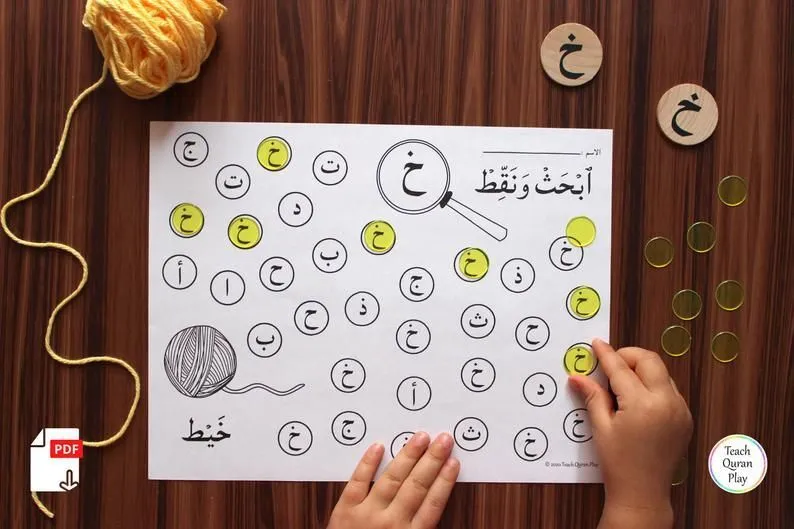
- “Listen and find the letter” games.
- Flashcards with pictures and letters.
- Short, simple stories.
- Light daily practice in real-life situations.
The goal is not to create a formal lesson, but to make learning a natural part of the day.
4. Reinforcing Skills Through Practice and Guided Reading
Any skill a child learns needs reinforcement, and that comes with practice.
You don’t need a lot of time; what matters is doing it regularly:
- Reading simple words daily.
- Repeating sounds in different ways.
- Encouraging the child to try, even if they make mistakes.
With time, you’ll notice:
- They read faster.
- They make fewer mistakes.
- They start understanding what they read.
And most importantly… they begin to enjoy reading instead of seeing it as something difficult.
Step-by-Step Arabic Phonics for Beginners
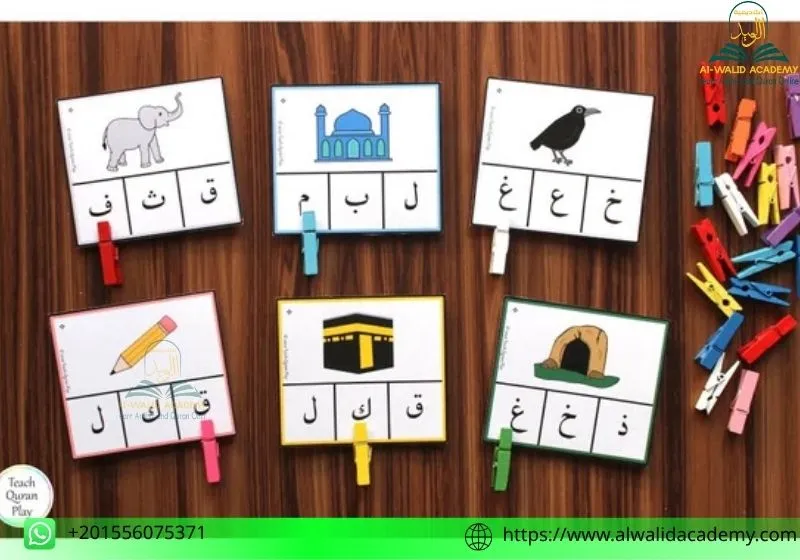
If you’re a beginner or want to start teaching your child Arabic from scratch, the step-by-step Arabic phonics method makes learning easy and fun.
The secret is to practice a little every day, focus on sounds rather than memorizing, and help the child naturally connect letters to words. This method can cover all Arabic letters in about a month.
Learn more about: Is Arabic A Hard Language To Learn
Step 1: Prepare Tools and Learn the Basics
Before you start, gather some simple tools:
- Flashcards with pictures for each letter
- An educational app like “Arabic Phonics Kids” or a similar one
- Short educational songs on YouTube
Explain to your child that each letter has its own sound, not just a shape. Example: “We’ll start with the letter Alif, its sound is ‘A’ like in ‘Ab’.” Start with easy letters: Alif, Ba, Ta, Tha, Jeem, Ha. Repeat each letter 5 minutes daily with a simple song or interactive movement.
Step 2: Teach Letters Through Play
Let the child learn letters using games:
- Letter Ba (بَ) → like the sound of a rolling ball, let the child imitate the movement and touch the ball.
- Game “Where’s the Sound?”: Say a letter sound and the child picks the correct picture.
- Practice short words: “Baab”, “Bat”’
For younger children (3–5 years), use dolls or models; for older kids, use interactive apps with rewards. The goal: the child automatically connects the sound to the letter.
Step 3: Build Simple Words
After a few days, start making 2–3 letter words: “Ab”, “Tab”, “Jabl”. Write them down and let the child read out loud.
Try the “Build the Word” game: give letters and let the child form real words like “Bahr”. Gradually add vowel marks (Fatha, Damma, Kasra). If the child needs help, use simple educational videos showing correct pronunciation.
Step 4: Review and Assess
Review all letters and words learned each week, and gradually add new letters like Dal, Dhal, Ra, Zay.
Create a progress chart: give a star for each word read correctly. If a mistake happens, go back one step and repeat. By the end of the month, try letting the child read a short story or simple verses like Surah Al-Ikhlas. Make it part of the bedtime routine and encourage parents to participate.
Step 5: Practice and Avoid Common Mistakes
Once all letters are learned, apply them on simple Quran texts or children’s books.
Common mistakes like confusing Dal (د) and Dhal (ذ) can be corrected with sound differentiation exercises. If the child gets bored, change the game or activity each week.
Track progress: after a month, the child should be able to read about 20 words independently. This method is very practical, helps the child learn in a fun, independent, and fast way.
Read also: Summer Quran Classes for Kids
Fun Ways to Teach Arabic Phonics at Home
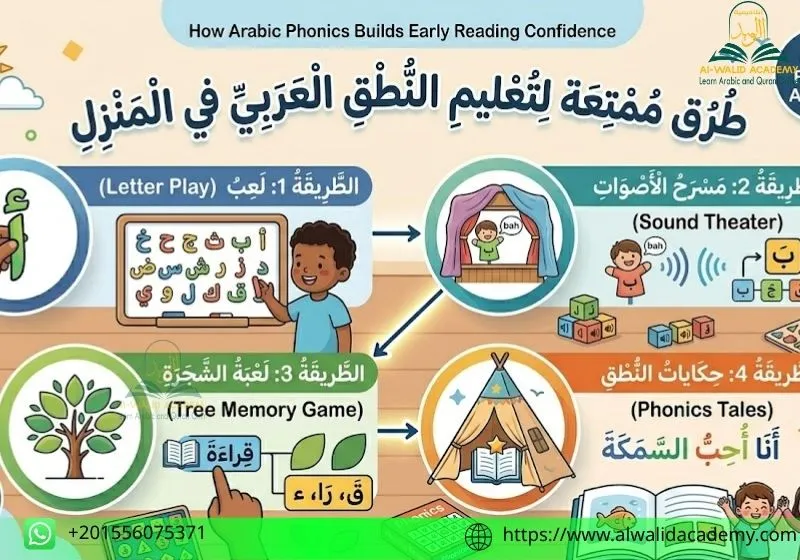
If you want to teach your child Arabic phonics at home without making it feel like studying, the key is to turn it into a fun and light activity. It’s not about spending long hours, but about keeping your child engaged and enjoying the process. Even 10 minutes a day can make a big difference if done in a simple and fun way.
Over time, you’ll notice your child starting to recognize sounds and form words naturally.
Start with simple sounds like “A”, “أ” and “Ba,” ب”, and make sure the pronunciation is clear from the beginning, because everything builds on that foundation.
Read also about: How to Learn Quranic Arabic Language
-
Letter Songs with Simple Movements
Children naturally enjoy repetition and movement, so use that to your advantage. Create a simple tune or use a familiar one, and add letter sounds to it.
For example:
Give each letter a movement:
- “Ba”, “بَ” → a small rolling hand movement.
- “Sa”, سَ” → a swimming motion.
- “Ta”, “تَ” → stretching arms like flying.
Repeating sounds with movement helps children remember faster and connect the sound with the letter easily.
-
Flashcard Games in a Fun Way
Instead of using flashcards in a traditional way, turn them into a game. You should prepare cards with letters and pictures, then say the sound and let your child find the correct card.
You can also:
- Let them arrange cards to form a word.
- Ask them to pick a card and say a word that starts with the same sound.
This method keeps them thinking and actively involved.
-
Simple Homemade Stories
You don’t need ready-made books. You can create short, simple stories yourself. This is done by picking a few words with the same sound and repeating them in the story.
For example:
A story using words like: “bab, باب – bata, بطة – bayt, بيت”
Read slowly, pause at key words, and let your child try to say them. This helps them learn sounds in context, which makes learning more effective.
-
Learning Through Daily Situations
You don’t always need a special lesson time—use everyday moments:
- In the kitchen: “Banana… what sound does it start with?”
- Outside: “Car… what’s the first sound?”
- During play: connect toys with letter sounds
This makes learning feel natural and part of daily life.
-
Movement and Hands-On Learning
Some children learn better through movement and action, so let them explore:
- Letter “Ra” → running.
- Letter “Ain” → seeing something real like honey.
- Letter “Ha” → saying the sound while doing an action.
When a child connects sound with a real experience, they understand and remember it better.
-
Simple Reward System
Encouragement makes a big difference. Create a simple system like:
- A star for each correct attempt.
- A small reward at the end of the week.
If they make a mistake, stay calm and let them try again without pressure.
Common Challenges Children Face When Learning Arabic Sounds
Learning Arabic sounds is a new experience for children, and it’s completely normal for them to face some difficulties at the beginning. The important thing is to understand what’s causing the issue so you can deal with it calmly.
- One of the most common problems is confusion between similar letters, whether in shape like (ب، ت، ث) or in sound like (د، ذ). The child simply hasn’t fully distinguished the differences yet. So it’s better to:
- Teach letters in small groups.
- Use pictures or familiar examples.
- Repeat patiently without rushing.
2-Also, some letters are harder to pronounce, like (ع، غ، خ), and this is very normal. The solution should be gradual:
- Let the child hear the sound first.
- Then imitate it.
- Use songs or simple repetition to help them pronounce comfortably.
3-Another common issue is that the child memorizes the letter shape but cannot read a word. This means they haven’t connected the sound to the word yet. In this case:
- Start with very short words.
- Increase difficulty gradually.
- Repeat the same pattern until it sticks.
4-In addition, boredom is a main reason children lose interest. Traditional methods make them disengage quickly, so it’s better to:
- Keep learning time short.
- Add play and movement.
- Encourage every small step.
5-Finally, a dialect or another language may affect pronunciation. The solution is simple:
- Let the child listen to standard Arabic regularly.
- Correct gently without pressure.
In the end, all these challenges are normal, and with consistency, you’ll notice clear improvement.
Learn also about: Best Online Hifz Program for Children
Best Age to Start Arabic Phonics for Children
Many parents ask: when should I start? The truth is, there’s no “wrong” time, but there is a more suitable time.
- At an early age, from 2 to 3 years old, the child is in the listening stage. So it’s better to:
- Let them listen to Arabic songs.
- Watch simple stories.
- Get used to the sound of the language without direct teaching.
2-Then, from 3 to 6 years old, this is the most important stage for actual learning. At this age, the child is ready to:
- Learn letters and their sounds.
- Read simple words.
- Connect sound with shape easily.
3-If the child is older than that, it’s still completely fine. But here we focus more on:
- Improving reading.
- Strengthening writing.
- Reviewing basics in an organized way.
The reason early start helps is that the child’s brain is very flexible at this age, which makes learning faster and more natural.
Important tips:
- Don’t pressure the child.
- Keep learning light and simple.
- Even 10 minutes a day is enough.
The goal is not speed; the goal is for the child to enjoy learning.
Arabic Phonics Activities That Make Learning Easier
Activities are what make learning easy and enjoyable at the same time. When a child feels like they are playing, they learn much faster.
- You can start with simple activities like:
- Linking each letter to a specific movement helps them remember the sound.
- Using dough to shape letters, so they see, touch, and learn at the same time.
2-There are also other helpful ideas:
- Let the child search for letters around the house or in books.
- Read simple words together like: house, book.
- Use stories or acting to give letters meaning.
3-If you want to add more excitement:
- Play word races using a specific letter.
- Or let them draw the letter and say a word with it.
4-Finally, consistency is the key:
- A simple daily practice.
- Even for a short time.
- With continuous encouragement.
This way, the child will learn naturally without pressure, and most importantly, enjoy the process.
How Arabic Phonics Builds Early Reading Confidence
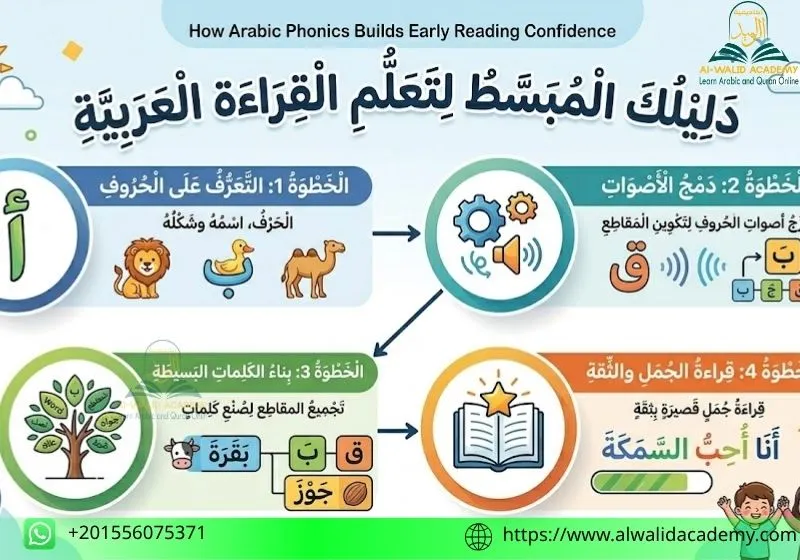
Arabic phonics works like a solid foundation that builds a child’s reading confidence from the first day.
The idea is not just to memorize letters, but to learn how to connect sounds to letters step by step, and this makes the child feel “I can read by myself!” instead of being afraid of long words or sentences.
- Start with simple words: like “بَابْ” (door) or “كَتَبْ” (he wrote), and let the child build the letters by themselves like a game. This makes reading a fun experience instead of a boring task.
- Gradual sentences: After two weeks, the child can read short sentences like “الْبَيْتْ كَبِيرْ” (the house is big), which increases their excitement and strengthens self-confidence, especially when they see their parents encouraging them.
- Independence in reading: The child will start reading children’s books or short Quranic verses alone without asking all the time “read for me,” and this gives them a sense of achievement.
- Notice signs of confidence: If the child starts asking for new books or tries to read harder words, this is a sign they are gaining real confidence. Always encourage them with simple words like “Bravo, you are a reading star!”
By applying phonics, you will see your child not only learning letters but also developing a confident personality in language, ready for school and Quran memorization, and this is an important investment for their future.
Read more about: How to Teach Noorani Qaida to Kids
Online Arabic Phonics Lessons for Children
Online Arabic phonics lessons for children are the perfect solution for parents who want fun and flexible learning from home, with personal monitoring of the child. These programs make learning easy, effective, and continuous without needing long time commitments.
- Choosing the right platforms: Platforms like Al-Walid Academy or apps like “Noorani Qaida Online” provide live 30-minute weekly lessons with recorded videos, each unit focusing on 4 letters with interactive games and exercises.
- Example session: It starts with a simple song like “أَ بَ تَ,” then pronunciation exercises, and ends with reading a new word like “سَمَا” (sky). The teacher corrects immediately, and the child progresses step by step.
- Tracking progress: Some platforms offer weekly reports about the child’s level, so you know the strengths and weaknesses and follow their development.
- Tips for success: Set a fixed time for lessons, sit with the child during the first two weeks to follow along, and continue with short daily exercises at home. Even the cost is simple (about 100 EGP per month), and the result is clear: your child reads fluently in about 3 months.
Learn more about: Arabic Lessons For Kindergarten
Why Choose Al-Walid Academy for Arabic Phonics for Children?
If you want your child to start loving Arabic and read letters confidently, Al-Walid Academy is the perfect place.
Here, learning is not just letters and words; it’s a fun and practical method that makes the child interact and enjoy while learning, with teachers specialized in the nature of young children and ways to naturally fix sounds and letters.
Features You Will Find at Al-Walid Academy:
- Interactive and enjoyable method: Videos, apps, and practical exercises that connect each letter with its sound and movement.
- Complete coverage of letters: All 28 Arabic letters are covered in 8 weeks in a fun way.
- Focus on correct pronunciation: So the child builds a strong foundation for reading, school, and memorization.
- Flexible online lessons: Fit your schedule with personal follow-up and weekly tests.
- Quick and tangible results: Children from age 4 read simple words and short verses after just a few weeks.
- Trusted reputation: Over 5,000 students succeeded and parents’ ratings are 4.9/5.
Register your child now at Al-Walid Academy and let them start their journey with Arabic and phonics in a fun and effective way!
How Parents Can Support Arabic Pronunciation and Phonics at Home
Your role as a parent is very important in helping the child fix Arabic pronunciation and phonics. Even if the child is learning at an academy, simple daily practice at home will accelerate their progress and help them gain confidence in reading without pressure.
Practical Ways to Support Your Child at Home:
- Short daily routine: 10–15 minutes daily for letter games or exercises using flashcards, colorful books, or apps.
- Listening and imitation: Play standard Arabic reading recordings and imitate letters and words together.
- Songs and stories: Use educational songs and illustrated stories to link the sound to the word in an enjoyable way.
- Letter play: Turn each letter into a movement or game, like “ع” for grape, “ح” for a candy, or a body movement.
- Gentle correction: Encourage reading from menus or signs and correct pronunciation kindly while giving continuous support.
- Rewards and motivation: Use small rewards or stickers when a letter or word is read correctly.
- Track progress: Record their voice every week and compare improvements to make them feel accomplished and keep motivated.
By using these methods, you will ensure your child learns Arabic letters and phonics naturally and enjoyably, and gains confident pronunciation skills quickly.
FAQs
Can Arabic Phonics help children pronounce words correctly?
Yes, learning Arabic phonics regularly helps children distinguish between different letters and pronounce words more accurately, reducing reading mistakes.
How can I make Arabic phonics enjoyable at home?
Turn learning into a game using songs, colorful flashcards, short stories, and movement exercises. This keeps children excited and helps them absorb letters and sounds easily.
How often should children practice Arabic phonics?
Short daily sessions of 10–15 minutes are better than long, infrequent lessons. Consistency is key for children to naturally retain each letter and sound.
What are the common difficulties children face with Arabic phonics?
Children may confuse letters that look or sound similar and struggle with throat letters like “ع” and “غ”. Daily repetition and exercises solve this problem.
Do parents need special skills to support Arabic phonics?
Not necessarily. Parents can help with simple daily activities like songs, reading stories, and using educational flashcards, as long as they maintain a regular routine.