‘Assalamu alaykum wa rahmatullahi wa barakatuh’ is not merely a phrase we utter in various situations to greet others or initiate a conversation. It goes far beyond that; it is a constant means of communication with Allah the Almighty to seek peace, mercy and blessings, whilst also strengthening the bonds of friendship and social ties between people, and serving as a way for Muslims to distinguish themselves wherever they may be.
In this article from Al-Walid Academy, we will explore Assalamualaikum Meaning, why Muslims use it, and the contexts and ways in which it is said.
Assalamualaikum Meaning
‘Assalamu alaykum’ is not merely a greeting or a passing phrase, but carries within it a sincere prayer and is an ideal way to foster solidarity and harmony amongst Muslims.
This great phrase has been used as a formal and distinctive greeting among Muslims from the time of the Prophet, peace be upon him, until the present day.
Due to its profound and sincere meaning, it has come to be used not only in religious contexts but has also become a formal greeting among most Arabs, regardless of their religion.
Literal Meaning in English
The phrase ‘As-salamu ‘alaykum’ consists of two main parts:
- The first is ‘as-salam’, meaning ‘peace’.
- The second is ‘‘alaykum’, meaning ‘upon you’.
By combining these two words, we obtain a short phrase with a profound meaning that soothes the soul, dispels hatred and fosters a sense of tolerance.
Spiritual Meaning of the Greeting
- The spiritual Assalamualaikum Meaning is profound and deeply spiritual, for Allah, the Exalted, has named Himself with 99 names, one of which is ‘Al-Salam’ (The Source of Peace). Saying ‘Salamu ‘alaykum’ with every greeting teaches us to place our trust in Allah and to draw peace from Him.
- The Messenger of Allah, peace be upon him, advised us to spread peace amongst ourselves, saying: “أَفْشُوا الْسَلَامَ بَيْنَكُم” ‘Spread peace amongst yourselves.’ Heeding the advice of the Messenger of Allah, peace be upon him, is a great matter for us in this world and the Hereafter.
- Praying daily and repeatedly for peace to descend upon us all removes animosity and hatred from our hearts.
Why Muslims Use It Around the World
As well as being a divine commandment and a distinctive greeting for Muslims, wishing others peace—whether upon meeting them, bidding them farewell, or at any time of day or night—fosters a spirit of friendship and love, and spreads goodness and blessings.
Can I Read the Quran in English? many people ask this question and the answer is of course only join our Quran Memorization Course
How to Pronounce Assalamualaikum Correctly
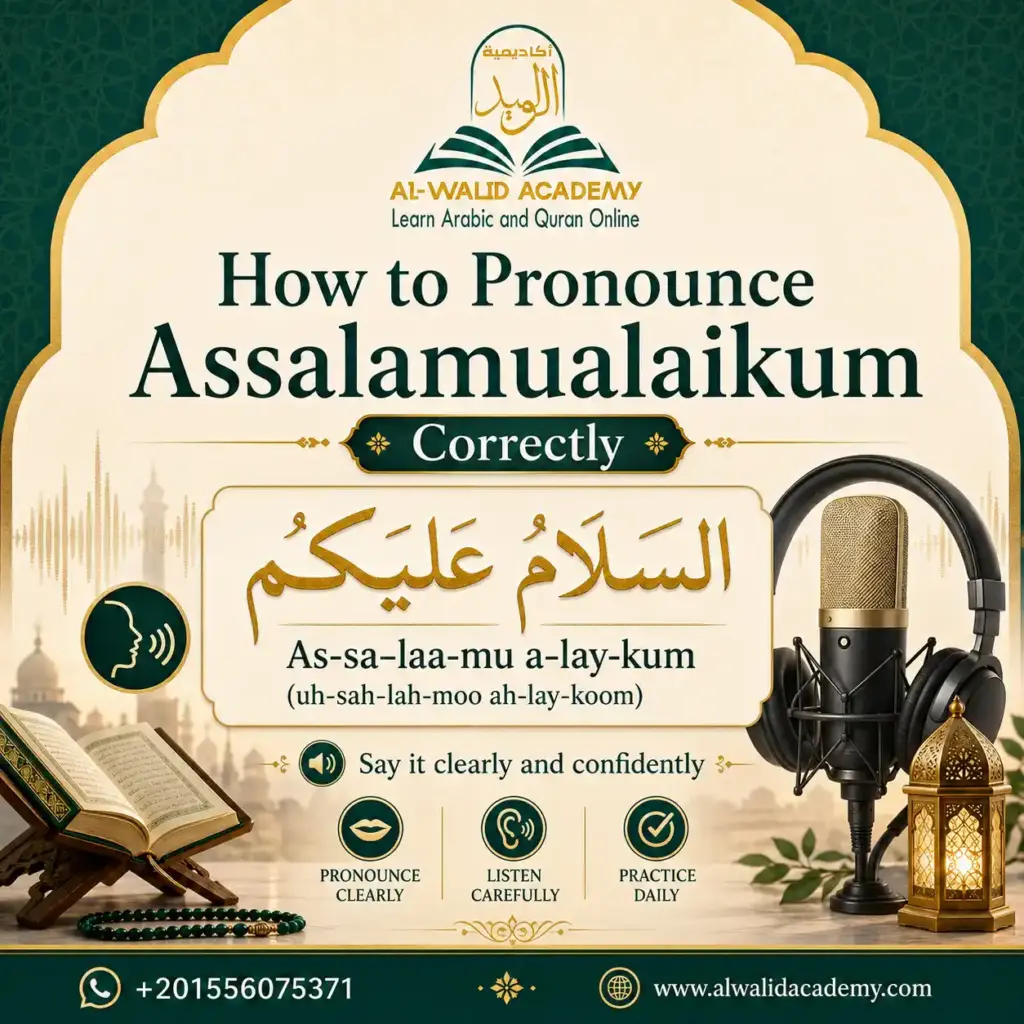
To pronounce ‘Assalamu alaykum’ correctly, it can be broken down into the following parts:
(As-sa-la-mu a-lay-kum).
Common Pronunciation Mistakes
There are some common mistakes to avoid when pronouncing ‘As-salamu ‘alaykum’, including:
- Failing to elongate the ‘alif’ when pronouncing ‘as-salam’; some people pronounce it as ‘as-sam’, which completely changes the meaning, as ‘as-sam’ means ‘poison’, making it sound as though you are wishing illness upon the person.
- Instead of pronouncing ‘‘Alaykum’ with a silent ‘y’, it is pronounced with a long ‘y’ and a kasra, so it becomes ‘Al-Salam ‘Alikom’ instead of ‘Alaykum’.
- Pronouncing it too quickly, which makes the phrase incomprehensible and prevents its spiritual meaning from being conveyed properly.
Beginner-Friendly Pronunciation Breakdown
(As-sa-la-mu a-lay-kum).
As_ sa_ la_ mu .. a-lay_ kum
It can be broken down as follows:
- “اَسْ” is pronounced like ‘as’.
- “ سَلَا”is pronounced like ‘sala’.
- “مُ”Mu is pronounced like a soft ‘Mu’ with the lips pursed.
- “عَلَيْ” Alai is pronounced like ‘Alai’.
- “كُمْ”Kum is pronounced like ‘KUM’.
Join our Learning Arabic for Beginners course, Take your first step towards learning the sciences of the Qur’an
The Sunnah of Saying Assalamualaikum
For most Imams, it is Sunnah to begin by offering the greeting of peace at any time, whereas responding to it is obligatory.
Hadiths About Spreading Salam
قَالَ رَسُولُ اللّهِ صَلَّى اللَّهُ عَلَيْهِ وَسَلَّمَ: “حَقٌ الْمُسْلِمِ عَلَى أَخِيْهِ إِذَا لَقِيَهُ فَلْيُسَلِمْ عَلَيْه”.
This means that when a Muslim meets another Muslim, he is obliged to greet him with the salutation of peace.
قَالَ رَسُولُ اللّهِ صَلَّى اللَّهُ عَلَيْهِ وَسَلَّمَ: “أَفْشُوُا الْسَلَامَ بَيْنَكُمْ ”
This is advice from the Messenger of Allah, peace be upon him, which is almost a duty: to spread peace amongst us.
Rewards of Greeting Others with Salam
- The reward for taking the initiative to offer greetings of peace.
- Thirty good deeds for offering a complete greeting of peace.
- Full compliance with the commands of Allah the Almighty and the Sunnah of His Prophet.
- Adopting the virtues of Muslims.
- The bestowal of blessings and goodness.
The science of Fiqh is a vast field that enables us to draw closer to God Almighty and follow the example of the Prophet Muhammad, peace be upon him. So join Fiqh Islamic Jurisprudence now.
Different Forms of Salam in Islam
In our religion, there is a single prescribed way to say and respond to the greeting of peace; however, given the variety of everyday situations, it is sometimes shortened to take the following forms:
Assalamualaikum
The most commonly used and suitable for everyday situations that call for speed, such as saying hello whilst walking.
Assalamualaikum wa Rahmatullah
This is considered a more ideal method, as it includes supplications for both peace and mercy from God Almighty, thereby increasing goodness and blessings.
Assalamualaikum wa Rahmatullahi wa Barakatuh
The most complete and ideal way to remember Allah, which ensures that one seeks peace, mercy and blessings from Allah the Almighty; and when recited in full, the reward is complete, insha’Allah.
When to Use Each Form
- Assalamualaikum: In everyday situations, such as when joining a group of people or during casual social encounters.
- Assalamualaikum wa Rahmatullah: it is used to invoke additional blessings, and also in more formal settings.
- Assalamualaikum wa Rahmatullahi wa Barakatuh: In fully formal settings, such as speeches, meetings and seminars.
Read about: How to study Islam at home
How to Reply to Assalamualaikum
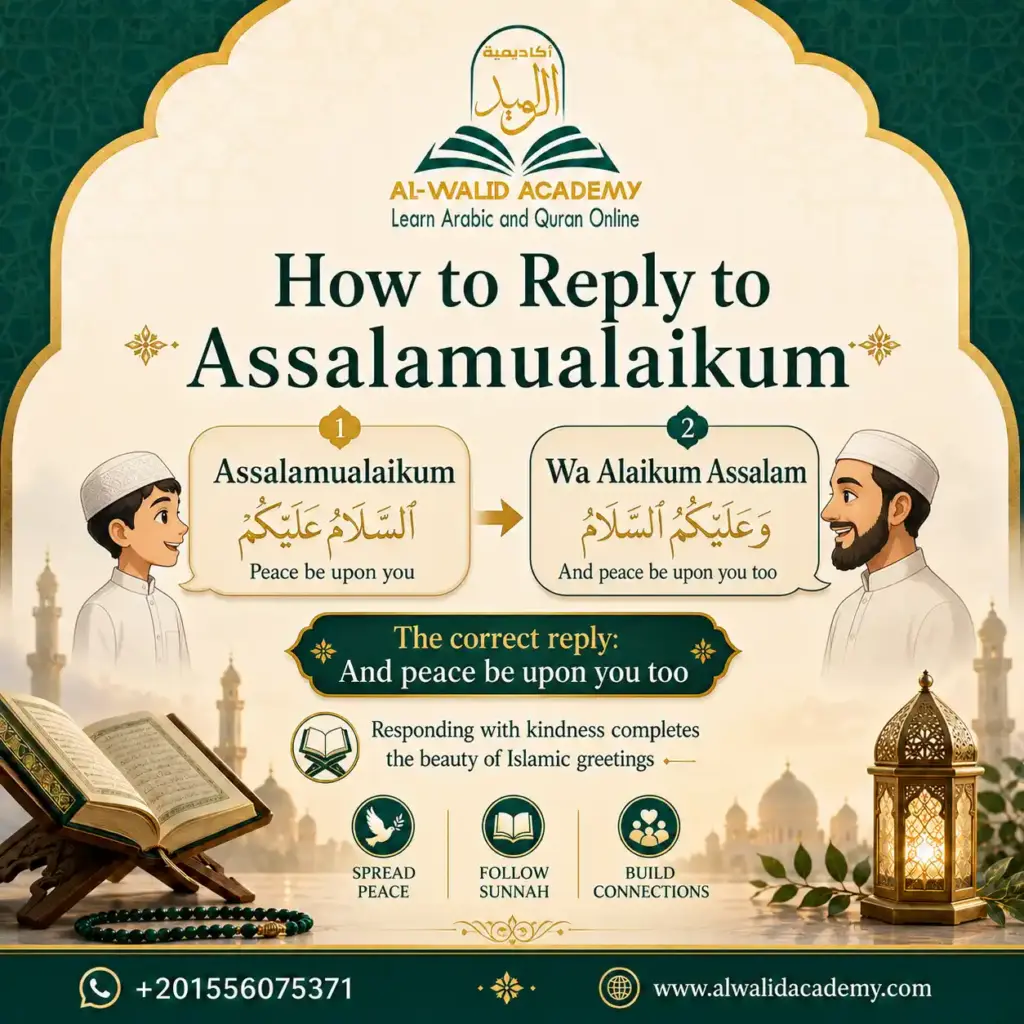
The Correct Sunnah Response
The correct response to a greeting of peace, in accordance with Seerah and the noble Prophetic tradition, is: ‘Wa Alaikum Assalam wa Rahmatullahi wa Barakatuh’. To ensure full reward and recompense.
Difference Between the Short and Long Reply
Short Reply: It is suitable for responding in quick social situations and when interacting informally with people you know.
Long Reply: It is more suitable for formal occasions and social speeches.
Etiquette with Muslims and Non-Muslims
- Start by greeting them to encourage them to do this wonderful thing.
- Use pronouns according to the number of people you are meeting; if you meet two people, you can say, ‘Peace be upon you both.’
- You can use the short, simple form of the greeting to make sure they understand it properly.
- Say the greeting loudly and slowly to ensure they hear and understand it fully.
When Should You Say Assalamualaikum?
Greeting Family and Friends
When meeting with family, friends and neighbours—even if these encounters are daily and brief—this helps to spread love, peace and goodwill on a daily basis and at every meeting.
Entering and Leaving the Home
Say ‘Assalamualaikum wa Rahmatullahi wa Barakatuh’ when entering your home, even if no one is there, for there are angels who dwell there and will return your greeting; and your supplication that peace, mercy and blessings from Allah the Almighty may be upon you is more likely to be answered.
Starting Messages, Emails, and Meetings
It is used to begin speeches, social occasions or emails, as it lends an air of formality and professionalism combined with warmth, respect and an Islamic character.
Saying Salam to Non-Muslims
Saying ‘Assalamu alaykum’ to non-Muslims and New Muslim Convert Guide is a gesture of great beauty and significance; even if it is not fully understood, it is the spiritual meaning behind this phrase that truly resonates.
Key Takeaways
- ‘Assalamu alaykum’ is a phrase with a powerful impact that reaches the heart through the tongue, conveying a sense of warmth and love.
- Using it in everyday situations and interactions brings a sense of blessing and a constant connection with God Almighty.
- It spreads peace, strengthens bonds and reflects the distinctive Islamic character.
The Difference Between “Wa Alaikum Assalam” and Longer Replies
| Reply | Meaning | Why It’s Better |
|---|---|---|
| Wa Alaikum Assalam | Peace be upon you too | The shortest correct reply |
| Wa Alaikum Assalam Wa Rahmatullah | Peace and Allah’s mercy be upon you | Adds mercy and kindness |
| Wa Alaikum Assalam Wa Rahmatullahi Wa Barakatuh | Peace, mercy, and blessings of Allah be upon you | The most complete and rewarding reply |
Common Mistakes People Make with Assalamualaikum
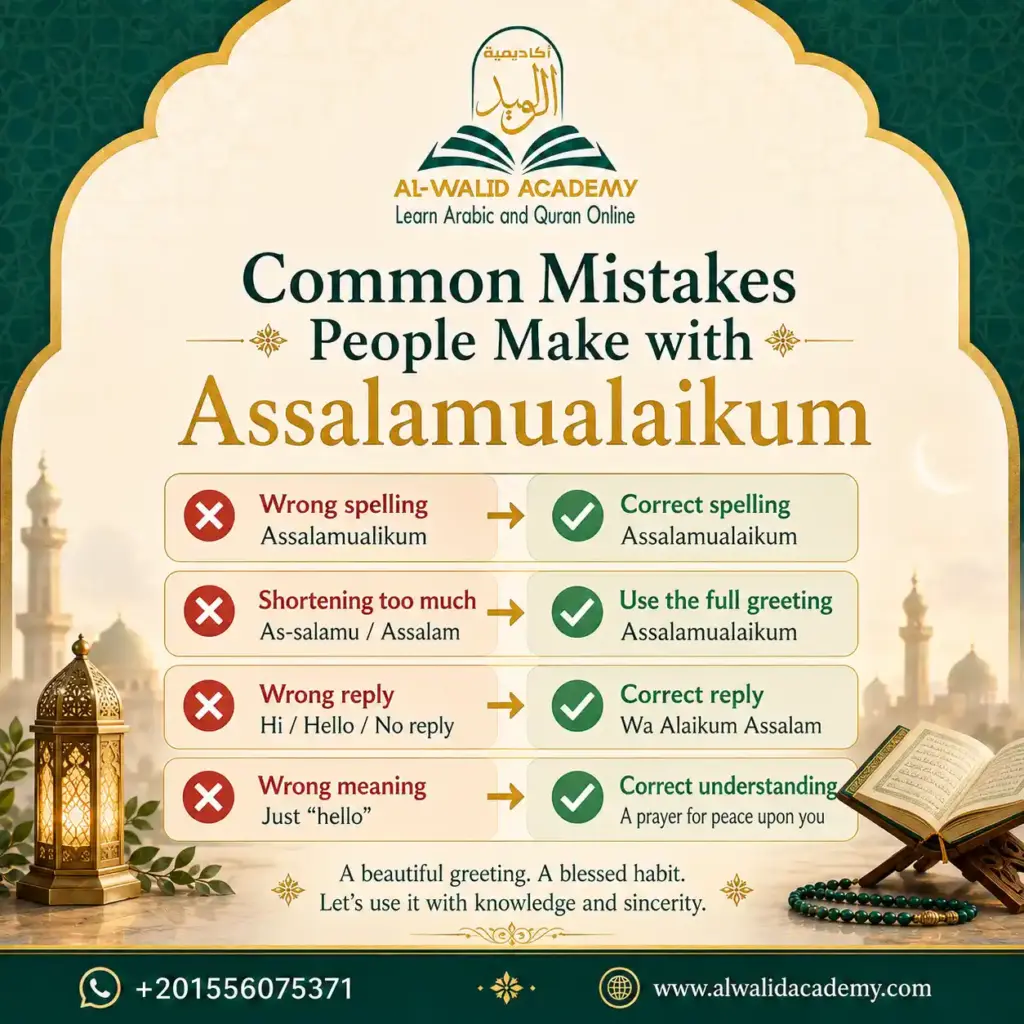
Firstly: Spelling mistakes
There are many mistakes people make when writing ‘Assalamu Alaikum’ for the sake of brevity, such as:
- A.S.
- AsA
- As’kum
The correct form
Write ‘Assalamu Alaikum’ or ‘Assalamualaikum wa Rahmatullahi wa Barakatuh’ in formal correspondence.
Secondly: Excessive abbreviation leading to a distortion of meaning
Excessive abbreviation of Assalamualaikum Meaning, particularly in online conversations and interactions, results in a loss of intellectual and spiritual meaning; this is a major mistake that people, especially young people, often make. For example:
- ASA
The correct approach
is to write it out in full, or, if you wish to abbreviate it, you can write “SALAM”.
Thirdly: Pronunciation errors
Pronunciation errors, which are sometimes unintentional among non-native Arabic speakers, such as saying:
- “Asa ‘alaikum” instead of “Al-salam ‘alaikum”
- Failing to pronounce the ‘ayn’ in ‘‘alaykum’
- Speaking too quickly, to the point where words become unclear
The correct approach
This can be overcome by practising correct pronunciation slowly until it is mastered.
Fourthly: Neglecting to return the greeting of Al-Salam
Failing to respond properly to the greeting of peace, or not paying attention to it, reflects a significant lack of respect and appreciation; returning the greeting of peace is an obligation, and one must do so in the best possible manner. For example:
- Some people merely say ‘And upon you’ or sometimes ignore the greeting altogether.
The correct way
To respond fully by saying ‘And upon you be peace’ or ‘And upon you be peace, and the mercy and blessings of Allah in full’.
Fifth: Failing to use the greeting of Al-Salam in situations where it is required
Saying ‘Assalamu alaykum’ is not limited to meeting people or in formal encounters; rather, it is part of our daily lives and the everyday situations we encounter repeatedly throughout the day.
The correct approach
Saying ‘Assalamu alaykum’ applies to many situations that some may overlook, including:
- Entering and leaving any place.
- Entering and leaving a gathering.
- Greeting both those you know and those you do not know.
Sixth: Avoiding saying ‘Salam’ due to poor pronunciation
This happens with non-Arabic speakers, some of whom avoid saying ‘Salam alaykum’ because they are not entirely confident in their pronunciation.
The correct approach
Continuous training and daily practice to overcome any hesitation and say ‘Salam’, even if the pronunciation requires some practice.
Why is Al-Walid Academy the best choice for studying Islamic studies?
Al-Walid Academy is not only one of the Online Quran Teaching Platforms, we your guide during your journey to learn quran and islamic studies:
- Offering simplified Islamic curricula suitable for all levels and ages.
- Specialist teachers with expertise in Islamic studies and the Qur’an
- Teaching the Holy Qur’an and tajweed in an accessible and practical way, with regular monitoring and assessments
- How to study Islam at home becomes easy by Providing flexible online lessons to suit the schedules of students and parents.
- Focus on understanding and application, not just memorisation
- A supportive learning environment that encourages continuous learning
- Ongoing monitoring of students’ progress and development
- Combining Arabic language learning and Islamic studies in one place.
Conclusion
In conclusion, Assalamualaikum Meaning is more than just an ordinary greeting; it is a beautiful invocation that conveys the meanings of peace, mercy and blessing, and reflects Islam’s values of love, respect and harmony amongst people.
Using this greeting and responding to it in the correct manner helps to spread affection and strengthen social bonds amongst Muslims in their daily lives. Whether in meetings, messages or gatherings, “Assalamu alaykum” remains a symbol of peace, brotherhood and good relations between people.
FAQ
How do Muslims say hello?
Among Muslims, the greeting is given in a specific form: ‘Assalamu alaykum wa rahmatullahi wa barakatuh’ (Peace be upon you, and the mercy and blessings of God). It is a friendly greeting in which we wish the person peace, mercy and blessings from God.
What is the full meaning of Assalamualaikum?
The full meaning of ‘Salam aleikum’ is a supplication to God Almighty to bestow peace upon the person or group of people to whom the greeting is addressed.
Is it disrespectful to say Assalamualaikum?
Not at all. ‘Assalamu alaykum’ is a phrase of great significance to Muslims; it is used as a greeting and carries a deep connection to God Almighty, as we ask Him to bestow upon us peace, mercy and blessings.