
Learning the days of the week is one of the first steps toward building practical Arabic vocabulary. Whether you are learning Modern Standard Arabic, preparing for travel, studying the Quran, or helping your children learn Arabic, knowing the days makes everyday communication much easier.
In this guide, you will learn the Days of the Week in Arabic, their English meanings, pronunciation, origins, Quranic references, and practical phrases. You will also discover simple ways to teach and memorize them.
What Are the Days of the Week in Arabic?
The Arabic language has seven days, just like English. However, the Arabic names are especially easy to remember because several days are based on Arabic numbers.
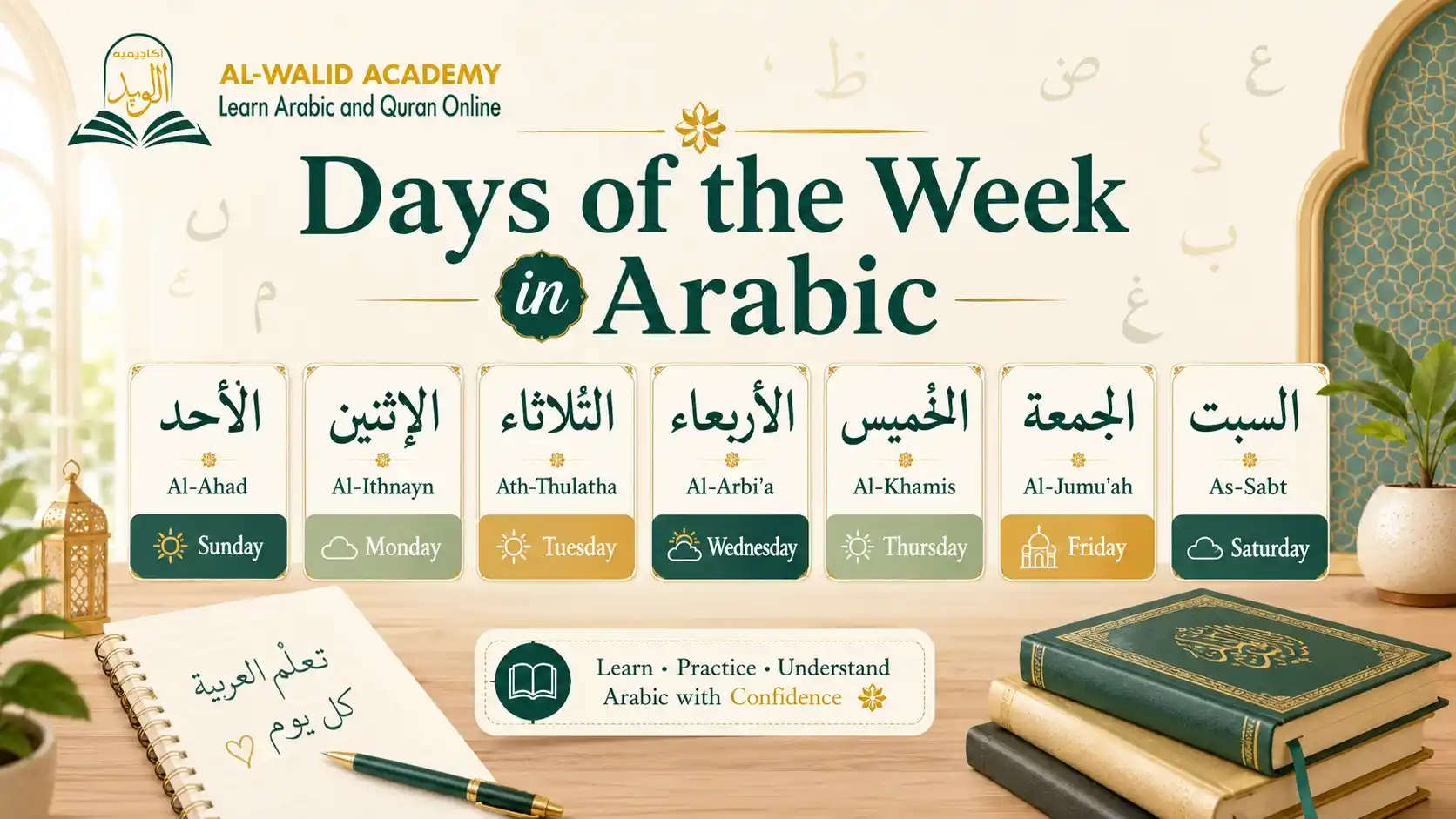
Here is a useful table:
| English | Arabic | Pronunciation |
| Sunday | الأحد | Al-Ahad |
| Monday | الاثنين | Al-Ithnayn |
| Tuesday | الثلاثاء | Ath-Thulatha |
| Wednesday | الأربعاء | Al-Arbi‘a |
| Thursday | الخميس | Al-Khamis |
| Friday | الجمعة | Al-Jumu‘ah |
| Saturday | السبت | As-Sabt |
The first five names are closely associated with counting. Sunday means “the first,” Monday means “the second,” Tuesday means “the third,” Wednesday means “the fourth,” and Thursday means “the fifth.” Friday and Saturday have different linguistic and cultural backgrounds.
When learning the Days of the Week in Arabic, it is useful to memorize the Arabic spelling together with pronunciation instead of trying to memorize isolated words.
Arabic Names for Days of the Week
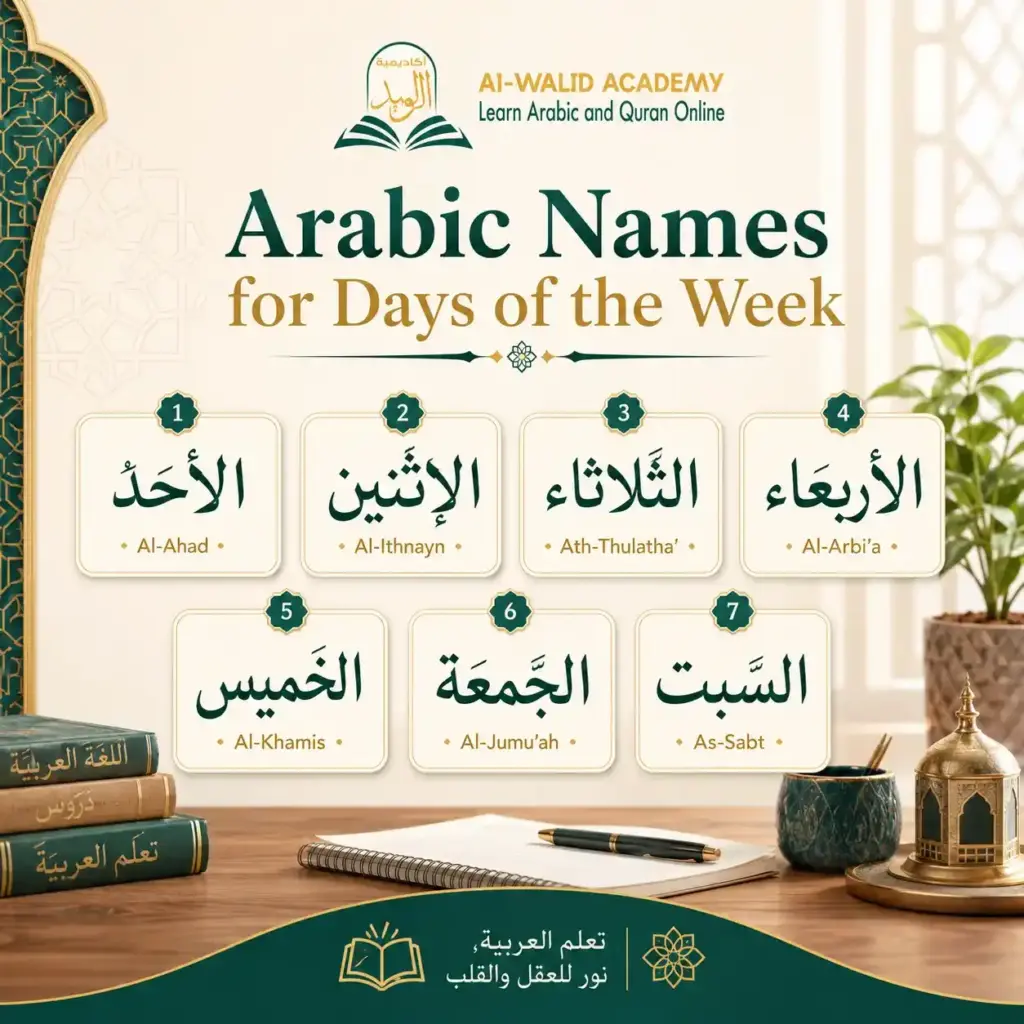
The seven Arabic names are:
الأحد – Al-Ahad – Sunday
The word Al-Ahad means “the first” and is related to the number one. It is normally used for Sunday.
الاثنين – Al-Ithnayn – Monday
Al-Ithnayn means “the two” or “the second.” It comes from the Arabic number two.
الثلاثاء – Ath-Thulatha – Tuesday
Ath-Thulatha means “the three” and is connected to the number three.
الأربعاء – Al-Arbi‘a – Wednesday
Al-Arbi‘a comes from the Arabic word associated with four, making Wednesday the fourth day in this traditional naming sequence.
الخميس – Al-Khamis – Thursday
Al-Khamis means “the fifth” and is related to the number five.
الجمعة – Al-Jumu‘ah – Friday
Friday has a special place in Islamic culture. The word Jumu‘ah is related to gathering or congregation and refers to the weekly Friday prayer.
السبت – As-Sabt – Saturday
As-Sabt is the Arabic name for Saturday. Its linguistic history is different from the number-based names of Sunday through Thursday.
Understanding these patterns can make the Days of the Week in Arabic much easier to remember.
Days of the Week in Arabic and English with Pronunciation
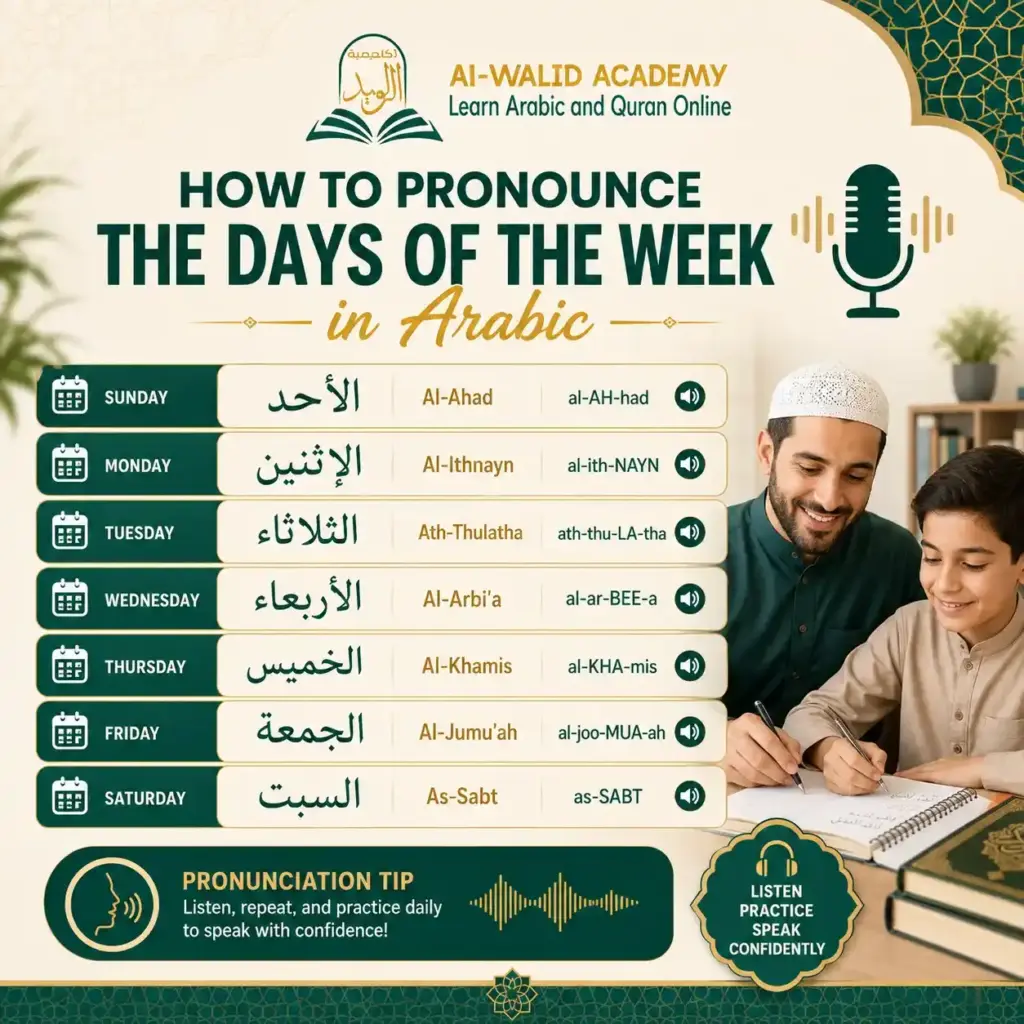
Pronunciation is important because Arabic contains sounds that may not exist in English. Here is a simple pronunciation guide:
- الأحد – Al-Ahad: al-ahad
- الاثنين – Al-Ithnayn: al-ith-nayn
- الثلاثاء – Ath-Thulatha: ath-thu-la-tha
- الأربعاء – Al-Arbi‘a: al-ar-bi-ah
- الخميس – Al-Khamis: al-kha-mees
- الجمعة – Al-Jumu‘ah: al-jum-oo-ah
- السبت – As-Sabt: as-sabt
The letter ث in Arabic is pronounced like the “th” sound in the English word “think.” Therefore, الثلاثاء begins with a “th” sound.
The letter خ in الخميس has a distinctive Arabic sound. It is produced toward the back of the throat and does not have an exact equivalent in standard English pronunciation.
Learners should listen to native Arabic speakers and repeat each word several times. This is particularly helpful when learning the Days of the Week in Arabic for conversation.
How to Pronounce the Days of the Week in Arabic
Arabic pronunciation becomes easier with regular listening and repetition. Do not worry if some sounds feel difficult at first. Begin slowly, divide longer words into syllables, and gradually increase your speed.
For example, you can divide الثلاثاء into:
Ath – Thu – La – Tha
Similarly, practice الأربعاء as:
Al – Ar – Bi – Ah
When saying the names, remember that Arabic has short and long vowel sounds. Paying attention to these differences can make your pronunciation clearer.
Another useful technique is shadowing. Listen to an Arabic speaker saying the word, pause, and repeat it immediately. Record yourself if possible and compare your pronunciation with the original.
With daily practice, the Days of the Week in Arabic can become part of your natural vocabulary.
Know more about our Summer Arabic Learning Schedule for Kids
Origins and Meaning Behind the Days’ Names
The names of the Arabic weekdays are not random. Their meanings provide an excellent memory system for beginners.
Sunday, الأحد, is connected with “one” or “first.”
Monday, الاثنين, is associated with “two” or “second.”
Tuesday, الثلاثاء, is associated with “three.”
Wednesday, الأربعاء, is associated with “four.”
Thursday, الخميس, is associated with “five.”
This sequence gives learners a logical way to remember five of the seven days. Instead of memorizing seven unrelated vocabulary items, students can recognize a numerical pattern.
Friday, الجمعة, is connected to gathering. It is especially significant because Muslims gather for the weekly Friday prayer.
Saturday, السبت, has a different origin and is traditionally associated with the concept of rest or cessation in Semitic linguistic traditions.
Learning the meanings behind the Days of the Week in Arabic can make vocabulary study more meaningful and memorable.
Connection to Numbers and Tradition
One of the most useful features of Arabic weekday vocabulary is its connection with numbers. Students who already know Arabic numbers from one to five may find the weekdays easier to learn.
For example:
- One → واحد → Wahid
- Two → اثنان → Ithnan
- Three → ثلاثة → Thalatha
- Four → أربعة → Arba‘a
- Five → خمسة → Khamsa
These forms are reflected in the traditional names of Sunday through Thursday.
Friday is different because its name is related to gathering rather than a number. This is also connected to its importance in Islamic tradition.
The numerical structure makes the Days of the Week in Arabic particularly suitable for classroom activities, games, flashcards, and children’s lessons.
Appearance of Days of the Week in the Quran
Some weekday names and concepts appear in the Quran. Friday holds a special place in Islam, as the Quran includes Surah Al-Jumu‘ah, chapter 62, which refers to the Friday gathering and highlights the importance of this blessed day.
Surah Al-Jumu‘ah teaches Muslims to give priority to the Friday prayer by answering the call to Salah and pausing trade or business once the prayer is announced.
The Quran also discusses concepts related to days and creation. For example, several verses mention the creation of the heavens and the earth in six days. These references show that understanding basic Arabic vocabulary related to time can help learners recognize familiar concepts while reading Islamic texts.
Students interested in Quranic Arabic may therefore find learning the Days of the Week in Arabic useful alongside broader vocabulary about time, dates, and worship.
How to Use Days of the Week in Arabic for Real-Life Phrases
Knowing individual words is only the beginning. Learners should practice using them in complete sentences.
Here are some useful examples:
1- ما هو اليوم؟
Ma huwa al-yawm?
What day is it?
2- اليوم الأحد.
Al-yawm Al-Ahad.
Today is Sunday.
3-غدًا الاثنين.
Ghadan Al-Ithnayn.
Tomorrow is Monday.
4- أمس كان السبت.
Ams kana As-Sabt.
Yesterday was Saturday.
5- أذهب إلى المدرسة يوم الأحد.
Adhhab ila al-madrasah yawm Al-Ahad.
I go to school on Sunday.
6- لدي درس يوم الثلاثاء.
Ladayya dars yawm Ath-Thulatha.
I have a lesson on Tuesday.
Using these expressions regularly will help you move from memorization to practical communication. Practice talking about your schedule using the Days of the Week in Arabic.
How to Teach Kids the Days of the Week in Arabic
Children usually learn vocabulary better when lessons are short, interactive, and repetitive. Instead of asking children to memorize all seven words at once, introduce two or three days at a time.
Use colorful flashcards showing the Arabic word, English meaning, and a simple picture. You can also create a weekly calendar and ask the child to identify the current day every morning.
Songs and rhythm are particularly effective. Children can repeat the names in order while clapping or moving around.
Parents and teachers can also create simple questions:
- ما اليوم؟ — What day is it?
- ماذا ستفعل يوم الجمعة؟ — What will you do on Friday?
- متى لديك درس اللغة العربية؟ — When do you have your Arabic lesson?
Games, stories, and daily conversations make the Days of the Week in Arabic more engaging for young learners.
Read about: How to Teach Arabic Letters to Kids
Tips for Learning and Memorizing the Days
There are several simple strategies that can make Arabic weekday vocabulary easier.
1. Learn them in order:
Start with Sunday and continue through Saturday.
2. Use the number connection:
Remember that Sunday through Thursday are linked to one through five.
3. Practice every day:
Spend only a few minutes reviewing the words.
4. Use them in sentences:
Vocabulary becomes easier to remember when used in context.
5. Listen to native pronunciation:
Listening helps you develop accurate pronunciation.
6. Connect words to your routine:
Say the Arabic name whenever you check your calendar.
7. Review Friday separately:
Because Al-Jumu‘ah has a special meaning, connect it with the Friday prayer.
Consistency is more important than studying for a long time. A few minutes of practice each day can make the Days of the Week in Arabic easier to recall.
Know more about: How Long Does It Take To Become Fluent in Arabic
Flashcards, Songs, and Practice Methods
Flashcards are one of the simplest tools for learning Arabic vocabulary. Write the Arabic name on one side and the English translation on the other. Test yourself in both directions.
Songs can also help children and beginners remember the correct order. Repeating the names with a rhythm creates a strong memory association.
Another method is calendar practice. Every morning, ask yourself:
ما هو اليوم؟
Then answer:
اليوم هو ______.
You can also write a weekly schedule completely in Arabic. For example, write your school, work, exercise, or Quran lessons next to each Arabic weekday.
These activities turn passive vocabulary into active language skills. Regularly seeing, hearing, writing, and speaking the Days of the Week in Arabic will reinforce your memory.
Common Mistakes When Learning Arabic Weekdays
Beginners often make mistakes with pronunciation, especially with ث, خ, and ع.
Another common mistake is confusing the order of the days. Learners may also memorize the English translation without remembering the Arabic spelling.
It is important to remember that Arabic is written from right to left. Practice writing each weekday several times while saying it aloud.
Do not focus only on individual pronunciation. Try to use each word inside a sentence. This helps you understand how Arabic speakers naturally talk about dates and schedules.
Finally, avoid trying to learn everything in one sitting. Spaced repetition is generally more effective than cramming.
Learn Arabic Vocabulary with Al-Walid Academy
Arabic vocabulary becomes easier to remember when students learn it through real examples, guided practice, and regular teacher support. At Al-Walid Academy, learners can build everyday Arabic skills step by step from home.
Build Arabic Skills with Structured Lessons
Through our Arabic Classes Online, students can learn useful words, improve pronunciation, and practise simple sentences in a clear and supportive way. These lessons are suitable for kids, beginners, and non-Arabic speakers.
Connect Arabic Learning with Quran
Arabic is also the key to understanding Quranic words, Islamic expressions, and daily Muslim vocabulary. Students who want to improve Quran reading can explore our Quran courses online and start learning with qualified teachers.
Improve Quran Reading and Tajweed
For students who want to read the Quran more accurately, our Online Quran Learning resources help with recitation, memorization, and confidence. Learners can also join Online Tajweed Classes to improve pronunciation, Makharij, and Tajweed rules step by step.
Learn Islamic Vocabulary and Values
Arabic learning becomes more meaningful when children connect words with faith, manners, Seerah, and Quranic lessons. Our Islamic Studies Online articles help families support their children’s Islamic knowledge alongside Arabic learning.
With regular practice and expert guidance, students can move from simple Arabic words to stronger reading, clearer pronunciation, and better confidence in both Arabic and Quran learning.
Conclusion
Learning the Days of the Week in Arabic is a simple but valuable step for anyone beginning Arabic. The seven names become easier to remember when you understand their meanings, numerical connections, pronunciation, and cultural significance.
Start by learning the seven names in order, practice their pronunciation, and use them in short sentences about your daily schedule. For children, combine repetition with songs, games, flashcards, and interactive activities.
With consistent practice, these essential words can quickly become part of your everyday Arabic vocabulary.
FAQs
What are the seven days of the week in Arabic?
The seven days are الأحد (Sunday), الاثنين (Monday), الثلاثاء (Tuesday), الأربعاء (Wednesday), الخميس (Thursday), الجمعة (Friday), and السبت (Saturday).
Which Arabic day means Friday?
Friday is الجمعة (Al-Jumu‘ah). The word is associated with gathering and has special significance in Islam because of the weekly Friday congregation and prayer.
Why are Sunday through Thursday connected to numbers?
Their names reflect a traditional numerical sequence: first, second, third, fourth, and fifth. This makes them easier for beginners to memorize.
What is Saturday called in Arabic?
Saturday is السبت (As-Sabt).
How can children memorize Arabic weekdays?
Use repetition, songs, flashcards, calendars, games, and short daily conversations. Connecting each day with a child’s routine can make vocabulary easier to remember.
Is learning Arabic weekdays useful for beginners?
Yes. Weekday names are common in everyday conversations and are useful for discussing appointments, school, work, travel, lessons, and religious activities.