Reading the Quran For The First Time is the beginning of a meaningful journey that helps you connect with the words of Allah and understand their guidance for everyday life.
Many beginners feel unsure about where to start, but the right approach can make the experience simple and rewarding.
In this guide, you will learn practical steps that help you read the Quran with confidence, understanding, and purpose from the very beginning.
What Should You Know Before Reading the Quran for the First Time?
Before you start reading the Quran for the first time, you need to understand that the right beginning depends on sincere intention, starting with short Surahs, and listening to correct recitation. These basic steps make the experience of reading the Quran easier and more meaningful from day one.
Reading the Quran for the first time does not require advanced Arabic knowledge or prior experience with Tajweed rules. It only requires a simple mindset, patience, and a genuine desire to learn.
The more calmly and consistently you start, the more naturally your understanding and reading skills will improve over time.
Parents who want their children to understand the language of the Quran may later enroll them in a Quranic Arabic Course.
Key Things You Should Know Before Starting
- Sincere intention: Your goal should be learning and getting closer to Allah, not just finishing pages.
- Start with short Surahs: It is better to begin with short Surahs from Juz Amma because they are easier to read, memorize, and understand.
- Listen to recitation: Listening to a skilled reciter helps you improve pronunciation and recognize correct articulation points.
- Use simple Tafsir: Easy explanations help you understand the meaning of the verses without complexity.
- Choose a quiet place: A calm environment helps you focus and reflect better during reading.
- Accept mistakes: Making mistakes at the beginning is completely normal and part of the learning process.
Why Are These Basics Important?
| Element | Benefit |
| Sincere intention | Makes reading an act of worship, not just a habit |
| Short Surahs | Eases the beginning and reduces difficulty |
| Listening to recitation | Improves pronunciation and correct reading style |
| Simple Tafsir | Helps understand the core message of the verses |
| Calm focus | Enhances reflection and deeper understanding |
Many beginners start with enthusiasm, but stop when they feel difficulty. However, following these simple steps makes consistency much easier and helps build a strong connection with the Quran gradually.
Start Your Journey with Al-Walid Academy
Learn Quran, Arabic, and Islamic Studies with certified teachers in fun, interactive, and personalized sessions. Join thousands of students around the world and begin your path today!
Book Your Free Trial SessionCan Beginners Read the Quran Without Knowing Arabic?
Yes, beginners can read the Quran without knowing Arabic by using translation and simplified Tafsir to understand the meanings, while gradually developing Arabic skills over time to improve comprehension and recitation.
Not knowing Arabic should not stop you from starting your Quran journey, because translation helps you understand the general meaning of the verses even if you cannot read the Arabic text fluently at the beginning. The most important thing is to start and continue step by step.
However, it is always better to combine reading, listening, and gradual Arabic learning, as this helps you connect the meaning with the original text and understand the Quran more deeply over time.
Many learners find that Learning Arabic for Beginners alongside Quran study makes it easier to recognize common words and understand verses directly from the original text.
How to Start Reading the Quran Without Knowing Arabic?
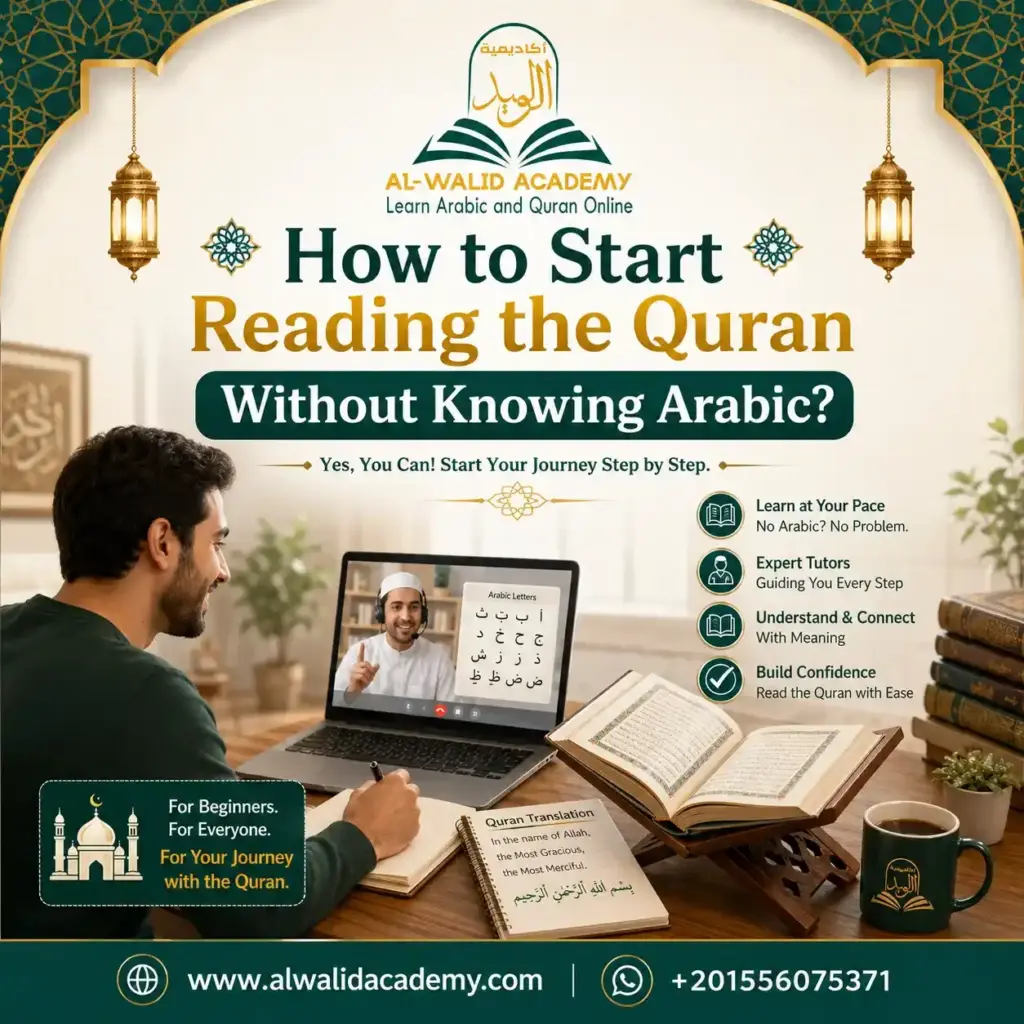
- Use a reliable translation to understand the general message of the verses.
- Read simple Tafsir that explains meanings in an easy way.
- Listen to a skilled reciter while following the text to improve pronunciation.
- Start with short Surahs like Al-Fatiha, Al-Ikhlas, Al-Falaq, and An-Nas to make learning easier.
- Whenever you come across a verse or concept that you do not fully understand, seek clarification from a qualified teacher or a reliable Islamic source to ensure accurate understanding.
For children who already know basic vocabulary, Online Arabic Conversation Classes can encourage speaking practice in a natural way.
Comparison of Learning Methods for Beginners
| Method | What It Provides | Result |
| Translation | General understanding of meaning | Clear awareness of the message |
| Simple Tafsir | Clear explanation of verses | Deeper and more accurate understanding |
| Listening to recitation | Improves pronunciation and Tajweed | Gradual correct reading |
| Short Surahs | Reduces difficulty at the start | Builds confidence and consistency |
| Learning with a teacher | Corrects mistakes quickly | Structured and accurate learning |
With consistent practice, you will gradually recognize more Arabic words, which will make your connection with the Quran stronger and clearer over time.
How to Start Reading the Quran for the First Time
To start reading the Quran for the first time correctly, begin immediately with a sincere intention, then use a reliable translation, and then choose short and easy Surahs while listening to correct recitation during reading.
These steps form the foundation that makes the beginning simple, clear, and free from confusion or pressure.
Reading the Quran at the beginning does not require prior experience or advanced Arabic knowledge. It only requires a gradual and simple approach that helps you build understanding and confidence step by step until reading becomes a stable habit.
The right way to start is not speed or quantity, but gradual learning, understanding, and consistency, because these are the elements that lead to real progress over time.
Read about: Quran Memorization Programs Online
1. Start with a Sincere Intention
Start reading the Quran with a sincere intention because intention is the true foundation of every act of worship. When your intention is clear and correct, reading the Quran becomes an act of worship that brings you closer to Allah rather than just a daily habit.
A sincere intention means that you read the Quran to learn, reflect, and act upon it, not just to finish pages or recite without understanding. Therefore, you should renew your intention internally before every reading session.
2. Choose a Reliable Quran Translation
Choose a reliable Quran translation because inaccurate translation may lead to misunderstanding, while an approved translation helps you understand the general message of the verses clearly and correctly.
Using translation at the beginning helps you connect the text with its meaning, but it does not replace the Arabic text; rather, it serves as a supporting tool for understanding during learning.
Examples of reliable tafsir and translations:
| Source | Type | Main Benefit |
| Tafsir Al-Jalalayn | Simplified Arabic tafsir | Short and easy explanation |
| Sahih International | English translation | High accuracy in meaning |
| Pickthall | English translation | Classical trusted style |
| Al-Muyassar Tafsir | Simplified tafsir | Very suitable for beginners |
Choosing a reliable source protects you from confusion and gives you correct understanding from the beginning.
3. Begin with Short and Easy Surahs
Start with short Surahs because they support gradual learning and help you build confidence quickly, while long Surahs may feel difficult at the beginning and affect consistency.
In fact, these chapters are often recommended among the 5 Surahs to Recite Daily because they are easy to remember, rich in meaning, and commonly recited in daily prayers.
Best short Surahs for beginners:
- Surah Al-Ikhlas: very short and helps understand Tawheed.
- Surah Al-Falaq: simple and clear in meaning.
- Surah An-Nas: easy and improves pronunciation.
- Surah Al-Asr: short but deeply meaningful.
- Surah Al-Kawthar: easy to memorize and repeat.
Starting with these Surahs gives you a quick sense of achievement and makes progress more visible with each day of reading.
4. Listen to Quran Recitation While Reading
Listen to correct Quran recitation while reading because it directly helps improve pronunciation and understanding of proper pauses and Tajweed rules. Combining listening and reading significantly speeds up learning and reduces mistakes.
With repetition, your tongue naturally begins to imitate correct pronunciation, making your reading smoother and more confident over time.
This is one of the same techniques commonly used in a Quran Recitation Course, where students develop accurate recitation skills through guided listening and continuous practice.
You can listen to skilled reciters such as Mishary Alafasy or Abdul Rahman Al-Sudais, then repeat after them to gradually improve your recitation accuracy.
Should You Read the Quran in Arabic or Translation First?

For beginners, it is better to read the Quran in Arabic while using a translation at the same time, because Arabic is the original text, while translation helps you understand the meaning more clearly and easily.
At the beginning, you may rely more on translation to understand the general meaning, then gradually move toward reading Arabic with listening and repetition until your skills improve naturally.
Best Method for Understanding and Starting
| Step | What You Do | Main Goal |
| Read Arabic text | Read the verse directly | Recognize the original revelation |
| Listen to recitation | Follow a skilled reciter | Improve pronunciation and Tajweed |
| Read translation | Understand the meaning | Grasp the message |
| Read simple tafsir | Clear explanation | Deeper understanding |
| Repeat reading | Continuous review | Strengthen learning |
Following this method creates a balanced learning experience between understanding and recitation, preventing confusion or difficulty at the beginning.
Best Surahs to Read First for Beginners
The best Surahs for beginners to start with are Surah Al-Fatiha, Al-Ikhlas, Al-Falaq, and An-Nas, along with short Surahs from Juz Amma. These Surahs are simple in recitation, easy to memorize, and clear in meaning, which makes them perfect for a smooth and gradual start.
When you begin with these Surahs, you will notice steady progress and a growing sense of achievement because you are building a simple foundation before moving to longer chapters.
-
Surah Al-Fatiha
Surah Al-Fatiha is the first and most important Surah for any beginner because it is recited in every unit of prayer. Learning it early helps you connect Quran recitation with your daily worship.
Al-Fatiha is known as “The Opening” and is considered the foundation of the Quran because it summarizes key themes such as praise, worship, and seeking guidance. It consists of only seven verses, yet it carries deep and essential meanings.
Taking your time with each verse helps you appreciate the guidance it offers and understand its teachings more clearly.
-
Surah Al-Ikhlas
Surah Al-Ikhlas is one of the easiest Surahs for beginners because it is very short and directly focuses on the concept of monotheism (Tawhid). It is widely memorized at the beginning of Quran learning.
This Surah has only four verses, yet it carries a profound meaning and is considered equal to one-third of the Quran in reward, according to authentic narrations.
Learning it early helps you understand the core belief of Islam in a simple and direct way, while also strengthening your memorization skills.
-
Surah Al-Falaq and Surah An-Nas
Surah Al-Falaq and Surah An-Nas are highly recommended for beginners because they are used as daily supplications for protection from harm and negative influences.
For readers interested in a deeper understanding, studying a Surah Al-Falaq explained lesson can help clarify the Surah’s message about seeking Allah’s protection from different forms of harm and evil.
These two Surahs also help improve pronunciation because they include a variety of Arabic sounds and repeated patterns that are helpful for practice.
Comparison between the two Surahs:
| Surah | Number of Verses | Main Purpose | Recommended Time |
| Al-Falaq | 5 verses | Protection from external harm | Morning & evening |
| An-Nas | 6 verses | Protection from inner whispers | Before sleep |
Regular recitation of both Surahs brings a sense of peace and spiritual stability during your learning journey.
- Short Surahs from Juz Amma
Short Surahs from Juz Amma are the best option for beginners because they are easy to read, simple to memorize, and frequently used in daily prayers, which helps reinforce learning naturally.
For the same reason, many parents choose Juz ‘Amma For Kids programs as a starting point when introducing children to Quran reading and memorization.
Examples of beginner-friendly Surahs:
| Surah | Number of Verses | Difficulty Level |
| Al-Kawthar | 3 verses | Very easy |
| Al-Asr | 3 verses | Very easy |
| At-Takathur | 8 verses | easy |
| Al-Adiyat | 11 verses | easy |
| Al-Qari’ah | 11 verses | easy |
It is best to start with the shortest Surahs like Al-Kawthar and Al-Asr, then gradually move to longer ones as your reading skills improve.
Basic Etiquette Before Reading the Quran

Basic etiquette before reading the Quran includes starting with Istiadha and Basmala, reading with respect and focus, and reciting slowly and clearly.
These manners help improve understanding, concentration, and the overall quality of recitation.
Following these etiquettes makes the reading experience more peaceful and spiritually meaningful while also improving pronunciation over time.
1. Start with Isti’adhah and Bismillah
Begin Quran recitation with Istiadha and Bismillah because this is the correct Sunnah practice. It helps you seek protection from Satan and prepares your mind for focused recitation.
This first step helps quiet the mind and prepares the heart to read the Quran with focus, respect, and deeper awareness.
Learn more about: What Does Bismillah Mean?
Correct way to begin:
| Phrase | Pronunciation | Meaning |
| Istiadha | A‘udhu billahi min ash-shaytan ir-rajim | Seeking protection from Satan |
| Basmala | Bismillah ir-Rahman ir-Rahim | In the name of Allah, the Most Merciful |
Istiadha is recited before every Surah, followed by Basmala (except Surah At-Tawbah).
2. Read with Respect and Focus
You should read the Quran with respect and full attention because you are engaging with the words of Allah. Calm and mindful reading improves comprehension and reduces mistakes.
Choosing a quiet environment and avoiding distractions helps you stay focused and gain more benefit from recitation.
Key manners during reading:
| Etiquette | Practical Application |
| Clean environment | Read in a quiet, clean place with fewer distractions. |
| Personal purity | Perform ablution before reading |
| Respectful posture | Sit in a respectful manner |
| Reduce distractions | Turn off the phone and noise |
| Heart presence | Focus on the meaning |
3. Recite Slowly and Clearly
Reciting the Quran slowly and clearly is the best approach for beginners because it improves pronunciation and deepens understanding of the meaning.
Reading too quickly at the beginning may lead to mistakes, so gradual improvement is recommended until fluency develops naturally.
Benefits of slow recitation:
| Benefit | Explanation |
| Better pronunciation | Correct articulation of letters |
| Deeper understanding | Reflection on meanings |
| Stronger memorization | Better retention of verses |
| Greater reward | Calm and mindful recitation |
With consistent practice, slow and clear recitation naturally develops into fluent and confident reading.
How to Understand the Quran as a Beginner
You can understand the Quran as a beginner by using a simple translation alongside an easy tafsir, focusing on the main meaning of each verse, and taking notes while reading. This approach makes understanding clearer and much easier than reading without guidance.
Understanding the Quran at the beginning does not require deep study, but it does require simple steps that help you progress gradually and grasp the message of each verse.
1. Read Simple Tafsir with Translation
The best way to understand the Quran is to read the translation first and then refer to a simple tafsir to understand the deeper meaning and context of the verse.
For learners who want structured guidance, Learn Quran Tafseer Online programs can make understanding the Quran easier by explaining verses in a simple and organized way.
Tafsir completes the meaning that translation alone may not fully explain and helps you connect the text with its intended message.
Suitable Tafsir for Beginners:
| Tafsir | Level | Feature |
| Al-Tafsir Al-Muyassar | Very easy | Simple and clear language |
| Tafsir Al-Jalalayn | Beginner | Short and direct explanation |
| Tafsir Al-Saadi | Intermediate | Simple yet detailed explanation |
| Ibn Kathir (simplified) | Intermediate | Comprehensive and reliable |
Always start with the verse, then the translation, then the tafsir. This sequence helps you understand step by step without confusion.
2. Focus on the Main Message
Focusing on the main idea of each verse is essential to understanding the Quran correctly, instead of getting lost in secondary details.
Every verse in the Quran delivers a clear message such as monotheism, patience, mercy, or moral guidance.
Key Messages in the Quran:
| Message | Meaning | Examples |
| Monotheism | Worshipping Allah alone | Surah Al-Ikhlas |
| Mercy | Allah’s mercy upon creation | Verses in Surah Al-Baqarah |
| Justice | Fairness among people | Surah An-Nisa and Al-Ma’idah |
| Patience | Staying firm during hardship | Story of Prophet Yusuf and Ayyub and reliable |
| Gratitude | Being thankful for blessings | Surah Ibrahim and Luqman |
After each verse, ask yourself: What is the main message this verse is trying to deliver?
3. Take Notes While Reading
Taking notes while reading helps you remember key meanings and return to them easily later. It also turns Quran reading into an active learning experience, not just passive reading.
Effective Note-Taking Methods:
| Method | Purpose | Benefit |
| Writing key verses | Focus on important meanings | Better retention |
| Writing questions | Clarify doubts | Deeper understanding |
| Linking to life | Practical application | Real-life connection |
| Summarizing surahs | Quick review | Easier revision |
Keep a dedicated notebook for the Quran and write your reflections daily.
Common Mistakes When Reading the Quran for the First Time
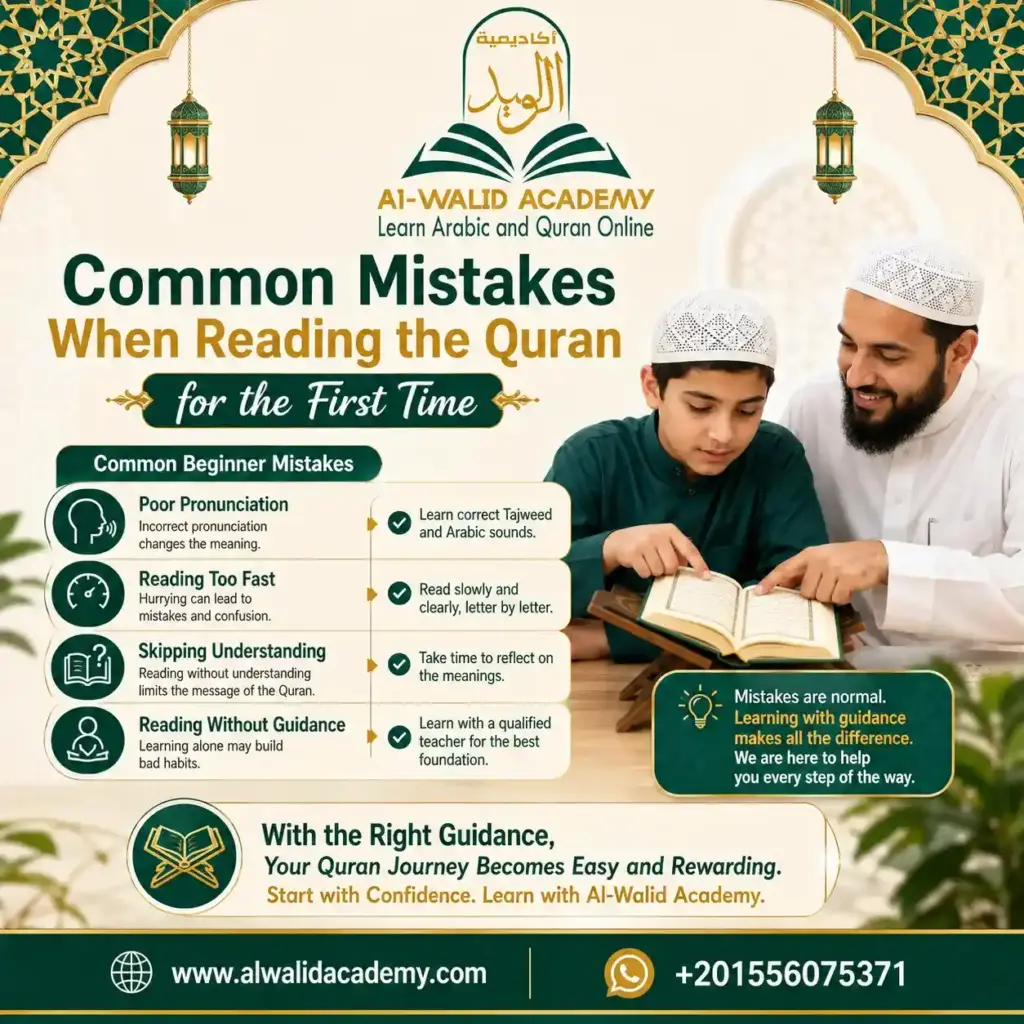
The most common mistakes beginners make when reading the Quran include rushing, not understanding meanings, ignoring correct pronunciation, and trying to finish too quickly. Avoiding these mistakes makes your experience more meaningful and effective.
Knowing these mistakes early helps you avoid frustration and build a consistent, healthy learning habit.
1. Starting with Long Surahs Too Early
Starting with long surahs at the beginning can be overwhelming and discouraging for most beginners. It is better to start with short surahs such as:
- Al-Ikhlas
- Al-Falaq
- An-Nas
Then gradually move to longer ones as your level improves.
2. Reading Without Understanding the Meaning
Reading without understanding reduces the benefit because the Quran is meant for reflection and guidance. Even if your Arabic is weak, translation and simple tafsir will help you understand the meaning and gain value from every verse.
3. Ignoring Pronunciation and Tajweed
Ignoring correct pronunciation and tajweed can lead to mistakes in recitation and reduce accuracy. Start by learning basic tajweed rules to improve your reading step by step such as:
- Elongation (madd).
- Clear pronunciation (izhar).
4. Trying to Finish Too Quickly
Trying to finish the Quran quickly reduces reflection and weakens understanding. It is better to read slowly and focus on understanding, even if you read only a few verses per day.
Start Your First Experience with Reading The Quran For The First Time at Al-Walid Academy
If you are starting to read the Quran For The First Time, Alwalid Academy gives you a clear and beginner-friendly path that helps you begin from zero and gradually build a strong and comfortable relationship with the Quran.
At Alwalid Academy, the focus is not limited to reading only, but extends to helping you understand what you read from the beginning.
What You Will Learn When You Start Reading The Quran For The First Time
- Step-by-step lessons designed for complete beginners.
- Basic Arabic reading support to help you pronounce words correctly.
- Simple explanations (Tafsir) to understand verses in an easy way.
- Foundational Tajweed rules to improve your recitation from day one.
- Organized reading plans that help you progress without pressure.
- Beginner-focused learning approach suitable for all ages.
Why Al-Walid Academy Works Well for Beginners
- The teaching style is built specifically for people starting from scratch.
- Patient and qualified instructors who guide you step by step.
- Balanced focus on both reading and understanding the Quran.
- Clear and structured system that prevents confusion.
- Flexible learning options that fit different levels and schedules.
Begin your journey of Reading The Quran For The First Time with Alwalid Academy and take your first steps in a simple, supportive, and well-guided learning environment.
Enroll today and start learning with confidence.
FAQs
What should I do before reading the Quran for the first time?
Before you start reading the Quran for the first time, you should set a sincere intention, choose a quiet place, and begin with a calm mindset. It is also helpful to start with short s
urahs and use a simple translation to understand the meaning.
Is it possible to read the Quran without knowing Arabic?
Yes, you can read the Quran even if you don’t know Arabic. Beginners usually start by reading the Arabic text alongside a reliable translation to understand the meaning while gradually improving their reading skills.
How do beginners start reading the Quran correctly?
Beginners start by learning basic pronunciation, reading short surahs first, and listening to correct recitation. This combination helps build confidence and improves reading step by step.
How much time should a beginner spend reading the Quran each day?
A beginner should read a small portion daily, even if it is just a few verses. Consistency is more important than quantity, and regular practice helps build fluency over time.
Is it better to read the Quran alone or with a teacher?
Learning with a teacher is highly recommended because they can correct pronunciation mistakes and guide you step by step. Self-learning is possible, but a teacher makes the process faster and more accurate.
Can I learn to read the Quran online?
Yes, you can learn to read the Quran online through structured courses and qualified teachers. Online learning is flexible and allows you to study at your own pace from anywhere.
When should I join Quran learning classes?
You should join Quran learning classes as early as possible if you are serious about improving your reading. Classes help you build correct habits from the beginning and avoid common mistakes.