Raising a generation of Muslims who are well-informed has become a major challenge today; therefore, we must start from an early age, the moment children begin asking questions about God, His Messenger, and other aspects of religion. In this article produces by AL-Walid Academy, we present the most common Islamic Questions and Answers For Kids along with convincing answers that are suitable for children.
Questions About Allah
Who is Allah?
One of the most common Islamic Questions and Answers For Kids When answering the question ‘Who is God?’ for children, the following points can be explained:
- God Almighty is the One who created us and brought us into being on Earth, just as He created the trees and rivers, and that these things do not exist on their own.
- Talk about God Almighty in terms of mercy and love, because young children are drawn to those who love them and with whom they feel safe.
- Talk about God Almighty’s power and how He is capable of doing anything; this is something that has a great impact on children, as they tend to love superheroes who use their powers for good.
Why do we worship Allah?
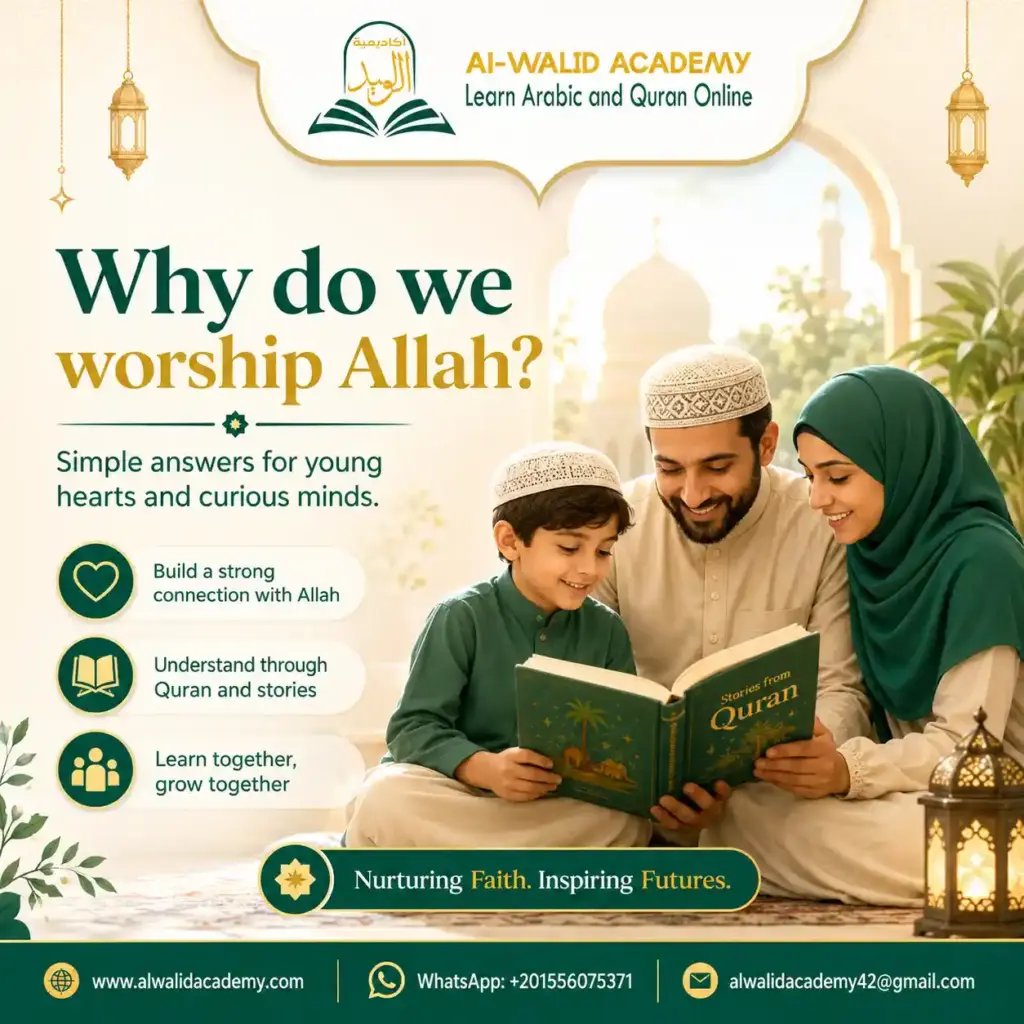
We worship God Almighty because He is the One who provides us with everything we need and ask for, who sustains us with food and drink, and who loves us more than anyone else; therefore, we must thank Him for this through our worship of Him.
What Are the 99 Names of Allah?
The 99 Names of Allah are known in Arabic as Asma Ul Husna, meaning the Most Beautiful Names. They describe Allah’s perfect attributes, including His mercy, wisdom, power, forgiveness, knowledge, and justice.
Learning these names is not only about memorizing a list. Muslims study their meanings to know Allah better, strengthen their faith, improve their duas, and reflect His guidance in their daily lives.
The 99 Names of Allah and Their Meanings
| No. | Arabic Name | Transliteration | English Meaning |
| 1 | الرَّحْمَنُ | Ar-Rahman | The Most Merciful |
| 2 | الرَّحِيمُ | Ar-Raheem | The Most Compassionate |
| 3 | الْمَلِكُ | Al-Malik | The King and Sovereign |
| 4 | الْقُدُّوسُ | Al-Quddus | The Most Holy and Pure |
| 5 | السَّلَامُ | As-Salam | The Source of Peace |
| 6 | الْمُؤْمِنُ | Al-Mu’min | The Giver of Safety and Faith |
| 7 | الْمُهَيْمِنُ | Al-Muhaymin | The Guardian and Overseer |
| 8 | الْعَزِيزُ | Al-Aziz | The Almighty |
| 9 | الْجَبَّارُ | Al-Jabbar | The Compeller and Restorer |
| 10 | الْمُتَكَبِّرُ | Al-Mutakabbir | The Supremely Great |
| 11 | الْخَالِقُ | Al-Khaliq | The Creator |
| 12 | الْبَارِئُ | Al-Bari’ | The Originator |
| 13 | الْمُصَوِّرُ | Al-Musawwir | The Fashioner of Forms |
| 14 | الْغَفَّارُ | Al-Ghaffar | The Constantly Forgiving |
| 15 | الْقَهَّارُ | Al-Qahhar | The All-Subduing |
| 16 | الْوَهَّابُ | Al-Wahhab | The Bestower of Gifts |
| 17 | الرَّزَّاقُ | Ar-Razzaq | The Provider |
| 18 | الْفَتَّاحُ | Al-Fattah | The Opener and Judge |
| 19 | الْعَلِيمُ | Al-Alim | The All-Knowing |
| 20 | الْقَابِضُ | Al-Qabid | The Withholder |
| 21 | الْبَاسِطُ | Al-Basit | The Expander |
| 22 | الْخَافِضُ | Al-Khafid | The One Who Lowers |
| 23 | الرَّافِعُ | Ar-Rafi’ | The One Who Raises |
| 24 | الْمُعِزُّ | Al-Mu’izz | The Giver of Honor |
| 25 | الْمُذِلُّ | Al-Mudhill | The One Who Humbles |
| 26 | السَّمِيعُ | As-Sami’ | The All-Hearing |
| 27 | الْبَصِيرُ | Al-Basir | The All-Seeing |
| 28 | الْحَكَمُ | Al-Hakam | The Perfect Judge |
| 29 | الْعَدْلُ | Al-Adl | The Utterly Just |
| 30 | اللَّطِيفُ | Al-Latif | The Most Gentle and Subtle |
| 31 | الْخَبِيرُ | Al-Khabir | The All-Aware |
| 32 | الْحَلِيمُ | Al-Halim | The Most Forbearing |
| 33 | الْعَظِيمُ | Al-Azim | The Magnificent |
| 34 | الْغَفُورُ | Al-Ghafur | The Great Forgiver |
| 35 | الشَّكُورُ | Ash-Shakur | The Most Appreciative |
| 36 | الْعَلِيُّ | Al-Aliyy | The Most High |
| 37 | الْكَبِيرُ | Al-Kabir | The Most Great |
| 38 | الْحَفِيظُ | Al-Hafiz | The Preserver |
| 39 | الْمُقِيتُ | Al-Muqit | The Sustainer |
| 40 | الْحَسِيبُ | Al-Hasib | The Reckoner |
| 41 | الْجَلِيلُ | Al-Jalil | The Majestic |
| 42 | الْكَرِيمُ | Al-Karim | The Most Generous |
| 43 | الرَّقِيبُ | Ar-Raqib | The Watchful |
| 44 | الْمُجِيبُ | Al-Mujib | The One Who Responds |
| 45 | الْوَاسِعُ | Al-Wasi’ | The All-Encompassing |
| 46 | الْحَكِيمُ | Al-Hakim | The All-Wise |
| 47 | الْوَدُودُ | Al-Wadud | The Most Loving |
| 48 | الْمَجِيدُ | Al-Majid | The Most Glorious |
| 49 | الْبَاعِثُ | Al-Ba’ith | The Resurrector |
| 50 | الشَّهِيدُ | Ash-Shahid | The Witness |
| 51 | الْحَقُّ | Al-Haqq | The Absolute Truth |
| 52 | الْوَكِيلُ | Al-Wakil | The Trustee and Disposer of Affairs |
| 53 | الْقَوِيُّ | Al-Qawiyy | The All-Strong |
| 54 | الْمَتِينُ | Al-Matin | The Firm and Steadfast |
| 55 | الْوَلِيُّ | Al-Waliyy | The Protecting Friend |
| 56 | الْحَمِيدُ | Al-Hamid | The Most Praiseworthy |
| 57 | الْمُحْصِي | Al-Muhsi | The One Who Counts Everything |
| 58 | الْمُبْدِئُ | Al-Mubdi’ | The Originator of Creation |
| 59 | الْمُعِيدُ | Al-Mu’id | The Restorer |
| 60 | الْمُحْيِي | Al-Muhyi | The Giver of Life |
| 61 | الْمُمِيتُ | Al-Mumit | The Bringer of Death |
| 62 | الْحَيُّ | Al-Hayy | The Ever-Living |
| 63 | الْقَيُّومُ | Al-Qayyum | The Self-Sustaining |
| 64 | الْوَاجِدُ | Al-Wajid | The Finder and Perceiver |
| 65 | الْمَاجِدُ | Al-Maajid | The Most Noble |
| 66 | الْوَاحِدُ | Al-Wahid | The One |
| 67 | الْأَحَدُ | Al-Ahad | The Unique and Only One |
| 68 | الصَّمَدُ | As-Samad | The Eternal Refuge |
| 69 | الْقَادِرُ | Al-Qadir | The All-Powerful |
| 70 | الْمُقْتَدِرُ | Al-Muqtadir | The Perfectly Powerful |
| 71 | الْمُقَدِّمُ | Al-Muqaddim | The One Who Brings Forward |
| 72 | الْمُؤَخِّرُ | Al-Mu’akhkhir | The One Who Delays |
| 73 | الْأَوَّلُ | Al-Awwal | The First |
| 74 | الْآخِرُ | Al-Akhir | The Last |
| 75 | الظَّاهِرُ | Az-Zahir | The Manifest |
| 76 | الْبَاطِنُ | Al-Batin | The Hidden |
| 77 | الْوَالِي | Al-Waali | The Governor and Patron |
| 78 | الْمُتَعَالِي | Al-Muta’ali | The Most Exalted |
| 79 | الْبَرُّ | Al-Barr | The Source of Goodness |
| 80 | التَّوَّابُ | At-Tawwab | The Accepter of Repentance |
| 81 | الْمُنْتَقِمُ | Al-Muntaqim | The Just Retributor |
| 82 | الْعَفُوُّ | Al-Afuww | The Pardoner |
| 83 | الرَّؤُوفُ | Ar-Ra’uf | The Most Kind |
| 84 | مَالِكُ الْمُلْكِ | Malik Al-Mulk | The Owner of All Dominion |
| 85 | ذُو الْجَلَالِ وَالْإِكْرَامِ | Dhul-Jalali Wal-Ikram | The Possessor of Majesty and Honor |
| 86 | الْمُقْسِطُ | Al-Muqsit | The Perfectly Just |
| 87 | الْجَامِعُ | Al-Jami’ | The Gatherer |
| 88 | الْغَنِيُّ | Al-Ghaniyy | The Self-Sufficient |
| 89 | الْمُغْنِي | Al-Mughni | The Enricher |
| 90 | الْمَانِعُ | Al-Mani’ | The Preventer |
| 91 | الضَّارُّ | Ad-Darr | The One Who Allows Harm by His Wisdom |
| 92 | النَّافِعُ | An-Nafi’ | The Giver of Benefit |
| 93 | النُّورُ | An-Nur | The Light |
| 94 | الْهَادِي | Al-Hadi | The Guide |
| 95 | الْبَدِيعُ | Al-Badi’ | The Incomparable Originator |
| 96 | الْبَاقِي | Al-Baqi | The Everlasting |
| 97 | الْوَارِثُ | Al-Warith | The Inheritor of All |
| 98 | الرَّشِيدُ | Ar-Rashid | The Guide to the Right Path |
| 99 | الصَّبُورُ | As-Sabur | The Most Patient |
Why Should Muslims Learn the 99 Names of Allah?
Studying the Names of Allah helps Muslims understand who they worship. For example, knowing Allah as Ar-Rahman encourages hope in His mercy, while knowing Him as Al-Alim reminds believers that He knows every visible and hidden matter.
Muslims can also use the names in dua according to what they need. A person seeking forgiveness may call upon Al-Ghafur, while someone asking for provision may call upon Ar-Razzaq.
The goal is not simply to repeat the names, but to understand their meanings, reflect on Allah’s perfect attributes, and strengthen the relationship between the believer and their Creator.
Read about: Best Online Hifz Teacher for Kids
Questions About Prophet Muhammad
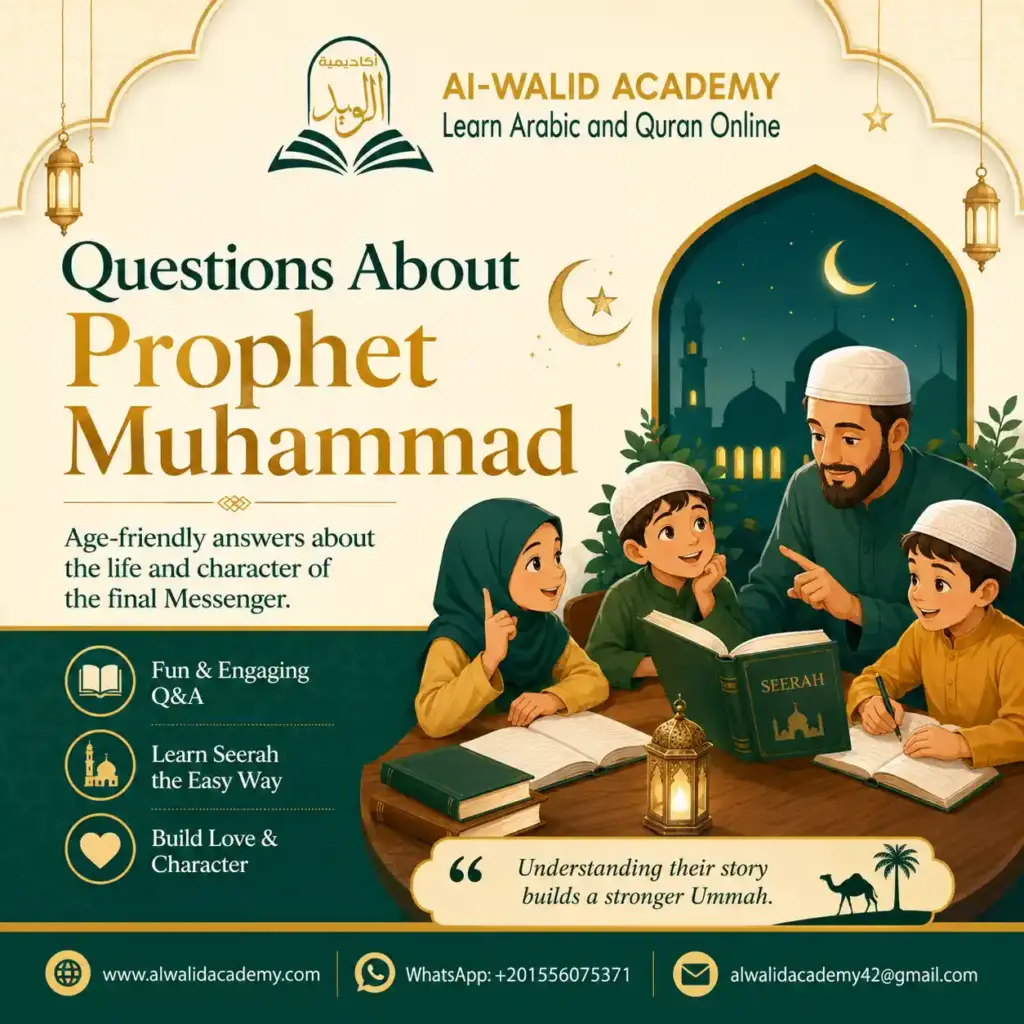
Who is Prophet Muhammad?
The Messenger of Allah, Muhammad, is the Seal of the Prophets and Messengers; he came to enlighten the earth with the message of Islam after corruption and polytheism had become rife. Allah revealed to him a heavenly book, the Holy Qur’an.
Why do Muslims love Prophet Muhammad?
- Muslims love the Prophet Muhammad because he endured great suffering, persecution, constant attempts on his life, and ridicule directed at him and his companions, so that the religion might reach us intact today.
- He was a great example of honesty, integrity and good morals.
- He was humble and fair in his dealings with both the rich and the poor.
- He suffered all kinds of trials in his life and taught us how to deal with them and be patient.
- He constantly urged kindness and charity towards women, children, orphans and the poor.
- He was ever concerned with guiding people and constantly prayed for their well-being, even for those who had wronged him.
- He was compassionate and loving towards his family and supported them in everything.
- He is the one who will intercede for us before Allah on the Day of Judgement and ask Allah to deliver the tormented members of his ummah from the Fire.
- Although he possessed great wealth, he devoted much of it to supporting the poor and those in need.
What did Prophet Muhammad teach us?
The Prophet Muhammad, peace be upon him, taught us all the virtues of humanity, tolerance, patience, love for God Almighty, devotion to Him, and detachment from worldly affairs.
He taught us courage, strength, and steadfastness on the straight path. He taught us to love our families and to show kindness to the poor, the needy, and those in distress.
- At Al-Waleed Academy, we offer a Seerah course designed to provide an in-depth study of the Prophetic Sunnah and to gain a deeper understanding of the life of the Prophet, peace be upon him.
Questions About the Quran
What is the Quran?
The Holy Qur’an is the sacred book of Muslims, which Allah revealed to His Prophet Muhammad, peace be upon him, over a period of 23 years, orally, due to the Arabs’ ability to memorise it perfectly without writing it down.
However, it was compiled in written form during the reign of Abu Bakr al-Siddiq. The Qur’an contains everything Muslims need in terms of laws and rulings pertaining to their religion, stories and lessons from previous peoples, verses about Paradise and Hell, and much more.
Who revealed the Quran?
God, may He be glorified and exalted, through the Archangel Gabriel, the angel entrusted with the revelation, who would descend and impart the noble verses to the Prophet over a period of 23 years
Why is the Quran important?
- The Qur’an is the Word of God Almighty, containing all the rulings and laws He has revealed, thereby ensuring the protection of rights and the establishment of justice.
- The Qur’an contains stories of previous nations and their punishment, whether through torment or a good reward.
- It is the means for those who wish to be addressed by God Almighty.
- It brings us comfort and tranquillity and removes worries from the heart.
- It contains verses and chapters that instil hope and reassurance, such as Surah Ad-Duha.
- Reading the Noble Qur’an brings great reward in the Hereafter.
Don’t miss Al-Walid Academy Quran Memorization Course to learn how to memorise the Holy Quran correctly, with perfect pronunciation and recitation
Look at: Best Online Hifz Program for Children
Questions About the Five Pillars of Islam
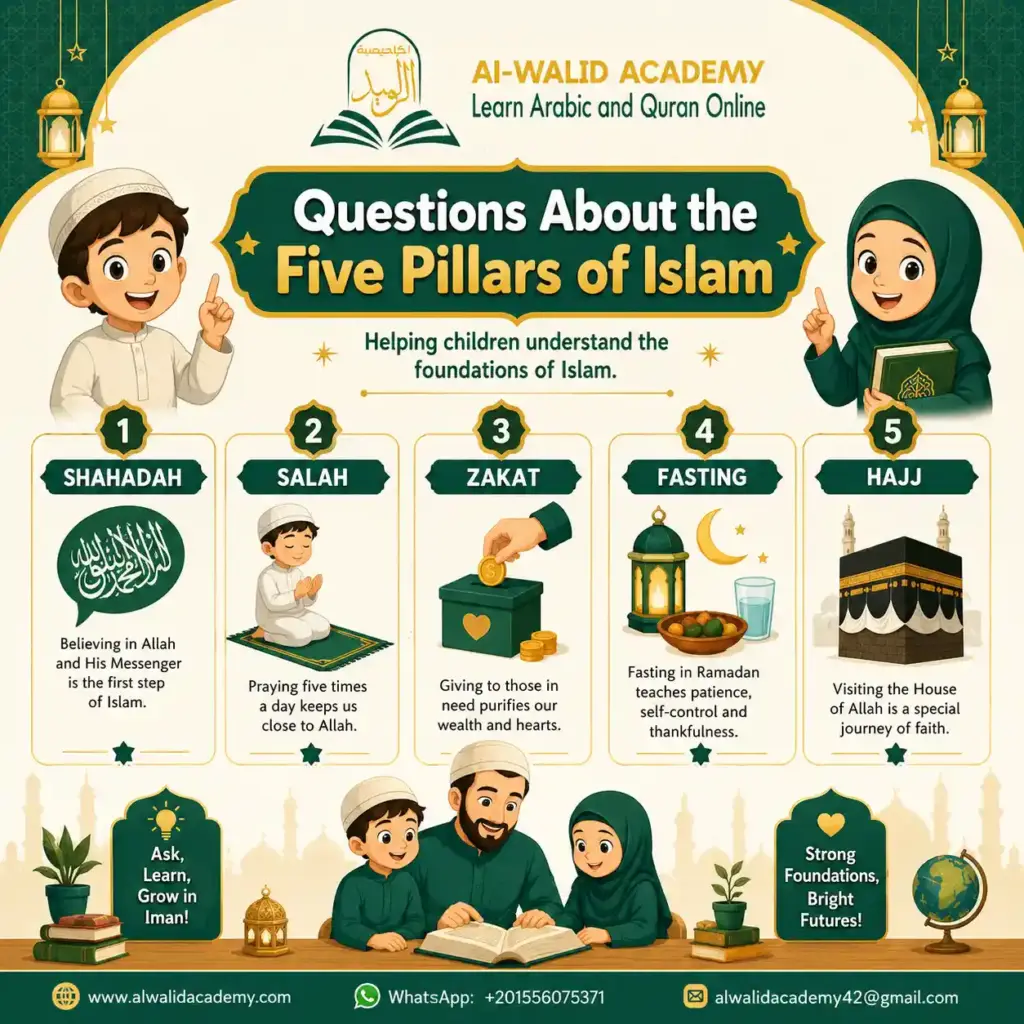
What is Shahada?
The Shahada is the first and most important pillar of Islam; through it, a person affirms the oneness of God and their complete submission to Him. Upon uttering the Shahada sincerely, a person becomes a Muslim. How to pronounce the Shahada means saying the phrase ‘There is no god but God, and Muhammad is the Messenger of God’.
“ لَا إِلَهَ إِلّا الْلَّه مُحَمَدٌ رَسُولُ الْلَّه”
Why do Muslims pray?
Muslims perform five obligatory prayers each day, as these are a duty prescribed by God Almighty and help Muslims feel a constant connection with their Lord.
Furthermore, prayer is the first of the Five Pillars of Islam for which a person will be held accountable upon their death; if it is sound, all their deeds will be sound, God willing, and if it is flawed, all their deeds will be flawed.
Why do Muslims fast in Ramadan?
One of the most common Islamic Questions and Answers For Kids> Fasting during Ramadan teaches us many virtues and instils in us many fine habits:
- It teaches us to control our desires, as we are unable to eat or drink throughout the day until the call to Maghrib prayer is sounded.
- The feeling of hunger, which makes us empathise with the poor and needy.
- Trust in God Almighty; even if the hours of fasting are long, the call to Maghrib will come and it will be time to break the fast. This applies to our lives too: even if times of hardship are long, relief will come.
Read more: Is It Haram to Force Your Child to Read the Quran
What is Zakat?
Zakat is derived from the term ‘tazkiyah’, which means purification. Under this system, Muslims whose wealth reaches a certain threshold contribute a sum of money to the poor and needy.
Zakat differs from sadaqah in that zakat is an obligation, whereas sadaqah is a recommended act. The purpose of Zakat As A Pillar of Islam is to foster social solidarity between the rich and the poor.
What is Hajj?
The Hajj is one of the Five Pillars of Islam and is an obligation for every Muslim who is physically able to perform it.
The Hajj lasts for around five to six days and involves a number of rituals, such as circumambulating the Kaaba, stoning the Jamarat, standing on Mount Arafat, and concluding with the Farewell Tawaf.
Questions About Salah
How many times do Muslims pray each day?
- There are five obligatory prayers to be performed each day: Fajr, Dhuhr, Asr, Maghrib and Isha.
- As for the Sunnah prayers, these include two rak’ahs before Fajr, four before Dhuhr, two after Maghrib and two after Isha.
- There are other prayers, such as Qiyam al-Layl, Duha, and How to Pray Witr Prayer, which carry great reward with Allah, the Almighty, but they are not obligatory.
Why is Salah important?
- Prayer is an important pillar of Islam; it is also the most frequently performed act throughout the day, and the first thing a person is asked about after their death. The importance of prayer
- lies in the fact that it is a daily connection with God Almighty.
- Prayer deters one from immorality and wrongdoing and strengthens one’s moral character
- Adherence to the prescribed prayer times fosters discipline in people and helps them to organise their time.
What do Muslims say in prayer?
- In the first rak’ah, after saying ‘Allahu Akbar’, we recite Surah al-Fatiha, followed by a surah from the Holy Qur’an.
- This is followed by the ruku’, during which we say ‘Subhan Allah al-‘Azim’ three times.
- After rising from the bowing, we say: ‘Sami’ allah leman hamidah’
- We then prostrate and say: ‘Glory be to Allah, the Most High’ three times.
- In the case of a prayer consisting of only two rak’ahs, such as the Fajr prayer, we recite the full Tashahhud, followed by the Tasslim.
- However, when praying more than two rak’ahs, we recite half of the Tashahhud after the first two rak’ahs and the second half upon completion.
Questions About Ramadan
What is Ramadan?
Ramadan is the ninth month of the Hijri calendar and is considered the holiest month for Muslims. During this month, Muslims fast from dawn until the call to prayer at sunset.
They also commit to good deeds such as reading the Qur’an, praying, performing night prayers and helping those in need. Muslims abstain from food, drink and sexual relations.
What is Laylatul Qadr?
- Benefits of Laylatul Qadr is so named because it is on this night that destinies are determined.
- This night is described as one of profound peace and security, during which the angels and the Holy Spirit, our Lord Jibril (peace be upon him), descend to the lowest heaven.
- Righteous and sincere worship for the sake of Allah on this night is equivalent to a thousand months of worship; therefore, Allah and His Messenger have advised us to make the most of it.
- The exact date of Laylat al-Qadr is not specified, but it falls within the last ten nights of Ramadan.
- It is recommended to recite the supplication: ‘O Allah, You are Forgiving and Generous; You love forgiveness, so forgive us.’” الْلَّهُمَّ إَنَّكَ عَغُوٌ كَرِيم تُحِبُ الْعَفْوَ فَاعْفُ عَنَّا”
Questions About the Prophets
Who was the first Prophet?
The first prophet was Adam, peace be upon him, and he was the first human being created by God.
Who was the last Prophet?
The last of the prophets is Muhammad, peace be upon him; he is the Seal of the Prophets and Messengers.
Which Prophets are mentioned in the Quran?
The Qur’an mentions a number of prophets, though it does not list them all; may peace and blessings be upon them all
- Adam
- Idris
- Noah
- Hud
- Salih
- Ibrahim
- Lot
- Ismail
- Isaac
- Jacob
- Joseph
- Shu’ayb
- Job
- Dhu’l-Kifl
- Moses
- Aaron
- David
- Solomon
- Elijah
- Elisha
- Jonah
- Zachariah
- John
- Jesus
- Muhammad
Don’t miss the Islamic Studies Course to gain a deeper understanding of the teachings of our Islamic faith
Questions About Islamic Manners
Why should we tell the truth?
We must speak the truth, for truth leads to salvation, strengthens our relationship with God Almighty, and boosts our self-confidence and our ability to face challenges.
Why should we be kind to parents?
Because they are the ones who raised us and looked after us, and the deeds most beloved to God Almighty are praying at the appointed times, followed by honouring one’s parents.
Why should we say, Bismillah?
We should say ‘Bismillah’ before undertaking any task, in order to seek blessings and guidance; it also strengthens our relationship and connection with God Almighty on a lasting basis and helps us to face life and its challenges.
Questions About Jannah and Jahannam
What is Jannah?
Paradise is the abode of eternal bliss that God Almighty has prepared for the righteous who obeyed His commands and avoided His prohibitions during their lives. In Paradise there is everlasting happiness and comfort, and there is no sorrow or pain.
What is Jahannam?
Hell is the place of punishment prepared by God Almighty for those who have disobeyed His commands and failed to avoid His prohibitions without repenting; there, the guilty will be punished in proportion to their sins, and then they will be admitted to Paradise once more.
How can a Muslim enter Jannah?
- The first pillar of entry into Paradise is faith
- Through which a person believes that God is the One and Only God, with no partner
- Believes in the angels, the prophets, the messengers and the Holy Scriptures
- Believes in destiny, both its good and its evil.
- The Five Pillars of Islam are:
- The Shahada
- Prayer
- Fasting
- Zakat
- The Hajj to the Kaaba for those who are able.
- Treating others with kindness and courtesy, and upholding good morals
- Constant repentance and seeking forgiveness, so that sins may be reduced and replaced with good deeds.
Why Islamic Questions and Answers Help Kids Learn
- Because it simplifies complex religious concepts based on the questions children ask and are keen to have answered.
- It fosters curiosity and a love of learning in children.
- It builds their confidence and deepens their interest in learning about their faith.
- It strengthens family bonds between parents and children.
Learn Islam for Kids with Al-Walid Academy
Al-Waleed Academy is distinguished by its unique teaching approach, particularly for Islamic Questions and Answers For Kids children, as:
- We offer a professional educational programme tailored to children of all ages.
- We rely on interactive methods that help make the learning experience more enjoyable and easier for children to grasp.
- Our educational programmes introduce children to Islamic beliefs, the pillars of Islam, and the stories of the prophets through clear, engaging, and age-appropriate lessons.
- We focus on instilling virtuous Islamic values and good behaviour that children should become accustomed to from a young age.
- Complete safety for the child, as the educational journey takes place under the supervision of qualified professionals.
- We maintain regular contact with parents to monitor progress step by step.
That is why Al-Walid Academy is the ideal choice for you and your children.
Conclusion
In conclusion, we can say that this simple and clear approach to presenting questions and answers greatly helps children to understand their religion correctly, whilst at the same time being suited to their level of understanding. *Islamic Questions and Answers For Kids* fosters their love for Allah the Almighty and His Messenger, and instils Islamic values in them from an early age.
FAQS
Why do Muslims pray five times a day?
Muslims pray five times daily to remember Allah, thank Him, ask for guidance, and maintain a strong connection with Him.
Why do Muslims fast during Ramadan?
Muslims fast during Ramadan to obey Allah, develop patience and self-control, appreciate His blessings, and remember people in need.
What does halal mean?
Halal means something that Islam permits. It can refer to food, actions, earnings, and choices that follow Islamic teachings.
Can children make dua?
Yes. Children can make dua at any time and ask Allah for help, guidance, forgiveness, and anything good.
How should Muslim children treat their parents?
Muslim children should respect their parents, speak kindly to them, follow their good instructions, and help them whenever possible.
Why should children learn Islamic manners?
Islamic manners teach children to be truthful, patient, respectful, generous, and caring toward family members and other people.
What should Muslim children learn first?
Children can begin by learning about Allah, the Five Pillars of Islam, short surahs, daily duas, basic Salah, and good Islamic manners.