

A well-planned Summer Arabic Learning Schedule for Kids helps children maintain their progress while making learning enjoyable rather than stressful.
Whether your child is learning Modern Standard Arabic, Quranic Arabic, or conversational Arabic, this guide will help you design a practical learning plan that fits your family’s schedule.
Summer Arabic Learning Schedule for Kids: A Complete Weekly Plan
A successful Summer Arabic Learning Schedule for Kids doesn’t require hours of studying every day. In fact, children often learn Arabic more effectively through brief, consistent lessons that become a regular part of their everyday schedule.
A balanced weekly schedule might include:
| Day | Main Focus |
| Monday | Arabic letters and pronunciation |
| Tuesday | Reading simple words and stories |
| Wednesday | Vocabulary building and speaking |
| Thursday | Writing practice |
| Friday | Quran reading or listening practice |
| Saturday | Fun Arabic games and review |
| Sunday | Family Arabic conversation and rewards |
Keeping activities varied prevents boredom while reinforcing every language skill. Parents can also adjust the schedule depending on the child’s age and learning level.
You can greatly benefit from the Learning Arabic for Beginners course offered by Al-Waleed Academy; contact us now.
Why Kids Lose Arabic Skills During Summer Break

Many parents notice that their children struggle to remember Arabic words or read fluently after a long vacation. Without regular practice, language skills naturally fade over time. A consistent Summer Arabic Learning Schedule for Kids helps prevent this “summer learning loss.”
Several factors contribute to losing Arabic skills:
- Limited exposure to Arabic at home.
- Spending more time on entertainment than educational activities.
- Lack of reading practice.
- No opportunities to speak Arabic regularly.
- Forgetting pronunciation rules without review.
Children who practice Arabic for just 20–40 minutes daily are far more likely to retain what they learned during the school year. Even simple activities like reading bedtime stories or labeling household objects in Arabic can make a noticeable difference.
How to Build an Arabic Learning Routine That Kids Can Follow
Creating a Summer Arabic Learning Schedule for Kids starts with building habits that are realistic and enjoyable. The routine should fit naturally into the family’s daily life rather than feeling like extra schoolwork.
Consistency is much more important than studying for long hours. Small daily improvements lead to significant progress over the course of the summer.
Set a Clear Daily Arabic Goal
Each lesson should have one simple objective.
For example:
- Learn three new Arabic words.
- Read one short paragraph.
- Practice one Arabic letter.
- Memorize one daily expression.
- Write five simple words.
Achievable goals help children feel successful and motivated. Celebrate each accomplishment with praise or a simple reward.
Keep Lessons Short and Consistent
Young children have shorter attention spans, making brief lessons more effective. An ideal Summer Arabic Learning Schedule for Kids includes sessions lasting between 20 and 40 minutes depending on age.
Instead of studying once a week for several hours, encourage children to practice every day. Daily repetition strengthens memory and improves confidence.
Parents can divide learning into several mini-sessions throughout the day instead of completing everything at once.
Mix Reading, Speaking, Writing, and Listening
Children learn languages faster when multiple skills are practiced together. A balanced Summer Arabic Learning Schedule for Kids should include activities that develop all four language skills.
Examples include:
- Reading beginner Arabic books.
- Listening to Arabic stories.
- Speaking simple daily phrases.
- Copying short Arabic sentences.
- Playing vocabulary games.
- Watching educational Arabic cartoons.
Changing activities every few minutes keeps children engaged and reduces boredom.
Daily Summer Arabic Learning Schedule for Kids

A simple daily routine can make Arabic learning easier to maintain during summer. This Summer Arabic Learning Schedule for Kids takes just 35 minutes a day and gives children regular practice in reading, speaking, vocabulary, and review.
The routine is flexible and can be completed in the morning, afternoon, or evening based on your family’s schedule.
10 Minutes for Arabic Letters and Sounds
Start each session by reviewing letters, pronunciation, and phonics.
Children can:
- Practice recognizing letters.
- Match letters with pictures.
- Repeat letters sound aloud.
- Trace letters on paper.
- Use alphabet flashcards.
This warm-up strengthens pronunciation and prepares children for reading practice.
Look at: How to Teach Arabic Letters to Kids
10 Minutes for Reading Practice
Reading every day builds fluency faster than almost any other activity. During your Summer Arabic Learning Schedule for Kids, encourage children to read material appropriate for their level.
Good reading materials include:
- Beginner storybooks.
- Picture books.
- Short dialogues.
- Simple Islamic stories.
- Quranic words for advanced learners.
Parents should read together with younger children and gently correct pronunciation without interrupting too often.
10 Minutes for Vocabulary and Speaking
Vocabulary becomes meaningful only when children actually use it.
Choose a theme each day, such as:
- Animals
- Colors
- Family
- Food
- School
- Nature
- Weather
Teach five new words and encourage children to create simple sentences using them. Asking everyday questions in Arabic also helps build speaking confidence.
5 Minutes for Review and Rewards
End each learning session by reviewing what was covered. A successful Summer Arabic Learning Schedule for Kids always includes positive reinforcement.
Simple reward ideas include:
- Sticker charts.
- Extra playtime.
- Choosing the bedtime story.
- Healthy treats.
- Points toward a weekend activity.
Rewards don’t have to be expensive. Consistent encouragement helps children associate Arabic learning with success and enjoyment.
4-Week Summer Arabic Learning Schedule for Beginners
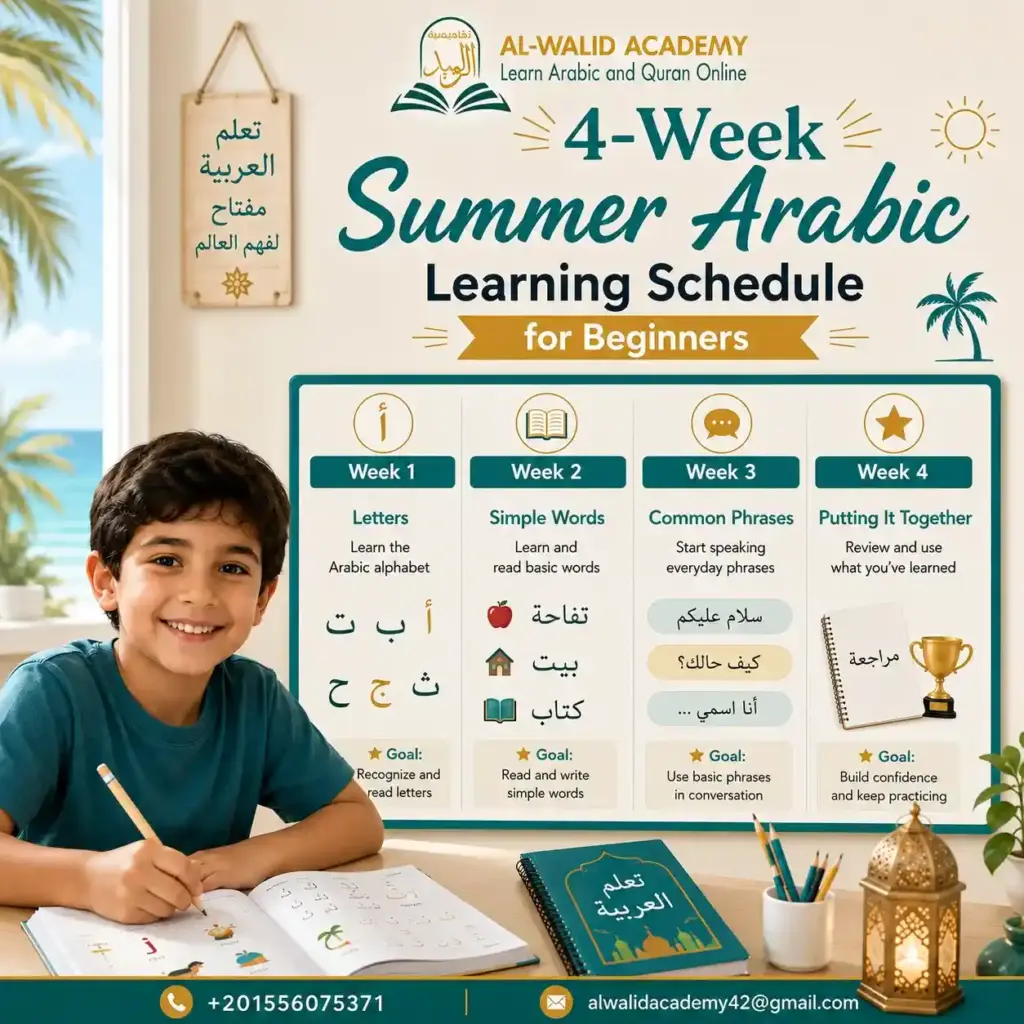
If your child is just starting to learn Arabic, a structured Summer Arabic Learning Schedule for Kids makes learning feel manageable and rewarding. Breaking the journey into weekly goals helps children master one skill before moving to the next. Parents can track progress while celebrating small achievements, keeping motivation high throughout the summer.
Week 1: Review Arabic Letters and Pronunciation
The first week focuses on building a strong foundation. Children should review the Arabic alphabet, recognize letter shapes, and practice proper pronunciation. Activities such as alphabet flashcards, tracing worksheets, and letter matching games make learning interactive. By the end of the week, children should feel confident identifying every letter.
Week 2: Read Simple Arabic Words
Once children recognize the letters, they can begin blending sounds into simple words. Introduce familiar vocabulary related to colors, animals, family members, and everyday objects. Reading short words aloud improves fluency while helping children connect pronunciation with meaning.
Week 3: Build Short Arabic Sentences
Now it’s time to combine vocabulary into complete thoughts. Encourage children to practice simple greetings, introduce themselves, describe objects, and answer basic questions. Speaking these sentences daily builds confidence and strengthens communication skills.
Week 4: Improve Fluency and Confidence
The last week focuses on reviewing everything learned before. Read short stories together, practice conversations, and revisit challenging vocabulary. A successful Summer Arabic Learning Schedule for Kids ends with children feeling more comfortable using Arabic in everyday situations rather than simply memorizing words.
If your kids intrested about quran cheak Summer Quran Classes for Kids
8-Week Summer Arabic Learning Schedule for Faster Progress
Families looking for more comprehensive learning can extend their Summer Arabic Learning Schedule for Kids to eight weeks. This longer plan allows children to build stronger reading, writing, listening, and speaking skills while avoiding information overload.
A suggested eight-week progression includes:
- Weeks 1–2: Arabic alphabet, pronunciation, and phonics.
- Weeks 3–4: Vocabulary expansion and beginner reading.
- Weeks 5–6: Sentence building, grammar basics, and writing practice.
- Weeks 7–8: Reading short passages, speaking exercises, Quranic vocabulary, and review.
Children who follow an eight-week schedule consistently often begin reading independently and expressing simple ideas in Arabic with greater confidence.
Arabic Learning Schedule by Age Group
Every child learns differently. The ideal Summer Arabic Learning Schedule for Kids should match the learner’s age, attention span, and language level.
Arabic Schedule for Ages 4–6
Young children learn best through play, such as songs, alphabet games, storytelling, and colorful flashcards, and sessions should last 15–20 minutes. Activities should focus on recognizing letters, repeating sounds, and learning basic vocabulary.
Arabic Schedule for Ages 7–10
Children in this age group can concentrate for 25–35 minutes. Their schedule should include reading simple books, writing short words, practicing conversations, and completing fun worksheets. Interactive games and rewards continue to play an important role in maintaining motivation.
Arabic Schedule for Ages 11–14
Older children can handle 40–60 minutes of structured learning. They should work on reading comprehension, grammar, writing paragraphs, expanding vocabulary, and improving conversational Arabic. Helping children read Arabic on their own and express their thoughts through simple writing activities can greatly improve their language skills over time.
Summer Arabic Learning Activities Kids Actually Enjoy
One of the best ways to make a Summer Arabic Learning Schedule for Kids successful is by incorporating activities that children genuinely enjoy. Fun experiences help children associate Arabic with excitement rather than obligation.
Arabic Flashcards and Word Games
Flashcards are perfect for reviewing vocabulary quickly. Turn them into matching games, memory challenges, or timed competitions to keep children engaged. Board games and online quizzes also reinforce vocabulary while encouraging healthy competition.
Quran Arabic Reading Practice
Reading selected Quranic words and short surahs helps children improve pronunciation while strengthening their connection with the Arabic language. Parents can focus on proper articulation (Tajweed for advanced learners) and explain simple meanings to increase understanding.
Arabic Story Time
Reading age-appropriate Arabic storybooks introduces children to new vocabulary naturally. Ask questions about the story afterward to encourage listening comprehension and speaking practice. Storytelling also improves imagination and reading confidence.
Speaking Practice with Daily Phrases
Encourage children to use Arabic during everyday routines. Simple expressions like greetings, polite phrases, asking for food, or describing daily activities help transform passive vocabulary into active communication. The more children speak Arabic , the more confident they become.
Ask for a Quranic Arabic Course from Al Walid Academy and get a fruitful summer vacation.
How Online Arabic Classes Help Kids Stay Consistent in Summer
Even with the best Summer Arabic Learning Schedule for Kids, some families find it challenging to maintain consistency without guidance. With online Arabic classes, children can follow a clear study plan, receive support from experienced teachers, and continue learning consistently from home in a comfortable and focused environment.
Qualified teachers can personalize lessons according to each child’s level, provide immediate feedback, and keep students motivated through engaging activities. Live classes also create opportunities for speaking practice, which is often difficult to achieve through self-study alone.
Many online programs combine reading, writing, listening, speaking, and Quranic Arabic in one curriculum, making them a convenient solution for busy families during the summer months.
Enroll in Online Arabic Conversation Classes at Al Walid Academy and get the skills needed for fluent Arabic conversation.
Sample Weekly Arabic Study Timetable for Kids
Here’s a simple timetable you can adapt to your family’s routine. A flexible Summer Arabic Learning Schedule for Kids helps children balance learning with outdoor activities, travel, and relaxation.
| Day | activities | Time |
| Monday | Letters and pronunciation | 30 minutes |
| Tuesday | Reading practice | 30 minutes |
| Wednesday | Vocabulary and speaking | 30 minutes |
| Thursday | Writing exercises | 30 minutes |
| Friday | Quran reading | 30 minutes |
| Saturday | Arabic games and review | 30 minutes |
| Sunday | Story time and family conversation |
Remember that consistency matters more than the length of each session. Even short daily lessons can produce significant improvements over the course of the summer.
Arabic lessons for kindergarten will be a great choice for your children.
Common Mistakes Parents Make with Summer Arabic Learning
Parents often have the best intentions, but certain habits can reduce the effectiveness of a Summer Arabic Learning Schedule for Kids.
Some common mistakes include:
- Expecting children to study for long hours.
- Skipping practice for several days at a time.
- Focusing only on memorization instead of communication.
- Ignoring speaking and listening activities.
- Using materials that are too difficult.
- Forgetting to celebrate progress and achievements.
Keeping lessons enjoyable, realistic, and consistent will lead to much better long-term results than pushing children too hard.
Teach Me How to Speak Arabic with Al-Walid Academy through interactive online lessons, expert native teachers, flexible schedules, and personalized learning for every level.
Start a Structured Summer Arabic Program with Al-Walid Academy
A well-designed Summer Arabic Learning Schedule for Kids helps children retain their language skills, build confidence, and enjoy learning throughout the summer break. Whether your child is learning the Arabic alphabet, improving reading fluency, or developing conversational skills, consistency is the key to lasting success.
At Al-Walid Academy, experienced Arabic teachers provide personalized online lessons that combine reading, writing, speaking, listening, and Quranic Arabic in an engaging learning environment. Flexible scheduling, interactive activities, and individualized instruction ensure that every child progresses at their own pace while staying motivated.
Conclusion
Creating a Summer Arabic Learning Schedule for Kids is one of the best ways to keep children engaged with the Arabic language during the school break.
Enroll your child in Al-Walid Academy today and turn this summer into a season of meaningful Arabic learning, lasting confidence, and continuous progress.
FAQS
What is the timeline for learning Arabic?
The timeline depends on a child’s age, learning frequency, and goals. With consistent practice of 20–30 minutes a day, most kids can learn the Arabic alphabet in 1–3 months, begin reading simple words in 3–6 months, and develop basic conversational skills within 6–12 months.
How old should kids be to learn Arabic?
Children can start learning Arabic as early as 3–4 years old through songs, games, and storytelling. Ages 4–7 are ideal for building strong pronunciation and language foundations, although children can successfully begin learning at any age.
How to teach Arabic to kids?
Teach Arabic through short, engaging daily lessons that include reading, speaking, listening, and writing. Use flashcards, storybooks, songs, educational games, and simple conversations, and encourage consistent practice with positive reinforcement and rewards.