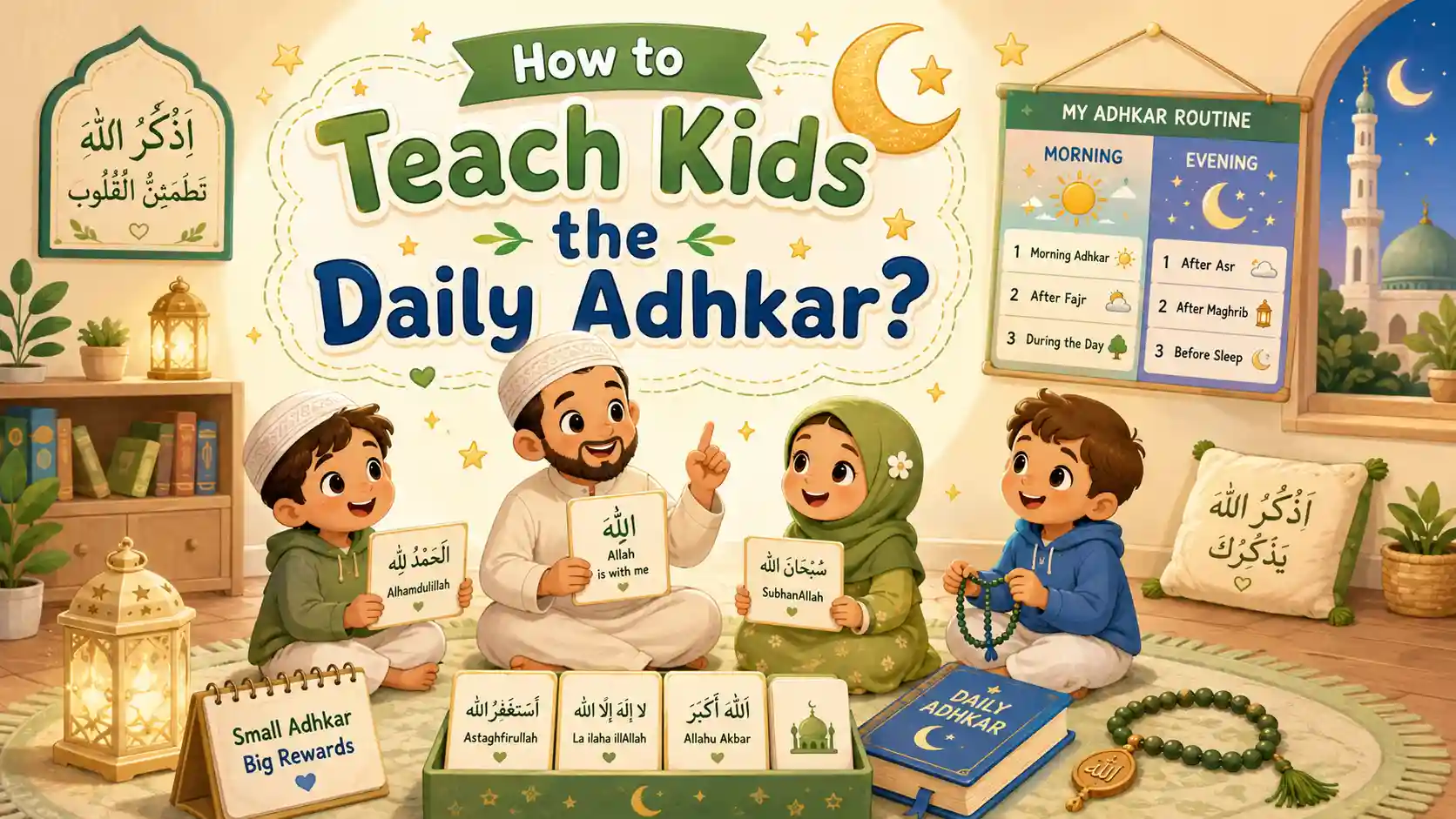
Teaching your child to remember Allah from a young age helps them fulfill their religious obligations and makes acts of worship and remembrance an integral part of their daily and spiritual routine; no day passes without them.
Therefore, we will present to you the best methods for “How to Teach Kids the Daily Adhkar” from Al-Walid Academy, as well as the mistakes most parents make and how to correct them.
What “Daily Adhkar” Actually Means for a Child
For adults, the morning and evening supplications serve as a means of protection; by reciting them, Allah surely shields us from the evils of this world, people, and the devils. They are not merely prayers to be recited, but rather a combination of verses from the Quran, remembrance of Allah the Exalted, and supplication to Him.
As for children, the situation is different. Between school, homework, and leisure activities, the practice can seem a bit strange to them because they do not fully grasp its importance. This is where parents play a crucial role in teaching this to their children.
- Don’t miss the opportunity to enroll in the Islamic Studies Course we offer at Al-Walid Academy and help your children develop a deeper connection to and understanding of their religion.
The Difference Between Adhkar and Dua
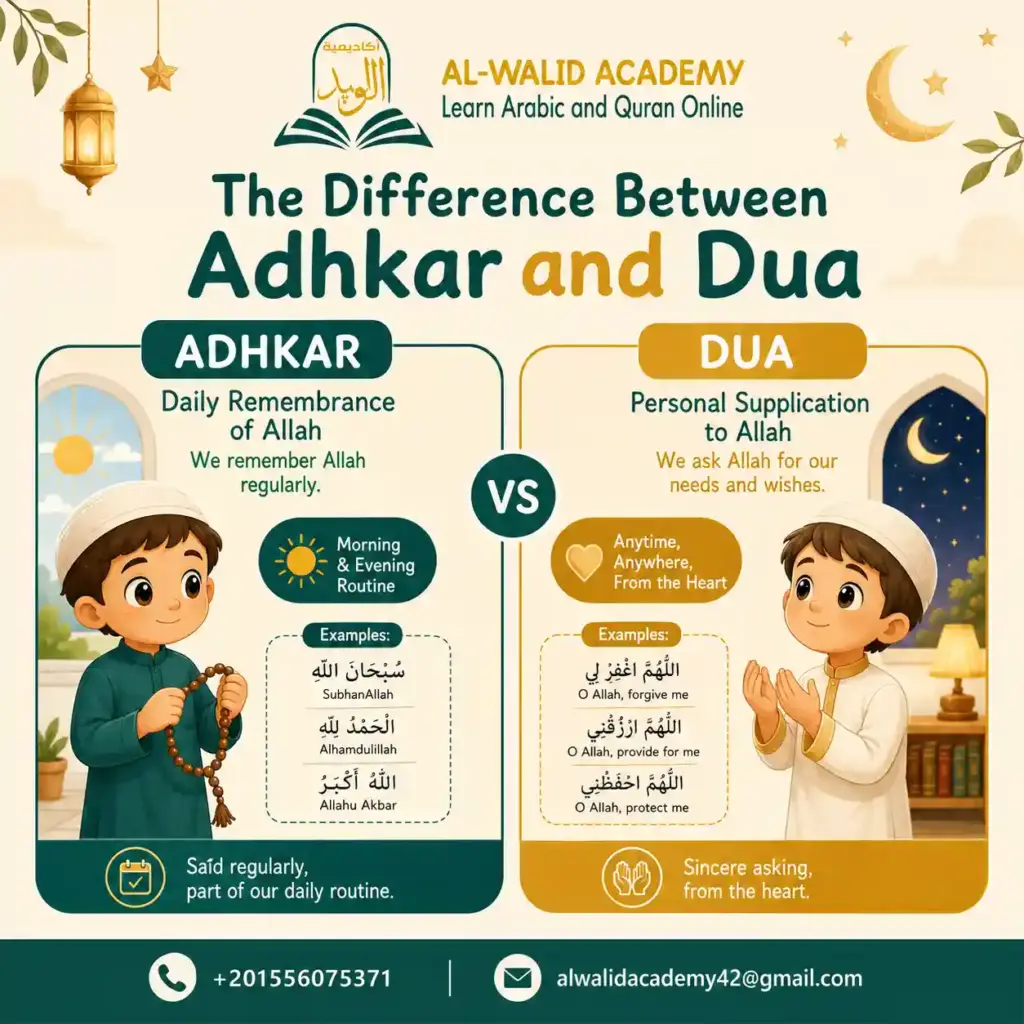
Adhkar and Dua are acts of worship of great significance that have a powerful and effective impact on our relationship with God Almighty and also help facilitate the affairs of our lives, but each has a different role.
| Adhkar | Dua |
| Dhikr is an act of worship associated with specific times, such as morning and evening dhikr, or with specific activities, such as dhikr before sleeping or before eating. Therefore, dhikr can be considered a spiritual practice that strengthens us in our daily activities. | Dua is an act of worship that Allah, the Exalted, loves; indeed, He becomes angry with those who do not ask. For it is Allah, the Exalted, who created us, and it is in His power to grant us what we desire. Therefore, supplication is intrinsically linked to human needs, whether material or spiritual. |
Why Should Children Learn Daily Adhkar?
How to Teach Kids the Daily Adhkar and encouraging them to do so consistently is important, as it helps to:
Strengthening the Relationship with God Almighty
Children form attachments and grow to love quickly, especially when that attachment is to God Almighty. How to Teach Kids the Daily Adhkar makes them remember God in various situations throughout their day: before and after meals, upon waking up, before going to sleep, and even when they feel afraid, among other times.
Developing Emotional Resilience
Children should get into the habit from an early age of turning to Allah the Almighty in all situations, so that their trust in Him and their reliance on Him may grow; the effects of this will become apparent as they grow older and face various life circumstances.
Cultivating Positive Habits
When children constantly mention the name of Allah, the Exalted, it continually teaches them that Allah is always with us and that He is the closest to each of us. This deepens their attachment to Allah, the Exalted, as well as their reverence for Him.
Following the Prophetic Sunnah
The Messenger of Allah, peace be upon him, was constantly mindful of Allah, the Exalted, in all places and at all times; paying attention to putting this into practice and teaching it to children from a young age is following the Prophetic Sunnah in Seerah.
Best Age to Start Teaching Kids the Daily Adhkar

How to Teach Kids the Daily Adhkar is not merely a matter of religious instruction; rather, it is a spiritual path that must be instilled from an early age.
- Ages 2 to 4: You can start with simple remembrances of God, such as saying “Salamu alaykum” when entering the house or “Alhamdulillah” after finishing a meal.
- Ages 5 to 7: You can start with simple Adhkar, such as the morning and evening supplications and the supplication for leaving the house.
- Ages 8 to 10: You can begin teaching longer supplications while explaining their meanings, such as the supplication we recite when getting into a car.
- Adolescents and Young Adults: Focusing on Contemplation and a Deep Understanding of These Adhkar and Their Meanings.
Teaching dhikr is supported by memorizing the Holy Quran and mastering its recitation, so have your children join us in the Quran Memorization Course before all the spots are filled.
Read about: How to Raise Muslim Children in the West
Why the Habit Collapses by Week Three
There are some mistakes we make when teaching our children the dhikr that negatively affect their progress, so we must avoid them and make sure to correct them.
The First Problem: Treating Dhikr as a Daily Obligation
Young children do not like rules or obligations, so one of the biggest problems in How to Teach Kids the Daily Adhkar is when parents treat dhikr as a mandatory daily obligation.
The Solution
Recite dhikr in a gentle manner, with parents participating, upon waking up, before bedtime, and during other activities—without treating it as an obligation.
The Second Problem: Trying to Have Young Children Memorize All the Dhikr
Sometimes parents want to teach their children everything, but this may not be in line with the children’s ability to understand and memorize.
The Solution
Start with simple dhikr, such as the dhikr for waking up, before going to sleep, before eating, or when leaving the house.
The Third Problem: Seeking Reward Rather Than Consistency
Rewards are considered one of the most important motivational tools that have a positive impact on children’s learning. However, sometimes parents focus on them to such an extent that the child associates the task with the reward, so that the task is not completed without it.
The Solution
- Offer rewards at infrequent and irregular intervals so that the child does not associate receiving them with what they do.
- Try to convey the spiritual meaning behind the dhikr so that the child connects with it.
Look at: Islamic Questions and Answers For Kids
How to Teach Kids the Daily Adhkar?
Establishing a routine requires a great deal of effort, especially when the challenge involves children’s religious practices.
-
Start with the meaning before memorizing
The spiritual meaning that children grasp, even if it is simple given their young age, is what makes them more attached to the dhikr.
For example
Instead of simply reciting the bedtime supplication, “In Your name, O Allah, I lay down, and by You I rise,” بِاسْمِكَ اللَّهُمَّ وَضَعْتُ جَنْبِي وَبِكَ أَرْفَعُهُ.
We explain its meaning to them: that Allah is the One who has the power to put us to sleep and then wake us up again.
-
Incorporating Remembrance of God into Daily Routines
Remembrance of God is essentially part of our daily routine, so we should incorporate it in a subtle and playful way that fits with children’s daily situations and habits.
-
Parental Involvement
Parental involvement makes How to Teach Kids the Daily Adhkar more exciting and impactful.
For example, instead of telling your children, “Don’t forget to recite your bedtime supplications,” start by reciting them aloud and have them repeat after you—this makes the experience more fun and impactful.
- Ensure that your children master the Arabic language and correct pronunciation through the Arabic Classes Online we offer at Al-Walid Academy.
Read more about: Islamic Moral Stories for Children
Morning and Evening Adhkar for Kids
There are some simple prayers with profound meanings that can be taught to children in a way that is appropriate for their young age.
Morning Adhkar
| Adhkir | Meaning | Importance |
| “ الْحَمْدُ لِلَّهِ الْلَّذِي أَحْيَنَا بَعْدَمَا أَمَتَنَا وَإِلَيْهِ النُّشُور” | Let’s start our day by praising God for giving us life so we can live another day in which we can play and learn. | From an early age, children learn the importance of thanking God for all His blessings, even if they have grown accustomed to them. |
| ” أَصْبَحْنَا وِأَصْبَحَ الْمُلْكُ لِلَّهِ” | God has granted us the opportunity to begin a new day in His universe | From the very beginning of each day, a child learns to submit to God and put their trust in Him. |
| ” بِسْمِ الَّلهِ الَّذي لَا يَضُرُّ مَعض اسْمِهِ شَئٌ فِي الْأَرْضِ وَلَا فِي الَّسَمِاءِ وَهُوَ ال” | In the name of God, the Most High, and may He protect us from the evils of this world, whether on earth or in heaven. | From an early age, a child learns to put their trust in God and not to be afraid, for God protects them from all evil. |
Evening Adhkar
| Adhkir | Meaning | Importance |
| “أَمْسَيْنَا وَأَمْسَى الْمُّلْكُ لِلَّهِ” | We’ve reached the end of the day, so thank God for protecting us and providing for us. | The child learns complete submission to God Almighty and the necessity of placing one’s trust in Him. |
| Reciting Surah Al-Ikhlas Meaning in English, Surah Al-Nas, and Surah Al-Falaq | These three suras are our personal guardians who protect us while we sleep and make our dreams happy. | The child learns how to turn to God for protection. |
| “ بِاسْمِكَ رَبِّي وَضضعْتُ جَنْبِي وَبكَ أَرْفَعُهُ” | We will go to sleep and remain safe and secure because of God’s presence; for He never sleeps, and He protects us. | A child learns that protection and safety come from the presence of God Almighty, and finds comfort in remembering Him. |
What Role the Quran Plays in Their Adhkar
How to Teach Kids the Daily Adhkar include many verses, such as Ayat al-Kursi and the closing verses of Surah al-Baqarah, as well as surahs such as al-Samad, al-Nas, and al-Falaq.
Consequently, for a child who has a background in memorizing the Holy Quran, this becomes much easier; rather than memorizing surahs from the Quran as a separate assignment, it becomes more like a review.
Fun Ways to Help Kids Memorize Daily Adhkar
- Make remembrance of God part of their daily routine: Keep the remembrance of God constantly in their minds, hearts, and on their tongues in all situations.
- Use interactive books and games: This helps encourage children and track their daily progress; interactive videos also have a significant impact.
- Set a good example: Children learn not by commands but by imitation and example, so start with yourself before instructing your children.
- Rewards and prizes: These help encourage children and make them more eager and enthusiastic about progress and achievement.
What to Do When They Resist
Resistance and rejection mean that the approach must be changed, and when it comes to religious and spiritual practices, it is essential to proceed with caution and work to change the approach by:
- Devising new teaching methods.
- Offering rewards that have a greater impact on children.
- Taking a break for a while and then starting over.
Common Mistakes Parents Make When Teaching Adhkar
There are some mistakes parents make when teaching their children how to Teach Kids the Daily Adhkar, which must be avoided and corrected
- Treating it as a duty: Instead of teaching the child in an encouraging way, the recitation of the dhikr is treated as an obligation, and the child is punished if he or she fails to perform it.
- The “All or Nothing” Mindset: Sometimes children are unable to complete their daily prayers due to boredom, fatigue, or even a change in mood; parents should accept this and continue to encourage them.
- Using Adhkar as punishment: For example, if a child misbehaves, his father tells him to ask Allah for forgiveness a certain number of times, so the child feels that supplications are a form of punishment.
- Lack of Role Models: Children learn by imitating their parents; forcing them to recite prayers or perform any other act without setting an example for them causes them to lose the desire to undertake and carry out such actions.
- Ignoring the Explanation of the Meaning: Every dhikr has a deep spiritual meaning and impact; children should be taught about it as much as possible, in a way appropriate for their age, so that they may become more attached to and connected with the dhikr.
How Online Islamic Classes Help Kids Learn Daily Adhkar
- Teaching Using a Proper Academic Approach: The dhikr is broken down into simple parts with a gradual and easy sequence that helps the child learn without fatigue or struggle.
- Connecting the Adhkar to real-life situations: The child understands how each supplication relates to the activities they perform throughout the day, so that reciting them becomes a natural part of their daily routine.
- Regular repetition aids memorization: Regular lessons allow for continuous review and repetition, making it easier for the child to remember them without relying on rote memorization.
- Pronunciation correction with a specialized teacher: Correction is a cornerstone of progress and mastery; therefore, working with a specialized teacher helps your child master the material correctly.
- Making Learning More Interactive: The lessons use interactive learning methods, such as quizzes and activities, which help make memorization an enjoyable experience and encourage the child to continue.
- Regular Progress Tracking: In our online Islamic lessons, we conduct periodic assessments to determine the child’s progress and identify exactly what they need to improve further.
Start Teaching Your Child Daily Adhkar with Al-Walid Academy
At Al-Walid Academy, we don’t just teach children about Islam through the lens of worship alone; rather, we strive to ensure that each child develops a distinct Muslim identity.
At Al-Walid Academy, we stand out for the following:
- We have a select group of outstanding teachers in all subjects, all certified by reputable institutions
- Extensive experience in teaching children and managing online classes and courses
- We use the best teaching methods, integrating technology and audio-based learning to achieve the best results
- Regular follow-ups with parents to understand their role and how they can support their children at home
- Periodic exams to assess students’ progress and identify areas for improvement
- A free trial class before enrollment to provide a deeper understanding of our curriculum and learning plan.
Conclusion
How to Teach Kids the Daily Adhkar is not merely about memorizing a set of supplications and Quranic verses; rather, it is the hidden lifeline we leave with our children to help them remember God at all times a talisman for giving thanks for His blessings, seeking salvation in times of difficulty, and seeking forgiveness for sins and mistakes.
FAQs
Should a child learn the full meanings of the dhikr?
A child is not expected to understand every meaning from a young age, but we should try to convey the meaning in a way that is appropriate for his or her intellectual abilities and level of comprehension.
How much time should be spent reciting the adhkar daily?
Just a few minutes are enough for a child, and reciting the adhkar can be incorporated into the daily routine without having to sit down and set aside a specific time.
At what age should children start learning daily duas?
Children can start learning simple daily duas from around age 3 or 4 through listening, repetition, and short phrases. At this age, the goal is not perfect memorization, but helping them become familiar with remembering Allah in daily life.
Should children learn the meaning of duas too?
Yes. Children should learn the meaning of duas in a simple way so they understand what they are saying. Even a short explanation can help them feel more connected to the dua and use it with sincerity.
What are the most important daily duas every child should know?
Children can start with simple duas such as the dua before eating, after eating, before sleeping, waking up, entering and leaving the home, and basic morning and evening adhkar. These are easy to connect with daily routines.
How can parents make learning duas fun for kids?
Parents can use flashcards, colorful charts, short audio repetition, rewards, bedtime practice, and real-life moments. Making dua part of daily habits is more effective than turning it into a difficult memorization task.
How long should the daily adhkar routine take with a young child?
For young children, 5 to 10 minutes a day is enough. A short, consistent routine works better than a long session that makes the child feel bored or pressured.
Should the adhkar be recited only in Arabic, or is translation enough at first?
It is best to gradually teach children the adhkar in Arabic, while also explaining the meaning in their own language. Translation helps them understand, but Arabic helps them connect with the original words of the dua.
My child memorizes the words but doesn’t seem to understand them — does that matter?
Memorization is a good first step, but understanding should come gradually. Parents can explain one small meaning at a time, so the child learns that duas are not just words to repeat, but a way to remember Allah and ask for His help.