
Detached pronouns are one of the fundamental components of sentences in the Arabic language; although they may seem difficult to some at first, as one progresses in their studies, they become easier and more enjoyable. In this article, we will explore the concept of Detached pronouns in Arabic and the difference between them and attached pronouns, with illustrative examples from the Qur’an and the Arabic language for practical application.
What Are Detached Pronouns in Arabic?
Separate or independent pronouns are pronouns that appear separately within a sentence, a pronoun is a word that takes the place of a noun and is often used to emphasise the subject, depending on the type and context of the sentence.
Definition of Detached Pronouns
These are constructed nouns used to emphasise the subject, who may be the speaker, an absent person, or the addressee. Although they are not essential to the sentence, they play a significant role in the Arabic language and help to clarify the meaning.
Why They Are Called “Detached”
Separate pronouns are so called because they stand alone as a constituent of the sentence and are not attached to any other word, whether a noun or a verb.
Difference Between Detached and Attached Pronouns
Pronouns in Arabic are divided into two types: separate and attached. Although both are important, they are used differently in sentences.
| Basis for Comparison | Detached Pronouns | Attached Pronouns |
| In terms of form | The Detached Pronouns is written separately within the sentence and does not join other words. | It never appears on its own in a sentence, but is always linked to the word that precedes it. |
| In terms of independence | Can be used independently in writing and speaking. | Not standalone and not available separately. |
| In terms of its position in the sentence | It usually comes at the beginning of the sentence. | It is already attached to the name or the letter. |
| In terms of usage | Used for emphasis, separation or Introduction. | Used for brevity and to link sentences. |
| Practical Examples | “ أَنْتَ تِلْمِيذٌ مُجْتَهِدٌ”You are a hardworking student. | “ كِتَابُكَ جَدِيدٌ”Your book is new. |
List of Detached Pronouns in Arabic
Independent pronouns are divided into a number of types that differ according to their use in sentences.
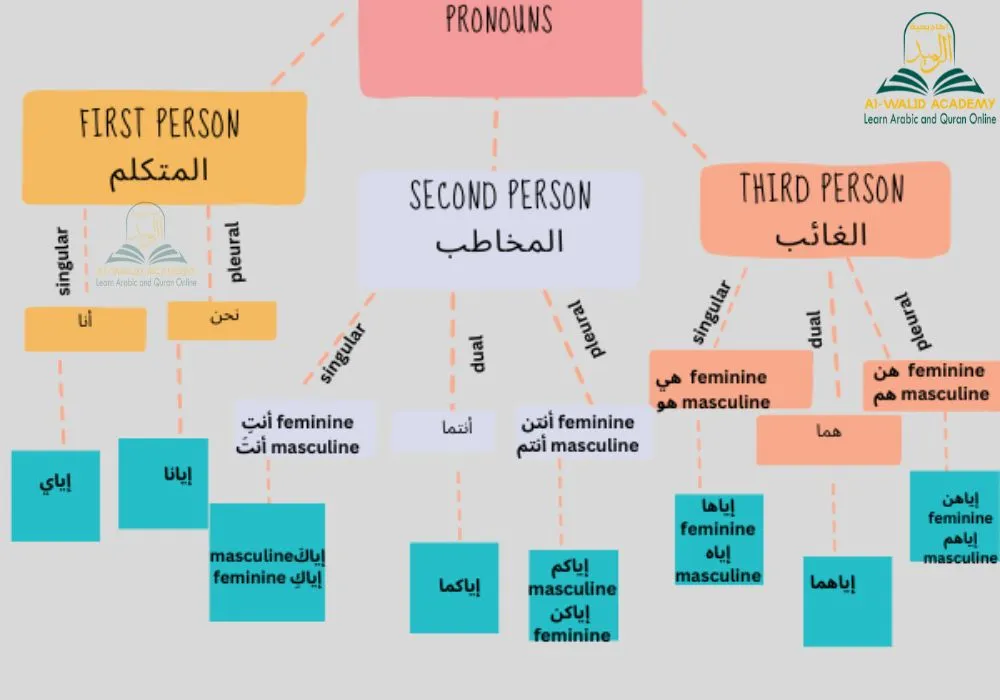
First Person Pronouns
It is used to refer to the person speaking, whether singular or plural.
- ANA “ I” “ أنا”: It expresses the first-person singular pronoun, whether male or female.
for example:” انا دكتور” which means I am a doctor. - NAHNU “ We” “ نحن”: It expresses the first-person pronoun for the plural, whether masculine or feminine.
for example: “ نحن أصدقاء” which means we are friends.
For learners who want to master Modern Standard Arabic, the course is a great choice for improving fluency and comprehension. You can also explore more Arabic, Quran, and Islamic learning options through the Al-Walid Academy.
Second-person pronouns are used when addressing or speaking to someone in front of you.
| Pronouns in Arabic | Meaning in English | Translation |
| أنْتَ | You for Masculine singular. | Anta |
| أنتِ | You for feminine singular. | Anti |
| أنتُمَا | You for two masculine and feminine. | Antoma |
| أنتُم | You for plural. | Antom |
| أنتُنّ | You for plural feminine. | Antun |
Third Person Pronouns
Third-person pronouns which is known as Dhama’ir al-Gha’ib are used to refer to someone who is not present and vary between those that express masculine, feminine, dual, and plural of both genders.
| Pronouns in Arabic | Meaning in English | Translation |
| هو | He or it. | Huwa |
| هي | She or it. | Hiya |
| هما | They for two. | Humā |
| هم | They For the masculine plural. | Hum |
| هن | They For the feminine plural. | Hunna |
Learn Quran, Arabic, and Islamic Studies with certified teachers in fun, interactive, and personalized sessions. Join thousands of students around the world and begin your path today!
Detached Pronouns in Arabic with Examples
To master independent pronouns- and to be able to distinguish between them- one must study various examples drawn from the Quran and the Arabic language.
Examples in Simple Sentences
Learning happens step by step. Here, we will discuss some simple Arabic sentences that help us learn Detached pronouns.
| Pronouns | Example in Arabic | Meaning in English |
| أنا | أنا أشرب اللبن | I am drinking milk. |
| نحن | نحن نذهب إلى المدرسة. | We go to school. |
| أنتَ | أنتَ تلعبُ. | You are playing. |
| أنتِ | أنتِ تلعبين. | You are playing. |
| أنتما | أنتما تلعبان. | You are playing. |
| أنتم | أنتم تلعبون. | You are playing. |
| أنتن | أنتُن!ّ تلعبنّ. | You are playing. |
| هو | هو يدرس اللغة العربية. | He is learning Arabic. |
| هي | هي تدرس اللغة العربية. | She is learning Arabic. |
| هما | هما يدرسان اللغة العربية. | They are learning Arabic. |
| هم | هم يدرسون اللغة العربية. | They are learning Arabic |
| هنَّ | هنّ يدرسن اللغة العربية. | They are learning Arabic. |
Examples from the Quran
The Holy Quran remains the foundation of the Arabic language and its rich meanings.
| Pronouns | Example in Quran | Meaning in English |
| أنا | “ وَ أَنَا الْتَّوَاب’ الرَحِيم” | Here, God describes Himself as one who accepts repentance and shows mercy to His servants |
| نحن | “ وَنَحْنُ أَقْرَبُ إِلَّيْهِ مِنْ حَبْلِ الْوَرِيد” | God, may He be exalted, describes His nearness to His servants as being closer to them than their own jugular veins. |
| أنتَ | “ إِنَّكَ أَنْتَ السَّمِيعُ الْعَلِيم” | God knows everything in the universe and hears everything in it, whether spoken in secret or aloud. |
| أنتما | “ أَنْتُمَا ومَن اتّبَعَكُما الغَالِبُون” | God Almighty was speaking to Moses and his brother Aaron, reassuring them as they faced Pharaoh. |
| أنتم | “وَلَا تَلْبِسُوا الْحَقَ بِالبَاطلِ وَتَكْتُمُوا الْحَقَ وأَنْتُم تَعْلَمُون” | God forbids us from mixing truth with falsehood and from concealing the truth despite its clarity and our knowledge of it. |
| هو | “وَ إِلهُكُمُْ إِلَهٌ وَاحِدٌ لَا إِلَهَ إِلَا هُوَ الرَّحْمَنُ الرَّحِيم” | There is no god but God, the Most Gracious, the Most Merciful. |
| هي | “ قَالُوا ادْعُ لَنَا رَبّضكَ يُبَيِّن لَنَا مَا هِى” | The Israelites asked Moses what colour the cow was that God had commanded them to slaughter. |
| هما | “ فَخَشِينَا أَن يُرْهِقَهُمَا طُغْيَنًَا وكُفْرَا” | This verse is from Surah Al-Kahf and tells the story of Al-Khidr and Prophet Moses |
| هم | “ وَمَا هُمْ بِضَارِينَ بِهِ مِنْ أَحَدٍ إِلَا بِإِذنِ الله” | No harm befalls anyone except by the will of God, even if all mankind and the jinn were to join forces |
| هنَّ | “ وَآَتُوا النِّسَاءَ صَدَقَتِهِنَّ نِحْلَةً” | God commands men to safeguard women’s financial rights |
When Are Detached Pronouns Used in Arabic?
There are many places where separate pronouns appear in sentences, and each place has a specific purpose.
As the Subject of a Sentence
- In Jumla Ismiyya, pronouns come in the form of a subject.
For example: “هي جميلة” which means she is beautiful.
- In Jumla felia pronouns come in the form of a subject.
For example: “ هي تلعب” which means she is playing.
For Emphasis and Clarification
In case of desire and confirmation of the completion of an action or the establishment of a certain characteristic.
For example: “كتبتُ أنا الدرس” which means I wrote the lesson.
Read about: Object Pronouns in Arabic
In Nominal Sentences (Jumla Ismiyya)
The presence of separate pronouns in nominal sentences is one of the most common and frequently occurring occurrences, for example:
- هي مجتهدةٌ.
She is hard working.
- نحن أمة محمد صلى الله عليه وسلم
We are the nation of Muhammad, peace and blessings be upon him.
- أنت طالبة مميزة.
You are an outstanding student.
Read about: Arabic Prepositions
Grammar Rules for Detached Pronouns
To ensure semantic accuracy and the correct usage of independent pronouns, it is essential to verify one’s understanding of the rules governing their use.
Case and Position in a Sentence
Detached pronouns in Arabic come at the beginning of Jumla Ismiyya and after the verb in the case of emphasis.
For Example:
- أنا أدرس.
I am studying.
- أقرأ أنا الدرس.
I am reading the lesson.
Agreement with Gender and Number
There are different pronouns for the first, third, and second person, so it’s essential to choose the appropriate pronoun based on gender and number. For example, the pronoun “هو” is used for the third-person singular masculine, “أنتم” for the second-person plural masculine, and “نحن” for the first-person plural.
Common Mistakes to Avoid
- Using an incorrect pronoun that is inappropriate for the context of the sentence, such as using a third-person pronoun instead of a second-person pronoun, affects the understanding of the sentence.
- Using the wrong pronoun is inappropriate for the type.
- Confusion between singular and plural.
- That the pronoun be very far removed from the noun or verb to which it refers.
Learn Arabic with the Best Place to Learn Arabic Online
Importance of Learning Detached Pronouns in Arabic
Foundation for Sentence Construction
Independent pronouns are considered one of the fundamental components of both nominal and verbal sentences. Therefore, a thorough understanding of the rules governing their selection and placement within a sentence is essential for comprehending the sentence itself and its structure.
Essential for Quran Understanding
Since Arabic is the language in which the Quran was revealed, understanding all of its rules and structures has become a matter of utmost importance for comprehending the Holy Quran and its meanings. Foremost among these components are pronouns.
Improving Arabic Fluency
A comprehensive understanding of independent pronouns is one of the most effective means of enhancing one’s grasp and comprehension of the Arabic language and its structures. This, in turn, deepens one’s understanding of meanings and grammatical analysis, ultimately leading to fluency in pronunciation and vocalization.
Practice Exercises on Detached Pronouns in Arabic
Mastering Detached pronouns in Arabic is achieved through continuous repetition and practice, leading to their complete mastery.
Fill-in-the-Blank Exercises
Fill-in-the-blank exercises are considered an effective method, particularly during the initial stages-as they help engage the mind in selecting the appropriate pronoun, in terms of both gender and number, and placing it in its correct position.
Sentence Correction Practice
Practicing the correction of erroneous sentences is also an effective method that trains both the eye and the mind to spot errors, as well as to identify the appropriate corrections for them.
Translation Exercises
The ability to correctly translate a sentence constitutes an advanced stage in achieving mastery, specifically of independent pronouns, and of the Arabic language and its comprehension in general.
If you want to build a strong foundation in Arabic, the Arabic Language Course helps you improve grammar, vocabulary, reading, and writing step by step. To speak more naturally and confidently, the Online Arabic Conversation Classes give you practical live speaking practice in a simple and supportive way.
Why is Al-Walid Academy the best for learning Arabic and the rules of Detached pronouns?
Al-Walid Academy is recognised as the premier destination for anyone wishing to learn the Arabic language and its various sciences, including Tajweed, Tafsir, Hadith and the serah, as it is distinguished by the following:
- Providing a comprehensive educational experience that combines mastery of the subject with the delivery of information using the latest effective methods.
- Simplified explanations of the material by specialists, with a gradual progression in depth to ensure comprehensive understanding.
- Flexible and effective teaching plans suitable for all levels and ages.
- Regular monitoring and continuous assessments to ensure progress and achieve the best results.
- As learning the language and the rules of Detached pronouns in Arabic relies heavily on developing skills, the Academy provides practical content that focuses on developing speaking, writing and listening skills.
All these effective steps are carried out under the supervision of a select group of teachers and within a stimulating learning environment to ensure continuous progress through an enjoyable learning experience.
Conclusion
Mastering Detached pronouns in Arabic is essential for understanding the language and a fundamental part of developing speaking, writing and listening skills in general.
It is therefore essential to ensure consistent and correct practice under the supervision of a specialist. If you are looking for an effective and structured way to understand and learn Arabic, Al-Walid Academy offers you a comprehensive learning environment that helps you progress effectively.
FAQS
How many detached pronouns are there in Arabic?
Detached pronouns in Arabic are commonly taught as 12 main forms: أنا, نحن, أنتَ, أنتِ, أنتما, أنتم, أنتن, هو, هي, هما, هم, and هن. Some grammar lessons count 14 pronoun slots because the dual forms أنتما and هما are counted separately for masculine and feminine.
How do detached pronouns change based on gender and number?
Detached pronouns in Arabic change according to person, gender, and number. For example, أنتَ is used for one male, أنتِ for one female, أنتم for a masculine plural group, and أنتن for a feminine plural group. In the third person, هو is used for one male, هي for one female, هم for masculine plural, and هن for feminine plural.
What are examples of detached pronouns in Arabic?
Examples of detached pronouns in Arabic include أنا for I, نحن for we, أنتَ for you masculine singular, أنتِ for you feminine singular, هو for he, هي for she, هم for they masculine, and هن for they feminine. Example sentences include أنا طالب, هو طالب, and هي طالبة.
What are separate pronouns in Arabic?
Separate pronouns in Arabic are another name for detached pronouns. They are pronouns that appear independently in the sentence and are not attached to another word. Examples include أنا, نحن, أنتَ, هي, and هم.
What is a hidden pronoun in Arabic?
A hidden pronoun in Arabic is called a mustatir pronoun. It does not appear as a separate written word, but it is understood from the verb form or the sentence context. For example, in the verb يكتب, the subject pronoun “he” is understood as hidden.
What are the 14 pronouns in Arabic?
The 14 Arabic pronoun slots often taught in grammar are: أنا, نحن, أنتَ, أنتِ, أنتما masculine, أنتما feminine, أنتم, أنتن, هو, هي, هما masculine, هما feminine, هم, and هن. Although أنتما and هما have the same written form for both genders, grammar charts often count them separately, which is why some lessons refer to 14 pronouns.
Which pronoun is used for Allah?
In Arabic, Allah is commonly referred to with the pronoun هو, translated as He. This is a grammatical convention in Arabic and does not imply biological gender. In Quranic language, Allah may also refer to Himself with أنا or نحن depending on the context and style.