
Let’s break down Dua Qunoot Explained in a simple way that helps us feel closer to Allah during prayer.
This dua is one of the most beautiful parts of the Witr prayer, and we’ll present it in an easy, friendly style from Al-Waleed Quran Memorization Academy so you can teach it to your kids with confidence.
If you’ve ever felt unsure about its details, this guide will walk you through Dua Qunoot Explained in a practical way that makes it much easier to apply in your daily life.
What Is Dua Qunoot? Dua Qunoot Explained
Dua Qunoot is a special supplication that a Muslim recites during prayer, especially in the Witr prayer. It is a heartfelt request to Allah for guidance, mercy, protection, and forgiveness. شئ
When a person recites this dua, they are not merely repeating words; they are experiencing a moment of deep devotion and closeness to Allah.
Additionally, this dua is not found verbatim in the Quran, but it is established in the Sunnah, which makes it one of the important supplications that the Prophet taught to Muslims.
For this reason, many people search for Dua Qunoot Explained to learn the correct way to recite it and to clearly understand its meanings—often through structured learning options like Quran courses online, which help improve both pronunciation and comprehension.
Moreover, this dua is comprehensive because it encompasses asking for good in both this life and the hereafter, helping a Muslim feel peace and reassurance during prayer.
The Meaning of the Word Qunoot in Arabic
The word “Qunoot ” in Arabic conveys the meanings of obedience, humility, and complete submission to Allah. When this word is used in the context of the dua, it reflects a state of deep devotion and humility before God.
In addition, Arabic dictionaries like Lisan al-Arab explain that Qunoot means standing with full submission, not just standing normally. Therefore, Qunoot differs from ordinary supplications because it combines prayer with an intense feeling of neediness toward Allah.
Thus, when a Muslim recites Dua Qunoot, they express their complete reliance on Allah in all aspects of their life, making the prayer more heartfelt and effective.
Read also about: Learn 40 hadith online
Is Dua Qunoot in the Quran or the Sunnah?
Dua Qunoot does not appear as a complete text in the Quran. However, the concept of supplication and turning to Allah in humility is mentioned in many verses, such as Allah’s words: “Call upon Me; I will respond to you.” This shows the importance of making dua in a Muslim’s daily life.
On the other hand, the specific wording of Dua Qunoot that we recite today comes from the Sunnah. Authentic narrations confirm that the Prophet Muhammad taught this dua to his companions. Therefore, Muslims rely on the Sunnah to learn the proper phrasing and method of reciting this dua.
From this, we understand that the Quran encourages all forms of supplication in general, while the Sunnah provides clear guidance on how to make these supplications correctly and effectively.
Who Taught Dua Qunoot and When?
The Prophet Muhammad was the one who taught Dua Qunoot Explained to his companions. One famous narration mentions that he taught it to his grandson, Al-Hasan ibn Ali, when the boy asked him how to ask Allah for help in the best way. This story confirms that the dua has an authentic origin in the Sunnah.
Moreover, the Prophet sometimes recited Dua Qunoot during times of hardship. This version is known as Dua Qunoot Nazila, and it was used to seek Allah’s help in difficult situations.
It is worth noting that Dua Qunoot is considered a confirmed Sunnah, meaning it is strongly encouraged but not mandatory. If a person forgets to recite it, their prayer remains valid. There is also flexibility in its recitation because the Prophet did not recite it in every single prayer consistently, showing that it is permissible to skip it on some occasions.
Have a look on: Importance of Memorizing the Quran
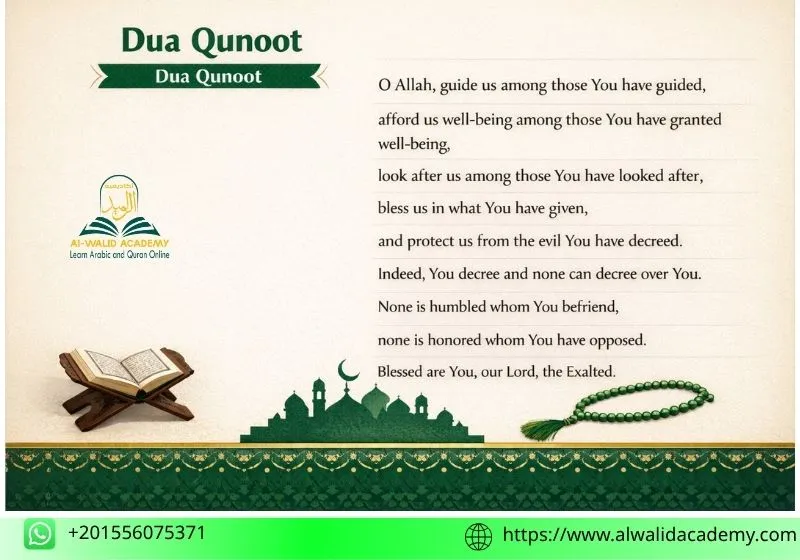
Dua Qunoot in Arabic and English
Many people look for Dua Qunoot in both Arabic and English so they can memorize it and understand it easily. Understanding the meaning helps a person recite it with more focus and devotion.
For this reason, it is useful to combine reading the Arabic text with knowing the English translation. This method helps people grasp the meanings better and also makes it easier for parents to teach the dua to their children in a simple and clear way.
The Full Arabic Text of Dua Qunoot
It is recommended to recite this dua slowly while concentrating on its meanings to feel its effect deeply in the heart.
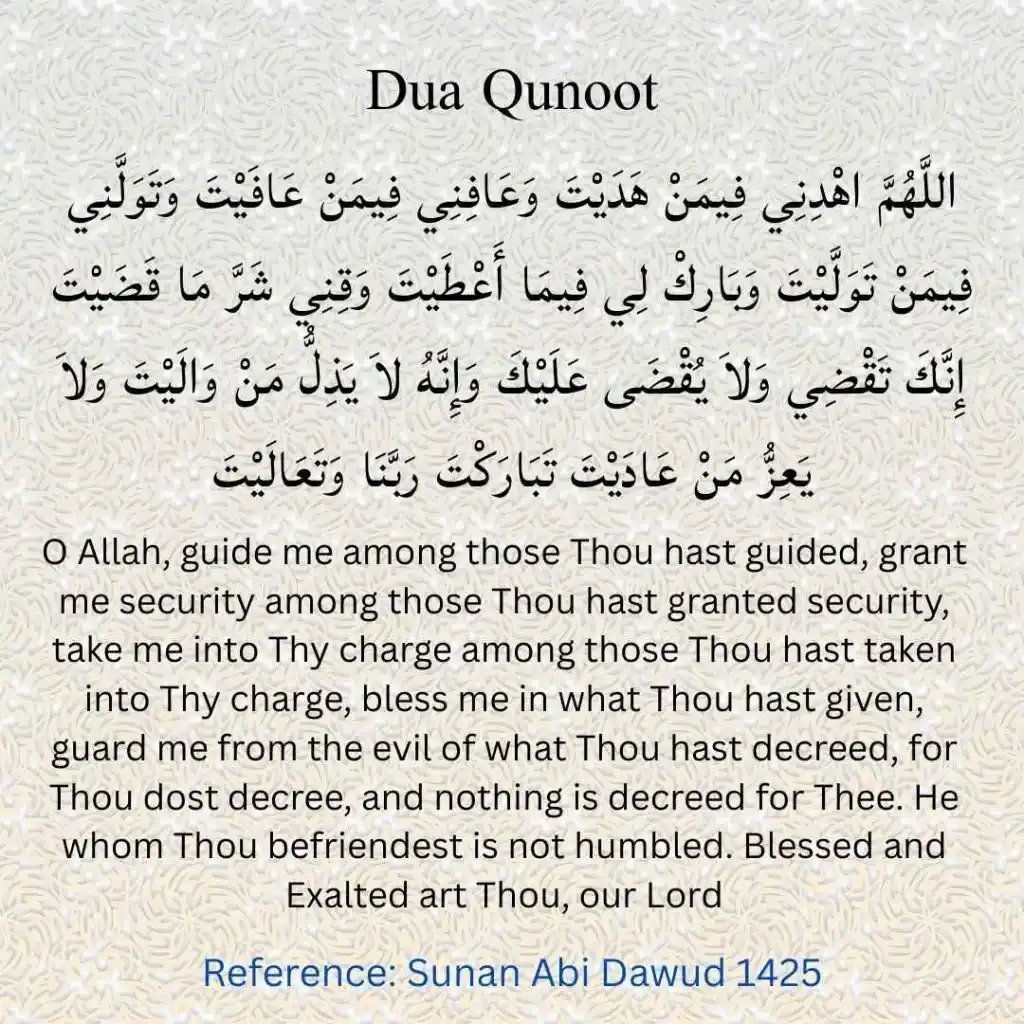
اللَّهُمَّ اهْدِنِي فِيمَنْ هَدَيْتَ، وَعَافِنِي فِيمَنْ عَافَيْتَ، وَتَوَلَّنِي فِيمَنْ تَوَلَّيْتَ، وَبَارِكْ لِي فِيمَا أَعْطَيْتَ، وَقِنِي شَرَّ مَا قَضَيْتَ، فَإِنَّكَ تَقْضِي وَلَا يُقْضَى عَلَيْكَ، وَإِنَّهُ لَا يَذِلُّ مَنْ وَالَيْتَ، وَلَا يَعِزُّ مَنْ عَادَيْتَ، تَبَارَكْتَ رَبَّنَا وَتَعَالَيْتَ، فَلَكَ الْحَمْدُ عَلَى مَا قَضَيْتَ، وَأَسْتَغْفِرُكَ وَأَتُوبُ إِلَيْكَ.
Dua Qunoot Transliteration — How to Read It Phonetically
If a person is not fluent in reading Arabic, they can use the following transliteration to recite it accurately:
Allahumma ihdini fiman hadayta, wa ‘afini fiman ‘afayta, wa tawallani fiman tawallayta, wa barik li fima a‘tayta, wa qini sharra ma qadayta,
fa innaka taqdi wa la yuqda ‘alayk, wa innahu la yadhillu man walayta, wa la ya‘izzu man ‘adayta, tabarakta Rabbana wa ta‘alayta,
falaka al-hamd ‘ala ma qadayta, wa astaghfiruka wa atubu ilayk.
Dua Qunoot English Translation — Word by Word Meaning
This English translation helps in understanding the deep meanings, making the dua more impactful:
” O Allah, guide me among those You have guided, Grant me well-being among those You have granted well-being, Take me into Your care among those You have taken into Your care, Bless me in what You have given me, Protect me from the evil of what You have decreed, You decree and none can decree over You, Whoever You support will never be humiliated, And whoever You oppose will never be honored, Blessed and Exalted are You, To You belongs all praise for what You decree, I seek Your forgiveness and turn to You in repentance.”
When a Muslim connects the Arabic text with these meanings, they feel the dua more deeply and experience greater devotion during prayer.
The Second Version — Dua Qunoot of Umar ibn al-Khattab
There is another version of Dua Qunoot transmitted from Umar ibn al-Khattab رضي الله عنه, which he used during times of hardship:
اللَّهُمَّ إِنَّا نَسْتَعِينُكَ وَنَسْتَغْفِرُكَ، وَنُؤْمِنُ بِكَ وَنَتَوَكَّلُ عَلَيْكَ، وَنُثْنِي عَلَيْكَ الْخَيْرَ، وَنَشْكُرُكَ وَلَا نَكْفُرُكَ، وَنَخْلَعُ وَنَتْرُكُ مَنْ يُفْجُرُكَ، اللَّهُمَّ إِيَّاكَ نَعْبُدُ وَلَكَ نُصَلِّي وَنَسْجُدُ، وَإِلَيْكَ نَسْعَى وَنَحْفِدُ، نَرْجُو رَحْمَتَكَ وَنَخْشَى عَذَابَكَ، إِنَّ عَذَابَكَ بِالْكُفَّارِ مُلْحِقٌ.
This version is longer and more comprehensive, making it suitable for moments when a person seeks a more intense supplication. It also demonstrates that Dua Qunoot does not have only one fixed form; it can vary depending on the need, as long as the meaning is correct and the devotion is sincere.
What are the two versions of Dua Qunoot?
There are two versions of Dua Qunoot because different companions of the Prophet reported authentic variations in its wording. Each version has its appropriate context:
- One is suitable for the daily Witr prayer.
- The other is used during hardships or crises.
This is not a contradiction; rather, it enriches the worship experience, giving the believer flexibility to choose the supplication that fits their situation.
Scholars agree that both versions are correct, and this comes from the fact that the Prophet taught more than one wording depending on the circumstances.
Read also about: Dua to Memorize Quran
- The Version Taught by the Prophet to Al-Hasan ibn Ali
This version was taught by the Prophet directly to Al-Hasan ibn Ali (may Allah be pleased with him). It focuses on guidance and protection.
The Arabic text:
اللَّهُمَّ اهْدِنِي فِيمَنْ هَدَيْتَ … تَبَارَكْتَ رَبَّنَا وَتَعَالَيْتَ
It is commonly recited during Witr prayer after the third unit (rak‘ah). Practically, reciting it every night brings a sense of peace and reassurance because it emphasizes seeking guidance and protection from harm.
- The Version Narrated From Umar ibn al-Khattab
This version, narrated by Umar ibn al-Khattab (may Allah be pleased with him), is longer and emphasizes seeking forgiveness and relying on Allah.
The Arabic text:
اللَّهُمَّ إِنَّا نَسْتَعِينُكَ وَنَسْتَغْفِرُكَ … إِنَّ عَذَابَكَ جِدًّا بِالْكُفَّارِ مُلْحِقٌ
Umar used to recite it during Fajr or in times of hardship, which is known as Qunoot al-Nazilah. For practical use, if you are facing a big problem or worry, reciting this version will help you fully rely on Allah and feel supported.
Which Version Should You Recite?
Choosing a version depends on your school of thought and the situation.
- The first version (Al-Hasan) is commonly used for daily Witr prayers in Shafi‘i and Hanbali traditions.
- The second version (Umar) is suitable during difficulties in the Hanafi tradition.
If you are a beginner, start with the first one as it is shorter and easier to memorize. Both versions are correct and commendable; each has its proper context and time.
Can You Combine Both Versions in One Prayer?
Yes, you can combine both versions in a single prayer, especially during Witr. The method is to recite the first version and then the second while raising your hands.
This is permissible and even recommended if you want to extend your supplication, but make sure not to make the prayer excessively long.
For example, during Ramadan, you can recite the first version as the main Witr supplication and the second version for a specific concern or worry, making your prayer richer and closer to acceptance.

Who Taught Us Dua Qunoot?
The Dua Qunoot Explained was taught by the Prophet Muhammad himself, and then his companions passed it on to the people.
This supplication guides a Muslim on how and when to pray properly and explains why it is important to follow it. It also emphasizes relying on Allah and trusting Him in all matters, whether in daily prayers or during times of hardship and difficulty.
The Prophet Teaching Al-Hasan ibn Ali
The Prophet specifically taught his grandson Al-Hasan ibn Ali a particular version of Dua Qunoot to serve as a practical model for prayer, especially for Witr.
Arabic Text:
اللَّهُمَّ اهْدِنِي فِيمَنْ هَدَيْتَ، وَعَافِنِي فِيمَنْ عَافَيْتَ، وَتَوَلَّنِي فِيمَنْ تَوَلَّيْتَ، وَبَارِكْ لِي فِيمَا أَعْطَيْتَ، وَقِنِي شَرَّ مَا قَضَيْتَ …
English Translation:
“O Allah, guide me among those You have guided; grant me well-being among those You have granted well-being; include me among those under Your care, grant me blessings in what You have given me, and keep me safe from the harm of what You have decreed.
This supplication focuses on seeking guidance, protection, and blessings from Allah, and it is used in Witr prayer according to Shafi‘i and Maliki practice.
For example, when a Muslim recites it after the final Witr rak‘ah, they feel a deep sense of peace and reassurance because their heart connects directly to Allah.
Qunoot Recited by Umar ibn al-Khattab — During Calamities (Qunoot al-Nazilah)
The version of Dua Qunoot narrated by Umar ibn al-Khattab was used specifically during times of hardship or calamities, known as “Qunoot al-Nazilah.”
Arabic Text:
اللَّهُمَّ إِنَّا نَسْتَعِينُكَ وَنُؤْمِنُ بِكَ وَنَتَوَكَّلُ عَلَيْكَ … إِنَّ عَذَابَكَ الْجِدَّ بِالْكُفَّارِ مُلْحَقٌ
English Translation:
“O Allah, we seek Your help, we believe in You, we put our trust in You, and we praise You. O Allah, You alone we worship, to You alone we pray and prostrate. We hope for Your mercy and fear Your punishment. O Allah, punish the disbelievers among the People of the Book who prevent others from Your way.”
This version is longer than Al-Hasan’s version and emphasizes seeking Allah’s help, protecting the community, and establishing divine justice. It also shows that Dua Qunoot is flexible and can be used in extraordinary situations, not just for daily prayers.
Practice of Companions — Ibn Abbas, Anas ibn Malik, Ubayy ibn Ka‘b
The companions applied Dua Qunoot in different ways, demonstrating its authenticity and flexibility:
- Ibn Abbas reported that the Prophet sometimes recited Qunoot after bowing (Ruku‘) in Witr and other prayers.
- Anas ibn Malik and Ubayy ibn Ka‘b taught their followers that the supplication could be recited either after rising from Ruku‘ or before it, depending on the prayer and situation.
These practices confirm the authenticity of Dua Qunoot in the Sunnah and show that it is suitable for both individual worship and times of communal hardship.
Therefore, every Muslim can choose the version and timing that best fits their prayer and circumstances.
Why Is Dua Qunoot So Powerful?
Dua Qunoot is very powerful because:
- It combines deep humility with direct supplication to Allah at a specific moment in the prayer.
- The Prophet recited it during times of hardship, and narrations show that it was often answered.
- It’s more than just words; it’s a heartfelt state that opens the doors of mercy and protects a person from calamities.
- What makes it especially remarkable is that it covers all of a person’s needs—both worldly and spiritual—in just a short time, which is why it is so effective.
Women can comfortably learn and practice through dedicated Quran Classes for Ladies in a supportive environment.
What Each Line of Dua Qunoot Is Asking Allah For
Every line of Dua Qunoot Explained has a clear meaning and request from Allah, helping you understand and reflect deeply:
- Allahumma ihdini fiman hadayta: Asking for guidance to stay on the right path and avoid misguidance.
- Wa ‘afini fiman ‘afayta: Requesting well-being—both physical and spiritual—protection from sickness and sin.
- Wa tawallani fiman tawallayta: Seeking Allah’s care and guardianship, asking Him to protect and choose you under His care.
- Wa barik li fima a‘tayta: Asking for blessings in what you have been given, like sustenance that is sufficient and grows.
- Wa qini sharra ma qadayta: Seeking protection from any harm that has been decreed, even challenges or difficulties.
Practical example: If you are facing work stress or a tough exam, focus on “qini sharra” and you will feel inner relief and protection.
If you want to understand every word, Learning Arabic for Beginners is a great first step.
The Spiritual State You Enter When Reciting Qunoot
When you recite Qunoot, your heart focuses entirely on Allah, your hands are raised, and your eyes look to the sky, like a child pleading with their parent.
This state purifies the soul from heedlessness and makes you feel your own weakness before the Lord of the universe. To reach this spiritual state, stand calmly, focus on your words, and imagine Allah in front of you.
Over time, you will naturally enter this deep spiritual immersion, just like the Prophet did in moments of hardship.
Why Scholars Called It the Prayer of the Devoted
Scholars like Al-Ghazali and Ibn al-Qayyim called Qunoot the “Prayer of the Devout” because one must have true piety and sincerity to recite it properly.
Not everyone can say it with a pure heart—it requires humility and fear of Allah. If you want to build a life of obedience and avoid sins, make Qunoot part of your daily prayers, as it fosters the awareness and devotion that protect you.
The Connection Between Humility and an Answered Dua
Humility and submission are key for a prayer to be answered, as Allah says: “Call upon Me; I will respond to you.” Qunoot teaches this humility through prolonged standing and sincere focus. Without humility, a dua can be like a paper tossed into the wind; with it, the supplication reaches Allah directly.
Practical example: notice how dua after fasting or during night prayers is often answered faster, because humility increases sincerity and strengthens your connection with Allah.
A full Arabic language Course helps you connect more deeply with the meanings of Dua Qunoot.
When and How to Recite Dua Qunoot
To begin with, it’s important to understand that Dua Qunoot is not just a set of words you recite—it’s a powerful moment of connection with Allah, where you ask for guidance, mercy, forgiveness, and protection. That’s exactly why both the timing and the way you recite it matter.
- Most commonly, Dua Qunoot is recited during the Witr prayer after ‘Isha, and this is the widely accepted practice among scholars.
- In addition to that, it can also be recited during other prayers in times of widespread hardship or crisis, which is known as Qunoot al-Nazilah.
As for its ruling, Dua Qunoot is considered a confirmed Sunnah, not an obligation. This means you earn a great reward for reciting it, but if you forget it, your prayer is still completely valid.
When it comes to how to recite it, you do so after rising from Ruku’ (bowing). At that point, you stand, raise your hands, and begin the supplication with calmness and humility.
Studying Fiqh Islamic Jurisprudence clarifies when and how to properly recite Dua Qunoot in prayer.
Dua Qunoot in Witr Prayer — Step by Step
If you want to perform Dua Qunoot correctly in Witr prayer, you can follow these simple steps:
- First, pray two rak‘ahs as you normally would. Then, in the last rak‘ah (usually the third), recite Al-Fatiha followed by a short surah.
- Next, perform Ruku’ as usual. After rising from Ruku’, this is where Dua Qunoot begins—raise your hands and start supplicating.
- While making the dua, keep your hands raised naturally, as if you are sincerely asking Allah. Once you finish, say “Ameen.”
- After that, say “Allahu Akbar,” go down into Sujud, and continue your prayer normally.
It’s also important to know that:
- You can recite the dua from memory or read it if you haven’t memorized it yet
- There are different versions of Dua Qunoot depending on the school of thought
For example, the Hanafi version focuses more on collective supplication, while the Shafi‘i version emphasizes personal guidance.
In the end, including Dua Qunoot in your last rak‘ah gives your prayer a peaceful and deeply spiritual closure.
Before Ruku or After Ruku — What Is the Correct Position?
Now, you might be wondering: should Dua Qunoot be recited before or after Ruku’?
In fact, the stronger and more widely accepted opinion is that it should be recited after Ruku’, meaning right after you rise and before going into Sujud.
At that moment:
- You raise your hands to chest or face level
- Your palms face upward
- You stay focused and present while making the dua
Once you finish, you simply say “Allahu Akbar” and proceed to Sujud, continuing the prayer as normal.
Although some opinions allow it before Ruku’, following the more authentic view is better.
And if you forget to recite it? No worries at all—your prayer remains valid.
Dua Qunoot in Fajr Prayer — the Shafi’i Position
When it comes to Fajr prayer, the ruling varies depending on the school of thought.
In the Shafi‘i madhhab, reciting Dua Qunoot in the second rak‘ah after Ruku’ is recommended. However, some scholars emphasize it more during times of hardship rather than on a daily basis.
In other words, not everyone practices it regularly, but it becomes especially meaningful during difficult times.
For example, during a community crisis, the imam may recite Qunoot aloud while the congregation responds with “Ameen,” creating a strong sense of unity and shared dua.
On the other hand, other madhhabs generally do not maintain the practice of Qunoot in Fajr regularly.
Qunoot al-Nazilah — When to Recite It During Times of Hardship
This brings us to an important type of Qunoot known as Qunoot al-Nazilah.
Simply put, it is recited during major hardships that affect the wider Muslim community, such as wars, pandemics, or natural disasters.
In this case, the dua is recited in the last rak‘ah of the prayer, after rising from Ruku’ and before Sujud—just like in Witr.
The purpose here is to sincerely ask Allah for:
- Relief from hardship
- Protection for people
- Patience and steadfastness
An example of such a dua is:
اللَّهُمَّ انصُرِ الْمُسْتَضْعَفِينَ، وَاحفَظِ الْمُسْلِمِينَ أَينَمَا كَانُوا، وَاكشِفْ عَنَّا الْبَلاءَ وَالوباءَ وَالشِدَّةَ، وَارزُقْنَا الصَّبْرَ وَالثَّبَاتَ، وَاغفِرْ لَنَا ذُنُوبَنَا، وَارحَمْنَا بِرَحْمَتِكَ يَا أَرْحَمَ الرَّاحِمِينَ.
Allahumma ansuril-mustad‘afeena, wahfazil-muslimeena aynama kanu, wakshif ‘anna al-bala’a wal-waba’a wash-shiddah, warzuqna as-sabra wath-thabāt, waghfir lana dhunubana, warhamna birahmatika ya Arhamar-Rahimeen.
Which means:
“O Allah, grant victory to the oppressed, protect Muslims wherever they are, remove from us hardship, disease, and distress, grant us patience and firmness, forgive our sins, and have mercy on us, O Most Merciful.”
A specialized Quranic Arabic Course helps you grasp the exact meanings behind every line of the dua.
Is Dua Qunoot Wajib or Sunnah?
Finally, let’s answer a very common question: is Dua Qunoot obligatory or not?
In most scholarly opinions, it is considered a confirmed Sunnah—not obligatory—but highly recommended.
To put it simply:
- If you recite it → you gain a great reward.
- If you miss it → your prayer is still valid.
However, in the Hanafi school, it is considered obligatory in Witr prayer.
The Difference Between Qunoot Witr and Qunoot Nazilah
To start with, many people confuse Qunoot Witr and Qunoot Nazilah, even though each one serves a completely different purpose.
Qunoot Witr represents a regular part of your daily worship. A muslim recites this supplication in the last rak‘ah of Witr prayer, and he asks Allah for guidance, mercy, and protection. In this way, the person ends his day with a sincere and personal connection to Allah.
On the other hand, Qunoot Nazilah appears only during major hardships. The Muslim community uses this supplication when events like wars, pandemics, or disasters affect large groups of people. In this case, the imam leads a collective dua, and the people ask Allah to remove the hardship.
Moreover, there is a clear difference in consistency:
- A Muslim performs Qunoot Witr regularly as part of his routine
- The community performs Qunoot Nazilah temporarily until the crisis ends
Therefore, Qunoot Witr strengthens your daily relationship with Allah, while Qunoot Nazilah helps the community return to Allah during difficult times.
| Aspect | Qunoot Witr | Qunoot Nazilah |
| Timing | Daily at the end of Witr prayer | Crises only, especially Fajr |
| Main Purpose | Personal well-being and blessings | Removing calamity from the community |
| Scholars’ View | Recommended by all schools | Valid in trials (sometimes obligatory) |
| Dua Phrasing | Shorter and most common (from Al-Hasan) | Longer with istighfar (from Umar) |
| Recitation Style | Silent alone, aloud when leading | Always audible in congregation |
| Practical Case | For peace before sleep | Group supplication during disasters |
What Is Qunoot Nazilah and When Is It Used?
Qunoot Nazilah refers to a special supplication that Muslims recite during widespread calamities.
In simple terms, the community uses this type of Qunoot when a major problem affects many people, such as a war, an earthquake, or a disease outbreak. The imam usually announces this practice and leads it during prayer.
Most commonly, the imam recites Qunoot Nazilah in Fajr prayer, and the congregation follows him. The community continues this supplication for a specific period, such as days or weeks, until Allah removes the hardship.
For example, during a pandemic, a mosque may include Qunoot Nazilah in Fajr prayer every day until conditions improve.
Importantly, Muslims do not use this supplication for personal problems. Instead, they reserve it for public and collective difficulties.
How the Prophet Recited Qunoot During Calamities
When we look at the Sunnah, we find that the Prophet practiced Qunoot during times of hardship.
The Prophet recited the supplication after rising from Ruku‘ in prayer, and he did so in a clear and audible voice when he prayed in congregation. The companions listened carefully, and they responded by saying “Ameen.”
In addition, the Prophet continued this practice for a limited period. He stopped the Qunoot once the hardship ended, which shows that this act connects directly to specific situations.
Therefore, a Muslim can follow this example by raising his hands after Ruku‘, making sincere dua, and focusing on the meaning of the words.
Can an Imam Lead Qunoot Nazilah in Congregation?
Yes, an imam can lead Qunoot Nazilah in congregation, and scholars consider this practice better in most cases.
The imam recites the supplication aloud, and the worshippers listen and respond with “Ameen.” This method creates a strong sense of unity, and it allows the entire congregation to participate in the dua.
If a person prays alone, he can recite the supplication quietly without any issue.
As for the decision to begin Qunoot Nazilah, the imam or the mosque authority usually makes this decision based on the presence of a real crisis.
Benefits and Spiritual Rewards of Dua Qunoot

Dua Qunoot is not just a prayer; it provides spiritual and emotional nourishment.
When you recite it regularly, it strengthens your faith, calms your heart, and helps you face life’s challenges with patience and hope. Moreover, it serves as a reminder of Allah’s guidance and mercy, creating a deep, meaningful connection between the believer and Allah.
-
Seeking Guidance — the First and Most Important Request
Firstly, Dua Qunoot emphasizes seeking guidance, which is the foundation of all goodness. When you say phrases like “Guide me among those You have guided”, you acknowledge your need for Allah’s wisdom in every decision.
This practice protects you from misguidance and helps you make the right choices in daily life. For example, if you are uncertain about a career path or personal decision, reciting this line sincerely can bring clarity and inner peace.
-
Seeking Protection From Evil and Harm
Furthermore, the dua asks Allah to protect you from all forms of harm, whether visible or hidden. When you recite “Protect me from the evil You have decreed”, it acts as a spiritual shield, safeguarding you from harm, illness, or negative influences.
Regular recitation not only provides reassurance but also builds patience and resilience, enabling you to handle personal or communal challenges with confidence.
-
The Effect of Dua Qunoot on the Heart and Soul
In addition, Dua Qunoot purifies the heart and strengthens the soul. It instills humility, increases awareness of one’s reliance on Allah, and promotes inner calm.
By consistently reciting this supplication, you will notice reduced anxiety, increased spiritual focus, and a sense of tranquility.
For instance, reciting it nightly for a month can make your heart feel lighter, more connected to Allah, and spiritually refreshed.
4-What Happens Spiritually When You Understand Its Meaning
Finally, understanding Dua Qunoot Explained transforms the act of recitation into deep spiritual reflection. Instead of merely repeating words, your heart engages in sincere worship, fostering a sense of closeness to Allah.
This comprehension enhances your gratitude, trust, and reliance on Allah’s wisdom, and it increases the likelihood of your prayers being accepted. Essentially, the more you internalize its meaning, the greater your spiritual growth and connection with Allah.
What Are Common Mistakes Made During Qunoot Dua?
Many people make common mistakes when reciting Dua Qunoot, such as memorizing without understanding, raising hands incorrectly, or mixing up different versions.
Although these mistakes seem simple, they can reduce the reward and spiritual impact of the dua. Fortunately, most of them are easy to fix, and with a little attention, you can experience greater focus and acceptance.
Mistake 1 — Reciting It Without Understanding the Meaning
The first common mistake is reciting the dua from memory without understanding its meaning. Simply reading the words without reflection turns the supplication into ordinary speech. Therefore, before prayer, study the meaning of each part.
For example, when you say “Qini Sharr”, realize that you are asking for divine protection at that moment. This awareness allows your heart to connect with the dua and increases your devotion.
A structured Quran Recitation Course helps you perfect your tone and fluency while reciting supplications like Qunoot.
Mistake 2 — Incorrect Pronunciation of Key Letters (ع ح ق)
Another frequent error is mispronouncing key letters like ‘Ayn, Haa, and Qaf, which can affect the dua’s correctness. To avoid this, practice with a tajweed teacher or record your voice and compare it with the proper recitation.
For instance, the word “Qadhta” must be pronounced accurately. With regular practice, you will master the correct pronunciation in just a few days.
To master proper pronunciation, enrolling in a Tajweed Course is essential for reciting Dua Qunoot correctly.
Mistake 3 — Raising Hands in the Wrong Position
Raising hands at the wrong time also diminishes the effect of the dua. Correctly, you should raise your hands only during the Qunoot, with palms facing up toward the sky, as if humbly asking Allah for help.
You do not need to keep your hands raised throughout the prayer. Focusing on devotion and sincerity will make the dua more spiritually effective.
Mistake 4 — Confusing the Two Versions and Mixing Them
Some people confuse the two versions of Qunoot or add incorrect phrases. This can distract from the dua and reduce its reward. Therefore, follow the authentic text from the Prophet or reliable scholars.
Choose the appropriate version for the prayer—use the short version for Witr and the longer version for times of calamity. Avoid any random additions or alterations.
Mistake 5 — Treating It as an Optional Add-On Rather Than a Devoted Supplication
Finally, some people treat Qunoot as an optional addition and recite it quickly, without focus. Although skipping it does not invalidate Witr, performing it with reflection and devotion increases reward and brings peace and humility to the prayer.
Consider the dua as a real opportunity to draw closer to Allah, not just words on your tongue.
How to Memorize Dua Qunoot Quickly and Correctly
Memorizing Dua Qunoot can be straightforward if you follow a clear and organized approach. By breaking it into smaller parts, understanding its meaning, and practicing it consistently, you will be able to recite it confidently and with full devotion.
Moreover, this method works well for both beginners and advanced learners, and within a week, you will notice significant improvement in your recitation.
1. Break It Into Three Parts and Learn One at a Time
First, divide the dua into three parts to make it easier to memorize:
- Part 1: اللَّهُمَّ اهْدِنِي فِيمَنْ هَدَيْتَ، وَعَافِنِي فِيمَنْ عَافَيْتَ
“O Allah, guide me among those You have guided, and grant me well-being among those You have granted well-being.” - Part 2: وَتَوَلَّنِي فِيمَنْ تَوَلَّيْتَ، وَبَارِكْ لِي فِيمَا أَعْطَيْتَ
“Take care of me among those You take care of, and bless me in what You have given.” - Part 3: وَقِنِي شَرَّ مَا قَضَيْتَ… تَبَارَكْتَ رَبَّنَا وَتَعَالَيْتَ
“Keep me safe from the harm within what You have decreed, for You are our Lord, the Most Blessed and the Most Exalted.”
Next, focus on memorizing one part each day. Repeat it around twenty times before moving to the next part. Then, gradually connect all parts.
For instance, on the first day, concentrate solely on the first part during Witr prayer, ensuring full attention and reflection.
2. Understand the Meaning Before Memorizing the Words
Furthermore, understanding the meaning of the dua before memorizing is essential. This helps you link the words to their significance, making retention easier.
For example, “قِنِي شَرَّ” means “protect me from evil,” which reinforces your understanding while reciting. Start by reading the Arabic text along with its English translation, reflect on it, and then repeat it aloud.
This approach transforms memorization into an act of contemplation, enhancing both devotion and focus.
3. Repeat It Daily in Your Witr Until It Becomes Natural
Additionally, repetition is key. Recite Dua Qunoot every day during Witr until it becomes second nature. Begin by repeating it ten times after your prayer, then include it in the last rak‘ah of Witr.
After a week of consistent practice, it will flow naturally during your prayer.
Perform the dua in a calm environment, free of distractions, which strengthens focus and makes it feel as natural as reciting Al-Fatiha.
4. The Role of a Teacher in Correcting Your Pronunciation
Finally, a teacher or Qur’an instructor plays a vital role in ensuring proper pronunciation, especially for challenging letters like ق (Qaaf) and ع (Ayn).
Although apps can assist, nothing replaces real-time guidance. Attend weekly sessions, listen carefully to your teacher, and repeat after them. This method guarantees accurate recitation, builds confidence, and adds spiritual depth to your Witr prayer.
Read also about: How To Choose the Right Quran Teacher
Teaching Dua Qunoot to Children — A Practical Guide

Teaching Dua Qunoot Explained to children is a great step if you want to build a strong connection between them and prayer from an early age. Not only that, but it also helps them feel calm and secure, since they learn to talk to Allah daily.
However, for the process to be effective, it’s important to present the dua in a simple and engaging way—not as a heavy memorization task.
When you combine understanding, repetition, and fun activities, you’ll notice your child starting to memorize and apply it naturally.
Read also about: Best Online Hifz Program for Children
The Right Age to Introduce Dua Qunoot to Kids
To begin with, choosing the right age makes a big difference. Generally, children between 4 and 6 years old are ready to listen and imitate simple words, which makes this a great stage to introduce the dua gently. At this point, full memorization isn’t necessary—just getting them familiar with the words is enough.
Then, as the child reaches around 7 years old, you can rely more on structured memorization, since they begin to better understand the concept of prayer. On the other hand, if your child seems a bit slower in memorizing, that’s completely normal. In this case, breaking the dua into smaller parts makes it much easier.
For example, many children have successfully memorized the dua within a few weeks when it was introduced gradually with daily repetition. Interestingly, this also helped improve their overall focus.
Read also about: Best Age for Learning Quran Online
How to Explain the Meaning to a Child in Simple Words
Next comes understanding, which is actually the key to strong memorization. When a child understands the meaning, remembering the words becomes much easier. لذلك، try explaining the dua using simple, everyday language they can relate to.
For instance:
- “اللهم اهدني” → means: O Allah, help me do what is right.
- “عافني” → means: O Allah, keep me healthy and strong.
- “وقني شر” → means: Protect me from anything bad.
In addition, you can turn the explanation into a short story or an imaginative scenario that the child enjoys. This makes the learning process more engaging.
Also, using tools like pictures, toys, or hand gestures can make the meaning clearer and easier to remember. With daily repetition—whether before bedtime or after prayer—the child will naturally connect the dua to their life and begin reciting it on their own.
Learn also about: How to Teach Noorani Qaida to Kids
Fun Ways to Help Children Memorize Dua Qunoot
Finally, to avoid boredom, it’s essential to include fun and interactive methods. Children learn much faster when they are engaged.
- First, you can use simple melodies with hand movements to make memorization easier
- Second, colored flashcards for each part of the dua can turn learning into a game
- Also, reward systems like stars can motivate the child to keep going
- In addition, recording videos of your child reciting the dua can boost their confidence
- Lastly, small family challenges create a fun and encouraging environment
For example, many children were able to memorize the dua in a short time by following these methods consistently. In the end, the idea is simple: when learning becomes fun, children absorb information quickly and without pressure.
Learn more about: Arabic Phonics for Children
How Al Walid Academy Helps You Master Dua Qunoot With Correct Tajweed
If you’re looking to learn Dua Qunoot Explained the right way without mistakes, Al Walid Academy can help you as it:
- Offers a practical approach that goes beyond simple memorization.
- Is not just about repeating words, but about mastering correct pronunciation and understanding every detail of the dua.
- Focuses on challenging letters like (ع، ح، ق), which makes a big difference in the quality of your recitation.
With consistent practice, you’ll find yourself reciting confidently during Witr, especially in Ramadan.
Learn Dua Qunoot With a Native Quran Teacher — Not Just a Text
To begin with, learning with a qualified Quran teacher is far more effective than relying on a book or app alone.
- The teacher listens to you and corrects mistakes instantly, which saves a lot of time and effort.
- Moreover, they guide you through pauses, tone, and proper recitation flow.
As a result, with regular sessions, your recitation becomes smoother and more accurate.
One-on-One Sessions for Adults and Children at Any Level
On the other hand, one-on-one sessions allow you to learn at your own pace based on your level. Whether you’re a beginner or looking to refine your skills, there’s a personalized plan for you.
For children, the approach is simplified and interactive, while adults receive more detailed correction and focus on precision. In addition, flexible scheduling makes it easier to stay consistent, no matter how busy your day is.
Read more about: One-on-One Quran Lessons
Book Your Free Trial and Start Reciting Dua Qunoot Correctly Today
If you are still feeling unsure, you can begin with a free trial session to see how it work. During this session, you’ll:
- Understand your current level and experience the teaching style firsthand.
- Learn key basics like the correct timing of Qunoot and proper pronunciation.
As a result, you can begin applying what you’ve learned in your Witr prayer on the same day.
FAQS
This section answers the most common questions in a quick and clear way about Dua Qunoot Explained, helping you understand everything you need before starting or practicing Dua Qunoot.
Is it permissible to recite Dua Qunoot in English?
It is not recommended to recite Dua Qunoot in English during prayer, as it should be said in Arabic; however, you can learn its meaning in English until you memorize it.
What should you do if you forget to recite Dua Qunoot during the Witr prayer?
If you forget Dua Qunoot, simply continue your prayer—your prayer remains valid and does not need to be repeated.
Is there a special Dua Qunoot for Ramadan?
There is no separate version for Ramadan, but you can add extra supplications if you wish.
How long is Dua Qunoot supposed to be?
There is no fixed length—it can be short or extended, as long as it is recited with focus and sincerity.
Is Dua Qunoot obligatory in Witr prayer?
Dua Qunoot is widely known as an important supplication in Witr prayer, though scholars may differ on some rulings related to it.
Can I make Dua Qunoot if I have not memorized it yet?
Yes, you can still make dua and learn Dua Qunoot gradually until you memorize it.
Can Dua Qunoot be recited in congregation?
Yes, Dua Qunoot may be recited in congregation, especially when praying behind an imam.