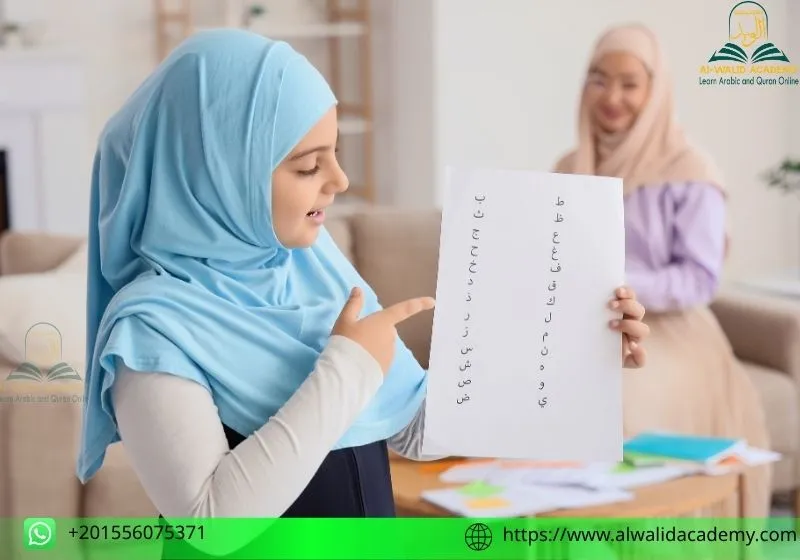
All languages initially consisted of sounds agreed upon by groups of people to represent specific meanings before writing systems and fixed letter shapes were developed. Therefore, the first step in learning Arabic correctly is to learn makharij of Arabic letters properly. Arabic is a blessed language, as it is the language in which the Holy Quran was revealed. For this reason, striving to learn and master Arabic is of great importance to every Muslim, regardless of nationality or native language. This article explores the importance of Arabic and the essential steps beginners need to reach an advanced level
Learn Makharij of Arabic Letters
Learn makharij of Arabic letters means knowing the places where the sound of each letter is produced. Learning these points is the starting point for mastering the Arabic language and reciting the Quran correctly, along with learning Tajweed (the rules of Quranic recitation).
However, you should know that mastering this is not merely a luxury but an act of worship to improve your recitation of the Holy Quran. Attempts to learn Arabic should be accompanied by patience and frequent practiceTo improve pronunciation and language development so that your recitation becomes more polished.
Why Makharij are Essential for Correct Arabic Pronunciation?
Learn makharij of Arabic letters is very important, as each letter has its own distinctive sound, and therefore:
- Preserving the general linguistic meaning is important because the Arabic language contains a large number of similar letters.
- Distinguishing all the letters of the Arabic language, as the Arabic language is unique in having a number of letters that do not exist in other languages.
- The correct recitation of the Book of God, which was revealed in the Arabic language, and preserving it from distortion.
What are Makharij of Arabic Letters?
These are the precise points of articulation for each letter of the Arabic alphabet. These points include the throat, lips, tongue, and nasal cavity. Learning the correct points of articulation is key to proper Quranic recitation, following the rules of Tajweed, and mastering the Arabic language.
Meaning of Makharij in Arabic
In Arabic, the term “makhraj” refers to the point of articulation, and in this context, it refers to the points of articulation from which the sounds of different letters are produced. Each letter of the Arabic alphabet has a distinct point of articulation, and identifying the correct point of articulation is essential for correct pronunciation.
How Makharij Affects Letter Sound?
Because the points of articulation of letters are the places from which the sound of each letter comes out, with its differences between the throat, tongue, lips, and other points of articulation, it is natural that each letter differs according to its point of articulation, for example:
- Throat: produces a deep sound like the letters ‘ayn’ “ ع” and ‘ghayn’ “غ”.
- Tongue: produces a back-voiced sound whose depth varies depending on the position of the tongue, whether it is at the front, back, or middle.
- lips: produce a soft sound, like the pronunciation of the letters ‘meem’ “ م” and ‘ba’ “ب”.
- Nasal cavities: produce a resonant sound, known as Ghunnah, similar to the letters “Noon” “ن” and “Meem” “م”.
Read about: How to Pronounce Arabic Letters with Tajweed?
Main Makharij Groups in Arabic
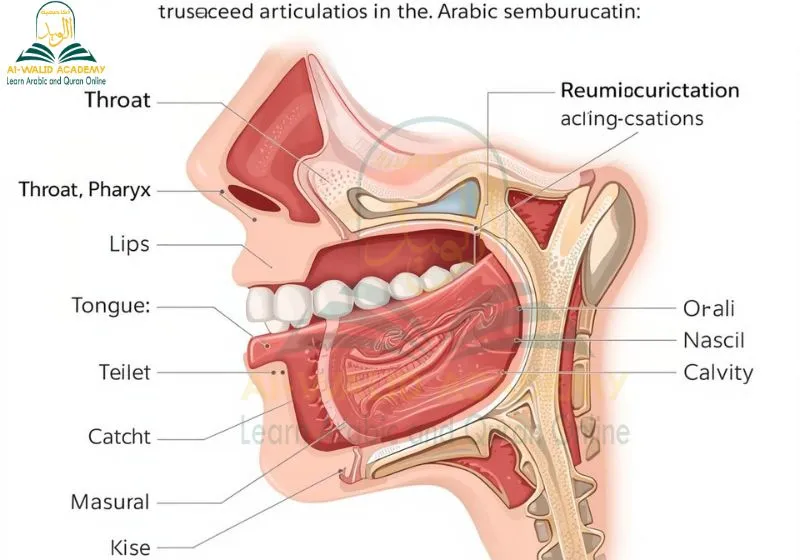
These are the specific points in the human body, including the throat, tongue, lips, and nasal cavity. Each produces a specific sound that represents a distinct letter of the Arabic alphabet, thus aiding in correct pronunciation and preserving the overall meaning.
Throat Letters Makharij
Six letters of the Arabic alphabet are pronounced from the throat. These are considered the most difficult for learners to distinguish between, but with practice, it becomes easier. The throat is divided into three regions:
Deepest Part of Throat
Almost near vocal cords produces two letters “Hamza’ “ء” and “Ha’.
Middle Part of Throat
Produces two letters, “Ain” “ ع” and “Ha” “ح”.
Upper part of Throat
Produces “Ghayn” “غ” and “Kha” “ خ”.
Tongue Letters Makharij
The tongue is the organ that represents the point of articulation for many letters of the Arabic language, as these sounds are produced by the tongue touching other points in the mouth, for example:
- When the back of the tongue touches the soft palate, the letter Q “ قاف” is produced.
- When the back of the tongue touches a soft plate, but slightly forward in the mouth, it produces “kaf” ك.
- When the middle of the tongue touches the roof of the mouth, it produces a sound like the letters “jeem” “ ج” and “sheen” “ش”.
- When one side of the tongue presses against the upper molar, it produces the letter “daad” “ ض”.
- When the tip of the tongue presses against the upper front teeth, it produces “daal” “د” and “taa” “ ت”.
Nasal Sound Makharij
The nasal cavity produces a sound called “Ghunna”; it is specific for two letters, “meem” “ م” and “noon” “ن”.
Lips Letters Makharij
Letters pronounced using the lips are the easiest letters for learners.
Ba “الباء”
Which is produced by touching of both lips.
Meem “ الميم”
Which is produced by closing both lips while a bit of air is coming out from the nose.
Wow “الواو”
It is produced when lips are rounded but not closed.
Fa “الفاء”
It is produced when the lower lip touches the upper teeth.
Read about: How to Learn Tajweed Rules
Learn Quran, Arabic, and Islamic Studies with certified teachers in fun, interactive, and personalized sessions. Join thousands of students around the world and begin your path today!
Common Pronunciation Mistakes Caused by Weak Makharij
Most errors in pronunciation made by students who learn makharij of Arabic letters, are not due to incorrect application of the rules of Tajweed, but rather to a lack of proper mastery of the articulation points of letters. Some Arabic letters share the same point of articulation but differ completely in pronunciation and form. These are some common mistakes:
Mixing Similar Arabic Letters
In Learning Arabic for Beginners, the most common mistake is mispronouncing letters that sound very similar. This stems from an inability to distinguish between them and a misconception that they are identical. However, the reality is not as it appears. Examples of such letters include
- “Seen” “س” and “Saad” “ص”.
- “Taa” “ ت” and “Heavy Taa” “ط”.
- “Haa” “ح” “and “Light Haa” “ه”.
- “Qaaf” “ ق” and “Kaaf” “ ك”.
Changing Word Meaning Due to Mispronunciation
Because Arabic is a precise phonetic language, any error in pronouncing a letter can significantly impair the meaning. This is a very serious mistake when reciting the Holy Quran, and therefore, it must be corrected. Examples of such errors include:
- The word “علم” (knowledge/science) is often mispronounced, with many saying “الم” instead.
- The word “حلم” ( Dream) is sometimes pronounced “هلم” which means “hurry up.”
How to Learn Makharij Step by Step
Because words are the foundation of every language, and each word is built from letters with distinct sounds, any disruption to this structure inevitably affects meaning. Since Arabic is the language in which the Holy Quran was revealed, even the slightest alteration in any letter is of great importance and must be avoided through specific measures:
Isolated Letter Practice
This is the first stage to learn makharij of Arabic letters that must be mastered before moving on to pronouncing words, and it means pronouncing each letter completely separately.
Its purpose
It involves ensuring the learner’s ability to pronounce letters correctly, and consistent repetition trains the lips, throat, and tongue to pronounce each letter correctly. This helps prevent the learner from developing a habit of mispronouncing words when encountering a complete sentence for the first time.
Letter Practice with Harakat
This is the next stage after mastering the articulation of letters. It begins with the correct pronunciation of the letter with its various vowel markings. The primary goal is to develop the ability to effectively integrate the articulation of the letter with its correct vowel marking, thereby increasing the ability to read letters correctly when placed within different words.
Applying Makharij in Words
This is the final learn makharij of the Arabic letters stage, which involves transitioning from pronouncing letters and their sounds in isolation to combining them with other letters within a word. This is the practical application to ensure that letters are not mixed up or their articulation changed during reading.
Contact us and learn Online Quran Classes in New York
Learning Makharij for Quran Recitation
Reciting the Holy Quran is a great spiritual act of worship, and there is nothing better than reading God’s book correctly to understand its meanings accurately. To ensure this, one must master the first step, which is the correct pronunciation of the letters.
Role of Makharij in Tajweed Rules
Correct pronunciation of the articulation points of letters is the basis for applying the various rules of Tajweed, such as the rules of ( المدود – القلقلة – الإظهار – الإقلاب……).
- Join our Tajweed Course For optimal learning and practical application with continuous follow-up
Preventing Errors in Quran Reading
Proper application of the correct articulation of letters prevents you from making mistakes during recitation and thus ensures:
- Ensuring that the meaning is conveyed correctly and protecting the Quran from distortion.
- Addressing the similarity in letters with the same point of articulation.
- Good application of the rules of Tajweed.
- Increasing spiritual understanding and drawing closer to God Almighty by reading His book correctly.
- Enhancing the reader’s confidence while reciting the Quran, thus increasing their enjoyment of the recitation.
Reciting the Holy Quran requires attention to several key aspects, including ensuring correct pronunciation of letters, understanding the rules of Tajweed, and continuous practice under the supervision of a specialized teacher. All of this is available in the Quran Memorization Course at Al-Waleed Academy.
Best Way to Improve Makharij Accuracy
Improving and developing pronunciation is a process that requires considerable effort and continuous monitoring, given the richness of the Arabic language. While the primary factor is dedication and a desire to improve, several other factors also play a role.
Learning with a Qualified Teacher
A qualified teacher is someone who has gone through the entire process and knows everything a student needs, from effective learn makharij of Arabic letters methods to achieving satisfactory results. This includes complete mastery of the articulation of letters and the rules of Tajweed, and undoubtedly, correct reading of the Arabic language and recitation of the Quran.
Regular Listening and Imitation
Choose a reciter whose recitation is accurate and adheres strictly to the rules of Tajweed. You can consult your teacher for a good recommendation. Make sure to listen to them daily.
How Long Does It Take to Learn Makharij of Arabic letters

It depends on several factors, including:
- Age.
- Learner’s native language (which is a major factor).
- Ability to understand and comprehend.
- A person’s capacity for consistent and uninterrupted training.
However, the period is roughly proportional to the duration of continuous training between:
- One to two weeks to learn the articulation points of the letters theoretically.
- From one to three months for the practical application of the articulation of letters during recitation.
- From 3 to 6 months to establish the correct pronunciation of letters during recitation.
- From 6 months to 12 months to ensure complete mastery and reach an advanced level.
Beginner Progress Expectations
For any beginner, learn makharij of Arabic letters is initially complicated, and many mistakes are likely. However, these mistakes gradually disappear with consistent practice. For a beginner, the basic tasks can be summarized in two aspects:
Recognizing the letters and mastering them completely, especially similar ones.
Practicing correct pronunciation.
Consistency and Practice Timeline
It depends on the time available to each learner and the period they dedicate to learning. However, the focus should always be on consistency rather than the quantity of material learned.
As the Prophet Muhammad (peace be upon him) said, “The best deeds are those that are done consistently, even if they are small.” Therefore, consistently practicing for 30 minutes a day to learn the articulation of letters or the pronunciation of words ensures remarkable and masterful progress over time.
Who Needs to Learn Makharij of Arabic Letters
Learn makharij of Arabic letters is extremely important for foreigners. It helps them communicate effectively and understand meanings correctly, whether it’s a general understanding of the language or the meanings mentioned in the Quran. And among the most famous learners of the Arabic language:
Quran Learners
It is of most importance that Arabic language learners master the articulation of letters to ensure the correct recitation of God’s Book, to preserve it from distortion, and to guarantee that all meanings, rulings, commands, and prohibitions are conveyed correctly.
Non Native Arabic Speakers
To ensure good communication with their Arabic-speaking peers. This also helps in better understanding the material they are studying. Whether they are studying in an Arab country like Al-Azhar in Cairo, or participating in Quran courses online. And the correct recitation of the Quran is undoubtedly the most important element.
Master Makharij of Arabic Letters With AL-Walid Academy
If you have spent a lot of time searching for a place to learn makharij of Arabic letters without success, and you are reading these lines now, congratulations! You have reached your destination. Al-Waleed Academy is the perfect choice for anyone who wants to speak Arabic from scratch until it feels like you were born in an Arab country. Al-Waleed Academy offers the best Arabic language Course with the following features :
Structured Lessons Guided by Qualified Arabic Teachers
- The study is conducted according to organized curricula developed by experts in the Arabic language who specialize in teaching foreigners, and it is not done randomly.
- The teachers possess high levels of language proficiency and diverse teaching skills to ensure that the information reaches everyone.
Personalized Feedback to Correct Pronunciation Accurately
Because it doesn’t stop at explanation, follow-up and error correction are also crucial. Follow-up relies on individual correction, which helps overcome errors and ensures continuous improvement.
Learn Quran, Arabic, and Islamic Studies with certified teachers in fun, interactive, and personalized sessions. Join thousands of students around the world and begin your path today!
Conclusion
In summary, we have stated that the first step in learning Arabic is to learn the makharij of Arabic letters. Although Arabic may be difficult for some learners, learning it is extremely enjoyable and a clear path to reading the Holy Quran correctly and reflecting deeply on its meanings and rulings.
FAQs
How Many Makharij in Arabic Letters?
The number of points of articulation in the Arabic language is 17, according to the consensus of scholars of Tajweed. The main ones are the throat, tongue, nasal cavity, teeth, and oral cavity.
What is the difference between the articulation points and the characteristics of letters?
The points of articulation of letters are the places from which the letter is pronounced, and as for its characteristics, they are the way in which it is pronounced, whether through whispering, clear articulation, concealment, and so on.
Does an error in pronunciation affect the meaning of the word?
Yes, it has a significant impact. Arabic is a very precise language; any slight change in the pronunciation of a letter can completely alter the meaning.
Is it possible to learn the articulation of letters without a teacher?
You can start learning the basic rules without a teacher, but practical application requires a teacher to follow up and correct mistakes.
What are the most difficult Arabic letters to pronounce for beginners?
The most difficult Arabic pronunciations for beginners are those of guttural letters such as ع، ح، غ، خ.