Many learners find it very difficult to recite correctly, as Arabic is not their mother tongue. The Quran Reading Correction Classes have been introduced to resolve this issue completely. By providing the basics of learning Arabic, the rules of tajweed and immediate correction of mistakes, combined with ongoing practice, the process becomes much easier and simpler.
What Are Quran Reading Correction Classes?
These are highly specialised teaching sessions, the purpose of which is to listen to students’ recitations and correct them in terms of the quality of memorisation, tajweed and the articulation of letters.
Definition of Quran Reading Correction Classes
Quran Reading correction Classes, also known as recitation correction courses or sessions, are specialised educational sessions that take place either one-to-one or in groups, and are usually conducted online.
These courses focus primarily on:
- The correct pronunciation and learning the Makharij of Arabic Letters.
- Explaining the rules of Tajweed and ensuring they are applied correctly.
- Correcting recitation errors, which may include mixing up letters or mispronouncing them.
The sessions are characterised by the continuous repetition of the verses, which facilitates memorisation and mastery.
Why Correction Is Essential in Quran Reading Classes
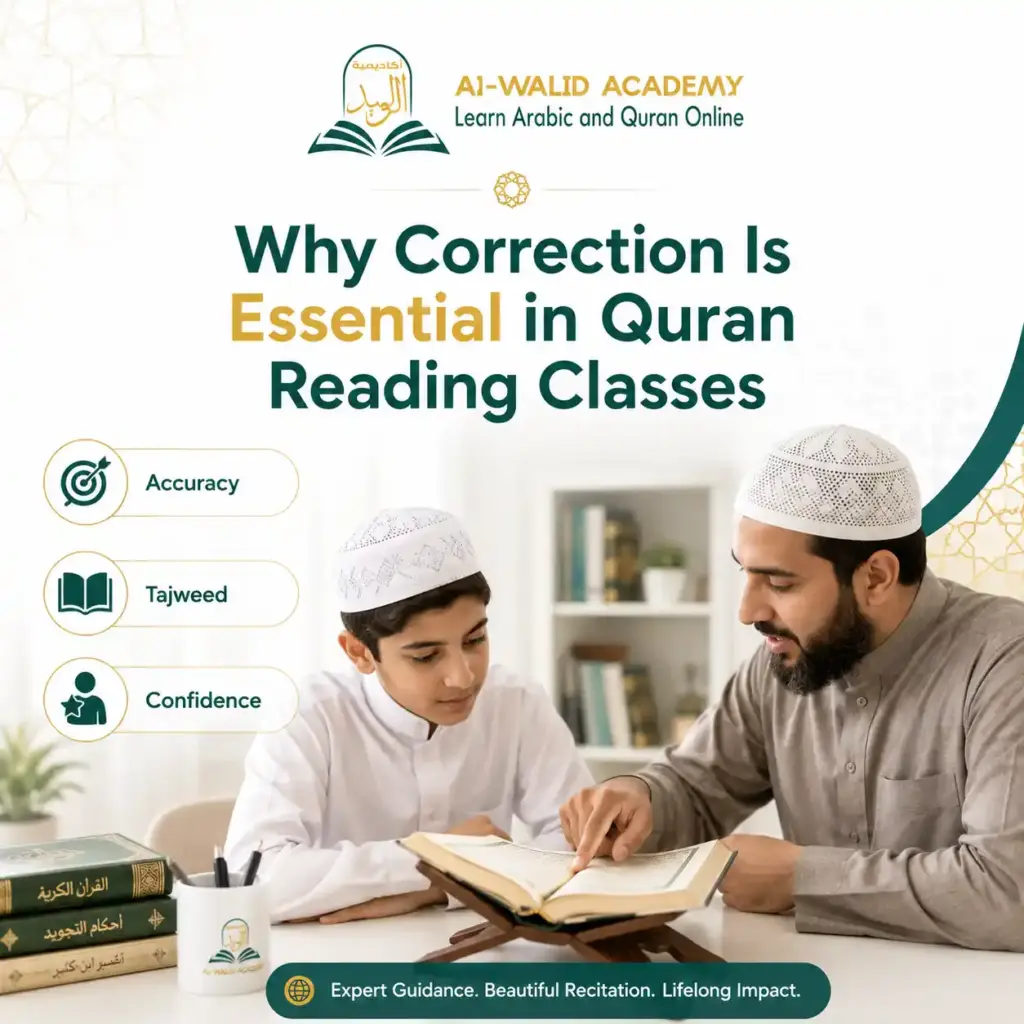
This is because the correct recitation of the Qur’an is a combination of mastery of the Arabic language, learning Tajweed Rules, and continuous practice of both.
The immediate correction of mistakes plays a vital role in correct recitation, as most recitation errors arise from failing to correct them and from a tendency to persist with them, making them difficult to overcome later on.
Who Needs Quran Reading Correction Classes
Quran Reading Correction Classes are not merely learning sessions tailored to a particular age group, but a way of life that keeps us constantly connected to the Book of Allah, the Almighty.
Beginners
Recitation correction sessions are ideal for beginners, as:
- They help them learn the correct articulation of letters and practise pronunciation.
- Teach the Online Noorani Qaida Course and how to apply it.
- Provide a supportive environment that helps them progress and persevere.
Intermediate learners
At this stage, the focus is on:
- Correcting recurring Tajweed Mistakes.
- Practising recitation with greater fluency.
- Gaining a deeper understanding of the rules of Tajweed and applying them with greater precision.
Advanced reciters
At this stage, the focus is on the quality of recitation and improving one’s voice; we could begin learning other styles of recitation.
Why Quran Reading Correction Classes Are Important
Lessons in correcting the recitation of the Qur’an are essential for every Muslim who seeks to recite the Qur’an correctly. Taking these lessons helps to:
- Avoid common tajweed mistakes that most people make when reciting the Qur’an, such as incorrect pronunciation of the ghunnah, shaddah, or the rules of madd.
- Avoid mistakes in the pronunciation of Arabic letters: these mistakes include confusing the points of articulation of letters or pronouncing them entirely incorrectly.
- Receive continuous feedback from teachers: Prompt and direct correction is one of the key factors in the success of these sessions, as it helps to quickly identify and rectify mistakes.
- Build confidence in recitation: Through continuous practice and constructive, personalised feedback, teachers guide students from hesitant recitation to fluent and skilful recitation.
Common Mistakes Students Make in Quran Reading
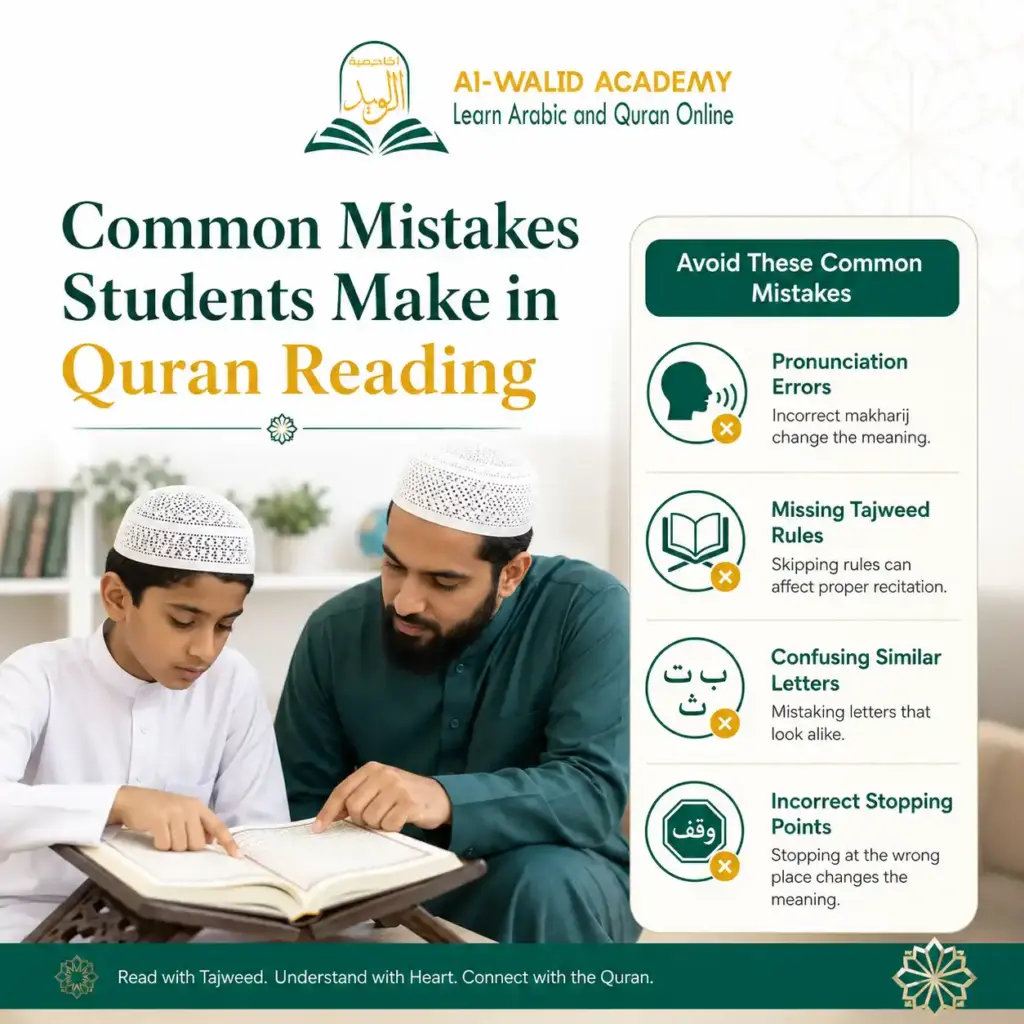
There are some common mistakes that students make whilst reciting. These mistakes take two forms:
- Obvious mistakes “ Lahn Jali” that result in a misinterpretation of the meaning.
- Subtle mistakes “ Lahn Khafi”, which affect the quality and fluency of the final recitation.
Among these mistakes are:
Incorrect pronunciation of letter articulation points
This is one of the most common mistakes. Therefore, care must be taken to correct it and practise until it is mastered. It includes:
- Incorrect pronunciation of certain letters, for example the letter ‘ḍād’ “ ضاد”, as it has no equivalent in English.
- Confusion in the pronunciation of the articulation points of certain similar letters, such as the qaf قاف, kaf “كاف”, sad “صاد” and sin “ سين”.
- Incorrect application of Tafkhim and Tarqiq, as occurs for some when pronouncing the word ‘ اللّه’ “ Allah” is pronounced with Tafkhim after a dammah or fathah, and with Tarqiq after a kasrah.
Failure to observe the rules of tajweed
Another major problem is the neglect of basic tajweed rules, which directly affects the accuracy and beauty of recitation. Common examples of this include:
- Failure to pronounce the ghunnah correctly in terms of prolonging it for two vowel counts or omitting it and skipping over it whilst reading, or prolonging it excessively beyond two vowel counts.
- Failure to pronounce the shaddah, which leads to a significant distortion of meaning.
- Failure to correctly apply the Noon Saakin Rules and tanween, namely, Izhar, ikhfaa, idgham, and iqlab, which leads to a significant distortion of meaning or pausing in incorrect places.
The rules of tajweed are what impart tranquillity and calm during recitation and aid in the correct understanding of the meaning.
Poor command of the Arabic language and lack of fluency in pronunciation
This problem is, to some extent, normal amongst non-native Arabic speakers and has a significant impact on the ability to learn, but it can be resolved through continuous practice. This problem stems from:
- A lack of continuous practice and guidance.
- Reading too quickly without paying attention to correct pronunciation and the application of Tajweed rules.
- Frequent pauses, which make the recitation sound disjointed.
- Stopping and starting at random, which affects the meaning and self-control.
Join the Quran Recitation Course at Al-Walid Academy and enjoy a proper recitation of the Holy Qur’an
What You Will Learn in Quran Reading Correction Classes
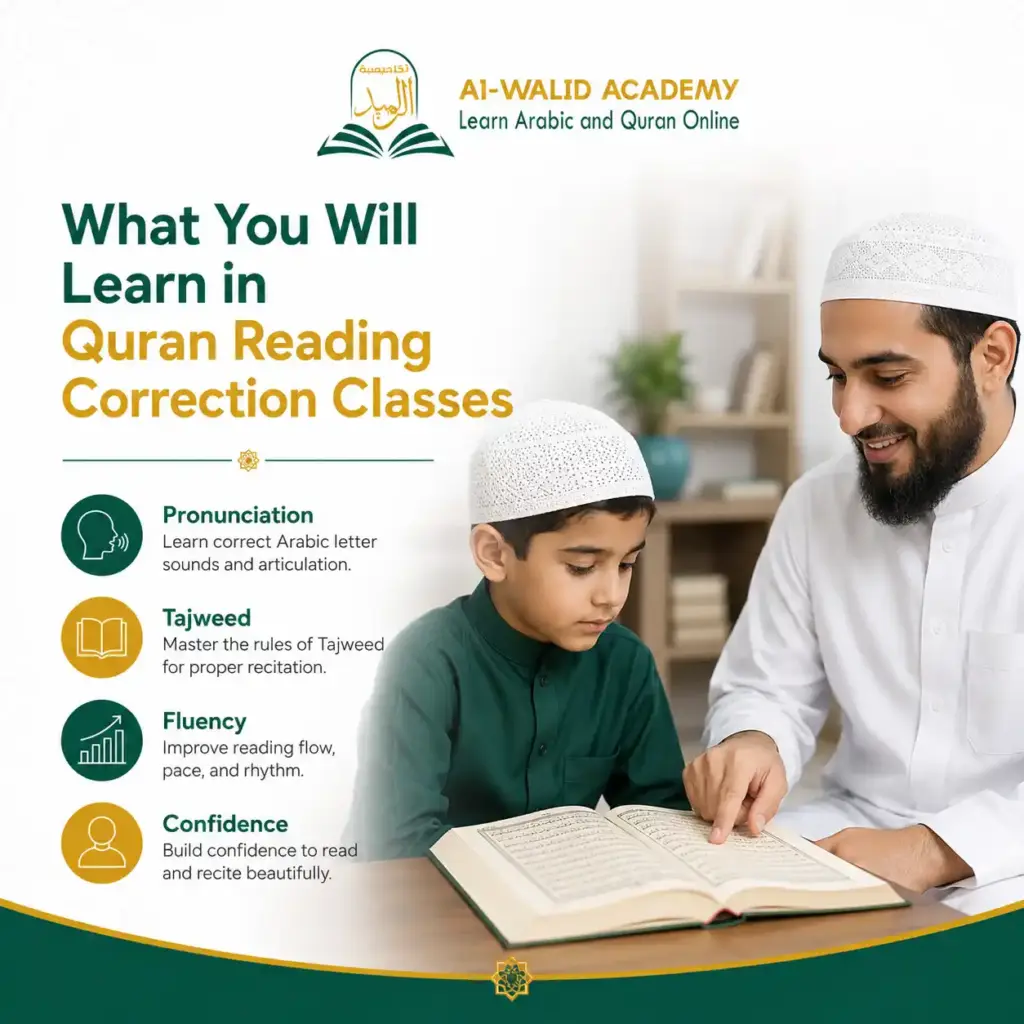
Quran Reading Correction Classes focus on building accurate and strong recitation skills by employing strategies that combine correct pronunciation and mastery of the rules of tajweed with continuous practice and assessment.
-
Correct Pronunciation of Arabic Letters
This is the first step in the learning process, through which students learn the following:
- Recognising Sifaat al-Huroof and their various positions within a sentence.
- Pronouncing letters with all their vowel marks.
- Distinguishing between letters with similar points of articulation.
- Producing clear sounds for Arabic letters in standard Arabic, without being influenced by their mother tongue.
-
Application of the Rules of Tajweed
The application of the rules of tajweed, ranging from the basics to more detailed rules, depends on the student’s level. These rules generally involve practising the following:
- Elongation: Types of Madd, how to apply them, and the duration of elongation for each type.
- Ghunnah.
- The letters of qualqala.
- The rules of noon sakina and tanween.
- The rules of waqf and ibtidā’ and how to apply them.
- Training in the correct application of these rules adds enjoyment to recitation and makes the meaning clearer.
-
Practising to improve recitation and make it more fluent
This is achieved by listening to the sheikhs repeatedly, practising recitation consistently, identifying mistakes and working to correct them.
-
Gaining confidence in reciting the Holy Qur’an
Through practice, ongoing support and the correction of mistakes, students gain a great deal of confidence in their recitation and become more receptive to learning and more likely to persevere.
How Quran Reading Correction Classes Work
Quran Reading Correction Classes are interactive sessions that have a significant impact on improving pronunciation and recitation of the Holy Qur’an by providing a structured learning environment that includes the following:
Live one-to-one sessions
These are suitable for beginner students and take place via platforms such as Zoom, with all attention focused on a single student.
What happens during the session?
- The teacher reads the text several times, explaining the rules of tajweed.
- The student then takes their turn to read.
- The teacher corrects any mistakes, whether in the pronunciation of letters or the rules of tajweed.
- The student reads again until they have mastered it.
Key features
- The focus is on a single student, which aids progress; furthermore, the immediate correction of mistakes helps to reinforce and consolidate the correct information.
- The level of study and progress depend on the student’s ability.
- The timetable and frequency of lessons are determined according to the student’s preferences.
Live group sessions
These are suitable for more advanced students and are also held via Zoom or a similar platform; they are characterised by the presence of more than one student at the same time.
What happens during the session?
- The teacher demonstrates correct pronunciation.
- Each student reads aloud once.
- The teacher corrects any mistakes made by the students, which are usually few given their advanced level.
Key features
Provides a supportive environment whilst offering the opportunity to learn from others’ mistakes.
Continuously monitoring progress
Monitoring progress is an essential part of the success of recitation correction lessons, and this is achieved by:
- Providing summaries on pronunciation and the rules of tajweed after each lesson.
- Monthly reports and periodic tests to assess the student’s level and identify areas for improvement.
- Providing notes and mind maps to aid memorisation.
Benefits of Online Quran Reading Correction Classes
Online recitation correction courses offer a modern and effective way to improve recitation with precision and professionalism, whilst saving time and effort, through:
- Convenience and time-saving: the ability to learn comfortably and safely from home, in a quiet and flexible environment suitable for all ages.
- Saving effort: Instead of travelling, How to Learn Quran with Tajweed at Home frees up more time for training and practice.
- Flexible scheduling: The Qur’an lessons are designed to suit busy lifestyles and schedules, allowing you to choose a suitable time and the number of sessions per week.
- Studying with qualified teachers: Given the difficulty of finding professional teachers abroad, access to qualified teachers online is essential.
Who Can Join Quran Reading Correction Classes?
Recitation correction lessons are suitable for all ages and levels, including:
Children
Quran lessons for Kids online are designed to be interactive and engaging for children, with a focus on building a solid foundation in Arabic letters and the rules of tajweed in a way that is appropriate for children.
Beginners
Suitable for beginners who have just started learning the Arabic alphabet and the ‘Qawa’id al-Nouraniyyah’ (Nouran rules), these lessons provide an ideal opportunity for them to apply these rules and improve their recitation.
Intermediate learners
For those who already have practical knowledge of:
- The Arabic alphabet and its pronunciation.
- As well as the basic rules of tajweed.
These lessons are an ideal next step for them to build on their knowledge and acquire new information.
New Muslims
It serves as a complete journey of faith, providing a supportive New Muslim Convert Guide environment in which they can learn:
- The shapes and characteristics of the letters.
- How to pronounce the letters with different vowel marks.
- The basic rules of tajweed.
With practice and consistent effort, they begin to gain confidence in reading the Holy Qur’an, and the process becomes much easier.
Tips to Improve Faster in Quran Reading Correction Classes
Consistent practice and steady progress are the foundation of real progress and tangible results. Here are some tried-and-tested tips from Al-Waleed Academy:
- Set aside time each day for recitation: Make recitation part of your daily routine; you don’t need to set aside a long period of time – half an hour a day is enough to ensure progress, provided you stick to it.
- Listen to skilled reciters: Make a habit of listening to professional reciters to train your ear to recognise correct pronunciation; this will also make memorisation easier later on.
- Record your recitation: Record your recitation and review it yourself before presenting it to others, as this helps you identify and correct mistakes.
- Prioritise accuracy over speed: Do not focus on the speed of your progress or on achieving results, especially at the beginning; simply concentrate on accuracy and consistency.
What Makes AL-Walid Academy the Right Choice?
- We have professional teachers with extensive teaching experience across all levels
- We offer flexible timetables to suit even the busiest schedules
- We offer trial lessons before final enrolment
- Optimised teaching plans that combine quality, proficiency and speed
- Teachers with complete mastery of the English language
- Lessons are offered at competitive prices, with ongoing special offers
- Teaching using the latest methods and interactive techniques.
Conclusion
Ultimately, the Quran Reading Correction Classes are not merely traditional lessons on reciting the Book of Allah; rather, they are a holistic journey in which we engage sincerely with the Book of Allah. Through them, we learn correct pronunciation, the application of the rules of tajweed, recitation skills, and self-discipline, all of which help us to appreciate the beauty of the Quran and the sweetness of correct recitation.
FAQS
Do I need to know Tajweed before joining?
No, you do not need prior Tajweed knowledge. The teacher will guide you step by step according to your level.
Are the classes one-to-one or in groups?
The classes are usually one-to-one, so each student gets personal attention and direct correction from the teacher.
What will I learn in Quran Reading Correction Classes?
You will learn correct pronunciation of Arabic letters, reading fluency, Tajweed basics, and how to avoid common recitation mistakes.
Can beginners join these classes?
Yes, beginners can join. The lessons are personalized and can start from the very basic level.
Are the classes online?
Yes, the classes are conducted online, making it easy for students to learn from home with flexible scheduling.
How long does it take to improve Quran reading?
Improvement depends on the student’s level, consistency, and number of weekly lessons, but regular practice usually leads to clear progress.
Do you offer classes for kids and adults?
Yes, Quran Reading Correction Classes are available for both kids and adults.
Can I take a trial class first?
Yes, many academies offer a free or trial class so students can experience the teaching style before enrolling.