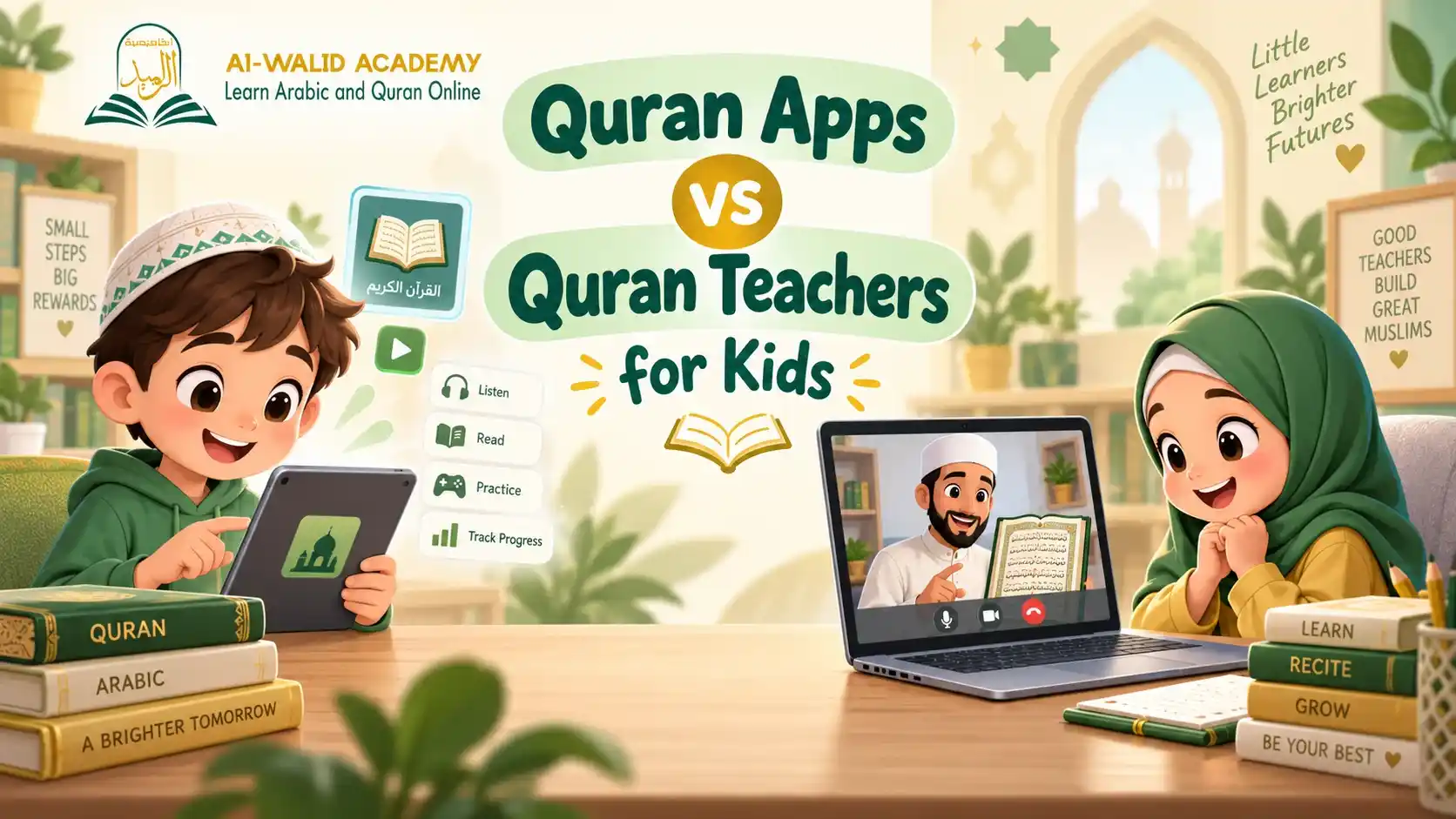

Quran Apps vs Quran Teachers for Kids is an important comparison for parents who want to choose the right Quran learning method for their children. Quran apps offer flexibility, interactive activities, audio recitation, and convenient daily practice, while qualified Quran teachers provide personalized guidance, pronunciation correction, Tajweed instruction, and motivation.
In this article, we will compare both options, explain their strengths and limitations, and help you decide which approach—or combination—best suits your child’s age, learning level, and Quran education goals.
Quran Apps vs Quran Teachers for Kids: What Is the Difference?
Quran learning apps are designed to make Quran study accessible through smartphones, tablets, or computers. Many include Quran reading tools, audio recitations, translations, memorization features, quizzes, and repetition exercises. They can make independent practice easier and more convenient.
A Quran teacher, however, provides direct human interaction. The teacher can listen to the child, identify mistakes, explain difficult concepts, adjust the lesson according to the child’s level, and provide immediate feedback.
Therefore, Quran Apps vs Quran Teachers for Kids is not necessarily about choosing one and completely rejecting the other. In many cases, the most effective approach combines professional teaching with technology-supported practice.
What Can a Quran App Teach Your Child?
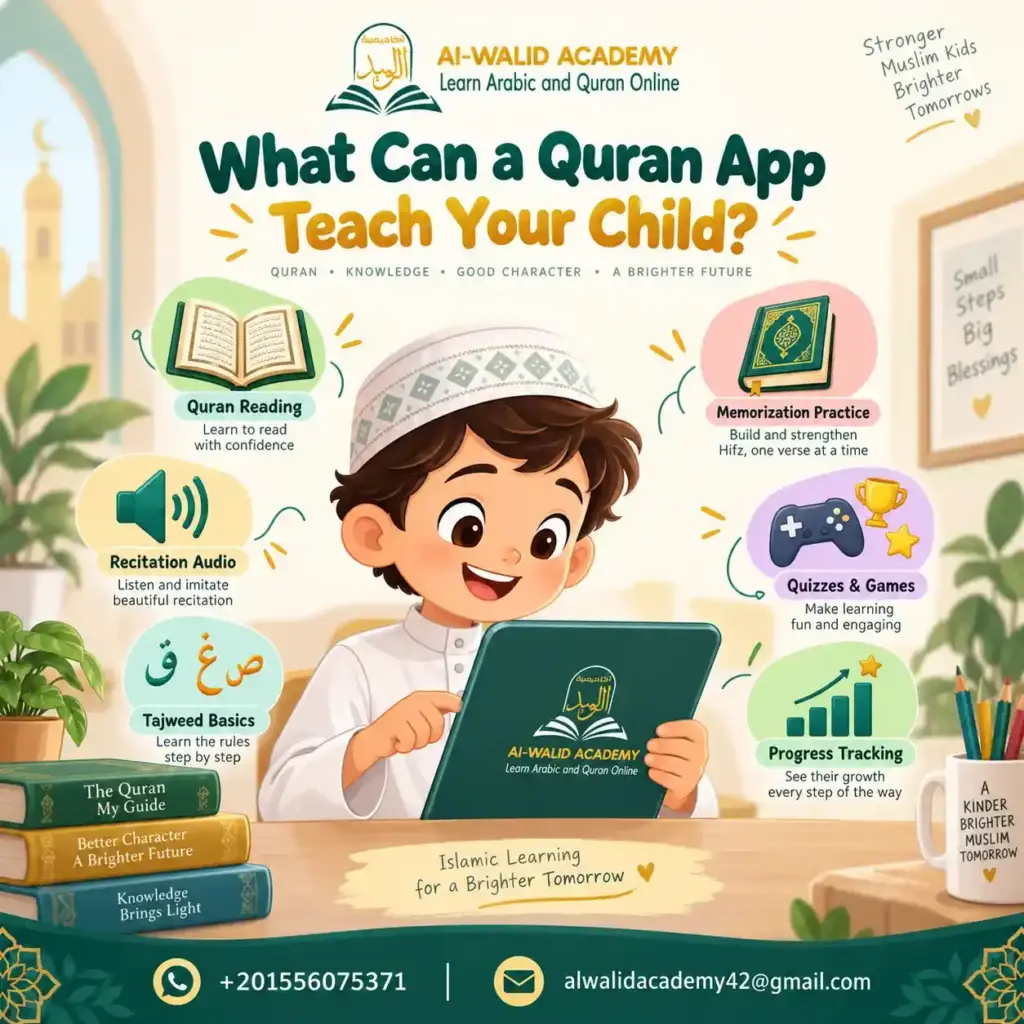
A good Quran app can introduce children to several important aspects of Quran learning. Depending on the application, children may be able to:
- Learn Arabic letters.
- Practice letter pronunciation.
- Read Quranic verses.
- Listen to professional recitations.
- Repeat verses for memorization.
- Review previously memorized passages.
- Learn basic Tajweed rules.
- Practice independently.
- Track their learning progress.
How to start learning the Arabic Language? For beginners, some apps can provide a simple introduction to Arabic letters and Quran reading. Interactive activities can also make practice more enjoyable for children who are comfortable using technology.
However, parents should understand that an app generally follows predetermined content and cannot always respond to an individual child’s specific mistakes.
When Quran Apps Work Well for Daily Practice
The biggest advantage of an app is accessibility. A child can practice for a few minutes almost anywhere without waiting for a scheduled lesson.
For example, parents can encourage their children to spend 10–15 minutes listening to a short Surah, repeating verses, or reviewing previously memorized material. This regular exposure can help children maintain consistency.
In the discussion of Quran Apps vs Quran Teachers for Kids, apps are particularly useful as a supplement to formal lessons. They can reinforce what the child has already learned with a teacher and provide additional opportunities for repetition.
Apps can also be useful during travel, weekends, school breaks, or other situations when attending a live lesson may not be possible.
Where Quran Apps Fall Short for Young Learners
Although Quran apps have many benefits, they have limitations. Young children often need encouragement and personal attention to remain focused. An app may provide instructions, but it cannot always understand why a child is struggling.
For example, a child may consistently pronounce an Arabic letter incorrectly. The app may recognize some errors, but it may not explain how to position the tongue or adjust the pronunciation in the same detailed way a qualified teacher can.
This is one of the most important considerations when evaluating Quran Apps vs Quran Teachers for Kids. Technology can support learning, but human instruction is especially valuable when accurate pronunciation and Tajweed are priorities.
What Does a Quran Teacher Provide That an App Cannot?
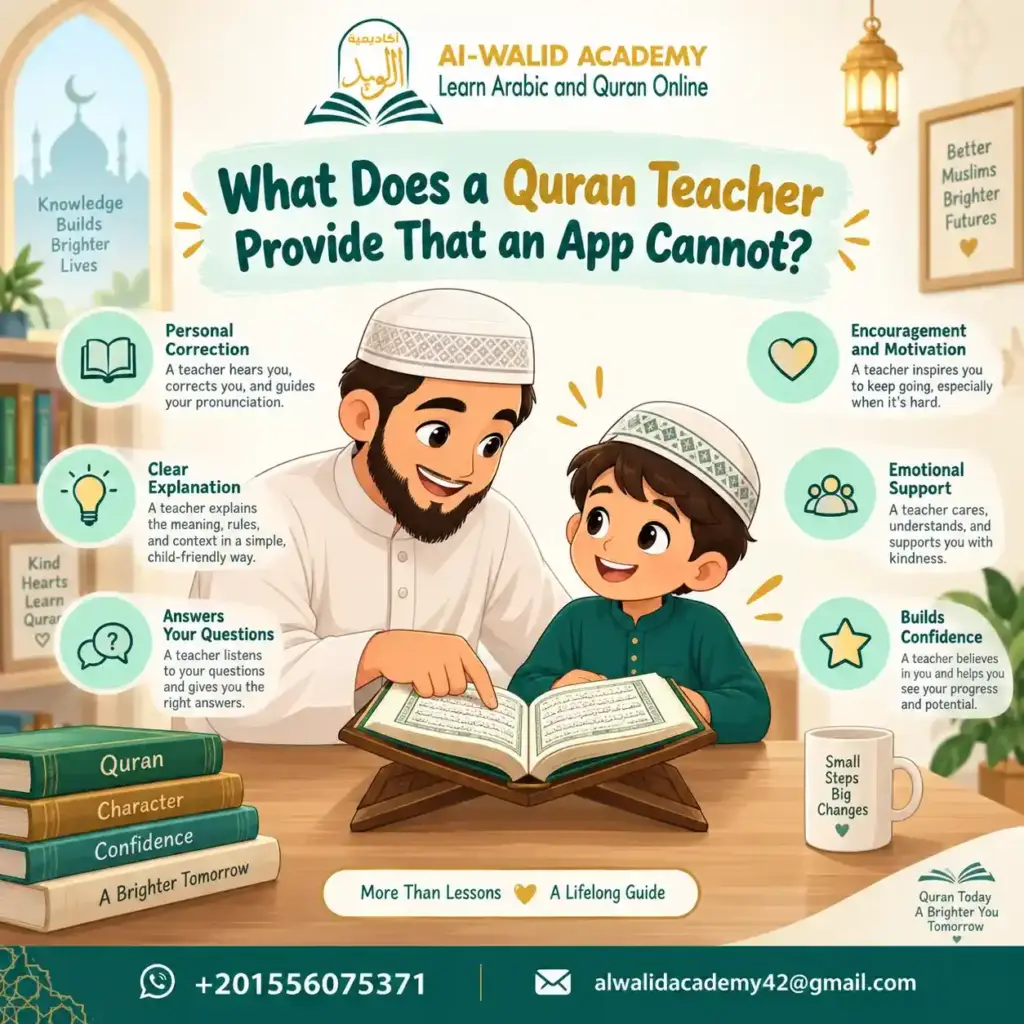
A qualified Quran teacher can create a learning experience around the individual child. Instead of giving every learner the same sequence of activities, the teacher can adapt lessons based on the child’s abilities and progress.
A teacher can:
- Listen carefully to recitation.
- Correct pronunciation immediately.
- Explain Tajweed rules.
- Identify recurring mistakes.
- Adjust the lesson difficulty.
- Encourage the child when learning becomes difficult.
- Answer questions.
- Monitor memorization.
- Create a personalized revision plan.
- Help develop consistent learning habits.
For many children, this personal relationship makes Quran learning more engaging and meaningful.
Live Pronunciation and Tajweed Correction
Correct pronunciation is an essential part of Quran learning. Children need to learn how Arabic letters are articulated and how Quranic words should be pronounced.
A live teacher can listen carefully to a child’s recitation and immediately point out mistakes. The teacher can repeat the correct pronunciation and ask the child to try again until the sound improves.
When considering Quran Apps vs Quran Teachers for Kids, this real-time correction is one of the strongest advantages of learning with a teacher. While some applications offer speech recognition or audio comparison, these features may not replace detailed guidance from a qualified instructor.
Personalized Feedback Based on Your Child’s Mistakes
Every child learns differently. Some children quickly recognize Arabic letters but struggle with connecting them. Others may read well but need more support with Tajweed. A teacher can identify these individual needs and adapt the lesson accordingly.
For example, if a child repeatedly confuses two Arabic letters, the teacher can create additional exercises specifically for those letters. The child can then practice them until the confusion decreases.
This level of personalization is an important factor in Quran Apps vs Quran Teachers for Kids, particularly for children who need extra support or have specific learning difficulties.
How to choose the right Quran teacher? Contact Al Walid Academy now, and we will help you to choose the best Quran teacher for your kids.
Can a Quran App Correct Your Child’s Recitation Accurately?
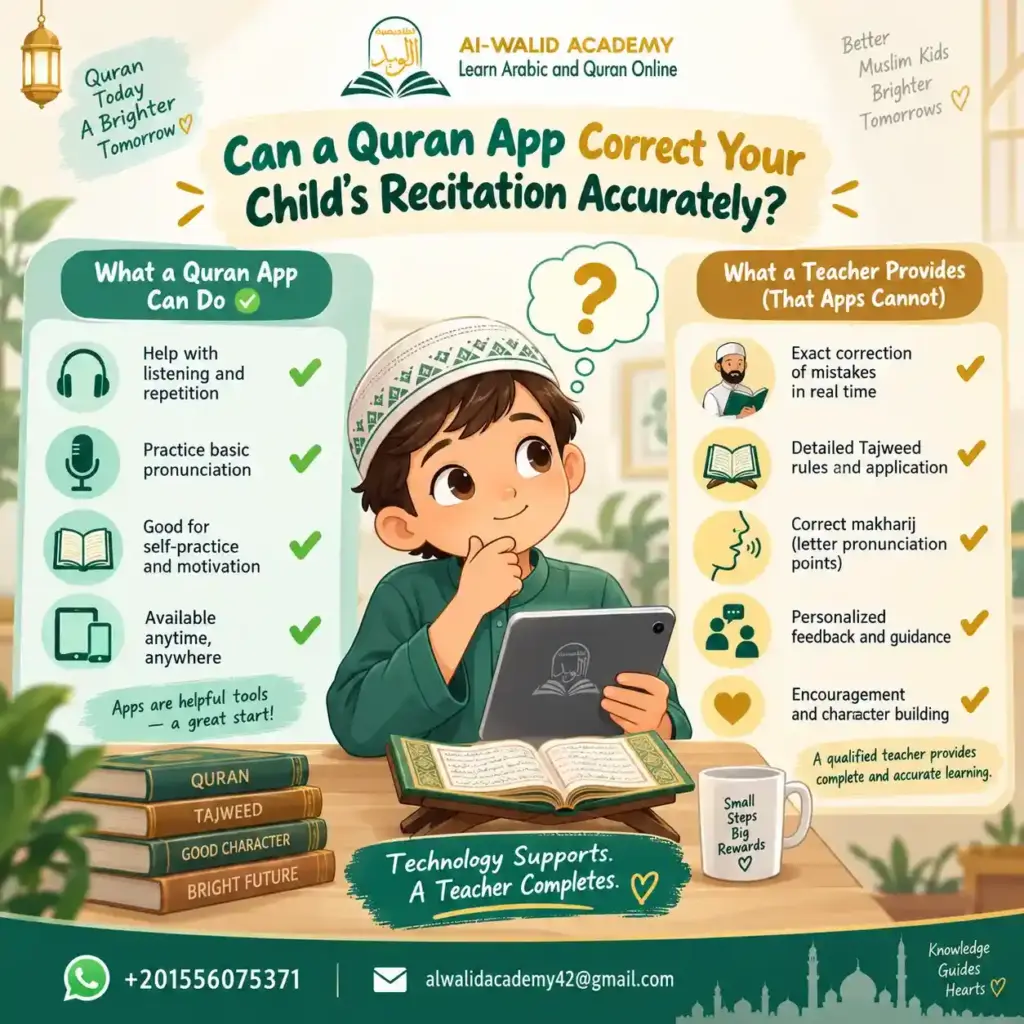
Some modern Quran apps provide pronunciation tools, audio playback, and speech-recognition features. These can be helpful for practice, especially when children want to listen to a verse and repeat it.
However, parents should be cautious about relying entirely on automated correction. Quran recitation involves detailed pronunciation and Tajweed rules that may require human evaluation.
An app can tell a child what the correct recitation sounds like, but a qualified teacher can explain why a particular pronunciation is incorrect and how to correct it.
Therefore, Quran Apps vs Quran Teachers for Kids should be viewed in terms of their different strengths. Apps are excellent for listening and repetition, while teachers are better suited to personalized correction and instruction.
Which Is Better for Beginners Learning Noorani Qaida?
For children who are completely new to Quran reading, the Online Noorani Qaida course provides a structured foundation for learning Arabic letters, vowel sounds, combinations, and basic reading skills.
A teacher can guide the child through each stage and make sure they understand the lesson before moving forward. This is particularly important because mistakes learned during the early stages can become difficult habits later.
Apps can help children review letters and sounds, but a teacher can observe the child’s performance and determine whether they are genuinely ready for the next level.
For this reason, Quran Apps vs Quran Teachers for Kids often favors teacher-led learning during the beginner stage, while apps can provide useful additional practice.
Which Is Better for Quran Reading and Tajweed?
If the primary goal is accurate Quran reading and Tajweed, direct instruction from a qualified teacher is highly beneficial.
Our Tajweed course involves rules concerning pronunciation, elongation, stopping, starting, characteristics of letters, and other aspects of Quranic recitation. Children may understand basic rules through an app, but applying those rules correctly requires practice and feedback.
A teacher can listen to the child read an entire passage and identify mistakes that might otherwise go unnoticed.
Therefore, when parents evaluate Quran Apps vs Quran Teachers for Kids, a teacher is generally the stronger choice for developing accurate recitation, while an app can be used for additional listening and practice.
Look at: Quran Reading Correction Classes
Which Is Better for Hifz and Daily Revision?
Both tools can support Quran memorization. Apps are particularly convenient for repeating verses and listening to the same recitation several times.
A child can use an app to listen to a Surah, repeat each verse, and review previously memorized passages. This can make daily revision easier.
However, a teacher can monitor whether the child has memorized the passage accurately rather than simply recognizing it from repeated listening. A teacher can also organize a revision schedule that balances new memorization with older portions.
In Quran Apps vs Quran Teachers for Kids, apps are therefore excellent for repetition, while teachers provide accountability and accurate assessment.
Learn more about: Daily Quran Memorization Schedule
Is a Quran App Enough for a Child to Learn Independently?
For older children who already have strong Quran reading skills, an app may provide enough resources for independent revision and practice.
For young beginners, however, completely independent learning may not be ideal. Children may misunderstand instructions, develop incorrect pronunciation, or move ahead before mastering the fundamentals.
Parents should also consider motivation. Young learners often need someone to encourage them and keep them focused.
The comparison of Quran Apps vs Quran Teachers for Kids shows that independence can work well for practice, but guided learning remains valuable for building a strong foundation.
Learn more: How to start the Quran for beginners
Should Your Child Use a Quran App and a Teacher Together?
In many families, combining both options can provide the best learning experience.
A child can attend structured lessons with a qualified teacher and then use an app for practice between classes. For example, the teacher can introduce a new Surah or Tajweed rule during the lesson, while the child uses an app afterward to listen and repeat.
This approach combines human guidance with the convenience of technology.
When considering Quran Apps vs Quran Teachers for Kids, parents do not always have to choose only one. A balanced approach can give children personalized instruction while encouraging regular independent practice.
How to Use an App Between Quran Lessons
Parents can create a simple routine for using an app between lessons:
- Review the lesson taught by the teacher.
- Listen to the correct recitation.
- Repeat the assigned verses.
- Practice difficult words.
- Review previously memorized Surahs.
- Avoid learning new rules without guidance when the child is still a beginner.
The app should reinforce the teacher’s lesson rather than replace it.
What Should Be Practiced With a Teacher?
Live lessons should focus on areas where personal feedback is most important. These may include:
- Arabic letter pronunciation.
- Noorani Qaida exercises.
- Quran reading.
- Tajweed application.
- Memorization assessment.
- Recitation correction.
- Difficult verses.
- Revision planning.
This division of responsibilities makes Quran Apps vs Quran Teachers for Kids less of a competition and more of a combination of useful learning resources.
Quran App or Quran Teacher: Which Fits Your Child Best?
The right choice depends on your child’s needs and learning objectives.
| Child’s Need | Quran App | Quran Teacher |
| Daily practice | Excellent | Excellent |
| Listening to recitation | Excellent | Good |
| Pronunciation correction | Limited | Excellent |
| Personalized lessons | Limited | Excellent |
| Tajweed feedback | Basic to moderate | Excellent |
| Memorization practice | Excellent | Excellent |
| Motivation | Limited | Excellent |
| Flexible practice | Excellent | Depends on schedule |
| Beginner guidance | Helpful | Excellent |
| Independent revision | Excellent | Helpful |
Overall, Quran Apps vs Quran Teachers for Kids should be decided according to the child’s learning stage. Apps are convenient and engaging, while teachers provide structure, accountability, and personalized correction.
Why Parents Choose Al Walid Academy for Online Quran Classes for Kids
For parents who want professional guidance without giving up the convenience of online learning, Al Walid Academy can provide a structured environment for children to learn the Quran from home. We also provide:
1. Qualified and Friendly Quran Teachers
Children learn with qualified instructors who can guide them through Quran reading, memorization, and Tajweed while providing personal feedback and encouragement.
2. Personalized One-to-One Classes
Al-Walid Academy offers one-to-one Quran courses online, allowing the teacher to focus on your child’s individual level, learning pace, and specific needs.
3. Quran, Tajweed, and Memorization
The kids’ program covers basic Quran recitation, memorization, and Tajweed rules, helping children develop accurate reading skills step by step.
4. Suitable for Different Ages and Levels
Lessons are personalized according to the child’s age and current Quran-learning level, making the classes suitable for beginners as well as children who already have Quran-reading skills.
5. Flexible Online Learning
Children can learn from home through live online classes, making Quran education easier to fit around school, family commitments, and different time zones.
6. Free Trial Class
Parents can try an initial free class to experience the teaching approach before committing to the program.
Conclusion
Both technology and traditional teaching have an important role in modern Quran education. Quran apps make practice accessible, flexible, and engaging, while qualified teachers provide the personal guidance children need to develop accurate reading, Tajweed, and memorization skills.
Ultimately, Quran Apps vs Quran Teachers for Kids is not simply a choice between technology and teachers. For many children, the most effective solution is to learn with a qualified teacher and use a Quran app as a supporting tool for daily practice and revision.
Give your child the guidance they need to build a strong relationship with the Quran. Enroll in Al Walid Academy’s online Quran classes for kids and make Quran learning structured, engaging, and convenient from home.
Frequently Asked Questions
Can Quran Apps Replace a Quran Teacher for Kids?
For some types of independent practice, apps can be very useful. However, they may not fully replace a qualified teacher, especially for beginners who need pronunciation, Tajweed, and personalized feedback.
What Age Can Children Start Using Quran Learning Apps?
Children can begin using Quran learning apps when they are developmentally ready to interact with digital learning tools. Younger children usually benefit from parental supervision and teacher-led instruction.
Are Quran Apps Good for Quran Memorization?
Yes. Quran apps can be useful for listening, repetition, and daily revision. However, a teacher should ideally assess the child’s memorization and correct recitation mistakes.
How Often Should a Child Learn With a Quran Teacher?
The ideal frequency depends on the child’s age, level, goals, and available schedule. Regular lessons combined with short daily practice can help children build consistency.