

Learning Tajweed rules is an essential step for anyone who wants to recite the Quran correctly, and this is where the importance of the Iqlaab Rule in Tajweed comes in. This rule is one of the key rules related to Noon Saakinah and Tanween, and it has a direct impact on proper pronunciation during recitation.
What Is Iqlaab Rule in Tajweed?
Understanding the Iqlaab Rule in Tajweed starts with knowing the basics of Noon Saakinah and Tanween, since this rule is directly connected to them.
Noon Saakinah is the letter Noon (ن) without any vowel—no Fatha, Kasra, or Dammah. In the Quran, it may appear with a visible Sukoon (ْ) above it, or sometimes with no sign at all. In both cases, the pronunciation is the same, and it is still called Noon Saakinah.
Tanween represents an extra Noon Saakinah sound added to the end of a word through double vowels (ً / ٍ / ٌ). Although Tanween appears as vowel markings in writing, it is pronounced as a Noon Saakinah during recitation.
There are four main rules of Noon Saakinah and Tanween, and each rule depends on the letter that comes after them:
- Izhar
- Ikhfa
- Idgham
- Iqlaab
The last of these rules is Iqlaab, which is the main focus of this article.
Apply Iqlaab rules step by step in Quran courses online from the comfort of home.
Definition of the Iqlaab Rule
The Arabic word Iqlaab (إقلاب) literally means to change or transform. In Tajweed, this meaning is applied practically by changing the sound of one letter into another under a specific condition.
In the Iqlaab Rule in Tajweed, the sound of Noon Saakinah or Tanween is changed into a hidden, unstressed Meem, accompanied by a light nasal sound (Ghunnah).
This change happens because pronouncing Noon directly before the letter Baa can be difficult due to the distance between their articulation points. Scholars replaced the Noon sound with Meem because:
- Meem and Baa have close articulation points.
- Meem and Noon are close in terms of Ghunnah.
This makes Quran recitation smoother, lighter on the tongue, and more pleasant to hear.
Interestingly, a similar sound change exists in languages such as English, French, and Latin, where a Noon sound naturally shifts to a Meem sound before certain consonants.
Read about: What Is Sukoon In Tajweed
When Does Iqlaab Occur?
The Iqlaab rule applies in only one specific case, with no exceptions. The single condition is that Noon Saakinah or Tanween comes directly before the letter Baa (ب). This applies whether they appear:
- In the same word.
- Or across two separate words.
If the letter following Noon Saakinah or Tanween is not Baa, a different Tajweed rule—such as Ikhfa or Idgham—will apply instead.
Apply Iqlaab correctly in every verse with our Tajweed Course.
Noon Saakinah or Tanween Before Baa
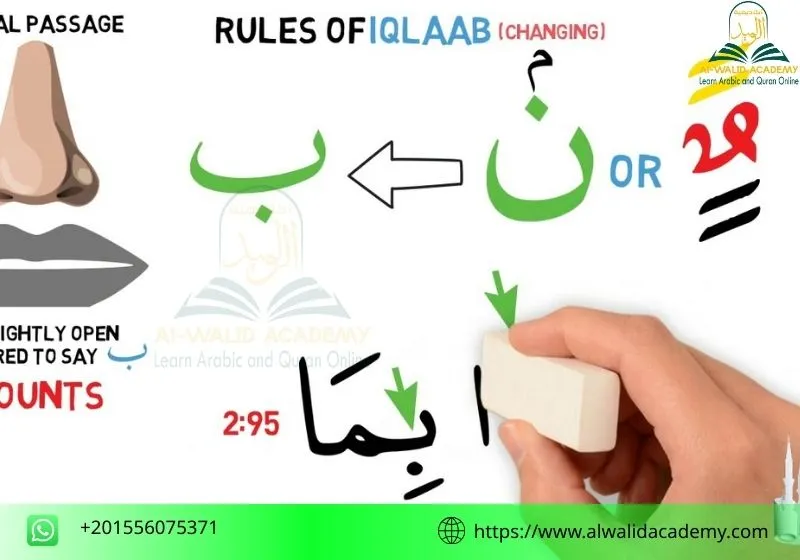
This is the core situation where Iqlaab must be applied.
Whenever you see Noon Saakinah (نْ) or Tanween followed by the letter Baa (ب), the Iqlaab Rule in Tajweed should be applied immediately.
In this case:
- The Noon sound is not pronounced clearly.
- It changes into a fully hidden Meem.
- A light Ghunnah is produced for about two counts.
Examples from the Quran
- (مِنْ بَعْدِ) Min Ba‘di → Pronounced as: Mim Ba‘di
(From after). - (مَنْ بَدَّلَ) Man Baddala → Pronounced with a hidden Meem and Ghunnah (Whoever changes).
- (فِيمَا أَنْبَأَ) Feema Anba’a → Iqlaab is applied before the letter Baa.
While applying Iqlaab:
- Focus on producing the Ghunnah from the nose.
- Keep the Meem hidden, not clearly pronounced.
- Maintain a smooth and connected sound.
When applied correctly, Iqlaab makes Quran recitation flow smoothly and sound natural, just as it was transmitted by skilled reciters.
| Type of Iqlaab | Explanation | Examples |
| Iqlaab with Noon Saakinah | Iqlaab occurs when a Noon Saakinah (نْ) is followed by the letter Baa (ب). The Noon sound is changed into a hidden Meem (م) with a light nasal Ghunnah. | – فَكَانَتْ هَبَاءً مُنْبَثًّا → Fakanat Haba’an Munbatha.- وَالصَّاحِبِ بِالْجَنبِ → Was-Sahibi Bil-Janbi- وَأَمَّا مَنْ بَخِلَ وَاسْتَغْنَى → Wa Amma Man Bakhila Was-Taghna- لَنَسْفَعًا بِالنَّاصِيَةِ → Lan Saf‘an Bin-Nasiyah. |
| Iqlaab with Tanween | Iqlaab happens when any type of Tanween (Fathah, Kasrah, or Dammah) is followed by the letter Baa (ب). The Tanween sound is changed into a hidden Meem (م) with a light Ghunnah. | – وَاللَّهُ سَمِيعٌ بَصِيرٌ → Wallahu Sami‘un Baṣir- ذُرِّيَّةً بَعْضُها مِنْ بَعْضٍ → Dhurriyyatan Ba‘duha Min Ba‘d (Tanween Fathah before Baa)- وَأَنبَتْنَا فِيهَا مِن كُلِّ زَوْجٍ بَهِيجٍ → Wa Anbatna Fīha Min Kulli Zawjin Bahij (Tanween Kasrah before Baa) |
Learn more about: Noon Saakin Rules
Learn Quran, Arabic, and Islamic Studies with certified teachers in fun, interactive, and personalized sessions. Join thousands of students around the world and begin your path today!
How Iqlaab Is Applied in Recitation
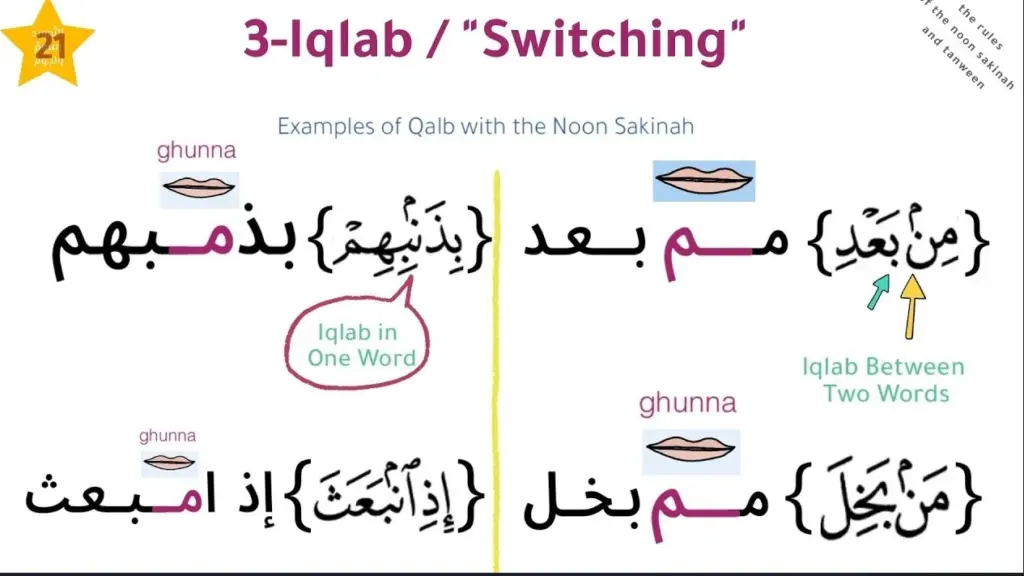
Applying the Iqlaab Rule in Tajweed is not just a theoretical rule; it also has practical steps that make your recitation smoother and more beautiful.
The rule applies whenever Noon Saakinah or Tanween comes before the letter Baa (ب), turning the Noon sound into a hidden Meem with a light Ghunnah.
This guide is designed to help you apply the rule practically, with examples and tips from the Quran, making it easier than ever to recite correctly.
Perfect your Iqlaab Rule in Tajweed while learning proper Quran Recitation Course techniques.
Changing Noon Sound to Meem
During recitation, Iqlaab occurs automatically when Noon Saakinah or Tanween meets the letter Baa (ب).
At this moment, the Noon sound is converted into a hidden Meem, making the pronunciation smooth without any stops or heaviness.
How to apply it correctly: Read the Noon as if it is a Meem Sakinah, but keep it hidden from the lips and produce the Ghunnah lightly from the nose so the recitation flows like water.
Examples:
- (أَنْبَأَكَ) (Surah Al-Baqarah: 119) → أَمْبَأَكَ (Anba’aka → Amba’aka).
- (مِنْ بَيْنَهُمْ) (Surah Al-Imran: 167) → مِمْبَيْنَهُمْ (Min Baynahum → Mim Baynahum).
Notice that the Noon is not pronounced fully, nor do you press the lips like in Idgham, but you make a light concealment with a slight nasal Ghunnah.
Read about: Meem Sakinah Rules
How to Pronounce Iqlaab?
While reciting the Quran, when you encounter Noon Saakinah or Tanween followed by the letter Baa (ب), remember that the Noon sound is not pronounced normally.
Instead, it is transformed into a hidden Meem with a light nasal Ghunnah. This change produces a sound similar to Meem (م), with a soft nasal emphasis.
The letter Baa is the only letter that triggers this rule, making it a unique aspect to recognize for proper recitation.
Improve Quranic Arabic reading with a focus on Iqlaab in the Quranic Arabic Course.
Practical example from the Quran:
(وجَعَلْنَا مِنْۢ بَیْنِ اَیْدِیْهِمْ سَدًّا وَّمِنْ خَلْفِهِمْ سَدًّا فَاَغْشَیْنٰهُمْ فَهُمْ لَا یُبْصِرُوْنَ) (Ya-Sin: 9)
The Noon in “من بَيْنِ” is followed by Baa at the beginning of the next word, Pronunciation with Iqlaab: “مِمْ بَيْنِ” with a light Ghunnah, Min Baiyni → Mim Baiyni.
Applying Ghunnah Correctly
Ghunnah is the nasal sound produced from the nose, not the mouth or throat.
In Iqlaab, the Ghunnah lasts about two counts, enough to give a nasal quality without turning into Idgham.
How to apply:
- Focus on producing Ghunnah from the nose while changing Noon to Meem.
- Keep the Meem hidden and short before the Baa.
- Listen to recitations by famous Qaris like Sheikh Al-Husary and focus on the light Ghunnah to avoid common mistakes:
- Pronouncing Noon instead of Meem.
- Hiding Meem without Ghunnah.
Practical Ghunnah examples:
(إِنْ بَرِزُوا) (Surah Al-Fath: 11) → إِمْبَرِزُوا (In Barazu → Imbarazu)
Applying Ghunnah correctly ensures the recitation is smooth, natural, and beautiful, maintaining clarity of letters and ease of pronunciation.
Why Iqlaab is Important in Recitation?
- Makes the transition between letters smoother and easier.
- Prevents heavy or broken pronunciation between Noon and Baa.
- Preserves the beauty and melody of the recitation.
- Brings the recitation closer to the style of the early Quran reciters.
Practice hidden Meem and Ghunnah in your Quran Memorization Course to improve Iqlaab.
How to Recognize Iqlaab in the Mushaf
How do you know where Iqlaab should be applied while reading the Mushaf?
In printed Qur’ans, Iqlaab is clearly shown with a small sign above the Noon Saakinah or Tanween, which reminds you to change the sound to a hidden Meem before the letter Baa.
In some tajweed-coded Qur’ans, you may see colored letters, small signs, or explanatory notes that indicate when Noon or Tanween should be converted into a Meem sound.
If your Mushaf doesn’t show any signs, just use this rule: whenever Noon Saakinah or Tanween is immediately followed by Baa, apply Iqlaab.
The Small Meem Sign
The main sign is a small Meem (مْ) above the Noon Saakinah or above the Fathah/Kasrah/Dammah of Tanween before the letter Baa. This is not just decoration, it’s a clear tajweed indication.
Here’s steps to recognize it:
- Look for Noon Saakinah or Tanween (ً ٍ ٌ).
- Check if it’s followed immediately by Baa (ب).
- If there is a small Meem sign above it, apply Iqlaab immediately with a light Ghunnah.
In short: the small Meem sign above the Noon or Tanween before Baa is your practical guide to apply Iqlaab easily and smoothly during recitation, whether in a regular Mushaf or a tajweed-coded Mushaf.
Adults can master Iqlaab Rule in our Quran Classes For Adults.
Common Mistakes in Applying Iqlaab
Many learners make simple mistakes while applying Iqlaab, but these can affect the beauty of the recitation. Heres the most common errors and gives practical corrections with real Quranic examples so you can improve your recitation immediately.
Forgetting Ghunnah
One of the most frequent mistakes is forgetting the Ghunnah. Without Ghunnah, Iqlaab becomes just a normal concealment and the Noon sound isn’t properly transformed into a hidden Meem. Ghunnah gives the sound a soft, resonant tone from the nose.
Practical examples:
“مِنْ بَيْنِهِمْ” (Surah Al-Imran: 167)
- Wrong: Mim Baynahum without Ghunnah → the sound is dry.
- Correct: add a light Ghunnah for two counts → Mim Baynahum.
Practice the Ghunnah alone first, like m-m-m from the nose before connecting it to Baa.
Ladies can refine their Iqlaab and Ghunnah in Quran Classes for Ladies.
Mispronouncing the Meem Sound
Another common mistake is pronouncing the Meem too clearly or pressing the lips like a normal Meem, instead of keeping it hidden. This makes the recitation heavy and not smooth.
Practical examples:
“إِنْ بَعْدَهُمْ” (Surah As-Saffat: 22)
- Wrong: In Ba’dahum or Im Ba’dahum with an open Meem.
- Correct: Meem fully hidden with a light Ghunnah → Im Ba’dahum.
Correction tips:
- Keep your lips lightly closed.
- Let the sound come from the inner cheeks like a soft whisper, not from the lips.
- Ghunnah should last about two counts only.
Other Common Mistakes to Watch Out For
- Pronouncing Noon Saakinah as it is, instead of converting it to Meem.
- Extending Ghunnah beyond two counts → disrupts the rhythm.
- Confusing Iqlaab with Idgham when the following letter is not Baa → remember: Iqlaab only applies with Baa.
Build a strong Tajweed foundation, including Iqlaab, in our Online Noorani Qaida Course.
Simple Tips to Master Iqlaab
Mastering Iqlaab requires focus and daily practice. With simple exercises, you can smoothly transform Noon Saakinah or Tanween into a hidden Meem with proper Ghunnah, making your recitation fluent and pleasant.
Listening and Repetition Practice
Listening and repeating is the best way to master Iqlaab and perfect your Quran recitation smoothly, so try the following:
- Start slowly: Focus on the small Meem sign above Noon Saakinah or Tanween before Baa and apply the transformation immediately with a light Ghunnah.
- Divide your practice: Recite about 5 verses with Iqlaab daily, record yourself, and compare with recitations of Sheikh Mishary Rashid or other famous reciters — you’ll notice improvement quickly.
- Use apps: Like Quran Companion to listen and repeat. Keep Ghunnah for about two counts only.
- Listen to professional reciters: Like Al-Hussary or Al-Minshawi to naturally mimic Ghunnah and concealment.
Practical exercise:
- Repeat each example about 10 times:
- “مِنْ بَعْدِ” → “مِمْبَعْدِ” (Min Ba’d → Mim Ba’d)
- “إِنْ بَرِزُوا” → “إِمْبَرِزُوا” (In Barazu → Imbarazu)
- Golden tip: practice singing the Iqlaab alone as m-m-m-b before reciting the full verse, 15 minutes daily.
Summary
Iqlaab is an easy but important rule: turning Noon Saakinah or Tanween into a hidden Meem before Baa with light Ghunnah, making the recitation soft and natural.
Key Points to Remember
- Main condition: Noon Saakinah or Tanween + Baa, look for the small Meem sign in the Mushaf.
- How to apply: hidden Meem + Ghunnah about two counts, not Izhar or Idgham.
- Common mistakes: forgetting Ghunnah or pronouncing Meem clearly — avoid them by listening, repetition, and daily practice.
Teaching Tips for Instructors
When teaching beginners:
- Use clear visual examples and highlight Baa after Noon.
- Practice short phrases repeatedly to internalize the transition.
- Emphasize the nasal Ghunnah (two counts) out loud.
- Show the difference between Iqlaab, Izhar, and Idgham so students know when to apply each rule.
Conclusion
Iqlaab is an essential yet simple Tajweed rule applied only when Noon Saakinah or Tanween precedes the letter Baa, transforming its sound into a completely hidden Meem with a light nasal Ghunnah lasting two harakat for smooth, pleasant recitation.
Spot it in the Mushaf via the small Meem symbol above the Noon, avoid common pitfalls like skipping Ghunnah or pronouncing Noon clearly, and master it fast by listening to expert reciters and daily repetition.
The mastery secret? Perfectly flipping Noon to hidden Meem with proper Ghunnah – this elevates your Quran recitation from beginner to professional excellence!
Master the Iqlaab Rule in Tajweed with Al-Walid Academy
If you want to improve your recitation and apply Tajweed rules practically, Al-Walid Academy will help you master the Iqlaab Rule in Tajweed step by step.
You’ll learn the rule not just theoretically, but also practically with real examples from the Quran, correct Ghunnah, and smooth pronunciation like the renowned reciters.
What you’ll benefit from with us:
- Learn the Iqlaab Rule in Tajweed in detail with easy-to-apply examples.
- Understand the correct Ghunnah and hidden Meem pronunciation practically.
- Daily exercises and listening to famous reciters to reinforce your skills.
- Individual guidance from qualified teachers to correct any mistakes in your recitation.
- Online learning available anywhere, anytime that fits your schedule.
Start now! Enroll in Al-Walid Academy and make your recitation accurate, smooth, and beautiful with the Iqlaab Rule in Tajweed, just like the early Quran reciters applied it.
FAQs
What is the difference between Iqlaab and Ikhfa?
Iqlaab changes the Noon or Tanween into a hidden Meem before the letter Baa with Ghunnah, while Ikhfa makes the Noon sound partially hidden before the other 14 letters, sometimes with a slightly longer Ghunnah.
Can Iqlaab happen in the middle of a word?
Yes, Iqlaab can occur inside a word if Noon Saakinah or Tanween comes before the letter Baa. It’s not limited to between words.
How long should the Ghunnah last in Iqlaab?
The Ghunnah in Iqlaab lasts about two counts only, not longer, to keep the sound smooth and natural.
Is Iqlaab only for Quran recitation or in daily Arabic too?
Iqlaab is specific to Quran recitation and does not apply in normal Arabic speech because it’s part of Tajweed rules.
How can beginners check if they applied Iqlaab correctly?
Record your recitation and compare it with famous reciters. Focus on the hidden Meem and make sure the sound is soft, not like a normal Meem.
Are there any exceptions to Iqlaab in Tajweed?
The rule only applies before the letter Baa. Any other letter doesn’t trigger Iqlaab, so this is the most important condition to remember.