
The moment you say ‘Once upon a time…’, a child’s eyes begin to light up, and their focus becomes 100 per cent. All children love stories. And when these stories teach them about Islamic moral stories for children, the impact is even greater and the reward more significant.
In this article, we will discuss examples of many stories that children love, identify the mistakes parents make and how to avoid them, and offer further advice from Al-Walid Academy.
What Are Islamic Moral Stories for Children?
These are stories from our Islamic faith about prophets, righteous men, or even people who disobeyed God and were punished as a result.
They are explained in simple terms with the aim of teaching children a lesson, deterring them from committing an evil act, or encouraging them to perform acts of worship or other good deeds; all presented in a straightforward manner appropriate to the child’s age and level of understanding.
Why Are Islamic Moral Stories Important for Kids?
The use of stories in education has many advantages, including:
- Conveying concepts that may be complex for children in a simple and easy-to-understand way.
- Linking a love of learning about religion, acts of worship, and good morals to something that captures children’s attention, such as the plots of stories.
- Fostering emotional connection and empathy in children.
- Helping to build a strong Islamic character.
- Instilling the values of the Islamic faith in children from an early age.
- Helping children to deal with different situations in the right way.
Read about: Islamic Questions and Answers For Kids
Best Islamic Moral Stories for Children

The stories of the prophets are a great source of wisdom from which we learn about worship, obedience, and patience from people who endured real suffering for the sake of pleasing God.
The Story of Prophet Ibrahim: Trust in Allah
One of the best stories that teaches children about devotion to God and trust in Him.
After Ishmael had grown up and become strong, the time came for him to help his father and rely on him.
God then set a difficult test for Abraham and his son Ishmael: Abraham saw in a dream that he was to sacrifice Ishmael.
When Ibrahim told Isma’il what he had seen, Isma’il responded with nothing but submission to God’s command, saying, ‘Father, do as you are commanded.’
God’s honouring of His prophets Abraham and Ishmael
When God saw their trust in Him and their submission to Him, He sent down a ram, which was sacrificed in Isma’il’s place, and this became a festival for Muslims known as Eid al-Adha.
The Story of Prophet Yusuf: Patience and Forgiveness
The story of Joseph is considered one of the finest stories because it is the only surah that recounts a story in its entirety, from beginning to end.
Joseph suffered greatly at the hands of his brothers, who hated him, threw him into a well, and then sold him into slavery; he was eventually taken to the household of one of the ministers of the Pharaonic state, where he faced great hardship that led to him spending several years in prison.
How did Allah reward His Prophet?
But Allah granted him victory in the end, and he became the ruler of Egypt. He returned to his parents and his brother, and forgave his brothers who had harmed him.
What we learn from the story
is that no matter how long the affliction lasts, relief will inevitably come, as Allah mentions in His words in Surah Yusuf: “ إِنَّهُ مَنْ يَتَقِي وَيَصْبِرْ فَإِنَّ اللَّهَ لَا يُضِيعُ أَجْرَ الْمُحْسِنِين.”
The Story of Prophet Musa: Courage and Faith
The Prophet Moses, the Messenger of God, was born during the reign of Pharaoh, at the very time when Pharaoh had ordered that all newborn boys be killed. However, God revealed to his mother that she should place him in a wooden basket and cast him into the river, so that he might be taken into Pharaoh’s household, where he would be raised and grow up to carry out his mission, fight Pharaoh and spread the worship of God.
However, he and those who believed with him were subjected to great harm and torture at the hands of Pharaoh.
How did Allah reward His Prophet?
As Moses and his people fled, they did not reach the seashore, and some of them thought that their doom was inevitable; but Moses trusted in his Lord and believed that He would save them.
Then the great miracle occurred: the sea parted and dry land appeared, across which Moses and his people crossed. When Pharaoh and his soldiers followed them, the sea closed in and they all drowned.
What we learn from the story
- Trust and reliance on Allah, even when things seem impossible.
- Patience in the face of adversity and confidence that relief is on the way.
- Demonstrating strength and courage when people turn away from the worship of Allah.
Look at: Islamic Education at a Young Age
The Story of Prophet Ayyub: Patience During Hardship
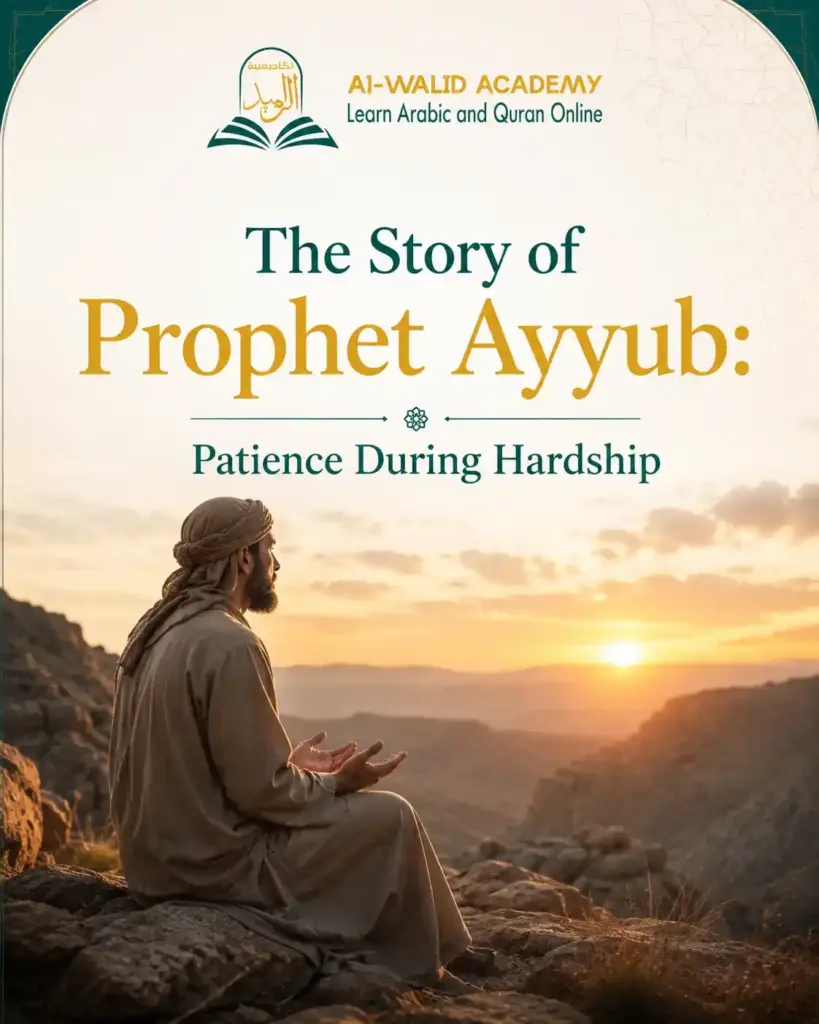
Ayyub, the Prophet of God, was a righteous man who was grateful to God; God had blessed him with abundant provision, a good wife, and many righteous children.
God wished to test him:
- He was afflicted with a severe illness to the extent that his skin fell away, revealing his muscles and bones.
- He lost all his wealth and the land he owned.
- All his children, whose number was fourteen, died.
How did Allah reward His Prophet?
After the affliction had lasted for more than seven years, Ayyub humbly prayed to his Lord to lift the affliction from him.
- God Almighty commanded him to strike the ground so that healing water might spring forth; bathing in it would cure his illness.
- God rained gold upon him, and he regained his wealth and his land once more.
- God blessed him with 28 sons and daughters.
What we learn from the story
- Patience in the face of adversity and trust in Allah, the Most High.
- Using His blessings to worship Allah and give thanks to Him, and not allowing them to distract us from worshipping Him.
- After a long period of adversity, relief comes from Allah many times over, so that we may forget the hardships we have endured.
- Giving thanks to Allah, the Most High, in good times and bad.
Prophet Muhammad ﷺ: Honesty and Good Manners
Everything relating to the life and biography of the Messenger of Allah, Muhammad, is a true story from which children learn good morals. Even before his mission, peace be upon him, he was known amongst his people as the truthful and trustworthy one. He never lied, and whatever trust was placed in him, he fulfilled it completely, alongside other fine moral qualities.
What we learn from this story
Constant honesty and trustworthiness earn you people’s respect and love, and above all, the love of Allah and His Messenger.
The Ant and Prophet Sulaiman: Kindness to Allah’s Creation
When King Solomon was touring the land with his soldiers, and God had granted him the ability to understand the language of all animals, he heard an ant warning the other ants to hide, for fear that Solomon and his soldiers might kill them whilst walking past without realising it.
This incident made King Solomon smile and thank God for the blessing He had bestowed upon him: the ability to understand the languages of all birds and animals.
What we learn from this story
To reflect on the power of God Almighty and to respect all the creatures He has created, for they are communities just like us.
Islamic Moral Stories from the Quran for Kids
- The story of Noah: the Prophet of God (peace be upon him), who continued to call his people to God for 950 years and endured all manner of harm and ridicule, until God granted him victory and destroyed the unbelievers with the Flood.
- Prophet Ibrahim: who refused to worship idols and went so far as to smash them, whereupon his people threw him into the fire, including his own father, but God commanded the fire to be cool to him and not to cause him any harm.
- The story of Ashab Okhdud: they were believers who remained steadfast in their faith despite the torture inflicted upon them by the unjust ruler, and they died as they were after being thrown into a vast ditch and set alight.
- Ashab Alkahf: They were a group of men who believed in the true Christian faith and, fearing the king’s torture, fled and took refuge in the cave, where God kept them alive for many years without any change coming over them; when they awoke, they found themselves in a different era.
- Ashab Sabet: These were Jews whom God had commanded at that time not to fish on the Sabbath; however, they were tempted by the prospect of a large catch and began setting their nets on Friday and gathering them on Sunday. God’s punishment for them was that they were turned into monkeys.
Look at: How to study Islam at home
Islamic Stories That Teach Good Manners
There are certain stories and real-life situations that carry great meaning and value, which we should teach our children, including:
Honesty
One of the boys promised the Messenger of Allah that he would meet him, and together they agreed on a time and place. The Messenger of Allah, peace be upon him, arrived at the appointed time, but the boy was late. The Messenger of Allah gently reminded him and chided him for being late.
- This incident teaches children from a young age the importance of taking responsibility and keeping their promises.
Kindness
The Prophet, peace be upon him, was so kind-hearted and compassionate that his compassion even extended to animals. Once, the Prophet came across a camel and its owner, who was carrying a heavy load and beating the animal to make it walk.
The Prophet stopped him from doing so and told him that Allah hears the groans and complaints of animals, even if the person does not understand them.
- This incident teaches children compassion and an appreciation for all living things.
Forgiveness
The Prophet used to suffer great harm, including from a woman who would throw rubbish in his path every day; until one day, she did not do so for several days.
The Prophet asked about her and learnt that she was ill, so he went to visit her.
- This incident teaches us the extent of the tolerance and kindness with which the Prophet, peace be upon him, lived his life.
Helping Others
One night, Khalifa‘Umar ibn al-Khattab was passing through the desert when he came across a tent where a woman was tending a fire whilst her young children wept.
When he spoke to her, he discovered that she was boiling water to make her children believe she was preparing food, so that they would fall asleep, as there was no food available.
The Caliph hurried to the treasury, fetched some flour and began to prepare food for the family himself.
- This teaches us to help others and to feel a sense of responsibility towards those in our care.
Patience
Asia, Pharaoh’s wife, set a great example of patience; she endured severe torture after professing her faith in the One and Only God and in God’s Prophet Moses, until she died.
- From this, we learn the importance of persevering through adversity and renouncing all worldly pleasures if they conflict with the worship of God and His Oneness.
Respect for Parents
One of the greatest stories illustrating filial piety in Islam is that of Awais al-Qarni, who was so devoted to his mother that he chose to remain by her side rather than meet the Messenger of Allah.
The Messenger of Allah praised his character, saying, ‘Awais will come to you; he has a mother to whom he is devoted, and were he to swear by Allah, he would certainly fulfil his oath.’
“ يَأْتِي عَلَيْكُمْ أُوَيْس وَلَهُ وَالِدَةٌ هُوَ بِهَا بَار، وَلَوْ أَقْسَمَ عَلَى الْلَّهِ لَأَبَرَهُ”
- From this, we learn of the great reward a person receives for treating their family with kindness, and the importance of honouring and treating one’s parents with kindness in our faith.
Read more: How to Raise Muslim Children in the West
How to Teach Islamic Morals Through Stories
Teaching children anything requires considerable skill and experience, particularly if it is Islamic Moral Stories for Children
Choose Simple Stories for Your Child’s Age
Choose simple stories that are suitable for the children’s age groups, for example:
- Children aged 3 to 5 need short, simple stories, such as the story of the Prophet Soliman and the ant.
- Children aged 6 to 9 can understand full-length stories, such as the stories of the prophets, and books and picture stories can be used to aid their understanding.
- Teenagers aged 10 to 12 are able to grasp the deeper meanings and the moral behind each story.
Explain the Moral After Each Story
Explain the moral behind each story or situation, setting it out in simple terms appropriate to the child’s age. For example:
- The story of Prophet Joseph teaches us patience, trust in God and forgiveness.
- The story of Prophet Noah teaches us great patience and love for God Almighty.
- The story of the Prophet Muhammad teaches us compassion, honesty and trustworthiness.
Connect the Story to Daily Life
Link the events and lessons from the story to real-life experiences.
For example:
- The way Prophet Solomon treated the ant teaches us to treat animals with kindness.
- Prophet Muhammad’s patience in the face of harm teaches us to deal with harassment and bullying in a positive way.
Ask Questions After Reading
Ask questions relating to the story that has been discussed to ensure the children have understood it.
For example, after explaining the story of Prophet Joseph or a story about tolerance, ask: ‘What would you do if you had a row with one of your brothers or friends?’
This will encourage the child to respond with tolerance and forgiveness, and to put this into practice should such a situation arise.
Common Mistakes Parents Make When Teaching Islamic Stories
There are certain mistakes that parents make when teaching their children Islamic Moral Stories for Children. Here are all the problems and their solutions with Al-Walid Academy
Telling Stories Without Explaining the Lesson
Failing to explain the moral and the purpose of each story diminishes the importance of discussing it, as children, particularly at a young age may not be able to deduce the moral for themselves.
How to overcome this
Explain the moral behind each story in simple terms appropriate to the children’s age, and how it can be applied in everyday life.
Using Fear Instead of Love
Intimidation is one of the factors that has the most negative impact on children; it does not merely lead to a dislike of learning, but may extend to a dislike of religion and religious practices.
How to overcome this
By consistently encouraging children to learn and rewarding them
Choosing Stories That Are Too Difficult
Starting with stories that are complex and full of detail is not particularly suitable for children; it leads to a loss of concentration and attention, and means they do not benefit from them.
How to overcome this
Choose simple, short stories so that the message gets across to the children, and ensure the storytelling does not drag on for hours, causing the child to lose focus.
Not Repeating the Moral in Daily Life
Children forget quickly and may not grasp the moral of the story when it is discussed for the first time.
How to overcome this
Repeat the story until the child understands it, whilst applying the lessons learnt from it in various situations.
Can Children Learn Islamic Stories Online?
With technological advancements and the availability of the internet, educating children about Islam and Islamic beliefs has become much easier, especially with the existence of academies such as Al-Walid Academy, given its:
- Teachers who specialize in Islamic studies and hold accredited certifications in teaching children.
- The use of the latest interactive methods to teach children, which helps convey information in an appropriate manner.
- A flexible schedule that accommodates all circumstances, whether parents are working or studying.
- Continuous monitoring through periodic exams and regular follow-ups with parents.
- A trial class is offered before enrollment.
And other features that make Al-Walid Academy a leader in teaching Islamic studies and the Quran.
Help Your Child Learn, Memorize, and Love Islam
Give your child a strong foundation in the Quran, Islamic values, and the life of the Prophet ﷺ through engaging online courses designed for young learners.
- Build Quran reading skills: Our Quran lessons for Kids online help children improve their recitation, pronunciation, and understanding with qualified teachers.
- Make memorization easier: Join the Quran Memorization Course for a structured and encouraging learning plan suited to your child’s pace.
- Strengthen faith and character: The Islamic Studies Course introduces children to worship, Islamic manners, beliefs, and essential daily teachings.
- Discover inspiring lessons: Through the Seerah course, children learn about the life of the Prophet Muhammad ﷺ and apply his values in everyday situations.
Choose the right course for your child and begin a meaningful learning journey with Al-Walid Academy today.
Conclusion
In the end, we realise the importance of Islamic Moral Stories for Children. It is an ideal way to give children a deeper understanding of the Islamic faith without putting pressure on them or making them feel bored.
Through stories about the prophets and accounts from the lives of the Companions and the righteous, children gain insights and learn virtuous values whose benefits cannot be overstated.
FAQs
Is telling stories to children enough to teach them Islamic morals?
In fact, that is not enough; one must be consistent and practise repeatedly, linking it to everyday situations and practising them over and over again.
What is the best time to read Islamic Moral Stories for Children?
Bedtime is the best time, as the child is calm and free from distractions, and is therefore more receptive.
Do all stories have to be taken from the Qur’an and the Sunnah?
There is nothing better than the Qur’an and the Sunnah for teaching our children good morals, but it is not a requirement; what matters is that the story is age-appropriate and has a positive moral.