Modern Standard Arabic is the official form of the Arabic language used throughout the Arab world. Learning it therefore opens up a world of opportunities for communication and for understanding the diverse political, media and educational cultures of the region. Furthermore, How to Speak MSA Fluently is not limited to reading and speaking; it also provides a solid foundation for reading the Qur’an correctly.
What Is Modern Standard Arabic and Why Is It Important?
It is the modern, standardised form of the Arabic language, derived from classical Arabic and the Qur’an. It is a standardised form that is used throughout the world today.
Why Is It Important?
How to Speak MSA Fluently plays a vital role in maintaining communication, as it provides:
- A standardised pronunciation guide, helping all Arabic speakers with different dialects to communicate.
- It is used in newspapers, books, television news and formal academic circles.
- It is of great importance in official dealings across various political, economic and social spheres.
- This is very important for learners of Arabic, as it provides them with a sound grasp of grammar.
Learning Arabic for Beginners becomes very easy at Al-Walid Academy.
Where MSA Is Used in Real Life
- Media and news bulletins.
- Education as Classical Arabic is a core subject at all educational levels across the Arab world.
- Official correspondence between states, such as contracts, laws and official documents.
- In religious sermons and lessons.
- In communication between Arabs from different countries, where it is regarded as a neutral and universally understood language.
- Advertisements and educational animations.
Read about: How to start Learning Arabic Language
Why MSA Is Important for Arabic Learners
How to Speak MSA Fluently is of great importance to foreigners, as it helps them to:
- Modern Standard Arabic is the official form of the Arabic language and is used in formal contexts such as media and news programmes.
- Modern Standard Arabic is considered a common language across the Arab world; consequently, learning it ensures the ability to communicate with a wide range of people.
- It provides learners with a solid foundation in the language and its associated grammar.
- It opens up a wide range of opportunities in various fields such as translation, business and international relations.
- Having a strong background in Modern Standard Arabic helps students to pursue university studies with ease and confidence.
Join our Online Arabic Conversation Classes and develop your language.
Start Your Journey with Al-Walid Academy
Learn Quran, Arabic, and Islamic Studies with certified teachers in fun, interactive, and personalized sessions. Join thousands of students around the world and begin your path today!
Book Your Free Trial SessionMSA vs Arabic Dialects: What Is the Difference?
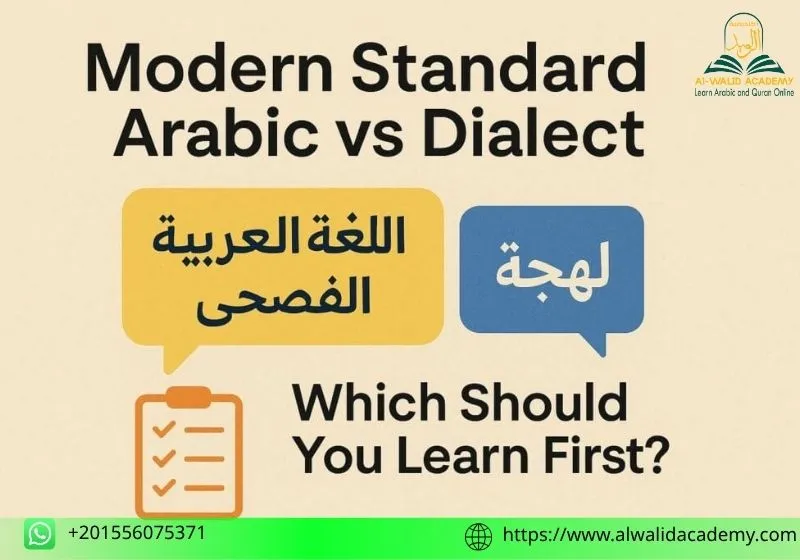
The Arabic Dialects is a simple, accessible language derived from Modern Standard Arabic; consequently, there are a number of differences between the two
How MSA Differs from Spoken Dialects
The differences between How to Speak MSA Fluently and colloquial Arabic lie in several aspects, including:
| MSA | Spoken Dialects | |
| Grammar rules | In MSA, one must adhere strictly to the rules of grammar and the correct use of case endings. | The dialects spoken across the Arab world do not strictly adhere to these rules, and many of them are omitted or simplified. |
| Vocabulary | Every word has a fixed meaning and pronunciation | Every word has a specific form and pronunciation that varies from country to country. For example, the phrase ‘How are you?’ is said as ‘Azik’ “ ازيك”in Egyptian Arabic and ‘Kifak’ “ كيفك”in Lebanese Arabic, and so on with other words. |
| Usage | MSA is used in various official documents | Spoken Dialects, on the other hand, is used in everyday, informal conversation. |
When to Learn MSA Instead of a Dialect
Although there are significant similarities between Spoken Dialects and Modern Standard Arabic, learning Modern Standard Arabic serves specific purposes, including:
- The ability to read books and texts across a range of subjects.
- Communicating with a wide Arab audience.
- The ability to understand news reports and official speeches.
Why MSA Gives You a Strong Foundation
MSA is considered the key to understanding other dialects, as:
- Learning MSA provides a solid foundation for a sound understanding of the language’s structure.
- It opens the door to exploring the Arab heritage of literature and various sciences.
- It enhances one’s ability to communicate in general, both in professional and everyday life.
How to Speak MSA Fluently
Learning Modern Standard Arabic is a long enjoyable journey with clear steps that need patience
Firstly: Build a Strong MSA Vocabulary
It forms the basis for understanding and using the language correctly in various formal and educational contexts, helping you to read texts, follow the news, and understand written and spoken content more easily
Learn High-Frequency MSA Words and Expressions
Start by learning common words and everyday phrases such as ‘thank you’ “ شكرًا”, ‘hello’ “ مرحبًا” Good morning “صباح الخير”.
This helps you become more familiar with the language, and the sounds of the letters will start to sound somewhat familiar to your ears.
Focus on Vocabulary for Daily Topics
Focusing on Daily Topics is one of the most effective ways to learn Arabic. This is because it helps to commit words to memory through daily use, often repeated many times. Furthermore, these words are a far cry from the complex academic vocabulary that can be difficult to grasp at first.
Use New Words in Full Sentences
Practising how to incorporate new words into sentences and using them is one of the most important steps in learning Modern Standard Arabic, as it helps to reinforce the word and ensure it is easily retained in the mind and memory.
Read more: Best Way to Learn to Speak Arabic
Secondly: Learn the Most Common MSA Sentence Patterns
Mastering the basic and common sentence structures in Arabic greatly facilitates the learning process, as it allows you to use the same structure in different ways, suitable for a wide range of situations
Start with Simple Sentence Structures
Start with simple structures that include the basic components of a sentence.
- In the case of Jumla Ismea, the basic structure consists of the subject and the predicate. for example:
“ الوَرْدَةُ حَمْرَاء,” which means the flower is red.
- In the case of Jumla Felia, the basic structure consists of the verb, the subject and the object. for example:
” كَتَبَ الْوَلَدُ الْوَاجِبَ,” which means the boy wrote his homework.
Practice Questions and Answers in MSA
Regular practice through questions and answers helps to consolidate language skills more effectively, keeps the mind alert and engaged, and improves the tongue’s ability to pronounce letters and their sounds accurately.

Thirdly: Use Common Verbs to Build Better Sentences
Focusing on the use of common verbs is one of the key factors in language learning.
Verbs such as ‘eats’, ‘drinks’, and ‘goes’ are used in many contexts in situations that recur daily; consequently, learning them has a significant impact on progress.
Essential MSA Phrases for Everyday Speaking
There are a number of sentences and phrases used on a daily basis; learning them helps you interact in many situations, such as greeting people, asking for help, and interacting in public places. These sentences are straightforward because they consist of set phrases that do not require you to start constructing the sentence from scratch. for example:
- ” صَبَاحُ الْخَيْرِ,” which means ‘good morning’ and is used as a morning greeting.
Greetings and Introductions in MSA
Learning the basic phrases used when greeting others or introducing yourself is an important step, particularly at the start, as it helps to create a friendly atmosphere right from the outset.
These include phrases such as:
- “Assalamu alaikum”” السَلَامُ عَلَيْكُمْ”؟
- “Hello….My name is “ مَرْحَبًَا اَنَا اسْمِى كَذَا”.
Common Questions and Everyday Responses
There are some common questions that are used on a daily basis, such as:
- When asking the time, we say, ‘What time is it?’ “كم الساعة” and the reply is, ‘It’s such-and-such o’clock.’ ”الساعة كذا ”
- When asking how someone is, we say, ‘How are you?’” كيف حالك” and the reply is, ‘I’m fine, thank God.’” بخير الحمد لله”
Learning these questions and answers helps you understand others and interact with them easily, and makes you better prepared for various everyday situations.
Fourth: Improve Your MSA Pronunciation and Listening Skills
Listening and speaking skills are fundamental aspects that require attention, as they form the basis of conversation and interaction
Master Arabic Sounds That Affect Fluency
It is essential to master the pronunciation of Arabic letters, as there are many differences between certain Arabic sounds and their English equivalents; furthermore, some sounds are entirely distinct, such as the ‘kha’ “ خ”, ‘dah’” ض”, ”and ‘taa’” ط”. Failure to master them properly can lead to significant misunderstandings.
Listen to Clear MSA Audio Every Day
Listening to Arabic on a daily basis from native speakers is one of the key factors in language development. Indeed, it is the foundation of learning, as children acquire fluency and proficiency in the language through constant listening followed by repetition until they master it.
Copy Native Pronunciation and Intonation
Once you have listened carefully, the next step is to try to pronounce the words correctly, paying attention to the articulation of the letters and the intonation used; sometimes the way a sentence is spoken or the tone of voice used is a significant part of the meaning being conveyed.
Fifth: Practice Speaking MSA Every Day
Fluency in a language does not come solely from memorisation, but from Arabic Words To Practice Reading knowing the letters, constructing sentences, and developing listening and pronunciation skills
Daily Speaking Habits That Build Fluency
Practising everyday conversation and using the language helps you improve your language skills significantly by:
- talking to yourself and describing your daily activities in Arabic.
- Practising reading texts aloud.
- Repeating sentences you hear from various sources, such as language learning apps and the television.
- If you stick to these simple habits, your language skills will improve rapidly, and with sustained practice over longer periods, you will eventually achieve fluency.
How to Practice MSA Without a Speaking Partner
You can improve your English without a conversation partner by using English-learning apps, or by recording your conversations and listening to them again
Look at: How Do Native Arabic Speakers Learn MSA
Sixth: Think in MSA Instead of Translating
One of the advanced techniques for improving Classical Arabic is practising translating responses from English into Arabic
Why Translation Slows Fluency
Sometimes translations are too literal, which can result in the meaning not flowing naturally and the message not coming across clearly, thus hindering fluency in the language. There is no harm in using them to translate individual words, but one should not rely on them entirely.
Start Thinking in Arabic
Start thinking about the names of the things around you in Arabic, and try to respond in Arabic as well. This helps you Learning Arabic As An English Speaker by developing your language skills in a practical way, and also allows you to identify words you can’t translate, look them up, and add them to your vocabulary.
Respond Faster in MSA
Make your first quick response in Classical Arabic; this stage is considerably advanced, as it relies heavily on vocabulary and the development of pronunciation and listening skills.
Common Mistakes That Block Fluency

- Pronouncing certain Arabic letters incorrectly, such as the letters kha’, ghayn and ta’, and substituting them with similar-sounding sounds.
- Ignoring Harakat In Arabic Language and vowel marks, leading to incorrect pronunciation and the meaning being conveyed inaccurately.
- Failing to make connections between the meanings of words leads to difficulties in learning.
- Confusing Classical Arabic with colloquial Arabic, resulting in linguistically incorrect meanings.
- Failure to adhere to the correct sentence structure and making ill-considered changes to word order.
- Confusing masculine and feminine forms, and the masculine and feminine plurals.
- Poor listening skills in Arabic which reduces comprehension and pronunciation abilities.
- Literal translation from the mother tongue results in imprecise meanings.
- The desire for quick results, which leads to rapid feelings of frustration and boredom.
A Simple Daily MSA Routine
- Learn 5–10 new words, with an example for each word to reinforce the meaning and see it used in various contexts.
- Listen daily to a short clip in Classical Arabic, focusing on pronunciation and repetition.
- Practise reading and try to grasp the general meaning of the text, identifying unfamiliar words and adding them to your vocabulary. This is What is The Best Way To Learn Arabic Vocabulary.
- Practise writing daily, focusing on the new words you have learnt.
- At the end of the day, review everything you have learnt to consolidate your memory and perfect your pronunciation.
Learn MSA with Al-Walid Academy
If you wish to know How to Speak MSA Fluently to a high standard, comparable to your native language, do not hesitate to join Al-Waleed Academy Best Place to Learn Arabic Online, as we will provide you with:
A comprehensive, professional, and progressive curriculum
At Al-Waleed Academy, we offer a comprehensive curriculum based on progressive learning, tailored to suit all levels and ages to ensure effective learning. The curriculum combines memorisation with continuous practice in listening and pronunciation to ensure progress.
A select team of specialist teachers
Teaching is delivered by a select team of specialist teachers with extensive experience in teaching Arabic, backed by qualifications from accredited institutions. Teaching methods are modern and focus on comprehension and the development of speaking, writing, reading and listening skills, enabling rapid and thorough progress.
Online Learning
At Al-Waleed Academy, we believe that education and learning need not conflict with a busy schedule. That is why we offer online learning through interactive sessions based on the latest teaching methods, ensuring full access to information with regular follow-ups throughout the week.
Flexibility in timetables and schedules
We offer flexible learning and follow-up sessions, allowing you to study at a time that suits you and at the intensity you desire.
A supportive and encouraging environment
At Al-Walid Academy, you are constantly in touch with fellow students who share your interests in learning, creating a competitive environment that encourages progress and perseverance and offers the chance to learn from others’ mistakes.
In short, the learning experience at Al-Walid Academy is not limited to How to Speak MSA Fluently; it extends to giving you the ability to use it with confidence and fluency in your daily and professional life.
Conclusion
How to Speak MSA Fluently is an enjoyable journey, but one that requires patience, practice and constant repetition; yet the rewards are well worth the effort, as Classical Arabic opens up a wealth of opportunities to explore Arab culture and also to learn Modern Standard Arabic.
FAQs
How long does it take to master Modern Standard Arabic?
It depends on the effort put in and your ability to take things on board, but generally speaking it takes between one and three years on average.
Is Modern Standard Arabic a spoken language?
Modern Standard Arabic is generally used in formal contexts such as the media, books and political meetings, but it differs from the spoken colloquial language
Should I learn Classical Arabic or Arabic dialects first?
It depends on your preferences and the main purpose of each language, but if you are learning out of a love for the language, it is advisable to start with the colloquial form, as this will make learning Modern Standard Arabic much easier.