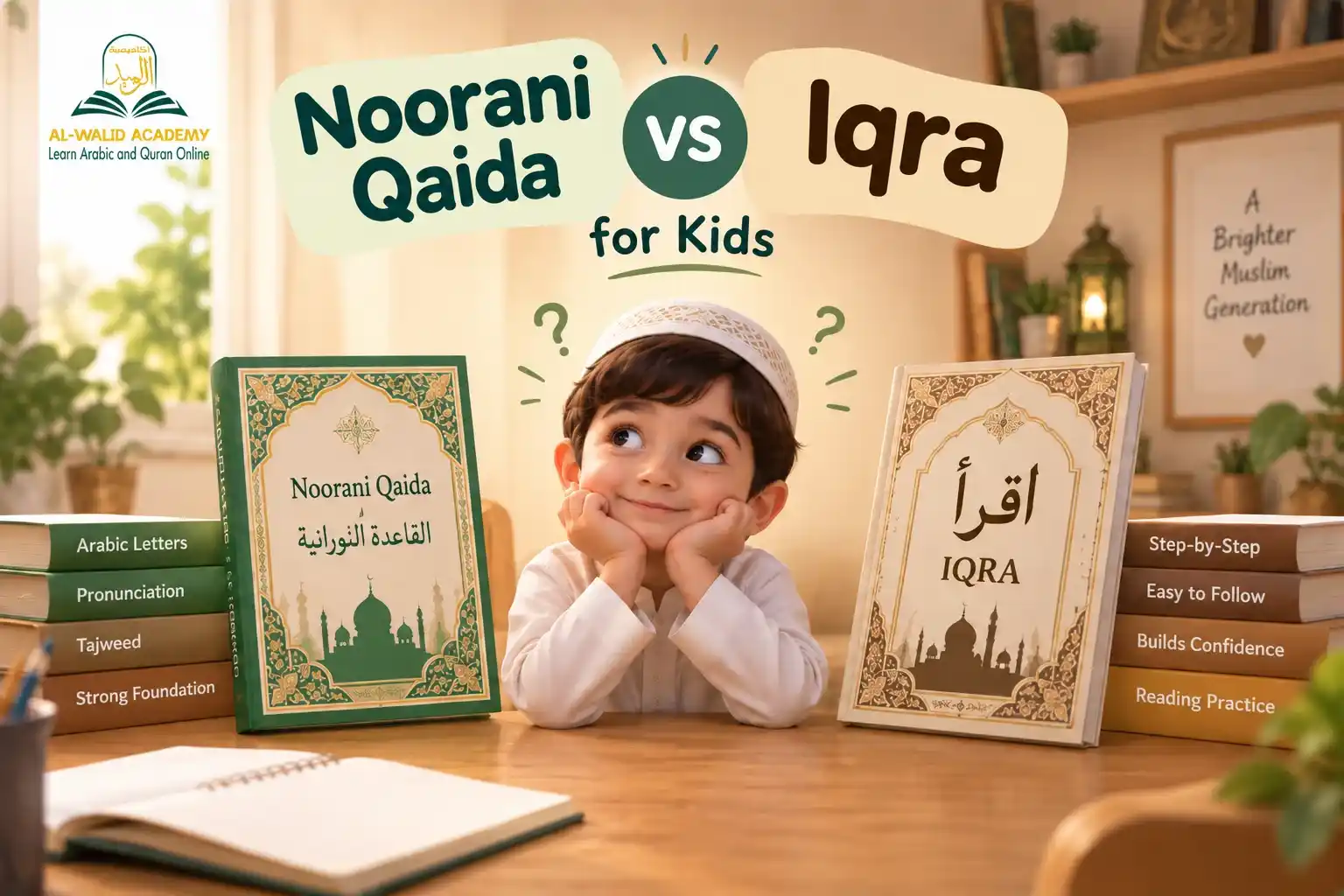
Noorani Qaida vs Iqra for kids is a common comparison because both approaches aim to build Quran-reading skills, but they organize learning differently.
The best choice depends on the child’s age, previous Arabic knowledge, learning style, pronunciation needs, and ability to practice consistently.
This guide explains the differences without assuming that one method is universally better.
Noorani Qaida vs Iqra for Kids: Which Is Better?
There is no single method that works equally well for every child.
An online Noorani Qaida course can be useful when a child needs a systematic introduction to Arabic letters, sounds, harakat, and basic reading rules. Its structured progression can help establish a strong foundation before the child reads longer Quranic passages.
Iqra is designed around gradual reading development, allowing learners to move through increasingly difficult exercises. It can appeal to children who benefit from seeing reading patterns develop step by step.
When considering Noorani Qaida vs Iqra for kids, parents should focus less on the name of the book and more on whether the method matches the child’s current ability.
How the Iqra Method Teaches Kids to Read Quran
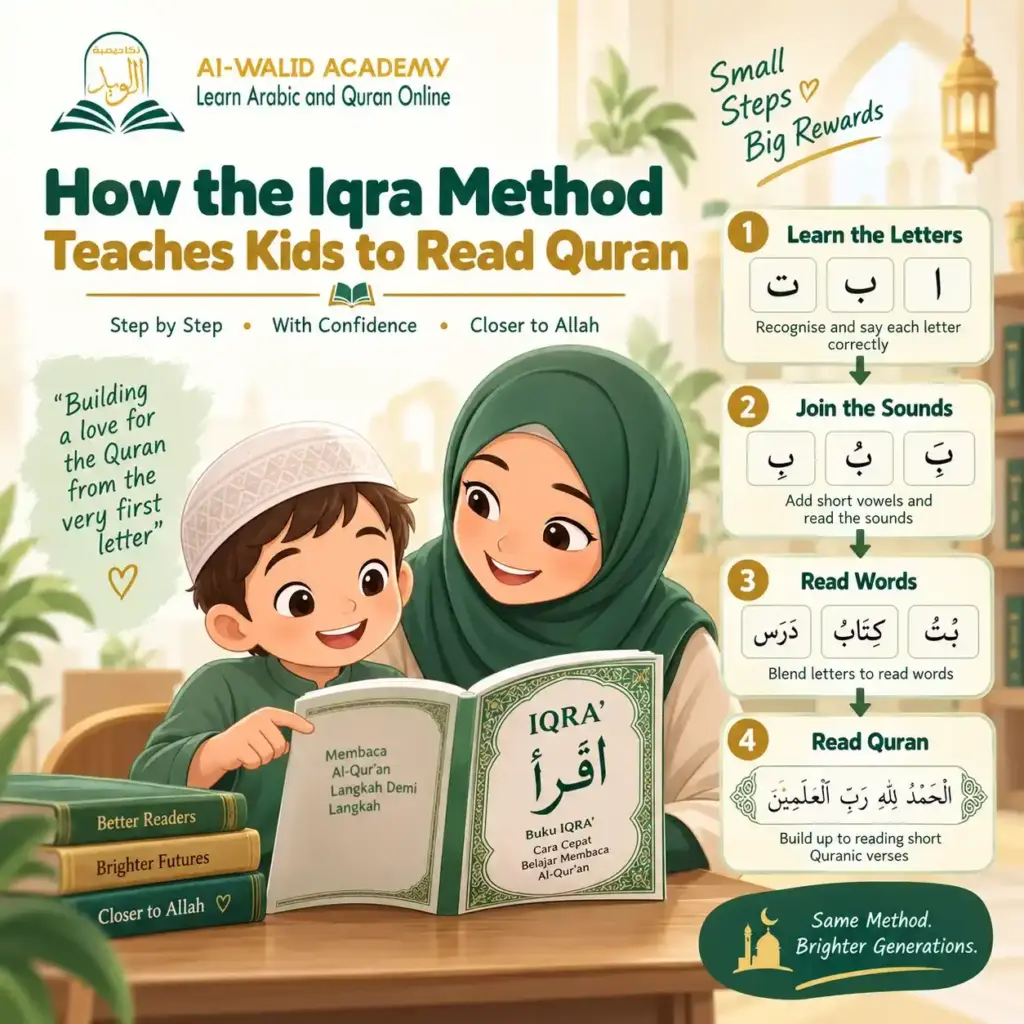
The Iqra method follows a gradual reading sequence. Children begin with basic Arabic reading elements and progress toward combinations, words, and more developed reading exercises.
Instead of expecting a child to master every reading rule before moving forward, the method introduces skills progressively. This can give children frequent opportunities to apply what they have learned.
A teacher can adjust the pace according to the child’s performance. If a learner understands a particular pattern quickly, lessons can progress. If the child struggles, the teacher can provide additional practice before introducing harder material.
This gradual structure makes Iqra suitable for children who enjoy learning through continuous progression.
How Noorani Qaida Teaches Kids Differently from Iqra
Learning techniques in Noorani Qaida place considerable attention on the foundations needed for accurate Quran reading. Children learn individual letters and their sounds before working with more complex combinations.
The method commonly introduces concepts such as:
- Arabic letters and their correct sounds
- Different vowel signs
- Letter combinations
- Sukoon
- Shaddah
- Tanween
- Basic pronunciation exercises
- Reading patterns used in Quranic text
The teacher can also use repetition to help children recognize sounds instead of relying only on visual memorization. Contact us to learn how to teach Noorani Qaida to Kids.
In Noorani Qaida vs Iqra for kids, this makes Noorani Qaida particularly attractive to parents who want their child to establish a structured pronunciation foundation from the beginning.
Iqra Books 1–6: How Kids Progress Through Each Level
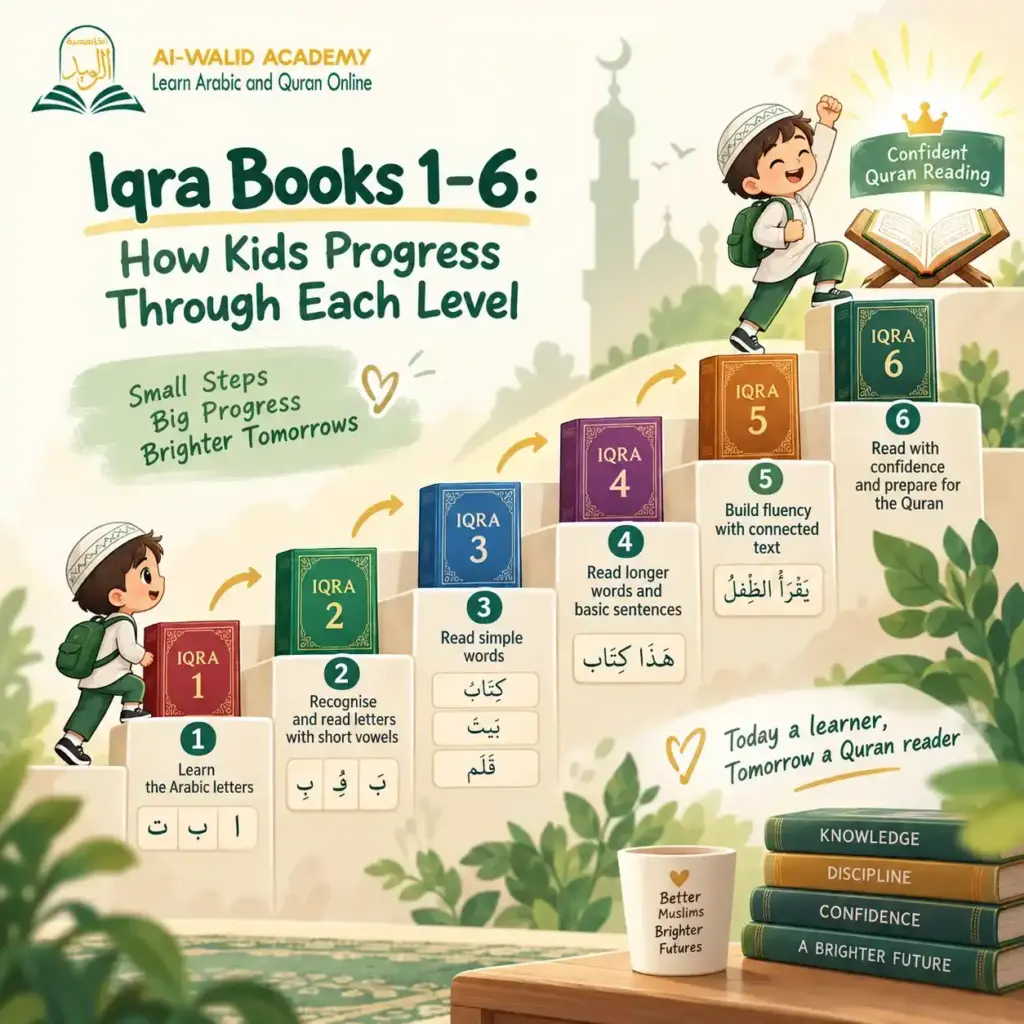
Iqra is commonly organized into a series of levels, with each book increasing the complexity of reading tasks. The child does not need to handle advanced Quranic reading immediately.
Progression generally moves from simpler combinations toward more fluent reading. As children advance, they encounter increasingly complex letter arrangements and Quranic reading patterns.
The six-book structure can make progress easy to monitor because parents and teachers can identify the learner’s current stage. However, completing a particular book does not automatically mean that a child has achieved fluent Quran reading.
Actual progress should be measured through accuracy, pronunciation, recognition, and independent reading ability.
Direct Reading vs Letter-by-Letter Learning
One important difference concerns how children approach reading.
Letter-by-letter learning gives children time to recognize individual characters and understand how sounds combine. This can be especially useful for beginners who are unfamiliar with Arabic script.
Direct reading approaches encourage children to recognize combinations and reading patterns as units rather than constantly separating every letter.
Neither approach should be treated as universally superior. A child who cannot recognize Arabic letters confidently may need foundational work, while a learner who already knows the alphabet may benefit from moving toward connected reading.
The comparison of Noorani Qaida vs Iqra for kids should therefore begin with the learner’s existing Arabic reading skills.
Which Method Is Easier for Young Children?
For very young learners, simplicity and lesson length can make a major difference.
Children around preschool and early primary-school ages may have limited ability to concentrate for extended periods. They usually benefit from short lessons, frequent revision, visual support, and encouragement.
A structured method can make lessons predictable, while a progressive reading sequence can give children a feeling of achievement as they advance.
Parents should not choose a book only because another child used it successfully. A child’s familiarity with Arabic, ability to distinguish similar letters, pronunciation, and attention span all influence how easy a method feels.
Which Method Helps Kids Start Reading Quran Faster?
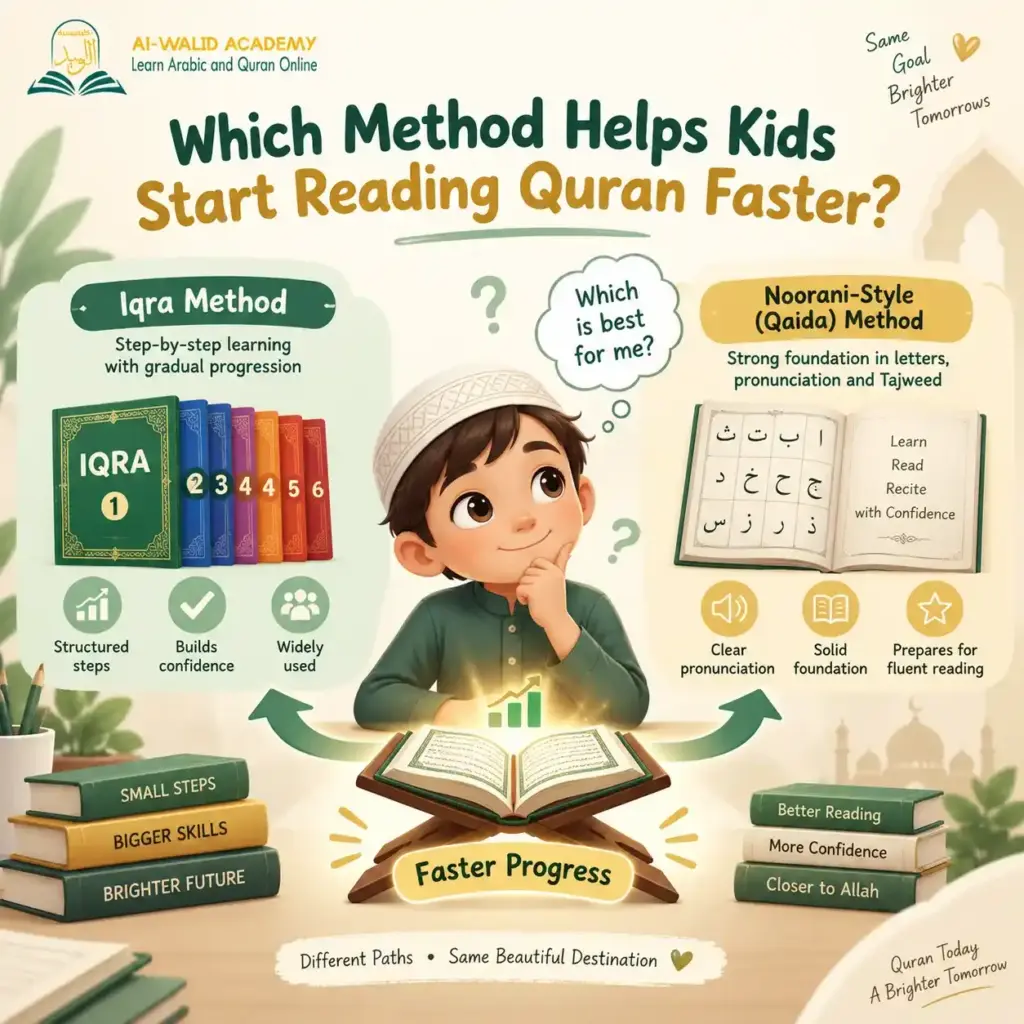
The speed of Quran-reading development depends on several factors rather than the curriculum alone.
A child who already recognizes Arabic letters may progress more quickly than a complete beginner. Regular lessons and home practice can also affect progress significantly.
Teacher feedback is another important factor. Correcting a pronunciation problem early may prevent the child from repeatedly practicing an incorrect sound.
With Noorani Qaida vs Iqra for kids, the faster option is therefore not necessarily the better long-term option. A method that produces quick reading but leaves pronunciation weaknesses may require additional correction later.
How to Memorize the Quran Fast and How to Improve Your Quran Recitation? Discover tips and tricks for effective Quran learning with Al Walid Academy.
Noorani Qaida vs Iqra for Tajweed and Pronunciation
Accurate pronunciation is an essential part of learning to read the Quran. Children need to become familiar with Arabic sounds and eventually learn relevant Tajweed rules.
Noorani Qaida is often used as a foundation for pronunciation because its exercises can isolate specific sounds and reading patterns. This allows the teacher to notice problems before the child starts reading longer passages.
Iqra can also develop reading ability progressively, but the quality of instruction remains important. A skilled teacher can identify pronunciation errors regardless of the textbook being used.
Parents should therefore ask how pronunciation and Tajweed will be taught rather than selecting a method based solely on the book title.
Which Method Is Better for Kids with Short Attention Spans?
Children with short attention spans may struggle with repetitive lessons that do not provide visible progress.
Teachers can make either approach more engaging by dividing the lesson into small activities. For example, a lesson may include reading practice, sound recognition, revision, and a short challenge.
Interactive questioning can also keep children involved instead of asking them to read continuously for the entire session.
The key consideration in Noorani Qaida vs Iqra for kids is whether the teacher can adapt the lesson structure. Even an excellent curriculum may become ineffective if the child is expected to study at a pace that does not suit their concentration level.
Which Method Keeps Children More Motivated?
Motivation often comes from experiencing progress.
Some children enjoy completing clearly defined stages because each completed section gives them a sense of achievement. Others prefer seeing immediate improvement in their ability to read words and phrases.
Parents can support motivation by celebrating effort rather than demanding perfection. Simple goals, positive feedback, and consistent lesson times can make online Quran learning feel manageable.
Teachers can also vary activities according to the child’s interests and abilities. This is particularly valuable during online Quran lessons, where maintaining attention requires active interaction.
Noorani Qaida vs Iqra by Child’s Age
What is the Best Age for Learning Quran Online and the best learning method for each age group? Age can provide a useful starting point, but it should never be the only factor used to choose a reading method.
Ages 4–6
Children in this age group are usually still developing basic literacy and concentration skills. Lessons should be short, interactive, and focused on recognition and pronunciation.
A teacher may begin with Arabic letters and simple sounds before introducing more complex combinations. Repetition should be natural and encouraging rather than demanding.
Ages 7–9
Children between seven and nine can often handle more structured reading practice. They may be ready for longer exercises and more frequent review.
At this stage, the teacher can assess whether the child needs stronger foundational work or can progress toward increasingly connected Quranic reading.
Ages 10 and Older
Older beginners may be able to understand explanations about reading rules more easily. They can also take greater responsibility for practice between lessons.
For these learners, the teacher can consider previous Arabic exposure, reading ability, pronunciation, and learning objectives before selecting the starting level.
How Long Does Iqra vs Noorani Qaida Take for Kids?
There is no fixed number of weeks or months required to complete either method.
Learning time can vary according to:
- The child’s starting level
- Lesson frequency
- Lesson duration
- Home practice
- Arabic familiarity
- Pronunciation difficulties
- Ability to retain previous lessons
- Teacher feedback and correction
A child attending several consistent lessons each week may progress differently from one who studies occasionally.
When evaluating Noorani Qaida vs Iqra for kids, parents should avoid comparing completion dates between children. Finishing a book quickly does not necessarily indicate stronger Quran-reading skills.
Can a Child Switch from Iqra to Noorani Qaida?
Yes. A child can change methods when there is a clear educational reason.
For example, a learner who has developed basic reading ability through Iqra may benefit from additional structured pronunciation practice. Similarly, a child who finds a particular sequence difficult may respond better to another teaching approach.
The transition should begin with an assessment rather than restarting everything automatically. The teacher can identify mastered skills and focus only on areas that need improvement.
This prevents unnecessary repetition and helps maintain the child’s motivation.
Can Kids Use Iqra and Noorani Qaida Together?
Using elements of both approaches can be practical when the teacher has a clear learning plan.
For example, one resource can support foundational pronunciation practice while the other provides progressive reading exercises. However, using two books without coordination may confuse a beginner.
The teacher should decide which skill each resource is intended to develop. Lessons should have a clear objective rather than moving randomly between materials.
A combined approach can be particularly useful when a child has good reading recognition but needs targeted pronunciation support.
Common Mistakes Parents Make When Choosing Iqra or Noorani Qaida
Parents sometimes make the decision based on assumptions rather than the child’s actual needs.
Common mistakes include:
- Choosing a method solely because another child used it
- Focusing on finishing the book quickly
- Ignoring pronunciation difficulties
- Expecting the same learning speed for every child
- Changing methods too frequently
- Providing insufficient home practice
- Selecting a curriculum without considering the child’s Arabic level
- Treating memorization and reading as the same skill
A better approach is to evaluate the child’s current abilities and create a realistic learning plan.
Noorani Qaida or Iqra: Which Should Your Child Start With?
The starting point should depend on what your child can already do.
Noorani Qaida may be a good starting choice when:
- The child is a complete beginner.
- Arabic letters are still unfamiliar.
- Pronunciation needs strong attention.
- Parents want a structured foundation.
- The learner needs systematic practice with reading rules.
Iqra may be suitable when:
- The child already recognizes Arabic letters.
- The learner responds well to progressive reading exercises.
- The child benefits from moving through clearly defined levels.
- The goal is to gradually develop connected reading.
How Al-Walid Academy Chooses the Right Quran Reading Method for Your Child
Al-Walid Academy can help parents make the decision based on the child’s current abilities rather than using the same starting point for every learner.
The learning process can focus on:
- Assessing the child’s current Quran-reading level
- Identifying Arabic letter recognition skills
- Checking pronunciation and reading accuracy
- Choosing an appropriate beginner resource
- Adjusting lesson difficulty as the child improves
- Providing regular correction and feedback
- Maintaining an age-appropriate learning pace
- Supporting consistent Quran practice at home
For Noorani Qaida vs Iqra for kids, individualized assessment is more useful than assuming that every learner should follow the same curriculum.
Why Choose Al-Walid Academy?
- Qualified teachers experienced in teaching children online
- Individual attention during lessons
- Age-appropriate Quran reading instruction
- Flexible online learning and various Quran courses online.
- Regular pronunciation correction
- Progress-focused lessons
- Supportive learning environment
- Communication with parents about the child’s development.
Conclusion
Ultimately, Noorani Qaida vs Iqra for kids is not about finding one universally better book. It is about choosing the approach that supports the individual learner’s reading level and learning style.
Explore Quran Learning with Al-Walid Academy and give your child a structured, supportive path toward confident Quran reading.
FAQs
Is Noorani Qaida better than Iqra for beginners?
No method is automatically better for every beginner. The appropriate choice depends on the child’s Arabic knowledge, pronunciation, age, and learning style.
Can a child learn both methods?
Yes. A teacher can combine resources when each one serves a specific learning purpose.
Which method is better for Tajweed?
Noorani Qaida is often useful for building foundational pronunciation and reading skills, while Tajweed should ultimately be taught and corrected by a qualified teacher.
How often should children study Quran reading?
A consistent schedule is generally more useful than occasional long sessions. The exact frequency should match the child’s age and ability to concentrate.
What if my child is struggling with the chosen method?
Ask the teacher to assess the difficulty. The child may need more revision, a slower pace, different activities, or a change in learning material.
Should parents choose based on age alone?
No. Age is useful for planning, but the child’s existing Arabic and Quran-reading skills should also guide the decision.