
The science of Tajweed is very similar to phonetics in the English language. No Muslim can master the recitation of the Holy Quran without a good grasp of the rules of Tajweed, and knowledge of what is ghunnah in Tajweed, which is one of the fundamental rules of Tajweed. Therefore, learning the rules of Tajweed is extremely important to ensure a correct recitation of the Book of God.
What Is Ghunnah in Tajweed?
Ghunnah is one of the fundamental rules of Tajweed (the science of Quranic recitation) and it occurs in numerous places throughout the Quran. It is specific to the letters Meem and Noon, and mastering its correct recitation provides great ease and comfort during recitation.
Simple Definition of Ghunnah
Ghunnah is a precise description of the nasal sound produced when reciting the Quran in specific places. It is specific to the letters Meem and Noon, and this sound is maintained for the duration of two vowel counts.
Ghunnah is considered fundamental to reciting the Holy Quran, and every reciter must master it for their recitation to be perfect. Complete adherence for what is ghunnah in Tajweed and the rules of Tajweed in general is what distinguishes the Book of God About anything else.
Why Ghunnah Is Important in Quran Recitation
Paying attention to the rules of Tajweed for reciting the Holy Quran is of paramount importance, as the Prophet Muhammad (peace be upon him) emphasized it. The ghunnah is like a balance that ensures correct pronunciation, and this is extremely important because neglecting it leads to errors in pronunciation.
- Join Tajweed Course at AL-Waleed Academy to learn the Tajweed rules with an elite group of teachers
How Ghunnah Affects Correct Pronunciation
Ghunnah is not merely an aesthetic element during the recitation of the Holy Quran, but its importance lies in:
- Distinguishing between letters, as it is specific to the letters Meem and Noon only.
- The specific duration of the nasal sound ensures that the letter is pronounced with its correct timing.
- Ensuring that the meaning is conveyed correctly, as an error in pronouncing the ghunnah may change the meaning or the structure of the speech, preventing it from being understood correctly.
- It affects other rules of Tajweed such as Idghaim, Ikhfaa, or Iqlab.
- It adds beauty and fluency that distinguishes the Book of Allah from any other speech.
Read about: How to Learn Tajweed Rules
Letters of Ghunnah
There are two main letters that have the characteristic of nasalization when pronounced: the letters meem and noon.
Noon and Meem with Ghunnah
Cases where nasalization is pronounced with the letters Meem and Noon
Noon
Gunnah is applied whenever noon carries a shaddah like in the word ”منَّه “. or with in specific Tajweed rules like Ikhfaa or Idghaam.
Meem
Gunnah is applied whenever meem carries a shaddah like in the word “ عم”
Read about: Meem Sakinah Rules
Where Ghunnah Occurs in Tajweed
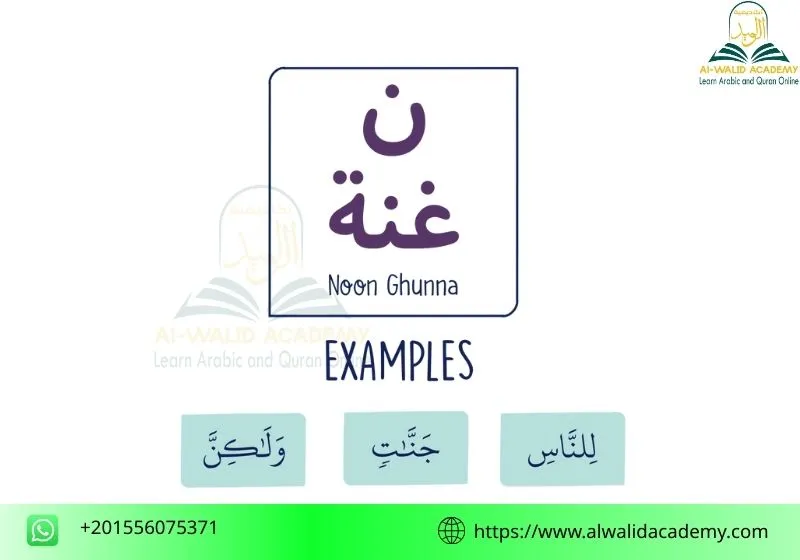
Ghunnah is a nasal sound and it represents an essential characteristic in Tajweed. It appears in specific rules related to Noon Saakinah, Tanween, and Meem Saakinah, it is important to achieve correct Quranic recitation.
Ghunnah in Noon Saakinah and Tanween
The noon Saakinah and the tanween have four rules in Tajweed, and the ghunnah is present in three of these rules, or other Tajweed rules like Ikhfaa or Idghaam with noon.
Idgham with ghunnah
If the noon Saakinah (ن) or tanween is followed by one of the following letters “ ي ,ن, م, و” which are grouped together in the word ”ينمو”, Idgham occurs between the noon Saakinah or tanween and the following letter, accompanied by a nasal sound (ghunnah) lasting two counts. For example “ من نعمة”.
Read about: Idgham With Ghunnah and Idgham Without Ghunnah
True Ikhfaa
If one of these letters” ت،ث، د، ذ، ز، س,ش, ص، ض، ط، ظ، ف” ق، ك” comes after a silent nun or tanween, The noon sakinah or tanween is hidden with ghunnah for the duration of two counts. For example the word “من قبل “.
Iqlab
If the letter Baa’ comes after the Noon Saakinah or Tanween, it is transformed into a hidden Meem with a ghunnah lasting two counts. For Example “ سمِيعٌ بصير”.
Ghunnah in Meem Saakinah
The Meem Saakinah has three Tajweed rules, and ghunnah is evident in two of them.
Idgham Shafawi
If the meem Saakinah is followed by a moving meem, the meem Saakinah is merged with the moving meem to become with shadah and accompaniment with ghunnah of two counts. For example “ لهم ما”
Read about: Idgham Shafawi
Ikhfaa Shafawi with Ghunnah
If the letter “ba” follows the meem Saakinah, we conceal the “meem” and it is accompanied by a ghunnah of two counts.
Read about: Ikhfaa Shafawi
Duration of Ghunnah
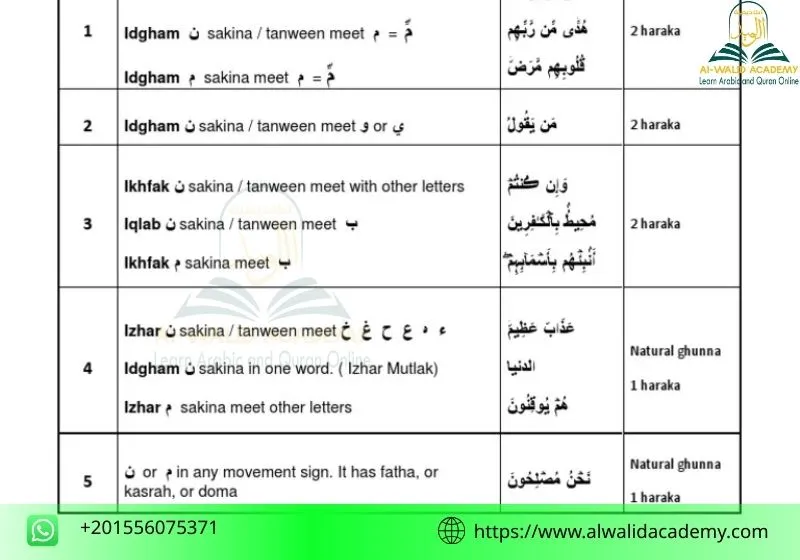
One of the most important features of Tajweed is that each rule has a specific method of pronunciation. The ghunnah is characterized by a specific way of pronouncing it during recitation, and this must be adhered to What is ghunnah in Tajweed as it is one of the most important fundamentals of Tajweed.
How Long Ghunnah Should Be Held
The ghunnah is two counts in its various forms, whether due to Idgham, Ikhfaa, Shadda, or Iqlab. Although the methods of recitation and the length of the prolongation may vary, the common rule is that it is two counts.
Learn Ghunnah the Right Way
Because ghunnah is one of the most important rules of Tajweed, learning it correctly has become extremely important for reciting the Book of God Almighty.
One-on-One Online Tajweed Classes at Al-Walid Academy
Al-Waleed Academy offers individual courses to Learn Quran Tafseer Online and the rules of Tajweed, which provides students with the opportunity to:
A thorough understanding of the rules of Tajweed, such as ghunnah.
- Practical application of the rules of Tajweed from different places in the Quran to ensure complete understanding of them.
- The teaching is done by teachers who specialize in the Arabic language and Quranic sciences, which ensures correct understanding.
- Continuous follow-up with parents and, undoubtedly, ongoing monitoring of the student to ensure that mistakes are corrected step by step.
- The teacher’s complete focus on one student ensures a full understanding and appreciation of the student’s abilities, thus enabling the development of a teaching plan appropriate to their level.
At Al-Waleed academy we provide Quran lessons for Kids online This helps you provide comfort and safety for your children during their learning journey.
Common Mistakes in Applying Ghunnah
There are many mistakes that must be avoided when pronouncing nasalization to ensure the correct recitation of the Book of God.
Overstretching or Weak Ghunnah
Excessive or insufficient prolongation of Ghunnah is a common mistake, especially among beginners. The duration of Ghunnah is approximately two vowel counts. This error often occurs due to a lack of breath control, as correct nasalization requires steady breathing while maintaining the correct position of the nose and mouth.
Simple Tips to Improve Ghunnah
Mastering the correct pronunciation of Ghunnah is not impossible; you can reap the rewards with continuous training under the supervision of a specialized teacher at Al-Waleed Academy.
Practicing Ghunnah Correctly
You can improve your Ghunnah pronunciation by following a number of steps, including:
- Listening daily to the Holy Quran recited by a skilled reciter.
- Ongoing and continuous training under the supervision of a specialized teacher.
- Start with the easy and short surahs, and you can ask your teacher to recommend what you should begin with.
- Learning the basics of the Arabic language Course greatly helps you master the articulation of letters and thus correct pronunciation.
- Initially, focus on verses that contain the same rules and principles of Tajweed to ensure complete mastery.
Summary of Ghunnah Rules
We can summarize the positions and rules of What is ghunnah in Tajweed in the following table:
| Pronunciation | Its Location | Rule |
| It is pronounced with a ghunnah of two counts. | Any part of the word | Noon with Shaddah |
| It is pronounced with a ghunnah of two counts. | Any part of the word | Meem with Shaddah |
| Idgham with ghunnah of two counts. | The noon Saakinah or tanween is followed by one of the letters of the word “ ينمو” | Idgham with ghunnah |
| Ikhfaa for the letter “noon” with ghunnah of two counts. | If one of the following letters “ت، ث، د، ذ، ز، س،ش، ص، ض، ط، ظ، ف، ق، ك” comes after the noon Saakinah or tanween. | True Ikhfaa |
| It is changed into a hidden meem with a ghunnah of two counts. | If the letter baa comes after noon Saakinah or tanween | Iqlab |
| A stressed meem withghunnah of two counts. | If a meem Saakinah is followed by a moving meem | Idgham Shafawi |
| The letter meem is hidden with ghunnah of two counts | If the letter “ba” comes after meem Saakinah | Ikhfaa Shafawi |
Key Points to Remember
- Ghunnah is a special nasal sound for the letters noon and meem.
- The duration of ghunnah lasts for two counts.
- Ghunnah is always accompanied to noon and meem with shaddah.
- In case of noon saakinah and tanween, ghunnah appears in Idgham with ghunnah, True Ikhfaa, and Iqlab.
- True Ikhfaa exist when one of the Ikhfaa letters follows Noon Saakinah or Tanween.
- Iqlab exists only when the letter Baa follows Noon Saakinah or Tanween.
- And for Meem Saakinah, ghunnah occurs in Idgham Shafawi and Ikhfaa Shafawi.
- Ghunnah must be balanced not exaggerated or weakened, to ensure correct recitation.
Learn Quran, Arabic, and Islamic Studies with certified teachers in fun, interactive, and personalized sessions. Join thousands of students around the world and begin your path today!
Conclusion
The nasal sound ghunnah adds a distinctive quality to the recitation of the Quran. Therefore, understanding what is ghunnah in Tajweed is crucial for enjoying the recitation of the Holy Quran smoothly. It begins with understanding the rules, then practicing and committing to achieve mastery and elevate your level of recitation.
FAQ
What are the 4 levels of Ghunnah?
Gunnah is categorized into four types: Most Complete Ghunnah, Complete Ghunnah, Incomplete Ghunnah, and Most Incomplete Ghunnah.
What is Idgham without ghunnah?
or Idghaam without ghunnah occurs when the letters laam and raa (ل، ر) follow a Noon Saakinah or Tanween.
Can Tajweed be self-taught?
Can Tajweed be self-taught? Yes, it can especially today with interactive apps and online teachers.
Meta des:
Discover what is ghunnah in Tajweed, where it occurs, its rules with noon and meem, and how to apply it correctly in Quran recitation.
Does Ghunnah occur with Noon Sakinah and Tanween?
Yes, Ghunnah occurs with Noon Sakinah and Tanween in some rules such as:
-
Idghaam with Ghunnah
-
Ikhfaa
-
Iqlaab
Is Ghunnah pronounced from the mouth or nose?
Ghunnah is pronounced from the nose, not the mouth, even though the letters involved are Noon and Meem.
What is the strongest form of Ghunnah?
The strongest Ghunnah occurs with:
-
Noon Mushaddad
-
Meem Mushaddad
Can Ghunnah change the meaning of the Quran?
Incorrect application of Ghunnah may affect pronunciation and beauty of recitation, and in some cases can impact meaning if letters are distorted.
How can I practice Ghunnah correctly?
The best way to master Ghunnah is:
-
Listening to qualified reciters
-
Practicing with a teacher
-
Learning through structured Tajweed courses
Which Tajweed course covers Ghunnah in detail?
Comprehensive Tajweed courses explain Ghunnah with theory, listening practice, and correction from qualified teachers.