
Many parents wonder about the best approach to How to Teach Arabic to Toddlers in a way that matches a child’s age and keeps learning enjoyable rather than stressful.
The good news is that young children can acquire Arabic naturally when they hear it regularly and use it in fun, everyday situations that connect to their interests and daily experiences.
Can Toddlers Really Learn Arabic?
Yes, toddlers can successfully learn Arabic. In fact, the early years of a child’s life are among the best stages for acquiring new words, sounds, and language skills.
When parents use the right How to Teach Arabic to Toddlers strategies, children can learn Arabic naturally and enjoyably without feeling pressured.
Today, many parents choose Quran courses online because they offer flexibility and personalized learning.
Why Do Toddlers Learn Languages So Easily?
Toddlers naturally pick up language from their surroundings. They do not learn through grammar explanations, but through hearing words often, watching how they are used, copying sounds, and repeating them in daily situations.
At this age, children are also less afraid of making mistakes. They willingly experiment with new words and sounds, which helps them develop confidence and improve their language skills over time.
What Makes Arabic Easy for Toddlers to Learn?
Several factors make it easier for toddlers to learn Arabic:
- They can imitate sounds and pronunciation quickly.
- They naturally connect words with people, objects, and actions.
- They learn through daily routines and repeated experiences.
- Their curiosity encourages them to explore new words and expressions.
Benefits of Learning Arabic at an Early Age
Learning Arabic during the toddler years offers benefits that go beyond language development.
| Benefit | How It Helps Your Child |
| Stronger language skills | Children gradually build a larger Arabic vocabulary. |
| Better listening abilities | They become more skilled at recognizing sounds and words. |
| Cognitive development | Learning a language supports memory, focus, and thinking skills. |
| Preparation for Quran learning | Children become more familiar with Arabic words used in the Quran. |
Best Age to Start Teaching Arabic to Toddlers

The best age to start teaching Arabic to toddlers is usually between 2 and 4 years old. During this period, children are especially receptive to learning new sounds and vocabulary.
However, children can begin learning Arabic successfully at any age when they receive consistent support and appropriate instruction.
Parents can also continue their learning journey through Quran Classes For Adults while supporting their children.
Why Is Early Childhood the Best Time?
During the early years, children are naturally developing their language abilities. This makes it easier for them to absorb new vocabulary and understand spoken language through everyday interactions.
Introducing Arabic during this stage can also create a strong foundation that supports future learning, including reading Arabic, understanding Quranic vocabulary, and studying Islamic subjects.
Interactive Quran lessons for Kids online can help children learn Arabic and Quran skills together.
What Can Children Learn at Different Ages?
The following table highlights what children can typically learn at different stages:
| Age | What Children Can Learn |
| 2–4 years | Basic Arabic words, everyday vocabulary, and common sounds. |
| 5–8 years | Simple sentences, broader vocabulary, and better comprehension. |
| +9 years | Reading skills, stories, and a deeper understanding of language structure. |
Is It Ever Too Late to Start Learning Arabic?
No, it is never too late for a child to start learning Arabic. While an early start can offer certain advantages, long-term success depends more on consistency and effective teaching methods than on age alone.
To help your child succeed:
- Expose them to Arabic regularly.
- Use activities that match their age and interests.
- Encourage them to speak without fear of making mistakes.
- Make Arabic part of daily routines and enjoyable experiences.
The earlier a child is exposed to Arabic, the more time they have to build confidence and familiarity with the language. This strong foundation can make it easier to learn the Quran, Tajweed, and other Islamic studies in the future.
A structured Arabic language Course provides a clear path for vocabulary growth and language development.
How to Teach Arabic to Toddlers at Home

You can teach Arabic to toddlers at home easily when you make the language part of their daily life instead of treating it as a separate lesson.
The best way for: How to teach Arabic to Toddlers at Home is to use simple words in daily routines with consistent repetition naturally and enjoyably.
At this age, children do not learn through explanations. They learn through listening, imitation, and real-life situations, so every daily moment can become a simple language learning opportunity.
Read more about: How to Teach Arabic Letters to Kids
1. Start with Simple Arabic Words
Start with very simple Arabic words because toddlers learn faster when the word is connected to something they see or use every day.
Examples of basic Arabic words to begin with:
| Category | Words |
| Greetings | Hello, good morning, good evening, goodbye |
| Family | Mom, Dad, brother, sister |
| Food | Water, milk, bread, apple |
| Daily expressions | Yes, no, please, thank you |
The more the word is linked to the child’s daily life, the faster it will be understood and remembered without effort.
Read also about: Arabic Phonics for Children
2. Use Arabic in Daily Routines
The best way to help a toddler retain Arabic is by using it in repeated daily routines, because children learn best from real-life situations they experience every day.
Use simple and consistent phrases in the same contexts:
- Upon waking up: Good morning
- Before eating: Bismillah
- During the day: simple, encouraging Arabic words
- Before sleeping: Good night
- When leaving: Goodbye
When children hear the same phrases daily in the same situations, they gradually understand them and start using them naturally.
Learn more about: Arabic Lessons For Kindergarten
3. Repeat Words Naturally Every Day
Daily repetition is the key to language learning at this stage because toddlers need to hear words multiple times before they can fully remember them.
To make repetition effective:
- Use the same word in different daily situations.
- Link words to real actions such as eating, playing, and sleeping.
- Do not force the child to repeat words.
- Keep exposure natural and indirect.
At first, the child listens. Then they begin to understand. Finally, they start repeating words naturally without pressure.
As children grow older, Online Arabic Conversation Classes can strengthen speaking skills.
4. Keep Arabic Practice Short and Fun
Teaching toddlers should always be short and fun because their attention span is very limited, and long sessions can quickly cause boredom.
The best approach is 10–15 minutes of daily learning with varied activities to keep the child engaged.
Fun learning activities include:
- Simple Arabic songs.
- Short picture stories.
- Light educational games.
- Learning words through play.
- Using gestures and movement with words.
The more enjoyable the learning experience is, the more the child will engage and want to continue.
Should Toddlers Learn Arabic Letters or Words First?
Toddlers should start learning Arabic words before learning letters because words are directly connected to their daily life and are easier to understand and remember.
When applying How to Teach Arabic to Toddlers correctly, starting with words helps the child build a strong linguistic foundation before moving to letters.
At this age, children learn through meaning and real-life situations rather than abstract symbols. That is why words are easier and faster to grasp than letters, which require a higher level of cognitive development.
Words are connected to things the child sees every day, making learning more natural and less complicated.
A structured Quran Recitation Course helps children improve pronunciation and confidence over time.
Stages of Child Learning in Simple Terms
| Age Stage | What the Child Learns | Learning Goal |
| 2 – 3 years | Simple daily words like mom, dad, and water | Linking words with real-life meaning |
| 4 – 5 years | Recognizing letter sounds | Building phonetic awareness |
| 6 – 7 years | Recognizing letter shapes | Preparing for reading and writing |
This gradual progression allows the child to learn without pressure and keeps their interest in Arabic strong.
Arabic Alphabet for Toddlers
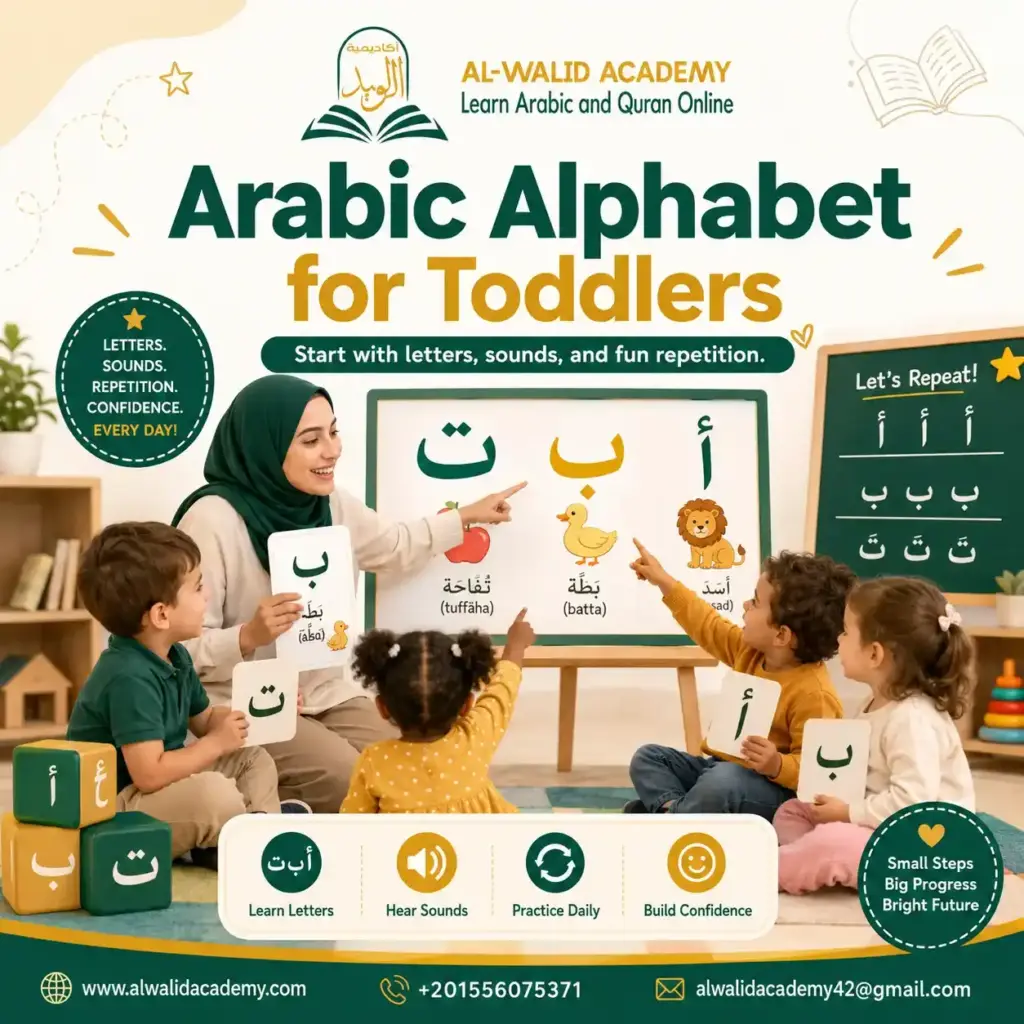
Teaching Arabic letters to toddlers should be gradual, simple, and based on repetition and play rather than memorization or traditional academic methods.
When letters are introduced in a fun way, children engage better and learn more effectively.
The Arabic alphabet contains 28 letters, and it can be introduced step by step using playful activities such as games, songs, and picture cards, making learning enjoyable rather than stressful.
Teach One Arabic Letter at a Time
It is better to focus on one letter at a time because toddlers cannot process multiple ideas deeply at this stage. When the child focuses on one letter, they understand it better and retain it longer.
For example, choose one letter per week such as:
- ب (Ba) — بابا (baba)
- م (Meem) — ماما (mama)
- أ (Alif) — أسد (asad)
Repeat the same letter throughout the week in different situations until it becomes familiar, then move to the next letter.
Focus on Letter Sounds, Not Writing
At the beginning, focus on the sound of the letter rather than its written form, because children develop listening and speaking skills before writing skills. This helps build a strong phonetic foundation.
For example:
- بَ is pronounced “ba” not “baa”
- تَ (Ta) is pronounced “ta” not “taa”
Each letter should also be linked to familiar words:
- ب (Ba) — بَابَا (baba)
- م (Meem) — مَامَا (mama)
- أ (Alif) — أَسَد (asad)
This connection between sound and meaning helps the child learn naturally and smoothly.
Use Flashcards, Colors, and Pictures
Visual tools help toddlers learn faster because children at this age rely more on images and colors than explanations. Flashcards are, therefore, one of the most effective teaching tools.
For best results:
- Assign a different color to each letter.
- Link each letter to a clear picture from daily life.
- Use words that start with the same letter.
- Repeat exposure throughout the day.
Example:
أ (Alif) + تفَّاحَة (tuffaha – tuffaha) + red color → Helps the child connect shape, sound, and meaning at the same time.
Why This Method Works
This method is effective because it follows the natural learning process: listening, understanding, recognizing, and then interacting.
The child does not feel like they are studying, but instead feels like they are playing and learning at the same time.
This approach also prepares the child later for Quran memorization, Tajweed, and a deeper understanding of Arabic in a smooth and natural way.
At Alwalid Academy, we use this interactive method to teach children Arabic by combining words, letters, and engaging activities to build a strong foundation in the language and prepare them for Quran learning in an easy and enjoyable way from an early age.
Easy Arabic Words for Toddlers to Learn First
The best way to teach toddlers Arabic is to start with simple, everyday words such as:
- Family
- Food
- Animals
- Basic commands.
These words help children understand quickly because they are directly connected to their daily life and real experiences.
When applying How to Teach Arabic to Toddlers correctly, choosing these first words makes learning natural, easy, and free from pressure.
These basic words are not just vocabulary items; they are the foundation for building a child’s connection with the Arabic language from the very beginning.
1. Family Words in Arabic
Family words are the first words a child should learn because they are related to the closest people in their life. This makes learning easier, more meaningful, and emotionally engaging.
Family Words Table
| Arabic | Pronunciation | Meaning |
| مَامَا | mama | Mother |
| بَابَا | baba | Father |
| أَخِي | akhi | Brother |
| أُخْتِي | ukhti | Sister |
| جَدِّي | jaddi | Grandfather |
| جَدَّتِي | jaddati | Grandmother |
Practical Daily Use
- أَيْنَ مَامَا؟ (Ayna mama) → Where is mom?
- مَامَا هُنَا (Mama huna) → Mom is here
- أُحِبُّ بَابَا (Uhibbu baba) → I love dad
This type of real-life repetition helps the child connect words with meaning instead of memorizing them in isolation.
Read also about: How to Teach Noorani Qaida to Kids
2. Food and Drink Words
Food and drink vocabulary is among the easiest for children to learn because it is used daily and connected to real needs like hunger and thirst.
Food and Drink Words Table
| Arabic | Pronunciation | Meaning |
| مَاء | ma’ | Water |
| خُبْز | khubz | Bread |
| حَلِيب | haleeb | Milk |
| تُفَّاح | tuffah | Apple |
| طَعَام | ta’am | Food |
| عَصِير | aseer | Juice |
Practical Use
- هَلْ تُرِيدُ مَاءً؟ (Hal tureed ma’?) → Do you want water?
- نَعَمْ أُرِيدُ مَاءً (Na’am, ureed ma’) → Yes, I want water
- الطَّعَامُ لَذِيذٌ (Al-ta’am laziz) → The food is delicious
Connecting words with real needs like eating and drinking makes learning faster and more permanent.
3. Animals and Toys
Animal and toy vocabulary is very engaging for children because it is linked to play and fun, making learning enjoyable rather than formal.
Animals and Toys Table
| Arabic | Pronunciation | Meaning |
| قِطَّة | qitta | Cat |
| كَلْب | kalb | Dog |
| طَائِر | ta’er | Bird |
| كُرَة | kura | Ball |
| لُعْبَة | lu’ba | Toy |
| سَيَّارَة | sayyara | Car |
Practical Examples
- هَذِهِ قِطَّةٌ (Hadhihi qitta) → This is a cat
- أُحِبُّ الْقِطَّةَ (Uhibbu al-qitta) → I love cats
- هَيَّا نَلْعَبُ بِالْكُرَةِ (Hayya nal’ab bil-kura) → Let’s play with the ball
Learning through animals and toys turns language into play instead of study, which increases engagement and retention.
4. Simple Arabic Commands
Teaching easy commands allows toddlers to use Arabic in real-life moments, making communication with parents smoother and helping new vocabulary stick more naturally.
Basic Commands Table
| Arabic | Pronunciation | Meaning |
| تَعَالَ | ta’al | Come |
| اجْلِسْ | ijlis | Sit |
| كُلْ | kul | Eat |
| اشْرَبْ | ishrab | Drink |
| نَمْ | nam | Sleep |
| قِفْ | qif | Stop |
Practical Use
- تَعَالَ هُنَا (Ta’al huna) → Come here
- اجلس (Ijlis) → Sit down
- اشْرَبِ الْمَاءَ (Ishrab al-ma’) → Drink water
This direct connection between word and action helps children understand and respond naturally without long explanations.
Fun Ways to Teach Arabic to Toddlers
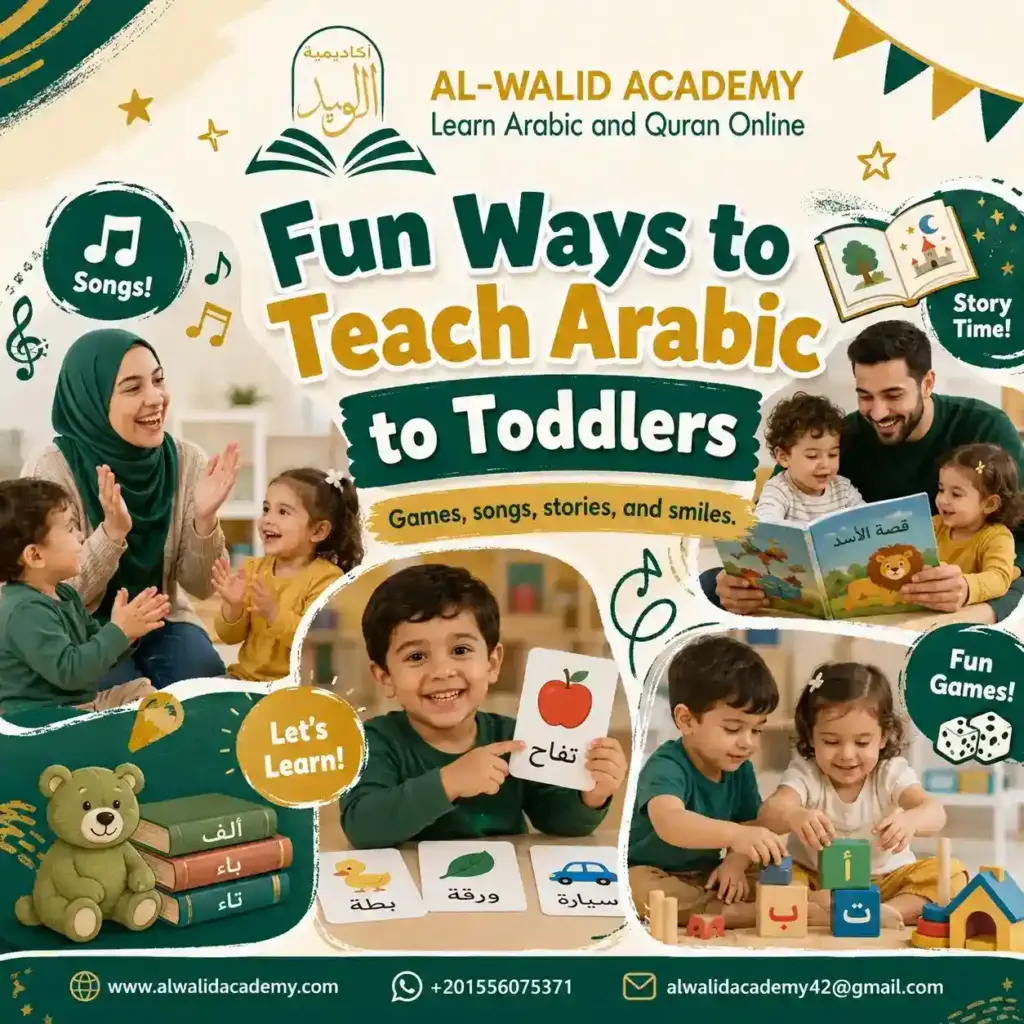
The most effective fun ways to teach Arabic to toddlers are Arabic songs, picture stories, interactive games, and labeling objects around the house.
These methods make learning natural and enjoyable, and they are a core part of applying How to Teach Arabic to Toddlers in a practical way.
Toddlers learn Arabic best when learning feels like play rather than study. When you combine sound, image, and movement, the child absorbs vocabulary faster and remembers it for longer.
Arabic Songs and Nursery Rhymes
Arabic songs and nursery rhymes help toddlers learn Arabic words quickly because rhythm and repetition make the language easier to remember.
When a child listens and repeats songs daily, pronunciation and vocabulary develop naturally.
| Type of Song | Example | Benefit |
| Alphabet Song | Alif Baa Taa song | Helps memorize letters easily |
| Numbers Song | Counting 1–10 | Teaches numbers in order |
| Colors Song | Red, Blue, Green | Builds color vocabulary |
| Animals Song | Cat, Dog, Bird | Teaches animal names |
| Islamic Nasheeds | Bismillah, Alhamdulillah | Builds daily Islamic phrases |
Sing one Arabic song daily for about 10 minutes. Repeat the same song for a full week so the child can internalize the words naturally through repetition.
Arabic Storytelling with Pictures
Arabic picture storytelling helps toddlers understand new vocabulary because images connect meaning directly to words. When a child sees and hears the word together, comprehension becomes faster and more natural.
Choose simple stories with large and clear illustrations. Repeat the same story for 5 to 7 days before switching to a new one. Point to each picture while saying the Arabic word slowly, then encourage the child to repeat it.
Simple storytelling tips:
- Choose books with one or two words per page
- Use large and colorful images
- Repeat the same story for a week
- Point and say words slowly
- Encourage repetition without pressure
Matching Games and Flashcards
Matching games and flashcards help toddlers connect Arabic words with images through active play.
This method strengthens memory because children learn best when they interact physically and visually.
| Game Type | Method | Benefit |
| Memory Match | Flip cards to find pairs | Improves memory skills |
| Arabic Bingo | Match words with pictures | Makes learning fun |
| Treasure Hunt | Find labeled objects | Connects words to real life |
| Letter Domino | Match similar letters | Reinforces letter recognition |
Create simple flashcards using clear pictures and bold Arabic words. Play with your child for 15 minutes daily to build consistent exposure without pressure.
Labeling Objects Around the House
Labeling objects around the house in Arabic helps toddlers learn vocabulary through daily visual exposure.
When a child sees the same word repeatedly in context, memorization becomes effortless.
| Place | Place |
| Door | بَاب |
| Window | شِبَاك |
| Table | شِبَاك |
| Chair | كُرْسِي |
| Bed | سَرِير |
| Book | كِتَاب |
Place simple labels on household items and repeat the word every time you see the object. This constant exposure builds strong and natural vocabulary retention.
How to Make Arabic Part of Your Toddler’s Daily Routine
Making Arabic part of a toddler’s daily routine means using fixed Arabic phrases during everyday activities such as waking up, eating, playing, and sleeping.
This consistent exposure helps children learn Arabic naturally without formal lessons.
| Time | Arabic Phrase | Meaning |
| Morning | صَبَاحُ الْخَيْرِ (Sabah al-khair) | Good morning |
| Before eating | بِسْمِ اللهِ (Bismillah) | In the name of God |
| After eating | الْحَمْدُ لِلَّهِ (Alhamdulillah) | Praise be to God |
| Playtime | هَيَّا نَلْعَبُ (Hayya nal‘ab) | Let’s play |
| Bedtime | لَيْلَةٌ سَعِيدَةٌ (Layla sa‘ida) | Good night |
Use the same phrase at the same time every day. Within a few weeks, the child will start repeating these phrases naturally because they are tied to real-life routines.
Should You Teach Spoken Arabic or Quranic Arabic First?
You should start with spoken Arabic before Quranic Arabic because toddlers need to understand everyday language first before moving to more structured religious language.
Spoken Arabic builds communication skills and helps children interact in daily life. Quranic Arabic is important, but it becomes easier when the child already has a strong foundation in basic vocabulary and understanding.
| Stage | Type of Arabic | Recommended Age |
| Stage 1 | Basic spoken Arabic | 2–4 years |
| Stage 2 | Expanded spoken Arabic | 4–6 years |
| Stage 3 | Intro to Quranic Arabic | 5–7 years |
| Stage 4 | Quran memorization & Tajweed | 6+ years |
Start with simple conversation and gradually move toward Quran learning when the child is ready. Steady practice combined with patience helps children make lasting progress over time.
After learning basic Arabic, children can gradually benefit from a beginner-friendly Tajweed Course.
Common Mistakes Parents Make When Teaching Arabic to Toddlers
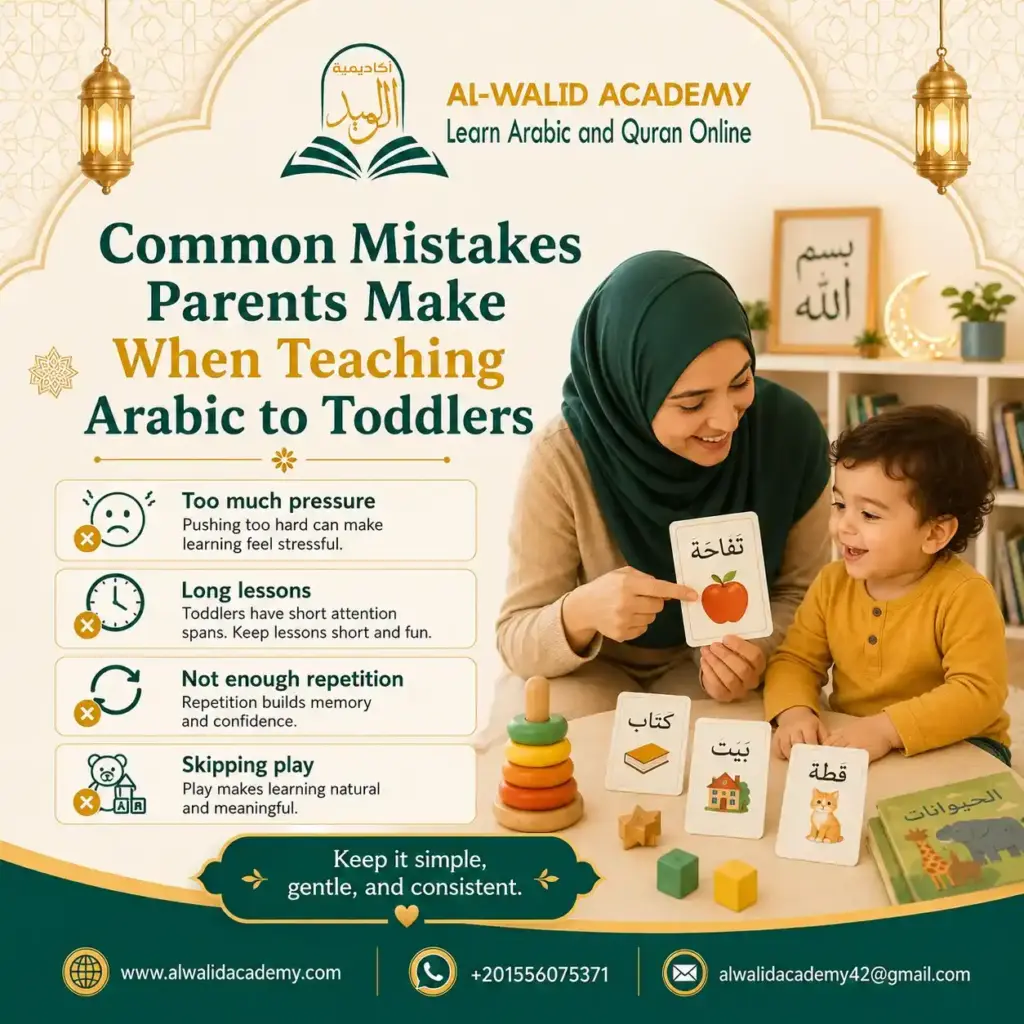
The most common mistakes parents make when teaching Arabic to toddlers include starting grammar too early, expecting fast results, overusing screen time, and not practicing consistently.
Avoiding these mistakes in How to Teach Arabic to Toddlers helps the child learn naturally, smoothly, and without pressure or frustration.
Many parents have good intentions, but incorrect methods can reduce the child’s motivation and slow down progress.
1. Starting with Grammar Too Early
Starting grammar too early weakens a child’s learning process because toddlers at this age need to hear and use the language, not analyze it.
Young children cannot understand abstract grammar rules. When grammar is introduced too early, the child may feel that Arabic is difficult and complicated. Instead, learning should begin with simple words and short sentences, and grammar should be introduced gradually at a later stage when the child is older and more ready.
Age-appropriate learning stages:
| Age | Suitable learning method |
| 2–4 years | Listening to simple words and repetition |
| 4–6 years | Short sentences and daily interaction |
| 6+ years | Basic introduction to grammar |
This gradual approach helps children build strong language skills without pressure.
2. Expecting Fast Results
Expecting fast results is one of the most common mistakes because language learning in children requires time and daily repetition before clear progress appears.
Arabic learning is a gradual process, not a quick one. Some children progress quickly, while others need more time, and this is completely normal.
Typical language development stages:
| Time period | Suitable learning method |
| 1–3 months | Understands simple words |
| 3–6 months | Says single words |
| 6–12 months | Forms short sentences |
| 1–2 years | Speaks longer sentences |
Patience and consistency are far more important than speed.
3. Using Too Much Screen Time
Excessive screen time reduces language learning quality because children need real human interaction to develop proper communication skills.
Screens may help with word recognition, but they are not enough to build speaking ability. A child needs to hear, respond, and interact with real people in real situations.
Recommended screen time by age:
| Age | Daily screen time |
| 2–3 years | 10–15 minutes |
| 3–4 years | 15–20 minutes |
| 4–5 years | 20–25 minutes |
Screens should always be a supporting tool, not the main learning method.
4. Not Practicing Arabic Consistently
Not practicing Arabic consistently is a major mistake because language fades quickly without daily repetition.
Regular short activities keep Arabic fresh in a child’s mind and support steady progress. Children learn better when they hear and use Arabic every day in natural situations.
Best practice schedule:
| Practice pattern | Duration | Result |
| Daily | 10–15 minutes | Strong and steady progress |
| 3 times weekly | 20 minutes | Moderate progress |
| Once weekly | 60 minutes | Weak progress |
Daily consistency is the key factor for successful Arabic learning in children.
How to Encourage Your Toddler to Speak Arabic
Regular communication in Arabic during daily routines helps toddlers feel comfortable using new words and expressions, even if it is not fully correct.
When the How to Teach Arabic to Toddlers approach is applied properly, the child gradually begins to speak with confidence without fear of making mistakes.
A child does not learn to speak through direct correction or pressure, but through repetition, daily exposure, and hearing the language in real-life contexts connected to their everyday routine such as eating, playing, and sleeping.
Effective ways to encourage a child to speak Arabic
| Method | How it is applied | Benefit |
| Praise attempts | Praise the child for any attempt to speak Arabic, even if simple | Builds confidence |
| Indirect correction | Repeat the word correctly without criticizing the child | Natural learning without frustration |
| Daily Arabic use | Speak Arabic during daily routines | Language familiarization |
| Language in play | Use Arabic words during playtime | Fun and easy learning |
| Shared reading | Read Arabic picture stories with the child | Expands vocabulary and connects words with images |
When the child says any Arabic word, it is important to respond with encouragement such as “Well done,” then gently repeat the word correctly.
This approach builds positive learning habits and encourages the child to continue speaking.
Can Toddlers Learn Arabic Online?
Yes, toddlers can learn Arabic online if they are provided with age-appropriate interactive content and parental supervision. Online learning becomes effective when it is not based only on watching, but on active participation and daily practice.
Children learn best when they listen, see, and engage in activities rather than just watch, so digital learning should always be combined with real-life practice at home.
Key benefits of learning Arabic online for toddlers
| Benefit | Explanation |
| Flexibility | Learning can take place at a suitable time for the family |
| Qualified teachers | Help with correct pronunciation and proper guidance |
| Live interaction | Allows the child to actively participate in lessons |
| Fun learning style | Uses games, songs, and visual materials |
| Continuous tracking | Helps parents monitor the child’s progress |
Online learning becomes much more effective when parents participate with the child during lessons and repeat vocabulary in daily life, as this strengthens understanding and retention.
When to Join Arabic Classes for Toddlers
The best time to enroll a toddler in Arabic classes is between 3 and 4 years old, when the child can focus for short periods and engage with learning activities more effectively. At this stage, learning is most successful when it is structured yet fun.
Specialized courses help build a strong foundation in Arabic through a gradual approach that combines play and education, making it easier for the child to later learn reading and Quran memorization.
Many families combine Arabic learning with an Islamic Studies Course for a more complete educational experience.
Suitable learning stages for toddlers:
| Age | Learning level |
| 2–3 years | Simple listening and repetition activities |
| 3–4 years | Learning basic vocabulary through play |
| 4–5 years | Structured introduction to letters and words |
| 5+ years | Beginning Quran memorization and basic Tajweed |
Choosing the right stage helps the child learn without pressure and makes Arabic a natural part of their daily life.
Why Do Many Families Choose Alwalid Academy for Teaching Arabic to Their Children?
If you are looking for a practical and structured way to apply How to Teach Arabic to Toddlers, Alwalid Academy provides a supportive learning environment where children can develop their Arabic language skills step by step in a way that matches their age and learning stage.
We believe that children learn best when they enjoy the learning process. That is why our teaching approach combines education with engaging activities, helping young learners build Arabic vocabulary, improve communication skills, and gain confidence from an early age.
What Will Your Child Learn at Alwalid Academy?
- A structured Arabic language program that starts with basic vocabulary and everyday expressions.
- Quran memorization courses designed specifically for young children.
- Simplified Tajweed lessons that help children pronounce Arabic and Quranic words correctly.
- Age-appropriate lessons in Islamic Fiqh and Seerah presented in an easy-to-understand format.
- Interactive educational activities that reinforce learning and make lessons enjoyable.
What Makes Alwalid Academy Different?
| Feature | Benefit for Your Child |
| Specialized teachers | Lessons tailored to children’s learning needs and abilities |
| Interactive teaching methods | Increased engagement and participation during classes |
| Structured learning path | Provides learners with the essential skills needed for future Arabic and Quran studies. |
| Continuous progress tracking | Helps monitor improvement and address learning gaps |
| Encouraging learning environment | Boosts confidence and develops a positive attitude toward learning |
FAQs
How Many Arabic Words Should a Toddler Learn First?
There is no fixed number of Arabic words a toddler must learn first. Most children benefit from starting with a small group of everyday words related to family, food, toys, and daily activities before gradually expanding their vocabulary.
Can Toddlers Learn Arabic and Another Language at the Same Time?
Yes, toddlers can learn Arabic and another language at the same time. Young children naturally have the ability to acquire multiple languages when they are exposed to them regularly and in meaningful daily situations.
What Type of Arabic Stories Are Best for Toddlers?
The best Arabic stories for toddlers are short, simple, and supported by colorful pictures. Stories with familiar topics and repetitive vocabulary help children understand new words more easily.
How Often Should I Read Arabic Books to My Toddler?
Reading Arabic books to your toddler every day is ideal. Even a few minutes of daily reading can strengthen vocabulary, improve listening skills, and increase the child’s familiarity with Arabic.
What Skills Should a Toddler Learn Before Reading Arabic?
Before learning to read Arabic, toddlers should develop listening skills, recognize common words, and become familiar with basic Arabic sounds. These foundational skills make reading easier later on.
Can Learning Arabic Help Improve a Child’s Memory?
Yes, learning Arabic can support memory development. Repeated exposure to words, stories, songs, and language activities helps children strengthen memory, concentration, and language retention skills.
How Can Parents Make Arabic More Enjoyable for Toddlers?
Parents can make Arabic more enjoyable by using games, songs, picture books, and everyday conversations. When Arabic becomes part of fun activities, children are more motivated to learn and use the language.
Is It Better to Learn Arabic with a Teacher or at Home?
The most effective approach combines both home practice and professional instruction. Parents provide daily exposure, while qualified teachers offer structured lessons that help children progress more efficiently.