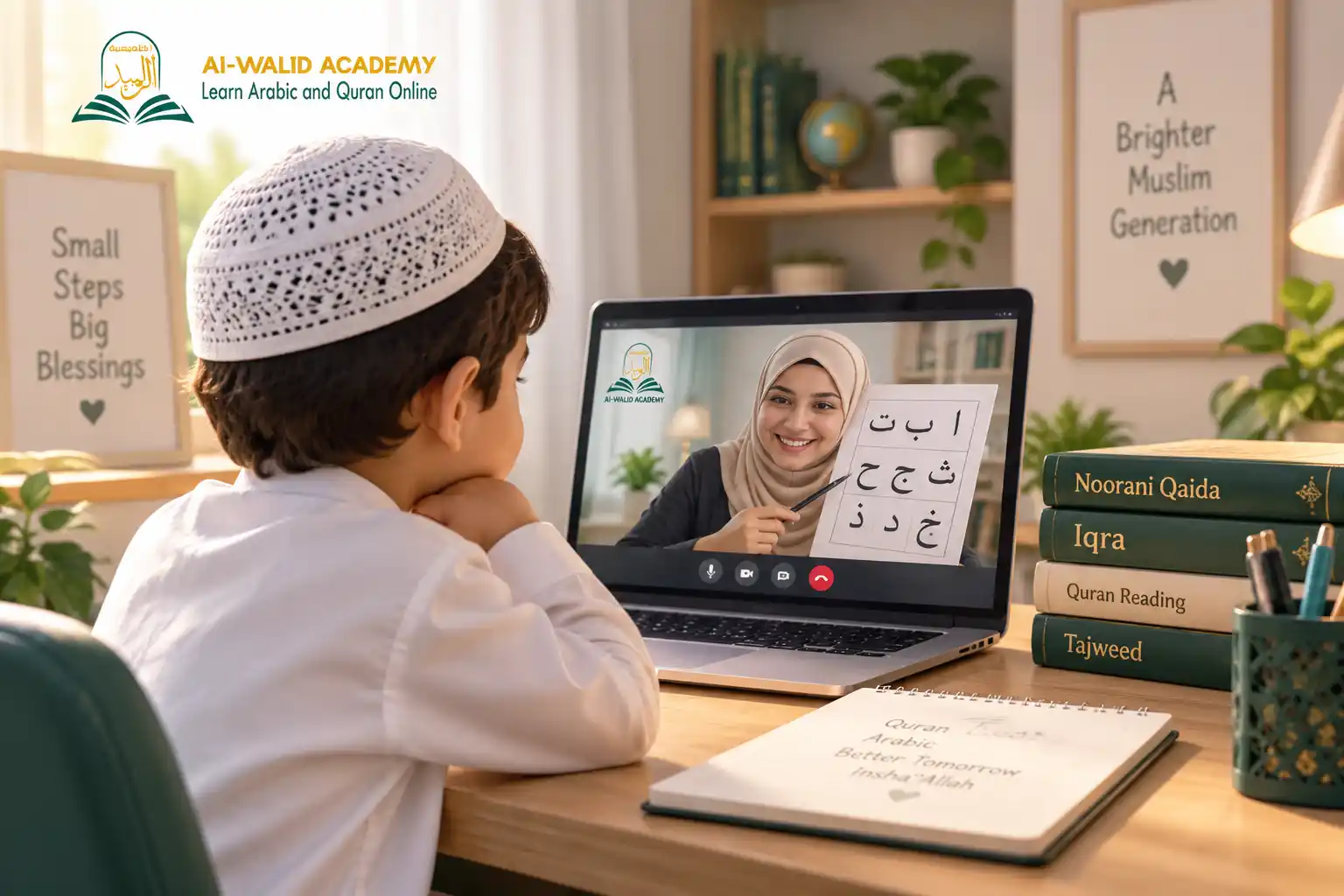

Memorizing the Holy Quran is a major responsibility that falls on parents, especially when their children are young; it requires choosing a qualified teacher and, without a doubt, a suitable and supportive environment.
With so many options available, the question that parents often ask is: Which is better one to one vs group Quran classes for kids? In this article, we’ll help you find a precise answer to this question with effective tips from experts at Al-Walid Academy.
Private vs Group Quran Classes: Key Differences
Before enrolling your child in a small group or a large group, you should carefully familiarize yourself with the nature of one to one vs group Quran classes for kids and the advantages of each.
| Private Classes | Group Classes | |
| Focus and Attention | 100% of the focus is directed toward the student, which maximizes the benefits and value of the session. | The teacher’s attention is divided among more than one student in the group, so the child must pay closer attention. |
| Flexibility | The program offers great flexibility in organization and customization based on what works best for the child in terms of memorization and review plans. | There is very little flexibility, so the teacher cannot find a schedule that works for all students or a standardized system for studying and reviewing. Therefore, the teacher sets a fixed schedule and specific times, and the student decides whether it works for them or not. |
| Pace of Education | The pace of instruction varies based on the child’s progress and ability to achieve goals. | The pace of instruction is steady, and students who fall behind the rest of the class must try their hardest to catch up. |
| Financial Cost | The financial cost is high because the teacher’s time is devoted exclusively to a single child. | The financial cost is lower because the teacher’s time is shared among several children in the group. |
| Environment and Motivation | The child needs encouragement from his or her teacher and parents due to the absence of peers. | The child is with friends in a stimulating environment that encourages persistence and progress. |
- Start enrolling your children today in Quran Memorization Course at Al-Walid Academy for an enjoyable experience and guaranteed results.
How Does Class Size Affect Your Child’s Quran Learning?
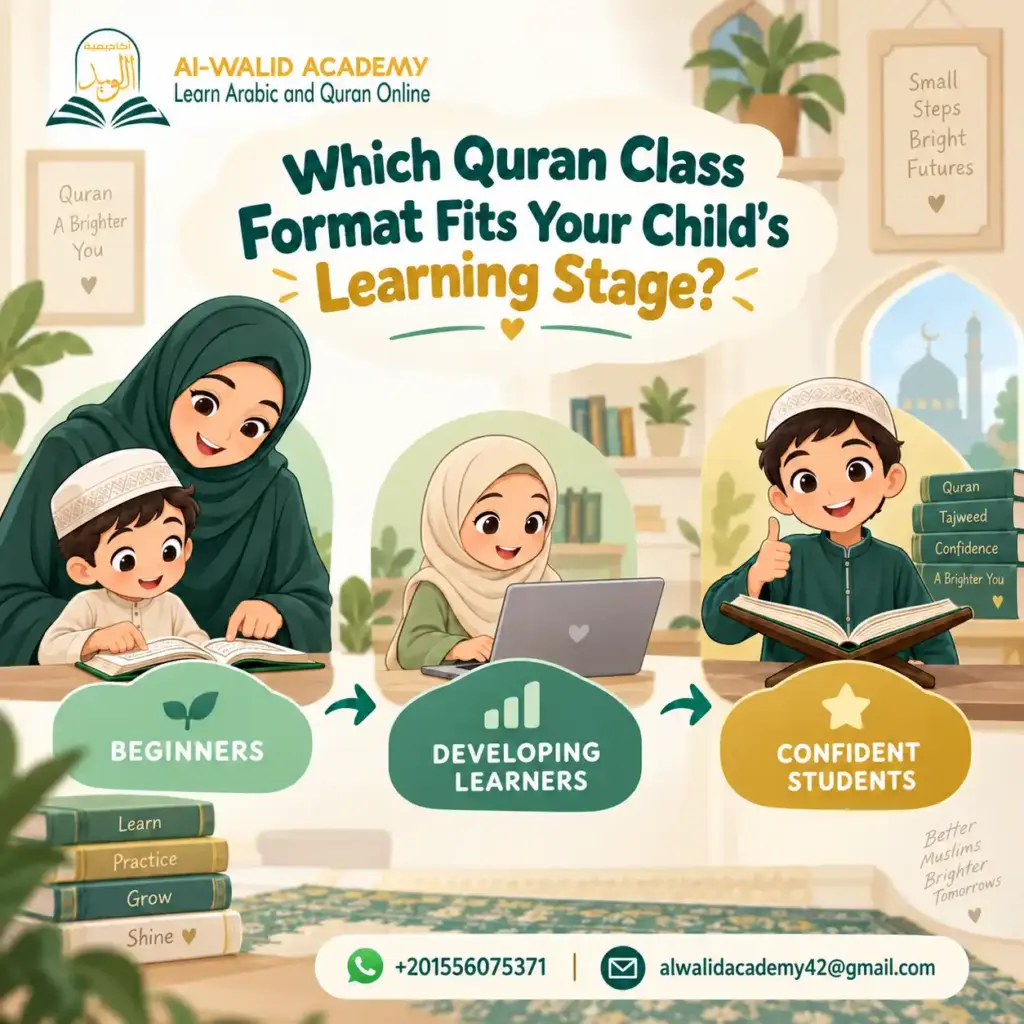
Class size can sometimes have a significant impact on students’ learning journey; as the number of students increases in one-on-one vs. group Quran classes for kids, the teacher’s effort and time are divided among them all.
one-on-one lessons: the student receives the teacher’s undivided attention, which facilitates continuous repetition and immediate correction.
- Who it’s suitable for: Young children or those who have difficulty fitting in and suffer from shyness.
Small groups of 3 to 5 students: provide enough time for each student to receive individual attention, and they foster a spirit of healthy competition among students that encourages them to persevere.
- Who it’s suitable for: children over 6 years old who can distinguish between letters and pronounce them correctly.
Large groups: In these groups, students have fewer opportunities for individual recitation and error correction.
- Who it’s suitable for: group recitation or explaining religious stories, but less effective for those learning to read or recite at the beginner levels.
Take advantage of your children’s vacation and sign them up for Quran lessons for Kids online at Al-Walid Academy.
How Much Recitation Time Does Each Child Get?
Assuming that each session lasts 60 minutes per student for listening, reading, and correcting errors, the average time spent with each student is
- 60 minutes for a one-to-one session.
- 10 minutes per student for a group of 6 students.
- 6 minutes per student for a group of 10 students.
Are Students Grouped by Age, Quran Level, or Both?
Most often, the two approaches are combined so that the primary focus is on grouping students of similar ability, while also taking into account their similar ages, to create an interactive and inclusive environment.
- Quran Recitation Course It is indispensable on the journey to memorize the Holy Quran, as it helps solidify recitation and master the rules of tajweed.
Which Quran Class Format Fits Your Child’s Learning Stage?
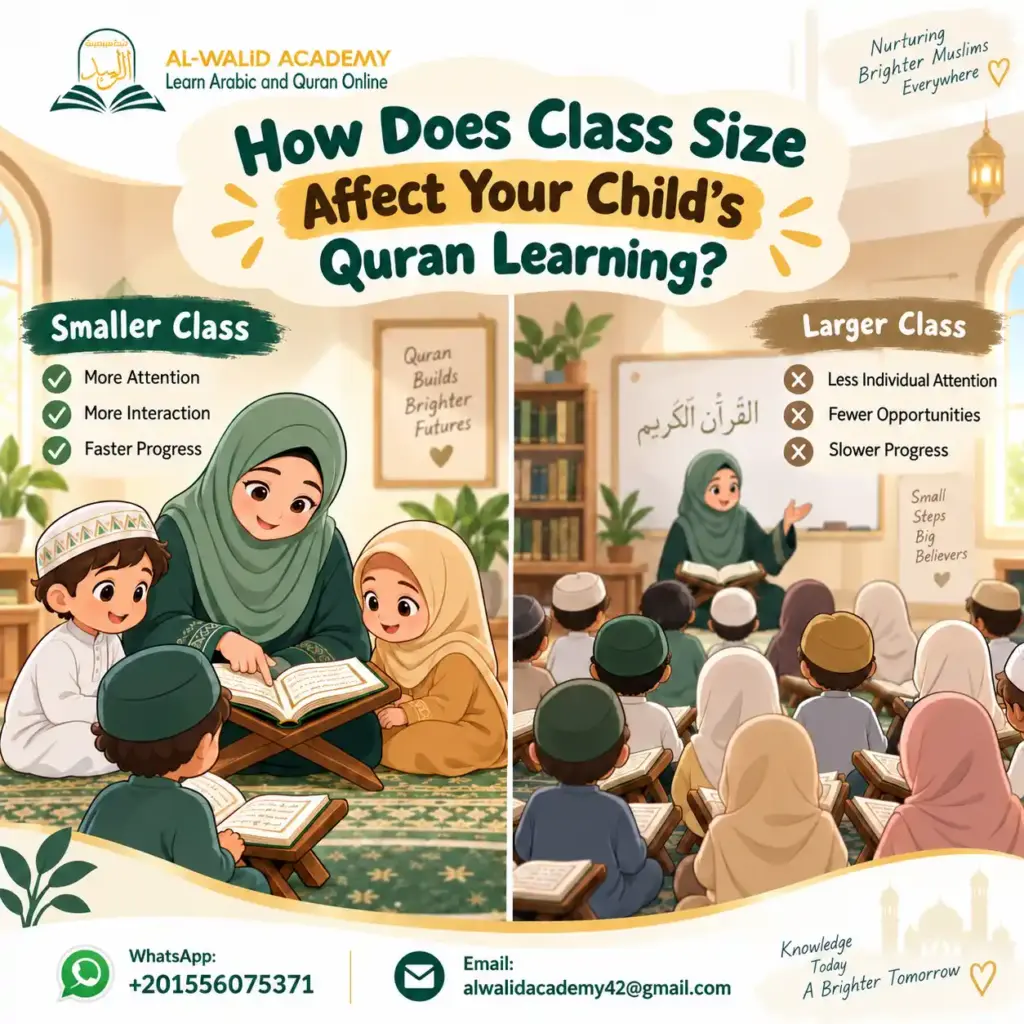
Your child’s characteristics are the key factor you need to understand in detail before choosing one-on-one vs. group Quran classes for kids, as small groups are better suited for certain children, while others thrive in larger groups.
Private vs Group Classes for Noorani Qaida Beginners
| Private Classes | Group Classes |
| It includes one-on-one instruction in the basic rules of tajweed, with intensive practice and correction of mistakes. Students can also quickly move on to the next tajweed rule once they have mastered it, without having to wait for the entire group. | The teacher explains the rules of tajweed to all the students, and then it is each student’s turn to practice and have their mistakes corrected.This method is suitable for children who learn quickly and who have a solid grasp of the basics of rules and pronunciation. |
Private vs Group Classes for Quran Reading and Tajweed
| Private Classes | |
| One-on-one lessons provide an opportunity to explain the rules of the Tajweed Course—such as the rules of mad and noon sakina in depth and in detail, along with practical application during recitation. | In the groups, the rules of tajweed are explained, and each student is given the opportunity to practice individually; recitation is often done in a group. |
Private vs Group Classes for Hifz and Quran Revision
| Private Classes | Group Classes |
| In Private groups, the amount of time devoted to memorization and review is determined based on the child’s level and pace of progress. There is also a great deal of flexibility in tailoring the sessions; for example, one entire session can be dedicated to review, another to memorization, and so on, depending on the student’s needs. | In groups, memorization is done by having each student recite aloud; the teacher corrects any mistakes and then reads the section to be memorized again in front of the students.All group members adhere to a system of memorization, review, and steady progress that cannot be changed. |
How Do Private and Group Quran Classes Affect Participation and Confidence?
Both one-on-one sessions and group lessons have their own unique advantages and characteristics that greatly benefit the child on his or her journey to learn the Quran.
When Group Learning Helps Children Participate
Education within a group setting significantly and noticeably helps children develop:
- Self-confidence and the ability to express their opinions
- A lack of fear of making mistakes in front of others, which helps them accept their mistakes later on
- Interaction with children their own age, which helps develop their social skills
When a Child May Benefit From One-to-One Quran Lessons
One-on-One Quran Lessons are an ideal option for children who suffer from:
- Excessive shyness and an inability to adapt quickly.
- Children who are restless and lose focus easily; being in a quiet environment helps them stay more focused.
- Children who have specific goals and want to intensify their efforts to achieve them in record time.
- At a very young age, when they lack the ability to integrate or try to understand within a group.
Do you think private lessons are worth the cost, or are they a waste of money?
To answer this question, we will discuss several aspects that define the experience of one-to-one vs. group Quran classes for kids:
- Lesson Frequency
The number of sessions a student can take during the week can be adjusted based on the student’s goals and ability to retain information; in group classes, however, the number of sessions is fixed.
- Teacher Feedback
The teacher’s role is clearly defined in one-on-one lessons, where they focus entirely on the student and correct their mistakes; in group classes, however, the teacher’s attention is divided among multiple students.
- Recitation Time
Recitation time is dedicated to a single student, which helps them master the rules of tajweed, review mistakes, and repeat corrections until they are perfected; in group classes, however, recitation time is divided among multiple students.
- To summarize, specialized groups are worth the cost when a child is young, has learning difficulties, struggles to integrate easily, or has a specific goal tied to a particular timeframe. Otherwise, general groups are perfectly suitable.
What Should Parents Look for During a Trial Quran Class?
A trial class is a very important step before making a decision; it serves as a realistic preview of the class before actually enrolling.
Does the Teacher Give Clear and Personalized Feedback?
The teacher is the key factor in the success of the Quran learning journey, especially with young children. Therefore, the teacher’s ongoing monitoring and evaluation of the child are essential for progress and continuity. To truly understand this, you should answer the following questions:
- Does the teacher provide a clear and accurate assessment of your child’s level at the end of the session?
- Does the teacher help you understand how you can support your child in memorization and follow-up?
- Does the teacher adjust their teaching method when they sense that the child is not understanding?
- Does the teacher identify mistakes accurately, and how does he or she help the child correct them?
- Can the teacher provide a clear lesson plan tailored to your child’s age and skill level?
The answers to these questions are what truly determine the teacher’s expertise, so don’t rely solely on certificates and experience.
Does Your Child Understand the Next Learning Goal?
Parents can observe their child’s initial understanding of the learning process and how well the child responds to the teacher’s explanations even at a young age, through the following:
- The child’s desire to complete the lesson and anticipation of the next one.
- The child’s repetition of what they learned during the lesson, whether it be a Quranic verse, a religious story, or something else.
- The extent to which the child understands and responds to the teacher during the lesson.
- At a young age, one sign that a child likes the teacher is the casual conversations the child has with him or her, which indicate the child’s affection for the teacher.
If you do not notice these signs in your children, you can request a trial lesson with the same teacher or request a change of teacher.
When Should a Child Switch Between Private and Group Quran Classes?
The transition from individual to group instruction is appropriate for a child in the following cases:
- If the child has mastered the basics of tajweed and reading and has begun the process of memorization and gaining a deeper understanding of the rules.
- If the child has the ability to integrate naturally with peers.
- If the child shows signs of boredom or a lack of desire to continue, being with children of the same age who are working on the same tasks will encourage them.
- Continuing with individual lessons may become too costly to sustain, so group lessons are a better option to ensure continuity.
How to Choose Between Private and Group Quran Classes for Your Child
The choice can be difficult for some parents—especially new parents or those with young children who can’t express their needs—but by following these tips, the process will become easier and more organized.
When Are Private Lessons Appropriate?
- If your child is young and has trouble fitting in with older children.
- If your child is in the early stages of learning to read and master proper recitation.
- If you want to achieve a specific goal, such as entering a competition, and need to intensify your child’s study efforts.
- If your child is shy to the point that it affects their comprehension and academic performance.
- If your child has learning difficulties and needs to maintain a specific pace in their studies and academic progress.
When are group lessons appropriate?
- If your child is sociable and needs to interact with peers.
- If your child has mastered the basics of recitation and the fundamental rules of tajweed.
- If they prefer a competitive environment and have a desire to win and excel.
- If they are able to concentrate and participate actively during class.
- Group lessons are financially feasible for parents, especially if they have more than one child.
Common Mistakes Parents Make When Choosing
- Choosing based solely on price, without considering the teacher’s experience and teaching ability.
- Relying on a teacher’s academic credentials without reviewing students’ past experiences with them and assessing how well those credentials align with real-world experience.
- Assuming that the quality of a class depends solely on its cost—that is, that a professional teacher is one who charges higher fees—when this belief is not a reliable measure.
- Placing all siblings in the same class without considering differences in age and academic level.
- Failing to reassess the decision, as the study method used at the beginning may not necessarily be as effective as students advance to higher levels. Therefore, progress and performance must be continuously evaluated.
At Al-Walid Academy, we offer a full range of options to help your child excel and master the Quran by heart.
Whether you prefer one-on-one lessons for your child or want them to join a group to foster healthy competition, simply contact us and sign up now.
With years of experience in Quran memorization, making Lesson Plans for Teaching Quran, and a team of teachers specialized in Quranic studies, your child’s memorization journey will be both perfect and enjoyable.
Conclusion
There is no joy greater than seeing your son or daughter memorize the Book of Allah. Therefore, striving to provide a suitable environment that encourages them to progress is a turning point, especially at such a young age. Making the right choice begins with identifying the appropriate group and understanding one-on-one vs. group Quran classes for kids and the advantages of each before making a choice.
Frequently Asked Questions
Are Private Quran Classes Better Than Group Classes for Kids?
It’s impossible to say for sure, but it is often appropriate when a child faces obstacles that hinder his or her integration with the rest of the students.
How Many Students Should Be in a Group Quran Class?
For optimal results, it is best to have between 6 and 10 students.
Which Is Better for Hifz: Private or Group Quran Classes
It depends on the child’s ability to participate and learn in group lessons, as well as his or her age. If the child is unable to participate and interact with the group, or if he or she is very young, then one-on-one lessons would be more appropriate.
How Do I Know if My Child Is Ready for a Group Quran Class?
If he masters the basics of pronunciation, recitation, and the rules of tajweed, and is able to put them into practice and make progress in memorization—even if the surahs are short.
Are Group Quran Classes Cheaper Than Private Lessons?
Yes, group classes are significantly cheaper than individual lessons, since the costs are spread across all participating students rather than just one student.