Should children learn Arabic before Quran, or can they begin Quran lessons immediately? The answer depends on what the child is expected to learn.
A child does not need to speak Arabic fluently before learning to read the Quran. However, learning Arabic letters, sounds, and basic vowel marks can make Quran reading much easier.
Should Children Learn Arabic Before Quran?
Should children learn Arabic before Quran is a common question among parents of non-Arabic-speaking children. In most cases, children do not need to complete a general Arabic course before starting Quran reading.
Instead, they can begin with the Arabic alphabet, correct pronunciation, Harakat, and letter combinations. These skills directly support Quran reading.
For young beginners, learning Arabic and Quran together can be more practical than spending months studying conversational Arabic before opening the Quran. The learning sequence should match the child’s age, ability, and previous exposure to Arabic.
Can Kids Learn Quran Without Knowing Arabic?

Yes. Children can learn to read the Quran without being able to speak or understand Arabic fluently.
Quran reading involves recognizing Arabic letters, connecting them correctly, pronouncing sounds accurately, and applying reading rules. Understanding the meaning of Quranic verses is a separate skill.
Therefore, a child may start learning Quran recitation while gradually developing Arabic vocabulary and comprehension. This is especially useful for children who grow up in non-Arabic-speaking families.
Parents asking Should children learn Arabic before Quran should distinguish between learning to read Arabic script and learning Arabic as a complete language. The first is directly connected to Quran reading, while the second can develop progressively.
What Arabic Skills Does a Child Need Before Reading Quran?
A child does not need advanced Arabic grammar or extensive vocabulary before beginning Quran reading. Basic reading foundations are usually more important.
Arabic Letter Recognition
Children should become familiar with the Arabic alphabet and recognize letters in different forms. Some Arabic letters change shape depending on their position within a word.
Regular practice with individual letters helps children identify them more quickly when they appear in Quranic words.
Correct Letter Sounds
Correct pronunciation is essential for Quran reading. Children should learn how Arabic letters sound and understand the differences between letters with similar pronunciations.
A qualified teacher can help identify pronunciation difficulties early and provide appropriate correction.
Harakat and Short Vowels
Children should learn basic Harakat in the Arabic language, including Fathah, Kasrah, and Dammah. They should understand how these marks affect the sound of a letter.
Learning Sukoon and other basic signs can follow as the child progresses.
Joining Arabic Letters
Children need to understand how individual letters connect to form words. Practicing connected letters prepares them to read simple Quranic words instead of recognizing letters individually.
This foundation makes the transition to Quran reading smoother.
Should Kids Learn the Arabic Alphabet Before Quran?
Yes, learning the Arabic alphabet is usually one of the first steps for a child who cannot recognize Arabic letters.
However, children do not necessarily need to master every aspect of the Arabic language before beginning Quran lessons. The focus can initially be on recognizing letters and producing their sounds.
For parents wondering Should children learn Arabic before Quran, a useful approach is to teach the Arabic alphabet specifically as a foundation for Quran reading. Once children become comfortable with letters, they can move toward Harakat, connected letters, and simple Quranic words.
Should Children Start with Noorani Qaida Before Quran?

For many beginners, Noorani Qaida can provide a structured introduction to Quran reading. It typically progresses from Arabic letters and basic sounds to Harakat, joined letters, words, and foundational pronunciation rules.
It is not the only possible method, but it can be helpful for children who are starting from zero.
If parents ask Should children learn Arabic before Quran, Noorani Qaida can offer a middle path: children learn the Arabic reading skills they need while preparing specifically for Quran recitation rather than studying general Arabic first.
Contact us now, and we will provide you with all the information you need to know about how to teach Noorani Qaida to Kids.
Quran Reading vs Learning Arabic: What Is the Difference?
Quran reading and Arabic-language learning are related but different goals.
| Quran Reading | Arabic Language Learning |
| Focuses on reading Quranic text | Develops communication skills |
| Teaches letter recognition | Builds vocabulary |
| Focuses on pronunciation | Includes speaking and listening |
| Uses Harakat and reading rules | Includes grammar and sentence structure |
| Leads toward Quran recitation | Can support everyday communication |
A child can therefore begin Quran reading without being able to hold a conversation in Arabic.
Quranic Arabic vs Conversational Arabic for Kids
| Quranic Arabic | Conversational Arabic |
| Focuses on the language that is used in the Quran | Focuses on everyday communication |
| Helps children understand Quranic words and verses | Helps children communicate in Arabic |
| Includes Quranic vocabulary and expressions | Includes common daily vocabulary |
| Supports Quran reading and comprehension | Supports speaking and listening |
| Introduces words commonly found in Quranic verses | Teaches phrases used in daily situations |
| Can be learned alongside Quran recitation | Often includes conversations, questions, and responses |
| Useful for understanding Islamic texts | Useful for communicating with Arabic speakers |
| May include basic grammar needed to understand Quranic sentences | Gradually introduces grammar for practical communication |
For families who want their children to understand the Quran more deeply, studying Quranic Arabic while learning to read can help them recognize the meanings of familiar words and verses.
Is It Better to Learn Arabic and Quran at the Same Time?
Learning Arabic and Quran together can also be a practical approach for many children. Rather than teaching them as two unrelated subjects, teachers can combine basic Arabic skills with Quran lessons, allowing children to apply what they learn directly while reading.
A child might learn a letter, practice its sound, read it with different Harakat, and then encounter it in a simple Quranic word.
This integrated approach can answer the question Should children learn Arabic before Quran in a practical way: children can learn the Arabic foundations needed for Quran reading while beginning their Quran journey gradually.
What Should a Non-Arabic-Speaking Child Learn First?
A non-Arabic-speaking child can start with:
- Arabic letter recognition.
- Correct pronunciation of individual letters.
- Basic Harakat.
- Simple connected letters.
- Short Arabic and Quranic words.
- Basic Quran reading rules.
- Gradual Tajweed instruction.
- Simple Quranic vocabulary and meanings.
The order can be adjusted according to the child’s age and learning pace. There is no requirement for a child to become conversationally fluent in Arabic before beginning Quran reading.
When Is a Child Ready to Start Reading the Quran?
A child is generally ready to begin Quran reading when they can recognize most Arabic letters and understand basic vowel sounds. Fluent Arabic and advanced pronunciation are not prerequisites for a child to begin learning the Quran.
A teacher can assess the child’s reading level and identify which foundational skills still need practice.
For parents asking Should children learn Arabic before Quran, readiness should be measured by reading ability rather than conversational Arabic proficiency.
Children who already recognize Arabic letters may be ready to move directly into a beginner Quran-reading program. Those starting from zero may benefit from Arabic alphabet and Noorani Qaida lessons first.
A Simple Learning Path from Arabic Letters to Quran Reading
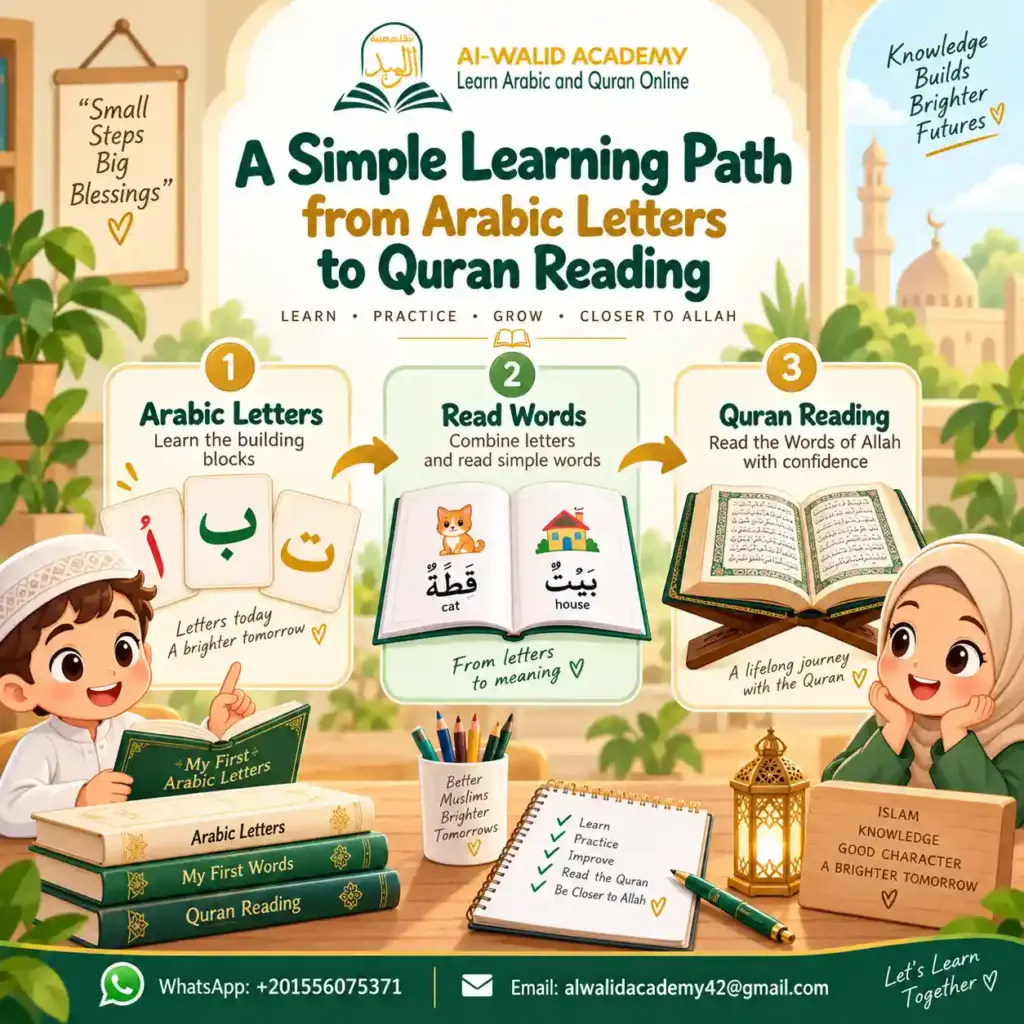
What is the Best Way to Learn to Speak Arabic? A gradual learning path can make the process less overwhelming for children.
Step 1: Learn Arabic Letters and Sounds
Begin by teaching the Arabic alphabet and the correct pronunciation of each letter in the Arabic language. Use repetition, visual activities, and short practice sessions to keep children engaged.
Step 2: Learn Harakat and Connected Letters
Once children recognize individual letters, introduce Fathah, Kasrah, Dammah, Sukoon, and other basic reading signs. Then practice connecting letters.
Step 3: Read Simple Quranic Words
Children can gradually move from isolated exercises to short words and simple Quranic combinations. This helps them apply what they have learned in an authentic Quranic context.
Step 4: Start Quran Reading with Basic Tajweed
After developing basic reading confidence, children can begin reading Quranic passages while learning age-appropriate Tajweed rules. Tajweed should be introduced progressively rather than overwhelming beginners with too many rules at once.
How Learning Arabic Helps Children Understand the Quran
Learning Arabic can provide children with more than the ability to pronounce Quranic words. As their vocabulary grows, they can begin recognizing the meanings of familiar words and expressions.
For example, learning common Quranic vocabulary can help children understand repeated words across different Surahs. Basic Arabic knowledge can also make explanations of Quranic verses easier to follow.
However, parents should remember that learning Arabic for children before the Quran does not mean children must achieve advanced Arabic proficiency first. Learning Arabic can continue alongside Quran reading and understanding.
Help Your Child Start Quran and Arabic with Al-Walid Academy
Al-Walid Academy for Quran courses online can provide children with a structured learning environment for acquiring advanced Quran and Arabic skills online. Lessons can be adapted to the child’s current level, whether they are completely new to Arabic letters or already able to read basic Quranic words.
A gradual approach can help children build confidence without making the learning process unnecessarily difficult.
With qualified online instruction, children can work on Arabic letters, pronunciation, Quran reading, Tajweed, and Quranic understanding through age-appropriate lessons.
Explore online Quran Learning and Arabic Classes Online with Al-Walid Academy and help your child build strong foundations in Arabic and Quran reading from home.
Conclusion
Ultimately, whether children learn Arabic before Quran has no single answer for every child, they do not need fluent Arabic before beginning Quran reading, but they do need basic Arabic reading foundations.
For many children, learning Arabic letters, pronunciation, and Quran reading together provides a practical and gradual path toward confident Quran recitation and deeper understanding.
FAQs
Should Children Learn Arabic Grammar Before Quran Reading?
No. Children can begin Quran reading without studying Arabic grammar first. Basic reading skills and gradual grammar learning can be introduced alongside Quran lessons.
Should Kids Learn Tajweed Before Studying Arabic?
Not necessarily. Tajweed focuses on correct Quran pronunciation, while Arabic helps children understand the language. Kids can learn both gradually according to their age and learning goals.
Can Online Quran Classes Teach Children from Zero Arabic?
Yes. Many online Quran classes are designed for beginners and can start with basic Arabic letters, pronunciation, and Quran reading before moving to more advanced lessons.