Teaching Surah Al-Fatiha for Kids is one of the best ways to build a strong connection with Allah from an early age. As the opening chapter of the Quran and an essential part of every prayer, it teaches children praise, faith, gratitude, and guidance. But how can parents make learning it easy and enjoyable? In this article, you will discover its key benefits and practical tips to help your child learn, understand, and love Surah Al-Fatihah.
What Is Surah Al-Fatiha?
- Surah al-Fatihah is the first surah of the Holy Qur’an; hence it is called al-Fatihah and appears at the beginning of the Mushaf.
- It is considered one of the greatest surahs of the Qur’an and is linked to another of the pillars of Islam, namely prayer.
- It is known as ‘Umm al-Kitab’ (the Mother of the Book) and consists of seven verses.
- Surah Al-Fatihah was revealed in Mecca and contains a number of profound religious meanings, namely: praising and glorifying Allah;
- emphasising the worship of Allah, the One and Only;
- seeking help from Allah alone in all matters and aspects of life;
- and concluding with a supplication to Allah to guide us to the straight path.
Al-Walid Academy Quran lessons for Kids online It is the ideal choice for teaching your children the various sciences of the Qur’an.
Why Is Surah Al-Fatiha Important for Kids?
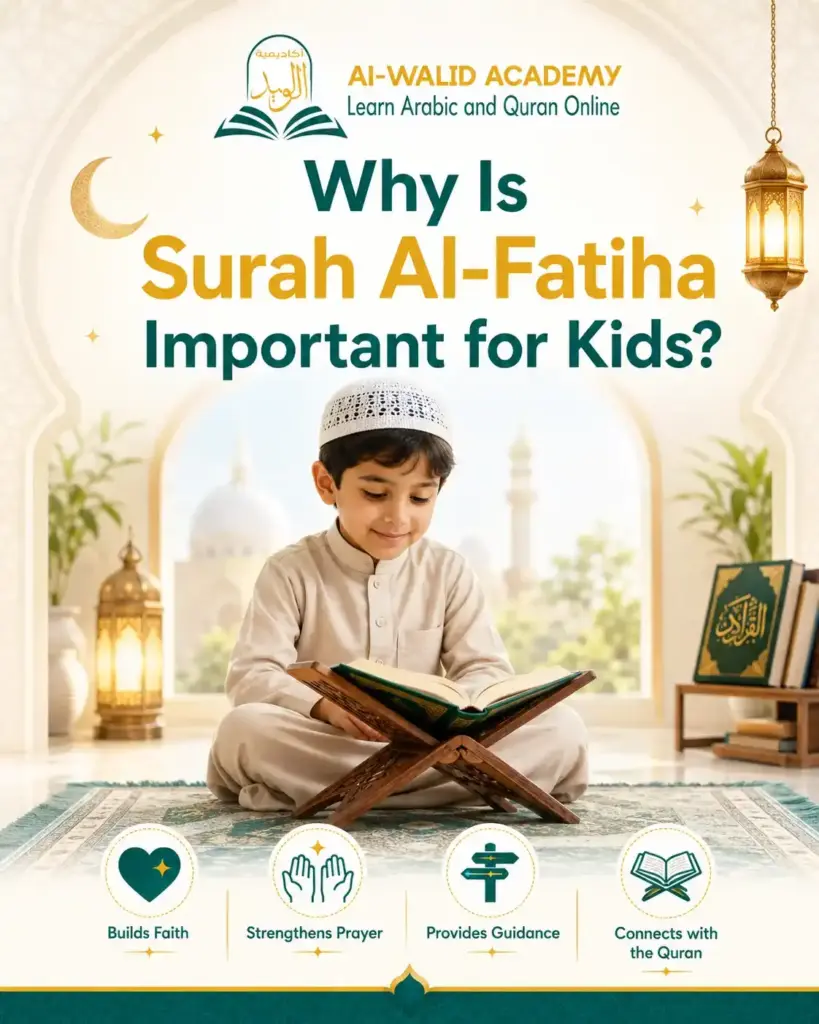
Surah Al-Fatiha for Kids is one of the most important steps in helping them learn a great deal about acts of worship and strengthening their faith in Allah the Almighty
The Opening Chapter of the Quran
Surah al-Fatihah is the first surah of the Holy Qur’an and is known as ‘Umm al-Kitab’ (‘The Mother of the Book’) and ‘al-Sab’ al-Mathani’ (‘The Seven Repeated Verses’) because it consists of seven verses.
Al-Fatiha is considered one of the greatest surahs of the Qur’an because it encapsulates the most important tenets of the Islamic faith: the absolute oneness of Allah, the Exalted; praise of Him; belief in the Day of Judgement; and the seeking of guidance.
Owing to the importance of Surah Al-Fatiha and the variety of spiritual meanings it instils in the soul, Allah, the Exalted, has commanded us to recite it in every rak’ah, and prayer is not valid without it.
A Surah Every Muslim Child Should Learn
Memorising Surah al-Fatihah and understanding its meanings is a fundamental step in the faith-based and religious upbringing of children, as:
- It is the foundation of prayer; prayer is not valid without it.
- It is the greatest surah of the Qur’an and is also easy for children to memorise.
- It contains profound meanings that teach children to turn to Allah, the Most High, to love Him and to praise Him.
- It teaches children how to supplicate, and that guidance comes solely through the grace of Allah, the Most High.
Check now the best Online Quran Teaching Platforms
Surah Al-Fatiha in Daily Prayers
Prayer is one of the Five Pillars of Islam and is the first thing a person will be asked about after their death; therefore, performing it properly and in full is obligatory.
Surah al-Fatihah is the fundamental and obligatory surah in all rak’ahs; without it, the prayer is not valid and is not accepted.
- Learn Quran Tafseer Online With Al-Walid Academy, you can understand the meanings of the Holy Qur’an and grow closer to God Almighty
Interpretation of Surah al-Fatiha
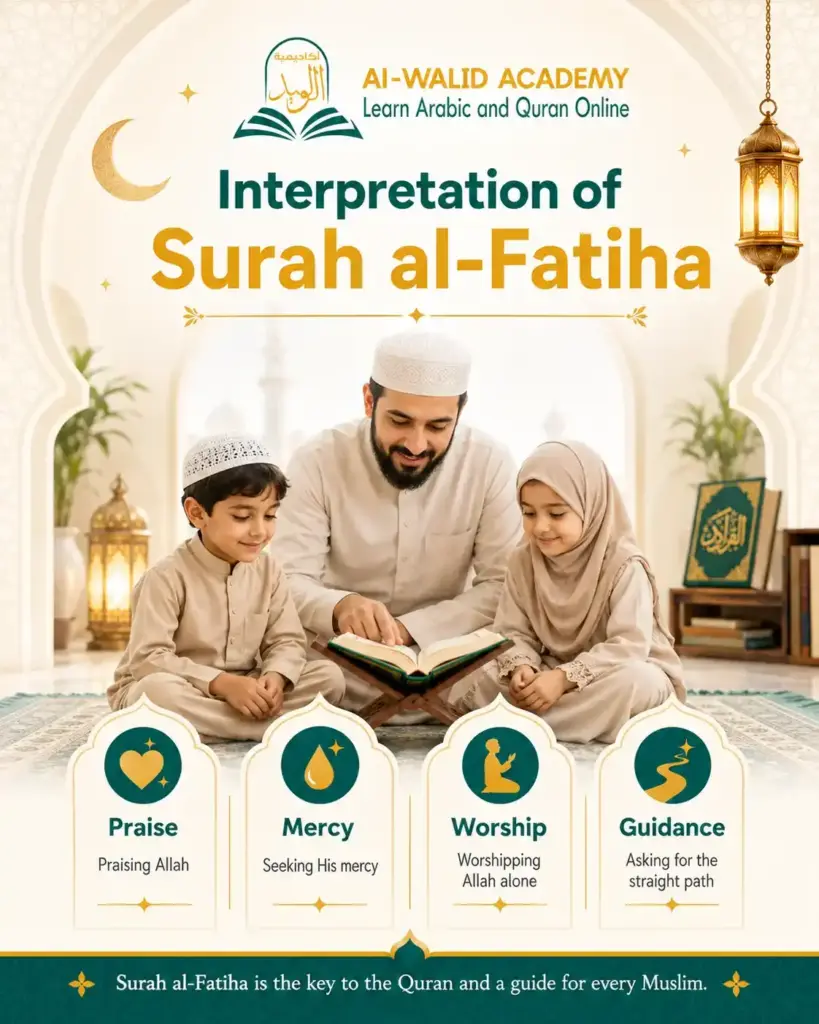
Surah al-Fatiha contains profound spiritual meanings which we discover and come to understand through the exegesis of the surah
“ الْحَمْدٌ لِلّْهِ رَبِّ الْعَلَمِين”
” Al hamdu lellahi rab alalameen”
- The surah begins with praise and glorification of Allah, the Most High.
- And when this verse is recited, Allah, the Most High, responds, saying, ‘My servant has praised Me.’
“ الْرَحْمَنِ الْرَحِيم”
” Al rahman Al rahim”
- The servant praises his Lord, Glorious and Exalted, by His names ‘the Most Gracious’ and ‘the Most Merciful’, to emphasise the abundance of God’s mercy and forgiveness.
- And Allah, the Most High, replies, saying, ‘My servant has praised Me.’
“مَالِكِ يَوْمِ الْدِّينِ”
” Malek Yom Aldeen”
- What is meant here is that it is God, may He be exalted, who reigns and rules on Yom Aldeen, which is the Day of Resurrection.
- And Allah, the Most High, replies, saying, ‘My servant has glorified Me’.
“ إِيَّاكَ نَعْبُدُ وإِيَّاكَ نَسْتَعِين”
” Eiak Nabudu wa Eiak tastaeen”
- It means that we worship none but God, and seek help in matters of both religion and worldly affairs from none but Him.
- God, may He be exalted, replies, saying: ‘To My servant what He has asked for ’
“ اهْدِنَا الْصِرَاطَ الْمُسْتَقِيم”
” Ehdna Alserat Almustakim”
- We ask Almighty God to guide us, lead us, and help us to remain steadfast on the path of truth.
“ صِرَاطَ اللَّذِينَ أَنْعَمْتَ عَلَيْهِمْ غَيْرِ الْمَغْضُوبِ عَلَيْهِمْ وَلَا الضَّالِين”
- The verses go on to describe the straight path ”the path which Allah has bestowed upon His righteous servants,” and which is the opposite of the path taken by those upon whom the wrath of Allah, the Most High, has fallen.
- God, exalted be He, responds to these verses, saying: ‘All this is for My servant, and My servant shall have whatever he asks for.’
Know and memorize with us Juz ‘amma For Kids
Benefits of Teaching Surah Al-Fatiha to Kids
There are many benefits that parents gain from teaching Surah Al-Fatiha to kids, including
Helping Children Understand Salah
Surah al-Fatihah is considered the essence of prayer, and through a simple understanding of its meanings, a child comes to grasp the profound significance of servitude to Allah, the Most High.
It is from Allah that one seeks guidance and assistance on the straight path; and from this, the child realises that prayer is not merely a series of physical movements, but a great act of worship, which in turn strengthens their focus and reverence during prayer.
- Teach your children Fiqh Islamic Jurisprudence with Al-Walid Academy
Building a Strong Quran Foundation
Surah al-Fatihah provides a wonderful introduction for children to understanding the messages of the Holy Qur’an, as it addresses the most important themes, namely:
- The Oneness of Allah, the Most High.
- An understanding of the extent of Allah’s mercy
- Discussions of Paradise and Hell.
- The necessity of walking and proceeding along the straight path.
This helps to foster a balanced religious outlook that combines love for Allah with a sense of responsibility and a commitment to good deeds
Improving Quran Recitation from an Early Age
Teaching children Surah Al-Fatihah correctly at an early age is a fundamental step through which significant progress can be made in reciting the Qur’an, by means of:
- Regular Quran Recitation Course and repetition during every prayer, which helps to correct pronunciation and improve the articulation of letters.
- It helps children to master the basic rules of recitation.
- A basic understanding of some of the rules of tajweed and becoming accustomed to applying them.
- Developing the ability to memorise other surahs from the Holy Qur’an.
Reaching this stage at a young age gives the child confidence and motivation to continue learning.
How to Teach Surah Al-Fatiha to Kids
At Al-Walid Academy, we present some effective and well-thought-out methods for teaching Surah Al-Fatiha to kids
Start with Listening and Repetition
Listening and repetition are the methods children rely on to memorise at an early age. Listening should be repeated several times throughout the day, whether through instruction from parents or a Qur’an teacher, or by reciting along with an audio recording of a reciter.
This helps the child to become familiar with the correct pronunciation and to consolidate certain verses before beginning the memorisation stage.
Teach One Ayah at a Time
It is best to start at a gentle pace, particularly in the early stages, for the following reasons:
- To take into account the child’s limited ability to concentrate and absorb information.
- To provide a sense of achievement, which helps children to complete tasks and make progress.
- To ensure that what has been learnt is firmly retained, and to allow sufficient time to revise what has already been learnt and link the verses together in sequence.
You can join our One-on-One Quran Lessons for kids and get a free trail.
Explain the Meaning in Simple Words
There is no denying the great reward we receive for memorising the Holy Qur’an, but the primary purpose of the Book of Allah is to understand and reflect upon it. Instilling this profound meaning from childhood has a significant impact on one’s connection with Allah and acts of worship in the long term.
This is achieved by simplifying the meanings of the verses so that children can understand and grasp them, and by making every effort to link the meanings of the verses to everyday life.
Practice Recitation with Tajweed
Care should be taken to recite the Holy Qur’an with proper Tajweed Course in front of children; even if they are not yet able to understand the rulings, their different types and how to apply them, it is the correct recitations that remain firmly in their minds.
Easy Surah Al-Fatiha Memorization Plan for Kids
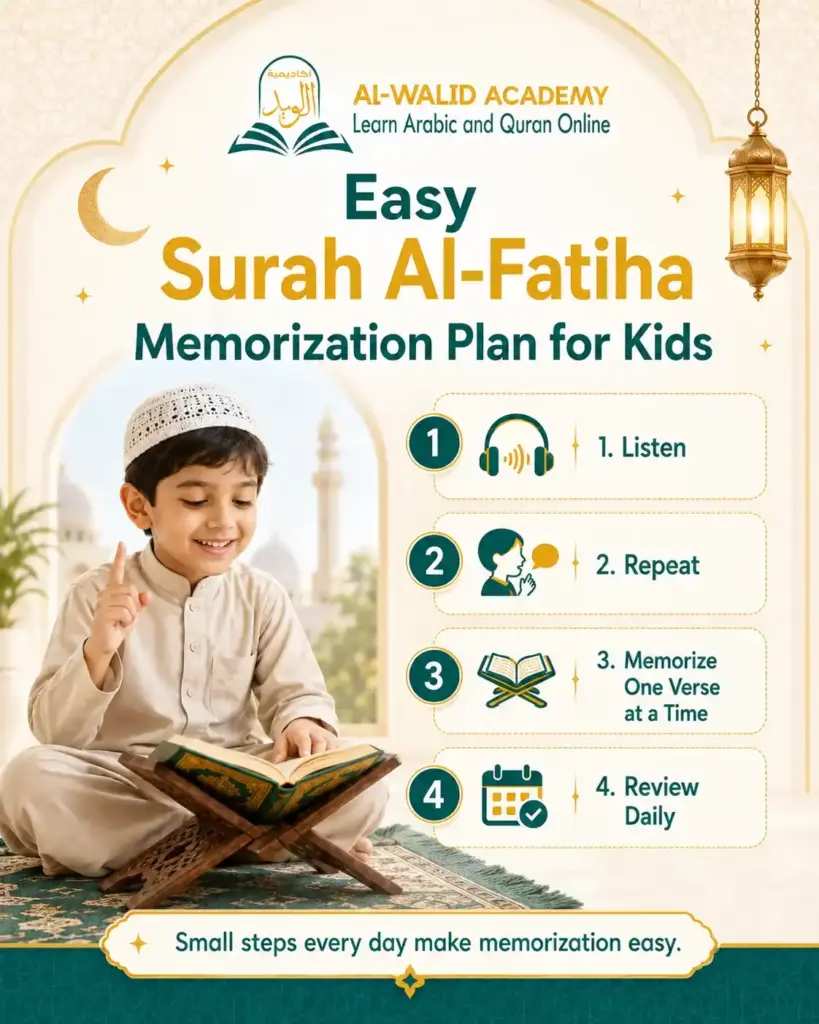
Teaching Surah Al-Fatiha for kids is different from teaching adults, and here are the most important tips for ensuring they remember it
Day 1: Listen and Repeat the Full Surah
Listening is the only way children learn at a young age; when a child hears a surah recited several times correctly, this helps to embed it in their memory, making it easier to memorise and helping them to master the recitation with proper tajweed.
Day 2: Memorize the First Three Ayahs
The first three verses are easy for children to memorise and pronounce, making them a good place to start. They also convey profound meanings that children can understand, such as the mercy of Allah, the Most High, towards us and the fact that He is in control of all things.
Day 3: Memorize the Remaining Ayahs
Memorise the remaining verses; this becomes easier as a result of practising reading the surah several times and having practised memorising the first three verses, so the child is better prepared to continue memorising until the end of the surah.
Day 4: Practice Full Recitation
Reciting the entire surah helps the child to link the verses together; their mind begins to memorise the natural sequence of the verses, and it also helps them to identify any mistakes in reading or recitation and to correct them.
Day 5: Review with Meaning
Revision is the key step in ensuring that what has been learnt is retained, and revising the verses whilst reflecting on their meaning further reinforces this retention and fulfils the primary purpose of the Book of Allah, which is to understand and reflect upon it.
Common Mistakes Kids Make When Learning Surah Al-Fatiha
It is important to be aware that any mistakes made whilst reciting Surah al-Fatiha may invalidate the prayer; therefore, one must ensure that it is recited correctly and in full.
Mispronouncing Arabic Letters
The letters of the Arabic alphabet are unique and have specific points of articulation when pronounced. Among the most common pronunciation errors are:
- Errors in recitation include shortening what ought to be lengthened, or lengthening what ought to be shortened.
- The mistake lies in the pronunciation of the letter ‘ḍād’, a letter found only in the Arabic language, which requires a great deal of practice before one can master its pronunciation.
- Failure to pronounce the shaddah correctly, which means pronouncing the letter twice.
Join our Arabic language Course and develop Arabic language and your children’s speaking skills
Rushing Through the Ayahs
Reciting the Qur’an too quickly is considered a serious mistake, as it detracts from the sense of reverence during recitation and hinders reflection on the Qur’an.
Memorizing Without Understanding
The Holy Qur’an was revealed to the Prophet Muhammad, peace be upon him, who, along with his companions, endured great hardship until it reached us today, to serve as a guide for us that ensures justice amongst people in all aspects of life, thereby helping us to lead a better life.
Consequently, merely reading or memorising it without understanding and reflecting upon it does not fulfil this purpose.
Ignoring Tajweed Rules
Even at a young age, adhering to the rules of Tajweed and the Online Noorani Qaida Course is no small matter; once a child gets used to pronouncing words correctly, it becomes very easy for them when they learn the rules later on.
Fun Ways to Help Kids Learn Surah Al-Fatiha
As children’s education should be combined with fun to ensure they stay engaged and focused, we should make use of a number of methods that help to achieve this
Use Visual Flashcards
Using children’s visual memory is very helpful for memorisation, as it makes the process more enjoyable and helps children easily make connections between words and their meanings.
Practice with Daily Salah
Encouraging a child to memorise through prayer helps them to consolidate their memorisation firmly and also helps them to concentrate and remain devout during prayer, even at a young age.
Encourage Short Daily Revision
Children get bored quickly, so long sessions dedicated to memorisation and revision are not suitable for them.
Consequently, setting aside short periods each day, lasting between 5 and 10 minutes, helps significantly to consolidate what they have learnt, prevents them from forgetting, and makes the learning experience easier and more enjoyable.
Reward Progress Gently
At a young age, children do not have real goals to work towards, so it is essential to offer them constant encouragement – whether through small prizes when they have memorised the required material, certificates bearing their names, or any other reward they enjoy that makes them feel a sense of pride and achievement.
Can Kids Learn Surah Al-Fatiha Online?
Yes, teaching children the Holy Qur’an online is considered an ideal and safer option for children, provided that the memorisation is supervised by a specialised academy such as Al-Walid Academy.
With many years’ experience in teaching the Holy Qur’an and its sciences, Al-Walid Academy has become an ideal choice due to:
- We provide specialist teachers with extensive experience in the Holy Qur’an, who hold qualifications from accredited institutions
- Complete fluency in various languages, making communication more effective
- Ongoing liaison with parents, with guidance on how to support learning at home provided by specialist experts
- Complete proficiency in dealing with children, managing their behaviour and conveying information to them.
- Regular assessments to monitor progress and address any shortcomings.
- Use of the latest modern methods and interactive tools to convey knowledge to children in an easy and enjoyable way.
Conclusion
Ultimately, we can say that the Holy Qur’an is a source of all goodness and blessings, but there are certain surahs that hold a special place, including Surah Al-Fatiha. It is the surah with which we begin the Holy Qur’an and which we recite many times a day in our prayers; therefore, teaching Surah Al-Fatiha for Kids is extremely important for strengthening their connection with Allah the Almighty and for learning how to pray, which is one of the pillars of Islam.
FAQS
Why should children learn Surah Al-Fatiha?
Children should learn Surah Al-Fatiha because it is recited in every unit of prayer and teaches them to praise Allah, seek His help, and ask for guidance.
What is the best age to teach Surah Al-Fatiha?
Parents can begin teaching Surah Al-Fatiha as soon as their child can listen, repeat short phrases, and recognize simple words. Early learning helps children memorize it more naturally.
How can I teach Surah Al-Fatiha to my child?
Teach one verse at a time, pronounce it slowly, repeat it regularly, and use child-friendly audio or visual materials. Praise your child’s progress to keep the learning experience enjoyable.
How can children memorize Surah Al-Fatiha quickly?
Children can memorize Surah Al-Fatiha by listening to a clear recitation daily, repeating each verse several times, and reviewing previously learned verses before adding new ones.
Should children understand the meaning of Surah Al-Fatiha?
Yes. Understanding its simple meaning helps children connect with the verses, recognize what they say during prayer, and develop a stronger relationship with Allah.
How long does it take a child to memorize Surah Al-Fatiha?
The time varies according to the child’s age, concentration, and practice. With short and consistent daily sessions, many children can memorize it within a few days or weeks.
How can parents make learning Surah Al-Fatiha enjoyable?
Parents can use games, reward charts, colorful learning cards, repetition with family members, and encouraging words to make memorization engaging and stress-free.