

Helping your child recite the Quran correctly does not have to be difficult. Tajweed in English for Kids gives children the opportunity to learn Quran pronunciation and recitation rules through simple English explanations that are easy to understand and apply.
What Is Tajweed in English for Kids?
Tajweed in English for Kids is a simplified teaching method that helps children learn how to recite the Holy Quran correctly using easy English explanations they can understand. The main goal is to help the child pronounce Quranic letters properly and recite verses clearly and confidently.
This approach introduces basic Tajweed rules gradually, such as:
- Correct pronunciation of Arabic letters.
- Rules of Madd (elongation).
- Ghunnah (nasal sound).
- Stopping rules.
But in a simple language that allows children to apply what they learn directly during recitation instead of just memorizing rules.
The best Quran courses online follow a gradual curriculum that matches the child’s age and learning pace.
Understanding Tajweed in a Child-Friendly Way
Tajweed for kids simply means teaching children how to pronounce each Arabic letter from its correct place and how to give each letter its proper sound while reciting the Quran.
The idea is that every sound in the Quran has a specific way it should be read, and children learn this step by step. In practical learning, the main concepts are simplified as:
- Makharij (articulation points): where each sound comes from in the mouth or throat.
- Sifaat (characteristics of letters): how each letter is pronounced, such as being soft or strong.
- Ghunnah, Madd, and Qalqalah: special sounds that make recitation correct and beautiful.
Children practice through repetition, listening, and imitation until they naturally improve their recitation without pressure or complexity..
Why Teaching Tajweed in English Helps Non-Arabic Speaking Kids

Teaching Tajweed in English helps non-Arabic-speaking children understand the rules more easily because they learn in a language they already know. This allows the child to focus on understanding and application instead of struggling with translation or difficult Arabic terminology.
For example, Makharij can be explained using simple words like “throat” or “lips,” and through practice, the child begins to connect the explanation with the actual sound during recitation.
This method also helps children:
- Understand rules faster.
- Apply correct pronunciation with confidence.
- Reduce mistakes during recitation.
- Enjoy learning the Quran instead of feeling overwhelmed.
Combining Tajweed lessons with Learning Arabic for Beginners helps children understand Quranic words while improving their pronunciation.
Why Is Tajweed Important for Kids?

Tajweed is important for kids because when a child learns Tajweed from the beginning, they become familiar with the correct pronunciation of Quranic letters and words. This prevents mistakes from becoming habits that are difficult to correct later.
Tajweed helps children:
- Recite the Quran correctly from an early age.
- Avoid pronunciation mistakes that may affect meanings.
- Improve memorization and revision skills.
- Gain confidence while reciting in front of others.
- Build a stronger and lasting connection with the Quran.
1. Correct Pronunciation from an Early Age
Learning correct pronunciation at an early age helps children develop proper articulation of Arabic letters from the start.
Young children naturally have a strong ability to listen and imitate sounds. This makes early childhood an excellent time to train them on the correct pronunciation of Quranic letters.
If a child confuses two similar sounds, consistent practice can gradually help them recognize the difference. Short daily sessions are usually more effective than long lessons because they keep children focused and motivated.
Effective ways to improve pronunciation include:
- Listening regularly to an accurate Quran recitation.
- Repeating letters and words after the teacher.
- Practice in front of a mirror to monitor how your lips and tongue move while pronouncing each sound.
- Recording the child’s voice and comparing it with the correct recitation.
- Set aside a short period each day for regular practice.
- Correcting mistakes immediately before they become habits.
2. Building Confidence in Quran Recitation
Tajweed helps children build confidence because they know they are pronouncing words correctly. When children feel confident in their recitation, they become more willing to read aloud in front of family members, teachers, or classmates.
Confidence does not come from memorization alone. It develops when children understand what they are doing and can apply Tajweed rules correctly. That is why continuous encouragement is important whenever a child masters a new letter or applies a new rule successfully.
Reading short passages after each lesson also allows children to see their own progress.
Many parents choose a Quran Recitation Course after Tajweed lessons to help children recite the Quran more fluently and confidently.
When children develop Tajweed skills, they become more able to:
- Recite confidently in front of family members.
- Participate in Quran classes without hesitation.
- Apply the rules they learn in practical situations.
- Identify and correct mistakes more quickly.
- Stay motivated and enthusiastic about learning.
3. Developing Love for the Quran
Tajweed helps children develop a love for the Quran because it makes recitation easier, more beautiful, and more enjoyable. When children enjoy reading the Quran, they become more eager to listen to it, memorize it, and learn from it.
Parents and teachers can strengthen this connection by presenting lessons in an engaging way that suits the child’s age.
As children repeatedly experience success and enjoyment, they begin to develop a strong bond with the Quran based on love and appreciation rather than memorization alone.
| Activity | How It Helps the Child |
| Listening to beautiful recitations | Encourages enjoyment and improves pronunciation through imitation |
| Practicing short surahs | Gives children a sense of achievement |
| Learning Tajweed gradually | Reduces frustration and makes learning easier |
| Understanding simple meanings of verses | Strengthens connection with what they recite |
| Receiving regular encouragement | Increases motivation and consistency |
A Quran Memorization Course can be a natural next step for children who enjoy reciting the Quran and want to strengthen their connection with it.
When Should Kids Start Learning Tajweed?
Children can begin learning Tajweed as soon as they are able to listen, imitate sounds, and follow simple instructions.
For most children, this is usually between the ages of 4 and 7, which many parents consider the Best Age for learning Quran Online.
At this stage, children have a strong ability to absorb and imitate new sounds, making it easier for them to learn proper Quranic pronunciation. Learning should always be gradual, enjoyable, and suitable for the child’s age and abilities.
Ideal Age to Start Tajweed for Kids
The ideal age for children to start learning Tajweed is generally between 4 and 7 years old. During this stage, children can easily recognize, imitate, and remember new sounds.
Younger children can begin by listening and repeating simple sounds and words, while older children can start learning Arabic letters, vowel marks, and basic Tajweed rules in a more structured way.
The key is to keep lessons enjoyable, interactive, and age-appropriate.
| Age Group | Recommended Learning Approach |
| 3–4 years | Listening, repetition, and imitation |
| 4–5 years | Learning letters and their sounds |
| 5–7 years | Basic Tajweed rules with practical application |
| 7+ years | More advanced rules and recitation improvement |
The most important factor is not the child’s age alone, but whether the lessons are presented in a way that keeps them engaged and motivated.
Signs Your Child Is Ready to Learn Tajweed

A child is usually ready to learn Tajweed when they can imitate sounds, show interest in the Quran, and focus for short periods of time.
These signs can help parents determine the right moment to begin structured learning.
Your child may be ready to learn Tajweed if they:
- Enjoy listening to Quran recitation regularly.
- Try to repeat words or verses after hearing them.
- Can focus for about 5–10 minutes at a time.
- Recognize some Arabic letters or are learning them.
- Respond positively to guidance and correction.
- Show curiosity about the Quran and how it is recited.
If you notice some of these signs, you can begin with short and simple lessons that focus on one skill at a time.
Basic Tajweed Rules in English for Kids
If you are wondering what Tajweed rules a child should learn first, the answer is simple: Arabic letter articulation points, short vowels, Madd (stretching sounds), Ghunnah, and basic Noon and Meem rules. These foundational rules help children recite the Quran correctly and clearly from the beginning.
When Tajweed is explained in English or through simple age-appropriate language, children can understand and apply the rules more easily, especially if Arabic is not their first language. The most effective approach combines listening, imitation, and regular practice rather than memorizing technical definitions.
Instead of introducing many rules at once, it is better to teach one concept at a time so children can build their skills gradually and confidently.
| Basic Skill | How It Helps Children |
| Arabic Letter Articulation (Makharij) | Helps them pronounce letters correctly |
| Harakat (Short Vowels) | Enables accurate reading of words |
| Madd | Teaches when to stretch sounds properly |
| Ghunnah | Helps apply important recitation rules correctly |
| Noon and Meem Rules | Improves recitation accuracy and fluency |
Arabic Letters and Makharij
Makharij are the articulation points where Arabic letter sounds originate. Learning them helps children pronounce Quranic words correctly and forms the foundation of proper Tajweed.
A simple way to explain Makharij to children is to show them that every sound comes from a specific place in the mouth or throat.
Some letters come from the lips, others from the tongue, and some from the throat. Once children understand where a sound comes from, they can reproduce it more accurately.
Many teachers use an Online Noorani Qaida Course to help children learn Arabic letters and their correct articulation points before studying advanced Tajweed rules.
Ways to help children master Makharij:
- Listen to the correct pronunciation repeatedly.
- Watch mouth movements carefully.
- Repeat after a teacher or parent.
- Practice one letter at a time.
- Compare similar-sounding letters.
| Example | What the Child Learns |
| ب and م | Using the lips correctly |
| ع and ح | Producing sounds from the throat |
| س and ص | Distinguishing between similar letters |
Harakat: Fatha, Kasra, and Damma
Harakat in the Arabic Language are the vowel marks that give Arabic letters their sounds. Without them, children cannot read words correctly. For this reason, Fatha, Kasra, and Damma are among the first concepts taught in Quran reading.
Children learn that the same letter can produce different sounds depending on the vowel mark placed on it.
| Harakah | Simple Sound |
| Fatha ()َ | Short “a” sound |
| Kasra (ِ) | Short “i” sound |
| Damma (ُ) | Short “u” sound |
A practical exercise is to use one letter with all three vowel marks:
- بَ (Ba)
- بِ (Bi)
- بُ (Bu)
This simple practice helps children recognize sound differences and strengthens their reading skills.
Madd: Stretching Sounds
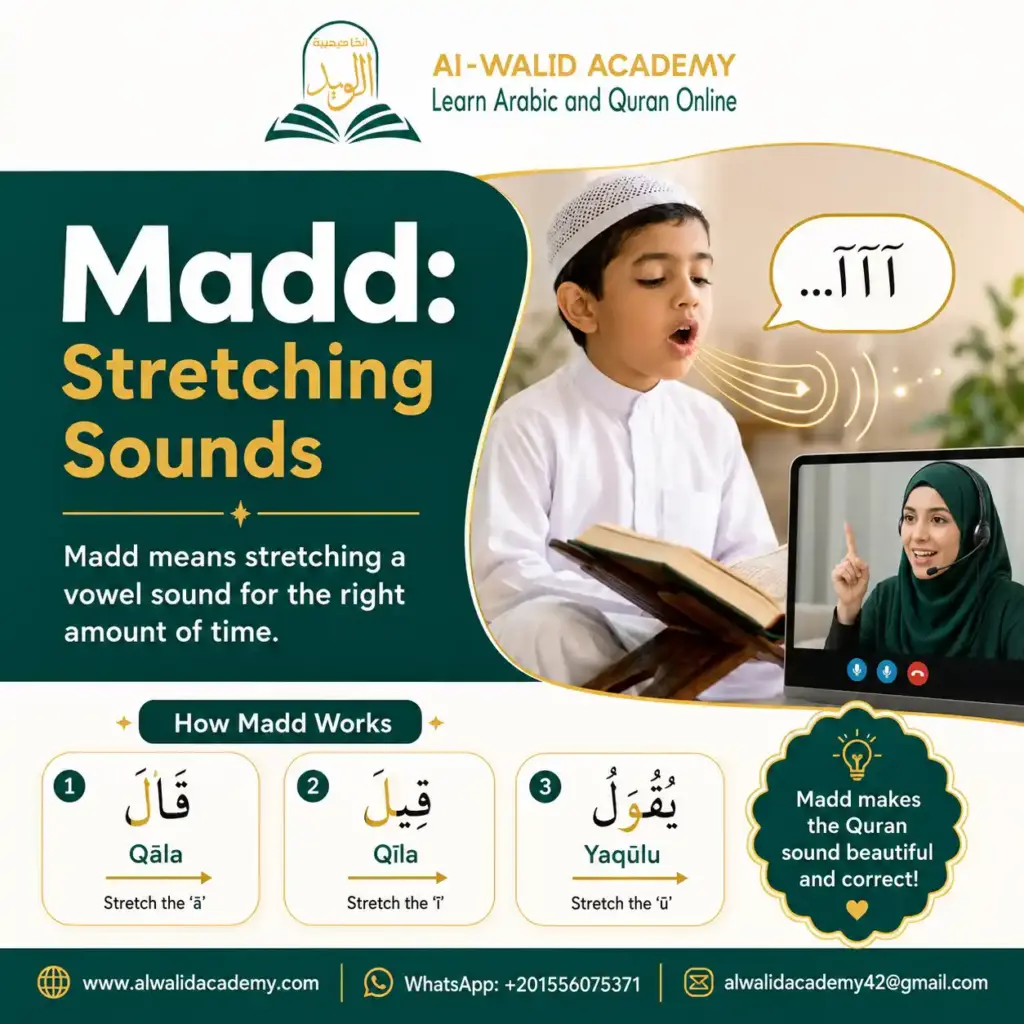
Madd means extending certain sounds for a specific length during Quran recitation. Learning Madd helps children develop a smooth rhythm and prevents rushing while reading.
At the beginner level, children only need to learn simple natural Madd before moving on to more advanced Types of Madd.
They gradually learn how to extend sounds when they encounter the letters of Madd and apply these rules correctly during recitation.
Benefits of learning Madd:
- Makes recitation clearer.
- Improves pronunciation.
- Enhances the beauty of Quran recitation.
- Prevents cutting sounds too short.
Teachers can help children understand Madd by counting quietly while stretching the sound, making the concept easy and practical.
Ghunnah and Qalqalah
Ghunnah and Qalqalah are two Tajweed rules that children can hear clearly while reciting. When taught through listening and repetition, they become easier to understand and apply.
Ghunnah
Ghunnah in Tajweed is a nasal sound produced in specific situations during recitation, especially with certain Noon and Meem rules.
Simple ways to teach Ghunnah:
- Let the child listen to the correct recitation first.
- Encourage repetition after the teacher.
- Help the child notice the nasal vibration.
- Practice with short and easy examples.
Qalqalah
Qalqalah is a slight echoing sound that occurs when specific letters are pronounced with Sukoon.
The letters of Qalqalah are:
- ق
- ط
- ب
- ج
- د
Children can practice these letters through short words and repeated listening exercises until they can identify and apply the sound naturally.
Simple Rules of Noon and Meem
Noon and Meem rules are among the most common Tajweed rules found throughout the Quran. Children benefit from learning them early through simple examples and gradual practice.
At the beginner stage, the goal is not memorizing technical terms but understanding how to pronounce words correctly in different situations. This also includes learning basic Meem Sakinah Rules in a simple and practical way.
Children learn that the pronunciation of Noon or Meem may change depending on the letter that follows.
| Rule | Letters (Arabic) | Child-Friendly Explanation | Example |
| Izhar | ء، هـ، ع، ح، غ، خ | Pronounce the sound clearly without hiding or merging it | مِنْ هَادٍ |
| Idgham | ي، ر، م، ل، و، ن | Merge the sound smoothly into the next letter | مَن يَقُول |
| Ikhfa | ت، ث، ج، د، ذ، ز، س، ش، ص، ض، ط، ظ، ف، ق، ك | Partially hide the Noon sound with a soft nasal tone | مِنْ قَبْل |
| Iqlab | ب | Change the Noon sound into a Meem sound with a nasal tone | مِنْ بَعْد |
How to Teach Tajweed to Kids in English
The best way to teach Tajweed to kids in English is to start with sounds before rules, teach one rule at a time, and use short daily practice with gentle correction.
This method helps children learn Tajweed in a simple, clear, and stress-free way.
1. Start with Sounds Before Rules
The first step is focusing on pronunciation and sounds before introducing any Tajweed rules. When children master the correct sound, understanding the rules becomes much easier.
At this stage, the teacher should focus on Arabic letters and show the child where each sound comes from in the mouth or throat. A mirror can be used so the child can see how the sound is produced.
The child listens to the teacher or an audio recording and repeats slowly and clearly. For example, starting with letters like (ب، م، ف) helps the child practice lip sounds before moving to tongue and throat sounds.
Most successful Quran lessons for Kids online begin with letter sounds and pronunciation before introducing detailed Tajweed rules.
2. Teach One Rule at a Time
Teaching one Tajweed rule at a time helps children avoid confusion and learn in a structured way, Each rule should be fully understood before moving to the next one.
- A good method is to focus on one simple rule for a week or more, such as short vowels or basic pronunciation rules.
- Daily exercises and quick revision of the previous lesson help strengthen learning.
3. Use Short Daily Practice
Short daily practice is more effective than long and irregular study sessions. Consistency helps children build strong pronunciation habits.
A simple daily routine can include:
- Quick revision of the previous lesson.
- Practicing a new concept.
- Reading or repeating a short verse.
Each session should be around 10 minutes only, This keeps the child focused and prevents boredom while building a daily learning habit.
4. Correct Mistakes Gently
Mistakes should always be corrected in a gentle and encouraging way to keep the child motivated. A positive learning environment helps children improve faster.
A useful method is: praise → correct → repeat. First, the teacher praises what is correct, then gently corrects the mistake, and finally asks the child to repeat properly.
Recording the child’s recitation before correction can also help them hear the difference and improve gradually without pressure.
Best Ways to Make Tajweed Fun for Kids
Making Tajweed fun for kids helps them stay engaged and learn faster through enjoyment and interaction. Using games, visuals, repetition, and rewards turns learning into an enjoyable experience.
1. Use Flashcards and Visual Tools
Flashcards and visual tools make Tajweed easier to understand by connecting sound with images; they help children remember rules in a simple way.
Each card can show:
- The Arabic letter.
- The articulation point (lips, tongue, throat).
- A simple visual hint.
A fun activity is a matching game where the child hears a sound and chooses the correct card. This improves both listening and recognition skills.
2. Practice with Short Surahs
Short Surahs help children apply Tajweed rules in real Quran reading while feeling a sense of achievement; they make learning practical and motivating.
- Each Surah should be divided into small parts, such as one or two verses.
- The child practices each part separately, then combines them.
- Completing each section should be rewarded to encourage consistency.
3. Use Listening and Repetition
Listening and repetition help children naturally improve pronunciation and Tajweed accuracy, the more they hear correct recitation, the better they imitate it.
- A fixed audio reciter can be used daily.
- The child listens to a short verse, repeats it several times, and then records their own recitation.
- Comparing recordings helps them notice mistakes and improve step by step.
4. Reward Progress and Encourage Confidence
Rewards and encouragement build confidence and motivate children to continue learning Tajweed.
- Small achievements make a big difference in consistency.
- A simple system can include stickers, points, or weekly goals.
- Positive feedback from parents and teachers also increases confidence and encourages children to recite in front of others without fear.
Common Challenges in Teaching Tajweed to Kids
Teaching Tajweed to kids may face some natural challenges during the learning journey. Understanding these challenges helps parents and teachers choose the right methods to deal with them effectively.
Below is a clear explanation of the most common difficulties children face while learning Tajweed, along with practical ways to handle them:
| Challenge | Reason | Practical Solution | Goal |
| Difficulty in pronunciation | Some Arabic sounds do not exist in other languages | Practice articulation points + mirror + repetition | Improve correct pronunciation |
| Short attention span | The child’s nature and inability to focus for long periods | Short sessions + interactive activities | Increase focus |
| Mixing similar letters | Similar sounds and articulation points | Sound comparison + repeated listening | Improve sound distinction |
| Rushing through rules | Moving too quickly between rules | Gradual learning one rule at a time | Strengthen understanding |
1. Difficulty in Arabic Pronunciation
Difficulty in pronouncing some Arabic letters occurs because sounds like (ع, غ, ق, ض) do not exist in many languages. This makes additional training on articulation points necessary for children.
Practical Steps to Improve Pronunciation
Children’s pronunciation can be improved through simple exercises that help them control their sound:
- Practice each letter individually and slowly.
- Use a mirror to observe mouth and tongue movement.
- Listen to a skilled reciter and imitate them.
- Repeat each letter 10 to 15 times daily.
- Focus on one letter per short session.
2. Short Attention Span
Children often struggle to stay focused for long periods, so learning sessions should be organized in a way that suits their age.
Best Ways to Handle Short Attention Span
Focus can be improved by breaking lessons into small and engaging parts:
- Divide the lesson into short segments.
- Add short breaks between each part.
- Use educational games during learning.
- Keep sessions between 10–20 minutes.
- Maintain constant interaction during the lesson.
3. Mixing Similar Letters and Sounds
Children may confuse similar letters such as (ت / ط) or (س / ص), which is common in early learning stages.
Effective Ways to Reduce Letter Confusion
This issue can be solved through comparison-based training that helps children distinguish sounds:
- Direct comparison between two sounds.
- Exercises to choose the correct sound.
- Repetition of words containing the letters.
- Recording the child’s voice and comparing it with a model.
- Daily practice until automatic recognition develops.
4. Rushing Through Tajweed Rules
Rushing through the Tajweed rules leads to weak understanding and poor retention in children.
Correct Approach to Stabilize Tajweed Rules
A gradual learning approach helps children build a deeper understanding:
- Focus on one rule at a time.
- Apply it practically before moving on.
- Regular review at the beginning of each lesson.
- Use short Surahs for practice
- Ensure mastery before progression.
Best Way to Learn Tajweed in English for Kids Online
Learning Tajweed online for kids has become one of the most effective modern methods, as it combines flexibility, interaction, and real-time correction from qualified teachers.
Choosing a structured Tajweed Course gives children a clear path to learn Quran recitation step by step.
Below are the main components that make online learning effective and easy for children:
| Element | Description | Benefit |
| One-on-one classes | Personalized learning for each child | Immediate error correction |
| Structured curriculum | Step-by-step learning system | Avoids confusion |
| Interactive tools | Audio + visuals + games | Increases engagement |
| Real-time feedback | Instant correction during lessons | Strengthens correct pronunciation |
1. One-on-One Classes with Qualified Teachers
One-on-One Quran Lessons with a specialized teacher give children full attention and help correct mistakes immediately. Benefits of One-on-One Learning:
2. Structured Tajweed Curriculum for Kids
A structured curriculum helps children learn step by step without confusion or pressure. Structured Tajweed Learning Stages are:
3. Interactive and Child-Friendly Lessons
Interactive lessons help children understand faster and make learning more enjoyable.
Some programs combine Tajweed with an Arabic language Course to help children develop both reading and language skills together.
Read about: Best Way to Memorise Quran
4. Real-Time Correction and Feedback
Real-time correction during lessons helps children learn the correct pronunciation from the beginning and prevents repeated mistakes.
Can Kids Learn Tajweed Online in English?
Yes, children can learn Tajweed online in English very effectively if the learning process is based on a clear curriculum, a qualified teacher, and interactive tools that help the child listen, imitate, and correct pronunciation.
This learning method is especially suitable for kids because it combines flexibility with practical, hands-on training.
When Should Parents Join Tajweed Classes for Kids?
It is best for parents to be involved from the early stages of learning Tajweed, as home support helps the child stay consistent and improves learning speed.
When parents participate in the learning process, children become more confident and more committed, and they naturally apply what they learn at home.
The Role of Parents in Supporting Tajweed Learning
- Understanding the teacher’s method through an introductory session.
- Setting a short daily revision time with the child.
- Using the same learning tools provided by the teacher.
- Following up on the child’s progress and communicating with the teacher when needed.
Some families also explore Fiqh Islamic Jurisprudence courses to help children understand practical Islamic teachings as they grow.
Learn Tajweed in English for Kids with Alwalid Academy
If you want your child to learn Tajweed in English for Kids in a simple and clear way, Alwalid Academy offers a structured learning experience designed especially for beginners and non-Arabic speaking children.
The academy focuses on building correct Quran recitation step by step through easy explanations, guided practice, and interactive online lessons.
Learning is designed to be gradual, starting from the basics of pronunciation and Arabic letters, then moving slowly into Tajweed rules so the child understands and applies without confusion or pressure.
Look at: Summer Quran Classes for Kids
Why Parents Prefer Alwalid Academy
- The learning style is simple and suitable for young children.
- It helps children gain confidence in Quran recitation step by step.
- The curriculum is organized and avoids random or confusing learning paths.
- Parents receive support and updates about their child’s progress.
Enroll in Alwalid Academy today and begin a guided journey toward correct and confident recitation.
FQAs
Can kids learn Tajweed in English without knowing Arabic?
Yes, children can learn Tajweed in English without knowing Arabic because the learning relies on simple explanations, listening practice, and repetition that helps the child imitate correct pronunciation step by step before moving to detailed rules.
Is online Tajweed in English effective for kids?
Yes, online Tajweed in English is effective when it is delivered by qualified teachers using interactive methods. Children improve their recitation by listening, repeating, and receiving immediate correction during lessons.
How long does it usually take a child to master Tajweed skills?
The duration depends on consistency and practice. Most children understand basic Tajweed rules within a few months, while mastery develops gradually through continuous learning and regular revision.
What are the most effective methods for teaching Tajweed in English to children?
The best method is to start with sounds and pronunciation before rules, use short daily sessions, and rely on repetition and listening. Keeping lessons simple and engaging helps children apply Tajweed naturally and correctly.