
If you have ever wondered who wrote the Quran, you may be surprised to learn that the Quran was not written as a complete book by one person at one time.
Understanding this history helps you appreciate how carefully the Quran was preserved from the beginning. Its preservation depended on both memorization and writing, creating a strong system for transmitting Allah’s revelation from one generation to another.
Who wrote the Quran?
When asking who wrote the Quran, it is important to distinguish between revelation, writing, compilation, and standardization.
Recording and Compilation Process
During Muhammad’s Lifetime:
- Oral Tradition: The primary mode of preservation was memorization by many companions.
- Physical Fragments: Scribes like Zayd ibn Thabit wrote down verses on palm leaves, flat stones, animal skins, and bones as they were revealed.
First Complete Compilation (Abu Bakr’s Caliphate)
- The Need: After the Prophet died in 632 CE, many companions who had memorized the entire text died in battle.
- The Task: The first Caliph, Abu Bakr, ordered a complete written master copy to be compiled.
- The Scribe: Zayd ibn Thabit led the collection of these scattered written pieces and verified them against the memories of the community.
Standardization (Uthman’s Caliphate)
- Uniform Text: Under the third Caliph, Uthman ibn Affan, the master codex was standardized to prevent regional variations in dialect and recitation.
- Distribution: Official copies were sent to major centers of the expanding Muslim world, forming the exact text used today.
Was the Quran Written by One Person?
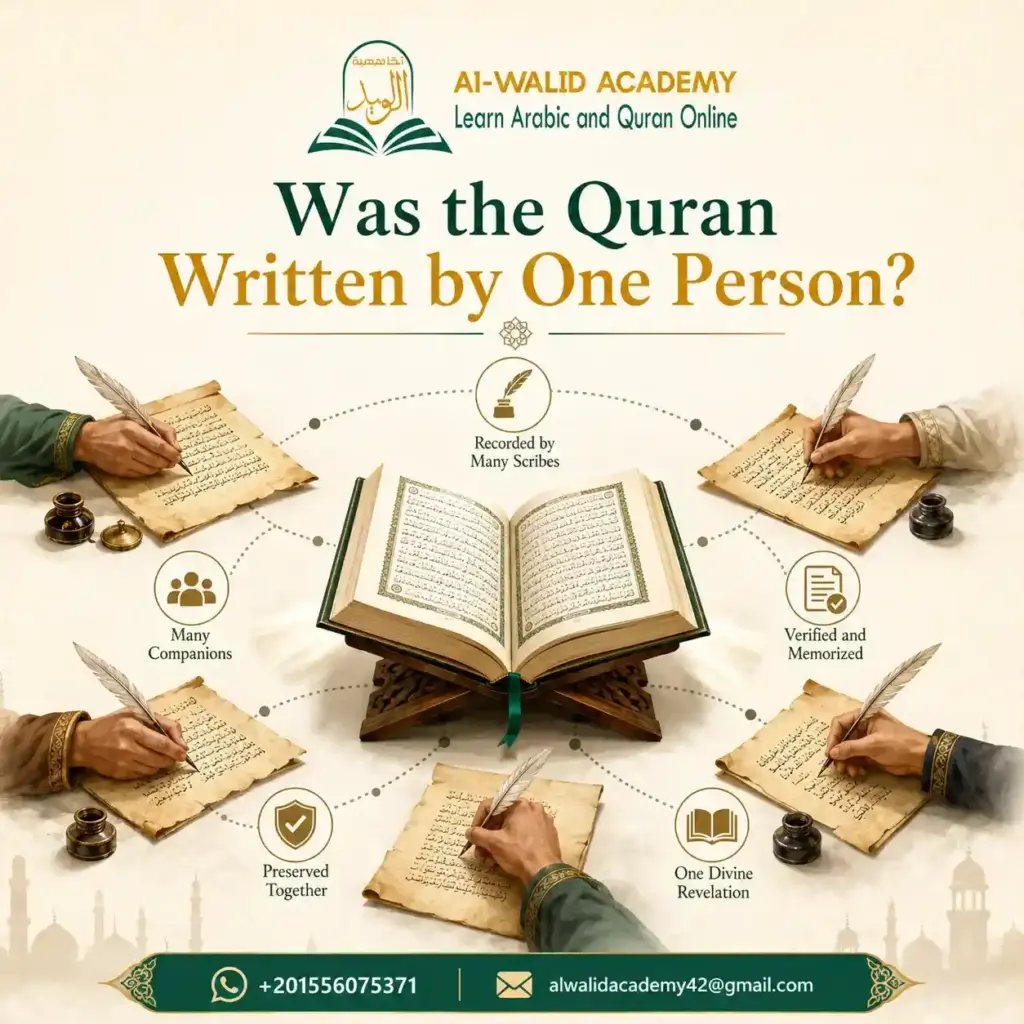
To understand how the Quran was written, you should know that the Quran was recorded by several scribes during the lifetime of Prophet Muhammad ﷺ. The Prophet ﷺ would receive revelation and then communicate it to his Companions.
The Companions preserved the revelation in two major ways: they memorized it and wrote it down. This dual method was extremely important because the Quran was preserved not only on physical materials but also in the hearts and memories of those who learned it directly from the Prophet ﷺ.
The writing materials available in seventh-century Arabia were different from modern books. Verses could be written on parchment, leather, flat stones, shoulder blades, palm stalks, and other available materials.
Thus, the Quran existed in written portions during the Prophet’s lifetime, but it was not yet collected into a single bound mushaf in the form familiar to readers today.
Who Told Prophet Muhammad to Write or Recite the Quran?
If you are researching the first Quran, you should first understand the role of Prophet Muhammad ﷺ. According to Islamic belief, Allah revealed the Quran to the Prophet ﷺ through Angel Jibril.
The first revelation came in the Cave of Hira when the Prophet ﷺ received the opening verses of Surah Al-‘Alaq. The command began with “Read” or “Recite” (Iqra’), emphasizing the importance of receiving and conveying the divine message.
The Prophet ﷺ then conveyed the revelation to his Companions. He instructed them to memorize the verses and had scribes record them. He also taught them where each revealed verse belonged within its surah.
This means that the Prophet ﷺ was the recipient and messenger of revelation, not its author.
How Was the Quran Revealed?
The question of how the Quran was revealed becomes clearer when you understand how revelation occurred. The Quran was revealed gradually rather than all at once. Islamic tradition describes the revelation as taking place over approximately 23 years, beginning around 610 CE and continuing until the Prophet Muhammad’s ﷺ death in 632 CE.
Some revelations addressed specific events, questions, social situations, or spiritual matters. Others provided guidance about belief, worship, morality, family relationships, justice, and the Hereafter.
The gradual revelation allowed the Companions to learn, memorize, understand, and practice the Quran step by step. The Prophet ﷺ recited the verses to them, and they passed the revelation to others.
This gradual process also meant that Quranic verses were being written throughout the Prophet’s mission.
When Was the Quran Written?
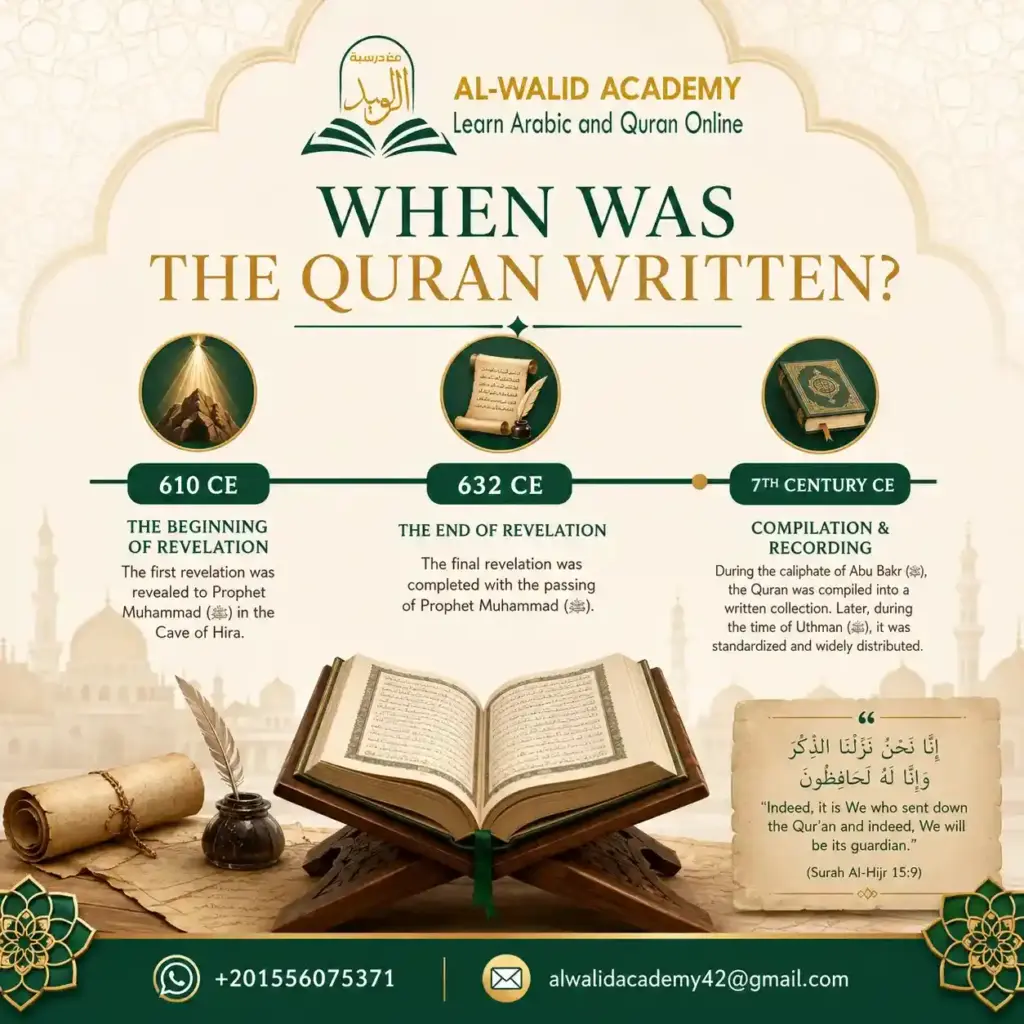
When considering how the first Quran was written, remember that writing began during the Prophet’s lifetime. The Quran was therefore not first written decades after his death. Individual revelations were recorded as they were revealed.
The Companions who served as scribes wrote verses under the supervision of Prophet Muhammad ﷺ. At the same time, many Companions memorized the Quran completely or memorized significant portions of it.
After the Prophet ﷺ passed away, the Quran had already been preserved through these written records and extensive memorization. However, the need arose to bring the written portions together into one organized collection.
This led to the first major compilation of the Quran into a single manuscript.
Who Wrote Down the Quran During the Prophet’s Time?
If you ask who wrote the first Quran, several Companions deserve recognition for their role as scribes. Zayd ibn Thabit is among the most famous because of his later responsibility for collecting the Quran.
Other scribes also recorded revelation during the Prophet’s lifetime. Their work was performed under the Prophet’s direction, and the Quran was memorized by numerous Companions.
The role of these scribes was not to create or edit the Quran. Their responsibility was to record the revealed words accurately.
A History of the Writers of the Holy Quran: Who Were the Scribes?
To answer how the first Quran was written, you should look at the collective role of the Quranic scribes.
The scribes of the Quran (Kuttab al-Wahy) were companions of Prophet Muhammad ﷺ who wrote down Quranic revelations as they were revealed.
Key Quranic Scribes
- Zayd ibn Thabit: One of the most prominent scribes; later led the first official compilation of the Quran under Abu Bakr.
- Ali ibn Abi Talib: Among the Prophet’s close companions and known for recording revelation.
- Ubayy ibn Ka’b: A renowned Quran reciter and one of the important scribes of revelation.
- Muawiyah ibn Abi Sufyan: Served as a scribe for the Prophet ﷺ and recorded revelation.
- Abdullah ibn Sa’d ibn Abi Sarh: Served as a scribe during the early period of Islam.
- Khalid ibn Sa’id ibn al-As: Reported among the early scribes who wrote for the Prophet ﷺ.
- Hanzalah ibn al-Rabi’: Also served as a scribe and was involved in recording the Prophet’s correspondence and other writings.
Who Compiled the Quran into One Mushaf?
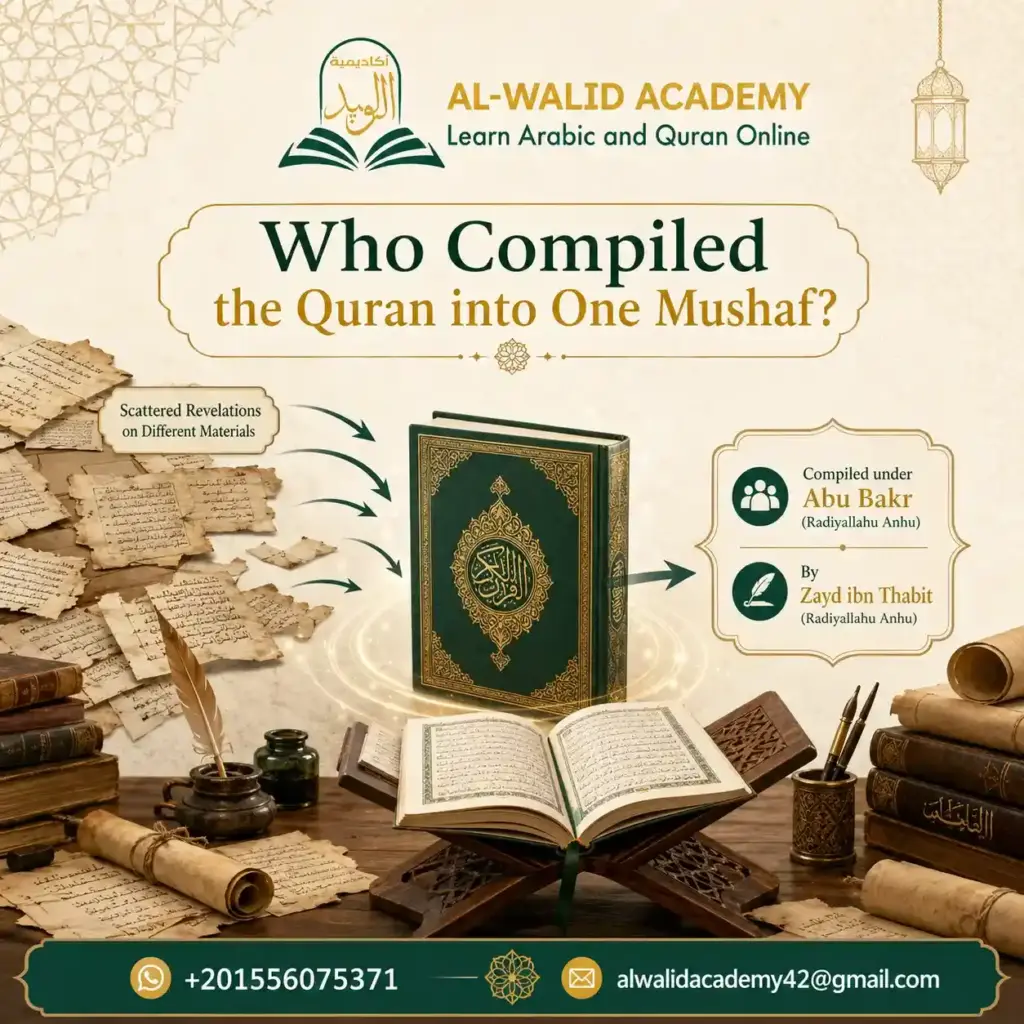
The answer to how wrote the first Quran also requires understanding the first official compilation. After the Battle of Yamamah, during the caliphate of Abu Bakr, concerns arose about the loss of Quran memorizers who had died in battle.
Umar ibn Al-Khattab suggested that the Quran should be collected into one manuscript. Abu Bakr initially hesitated because the Prophet ﷺ had not previously gathered the Quran into one single volume.
Eventually, Abu Bakr agreed that this was necessary for preservation. He appointed Zayd ibn Thabit to lead the task.
Zayd collected the written Quranic materials and verified them carefully with the testimony and memorization of the Companions. The resulting collection was kept first with Abu Bakr, then with Umar ibn Al-Khattab, and later with Hafsah bint Umar.
The Role of Abu Bakr and Zayd ibn Thabit in Compiling the Quran
To understand how they wrote the first Quran, you should distinguish between writing individual revelations and compiling them into a complete collection.
Abu Bakr’s Role: Initiation and Leadership
- Recognized the Threat: After the Battle of Yamamah, many Quran memorizers were killed, creating concern about preserving the Quran.
- Authorized the Project: After consulting Umar ibn al-Khattab, Abu Bakr ordered the Quran to be collected into one verified compilation.
- Appointed Zayd: He chose Zayd ibn Thabit to lead the collection and verification process.
- Preserved the Suhuf: The completed manuscript was kept with Abu Bakr, then passed to Umar and later Hafsa bint Umar.
Zayd ibn Thabit’s Role: Execution and Verification
- Led the Process: Served as the main compiler because of his knowledge of the Quran and experience as a scribe of the Prophet ﷺ.
- Gathered Sources: Collected Quranic verses from written materials and the memories of the Companions.
- Verified the Verses: Carefully checked the collected material to ensure its authenticity.
- Applied Strict Criteria: Required reliable evidence before including verses in the compiled Suhuf.
What Was the Uthmanic Mushaf?
The history of the first Quran does not end with Abu Bakr’s compilation. During the caliphate of Uthman ibn Affan, Islam had spread to different regions, and Muslims from different areas were learning to recite the Quran.
Uthman became concerned about disagreements in recitation among Muslims from different regions. He therefore commissioned a committee to prepare standardized copies based on the established Quranic collection.
Zayd ibn Thabit was again involved, together with other Companions. Copies were prepared and sent to major Muslim centers.
This became known as the Uthmanic codex or Uthmanic Mushaf. Its purpose was to unite Muslims around a standardized written form and prevent disputes over the written representation of the Quran.
How Old Is the Quran?
If you are researching the first Quran, you may also wonder about its age. The Quranic revelation began in approximately 610 CE and continued until the death of Prophet Muhammad ﷺ in 632 CE.
Therefore, the Quran has been transmitted for more than fourteen centuries.
What Language Is the Quran Written In?
Another important part of understanding how wrote the first Quran was written is recognizing What Language Is the Quran is written in. The Quran was revealed in Arabic.
The Quran itself describes its revelation as an Arabic Quran. Its language is classical Quranic Arabic, with a unique linguistic style, vocabulary, rhythm, and rhetorical structure.
For this reason, Muslims around the world learn to recite the Quran in Arabic, even when Arabic is not their native language. Translations can help readers understand the meaning, but they are generally understood as interpretations of the Quran’s meanings rather than the Quran itself in its original Arabic form.
The Importance of Arabic in the Quran
When studying the Quran, Arabic is an essential part of the story:
- Language of Revelation: The Quran was revealed in Arabic.
- Deeper Understanding: Arabic reveals meanings and nuances that translations may miss.
- Quranic Eloquence: It helps appreciate the Quran’s unique linguistic style.
- Better Tafseer: Arabic supports accurate understanding of Quranic explanations.
- Correct Recitation: It helps with proper pronunciation and Tajweed.
- Access to Classical Sources: Many early Islamic scholarly works are in Arabic.
- Stronger Connection: Understanding the words makes Quran recitation more meaningful.
How to Learn Quranic Arabic Language? Contact Al-Walid Academy to choose from many Quran courses online.
Difference Between Writing, Compiling, and Standardizing the Quran
To fully understand how the first Quran was written, keep these three concepts separate:
| Writing | Compiling | Standardizing |
| During the Prophet’s lifetime, individual revelations were written down by scribes under his direction. | After the Prophet’s death, Abu Bakr authorized the collection of the written portions into one comprehensive manuscript, with Zayd ibn Thabit leading the work. | During Uthman’s caliphate, standardized copies were prepared and distributed to help preserve unity in written Quranic transmission and recitation. |
These were different stages of preservation. None involved a person inventing, authoring, or changing the Quran.
What Should You Learn After Understanding the History of the Quran?
Now that you understand the history of the first Quran, you can explore the Quran from a deeper perspective. Learning about its revelation and preservation can make your Quran studies more meaningful.
1. Core Islamic Sciences
- Study Tafseer – Explore reliable explanations of the verses, their meanings, context, and lessons.
- Learn the Reasons for Revelation (Asbab al-Nuzul) – Discover the circumstances and events connected to the revelation of particular verses.
- Study Tajweed – Learn the correct rules of Quran recitation and pronunciation.
2. Comparative and Historical Context
- Hadith and Sunnah: Study the recorded sayings, actions, and teachings of Prophet Muhammad ﷺ to understand how the Quran was explained and applied in daily life.
- Ulum al-Quran (Quranic Sciences): Explore subjects such as Makki and Madani verses, reasons for revelation (Asbab al-Nuzul), Nasikh wal-Mansukh (abrogation), Quranic compilation, and different modes of recitation (Qira’at).
- Comparative Theology: Compare Quranic narratives about prophets and major religious themes with their presentation in the Torah, Bible, and other religious traditions for a broader academic perspective.
Explore Quran Learning with Al-Walid Academy
If you have been searching for how to learn the Quran, learning its history is only the beginning. Your next step can be developing a stronger relationship with the Quran through structured learning at Al-Walid Academy:
- Learn Quran Online: Study Quran recitation, memorization, and understanding.
- Master Tajweed: Improve pronunciation and recite the Quran correctly.
- Memorize the Quran: Follow a structured and personalized Hifz program.
- Study Tafseer: Understand the meanings and lessons of Quranic verses.
- Learn Quranic Arabic: Understand Quranic vocabulary and expressions.
- One-to-One Classes: Receive personalized guidance from qualified teachers.
- Flexible Learning: Attend online lessons from the comfort of your home.
- Start Your Journey: Develop a stronger connection with the Quran through consistent learning.
Conclusion
Finally, we hope we have answered the question of who wrote the first Quran very well. The Quran was not written by one person. It was revealed by Allah to Prophet Muhammad ﷺ and recorded by several Companions during his lifetime.
Start your Quran learning journey today and discover how studying the Quran with qualified guidance can help you recite, understand, and apply its teachings in your everyday life.
FAQs
Who gave the Koran to Muhammad?
Muslims believe the Quran was revealed to Prophet Muhammad ﷺ by Allah through the Angel Jibril (Gabriel).
Where is the oldest copy of the Quran?
Some of the oldest surviving Quranic manuscripts are held in collections such as the University of Birmingham, the Bibliothèque Nationale de France, and the Sana’a manuscript collection in Yemen. The Birmingham manuscript contains some of the oldest known Quranic parchment fragments.
Who printed the first Quran?
The first complete printed Quran with movable type is generally associated with Paganino and Alessandro Paganini, printed in Venice around 1537–1538.
How many years ago was the Quran written?
The Quran dates back about 1,400 years. Its revelation to Prophet Muhammad ﷺ began around 610 CE and continued until his death in 632 CE, while its verses were also recorded by scribes during his lifetime.
When was the first Quran written on paper?
The earliest Quranic texts were not written on modern paper but on materials such as parchment. The Quran was collected into a unified written compilation shortly after Prophet Muhammad’s ﷺ death, during the caliphate of Abu Bakr. Some of the earliest surviving Quran manuscripts date to the seventh century; the Birmingham Quran parchment has been radiocarbon dated to 568–645 CE.
How many authors wrote the Quran?
According to Islamic belief, the Quran does not have human authors. Muslims believe it is the word of Allah, revealed to Prophet Muhammad ﷺ, who recited the revelations while his companions memorized and recorded them in writing.
Is the original Quran still in existence?
No complete handwritten copy produced during Prophet Muhammad’s ﷺ lifetime is known to survive today. However, several very early Quranic manuscripts and fragments still exist, including the Birmingham Quran manuscript, which is considered among the earliest surviving written evidence of the Quran.
Was the Quran written before the Bible?
No. The biblical texts were composed centuries before the Quran. The Hebrew Bible contains writings dating from centuries before the Common Era, while the New Testament dates mainly to the first and second centuries CE; Quranic revelation began in the seventh century CE.
Who told Muhammad to write the Quran?
According to Islamic tradition, Allah revealed the Quran to Prophet Muhammad ﷺ through the Angel Jibreel (Gabriel). Muhammad ﷺ recited the revelations to his companions, and designated scribes recorded the verses, so it is more accurate to say that he received and conveyed the Quran rather than personally authored it.