

Languages are the primary means of communication and the starting point for integrating into the customs and traditions of different societies. When it comes to Arabic lessons for residents of Qatar, this becomes even more important.
Although English is widely spoken, Arabic remains the dominant language there.
In this comprehensive article, we will explore the importance of learning Arabic for residents of Qatar, the best steps to get started, the main challenges you may face, and tips for overcoming them.
Why Arabic Lessons Are Important for Qatar Residents
Qatar is considered one of the Arab countries most open to Western cultures, as evidenced by the foreign community of various nationalities living there; however, Arabic remains the official language used both in administrative contexts and in everyday life.
Living in an Arabic-Speaking Environment
Learning Arabic Lessons for Qatar Residents is important for foreigners living in Qatar, despite the prevalence of English speakers, as:
- It helps you to engage with the friendly Qatari people and learn more about their customs.
- It allows you to get to know Arabs from other nationalities, such as Moroccans, Syrians, and Lebanese.
- Immersing yourself in their culture opens up new horizons and helps you seize greater opportunities.
- Join AL- Walid Academy Arabic language Course and start learning Arabic with steady steps.
How Arabic Lessons Can Improve Communication for Qatar Residents
Not being fluent in the language spoken by the people in the country where you live makes things more difficult, even in everyday situations, for example:
- Having everyday conversations with work colleagues and friends.
- Reading various signs and advertisements.
- Buying something from a restaurant or supermarket.
Therefore, learning Classical Arabic Course Online makes life much, much easier for foreigners living in Qatar.
Cultural and Professional Advantages of Arabic Lessons for Qatar Residents
- Teach Me How to Speak Arabic opens up a wealth of opportunities to learn about Islamic customs in general and Qatari traditions in particular.
- It provides an opportunity to explore aspects of the country’s culture, such as literature, culture, and the economy, amongst others.
- Learning Arabic makes daily communication in Qatar much easier, helping residents build stronger connections with neighbours, colleagues, and the wider community. It also helps them feel more included, confident, and connected to the culture around them.
Who Needs Arabic Lessons in Qatar?

Learning Arabic is not limited to a particular age group or specific group of people, but there are certain groups for whom the learning process is significantly affected, and they are
Expats Living in Doha and Beyond
Although there is a large expatriate community and many Arabs who speak English, learning Arabic makes life in Qatar even better, as:
- The best way to learn to Speak Arabic helps you gain a deeper understanding of Arab people in general and Qataris in particular.
- It makes it much easier to integrate into society, whether when buying and selling, dealing with administrative and government bodies, or in other situations.
Children in International Schools
The Arabic language remains an integral part of Qatari identity; consequently, teaching it to children, particularly those attending international schools, helps them to:
- gain confidence and a sense of security, and develop language skills from an early age.
- integrate more deeply into society.
- and adapt more effectively to their surroundings.
Professionals and Business Owners
For business professionals in Qatar, learning Arabic can make communication smoother and more effective, especially when dealing with government offices, administrative procedures, or Arabic-speaking customers. It helps build trust, avoid misunderstandings, and create stronger professional relationships in daily business interactions.
New Residents and Travelers
Arabic Lessons for Qatar Residents gives travellers and new residents a more meaningful experience of life in Qatar, as
- It helps them to forge a deeper connection with the places they visit and understand the local customs and traditions, rather than simply being there.
- It fosters warmth and affection through genuine bonds with the Qatari people.
- It boosts confidence and a sense of security when faced with any situation or conversation.
Online Noorani Qaida Course at Al- Walid Academy: The first foundation for building a sound Arabic language.
Types of Arabic Lessons for Qatar Residents
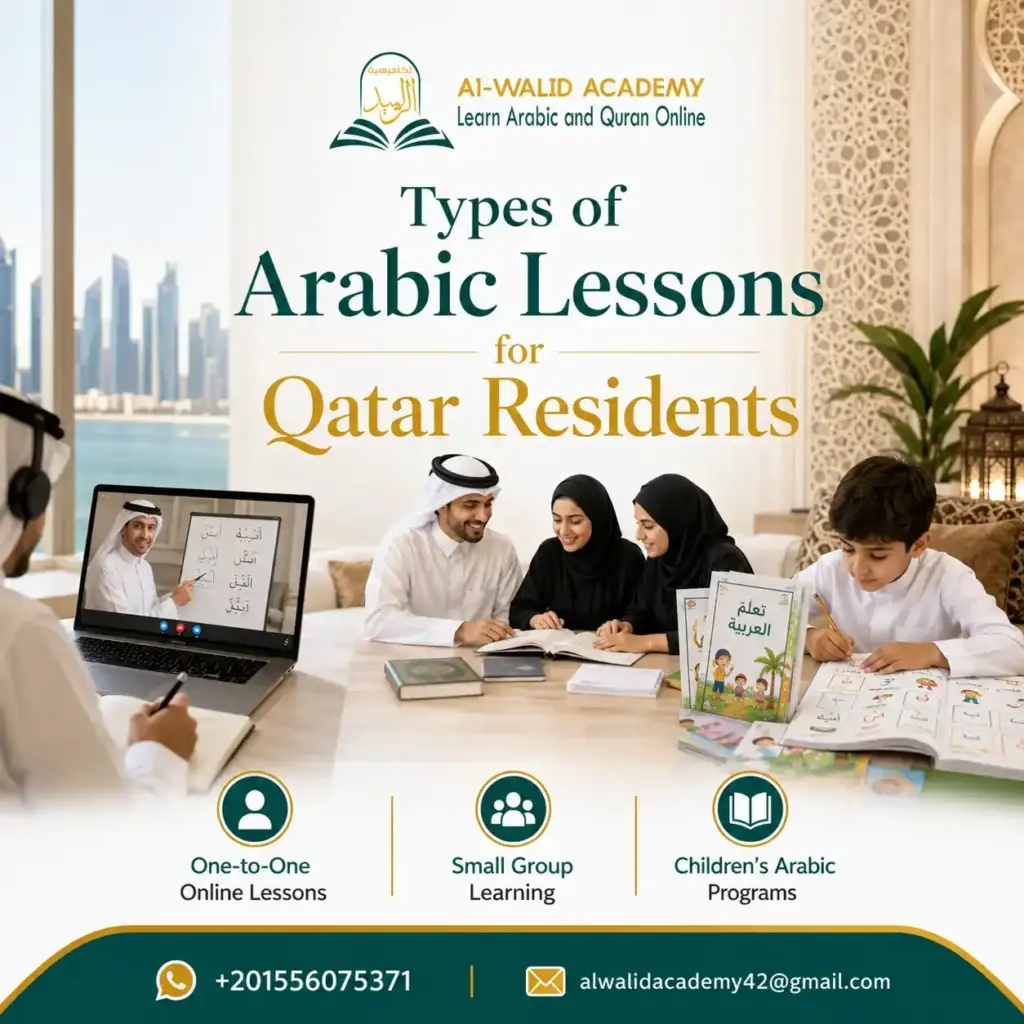
There are many different approaches to learning Arabic, which can be chosen depending on the learner’s objectives. These include:
Arabic Fusha (Modern Standard Arabic)
Modern Standard Arabic, as used today throughout the world, is considered one of the most important forms of Arabic language study available.
Modern Standard Arabic is commonly used in more formal contexts, such as:
- News bulletins and advertising programmes;
- Official correspondence and documentation;
- Correspondence with government bodies.
Consequently, learning Modern Standard Arabic offers a great opportunity to speak with depth and to acquire a thorough understanding of the language’s terminology, although its study is often combined with that of one of the spoken dialects.
Read more: How to Speak MSA Fluently
Conversational Arabic (Dialects)
This type of lesson focuses on learning other dialects of Arabic, such as Egyptian, Lebanese or Syrian. This helps to:
- Improve communication with a wider group of people who speak these dialects.
- Enhance everyday interactions and communication in everyday situations, such as greetings and shopping.
- Build confidence when speaking and foster a greater sense of engagement with the country’s customs and traditions.
Look at: Which Arabic Dialect Should I Learn
Quran and Tajweed Classes
Qur’an and Tajweed Courses are considered among the most effective in Qatar, as they enable students to learn the following:
- The rules of tajweed and how to pronounce the articulation points of letters correctly;
- The correct application of the rules of tajweed and ongoing practice in this regard;
- The proper recitation and memorisation of the Qur’an, and an understanding of its verses.
Arabic for Kids
The teaching of Arabic to children follows a distinctive approach, in which play and fun must be combined with learning through:
- The use of stories and songs to help children memorise the letters;
- Starting with simple words and sentences;
- The use of activities such as drawing and colouring books to facilitate learning.
Learn more: How to Teach Arabic Letters to Kids
Benefits of Online Arabic Lessons for Qatar Residents
With advances in communication technology and the availability of the internet, accessing online Arabic language lessons has become a great opportunity for the following reasons:
Flexible Scheduling to Fit Your Routine
With our increasingly busy lives, work commitments and responsibilities, finding enough time can be a barrier to learning a new language. However, with programmes available to suit all schedules, whether for work or study, the process becomes much more convenient and comfortable.
Learn Arabic Lessons from Home Comfortably for Qatar Residents
Learning Arabic Lessons for Qatar Residents from home is an ideal option due to its many advantages, including:
- Complete comfort whilst studying, as you can choose the right place and the right time, rather than being tied to a specific classroom and timetable when studying away from home.
- The ability to choose the right time throughout the day.
- The ability to integrate study time into your daily routine to free up more time.
- Avoiding crowds, public transport, and the time spent commuting.
One-to-One Personalized Arabic Lessons
One-to-one Arabic Lessons for Qatar Residents, which are characterised by:
- scheduling and organisation tailored to your availability and your desired pace of progress.
- the option to choose between learning Classical Arabic or the colloquial dialect.
- personalised support to develop reading and writing skills.
- uninterrupted focus on a single student, which enhances progress and productivity.
Access to Native Arabic Teachers
Online learning gives you access to the teacher of your choice from anywhere in the world.
This includes native Arabic-speaking teachers. This is a major advantage, as it helps you to learn pronunciation and the articulation of sounds correctly and accurately.
How to Choose the Best Arabic Lessons for Qatar Residents

A large part of the success of the learning journey depends on choosing the right teacher or academic institution to join; this is one of the most important requirements that must be met
Check Teacher Experience and Qualifications
Choosing the right teacher is fundamental to the success of the learning process; therefore, they must possess:
- A thorough command of the Arabic language, along with the ability to explain and convey information clearly.
- Good command of English to ensure clear communication.
- Proven experience in teaching Arabic to non-native speakers.
Look for Flexible Scheduling Options
Establishing a flexible study schedule is one of the most important aspects to focus on, in order to ensure consistency and avoid obstacles. This can be achieved by enrolling in evening courses or by focusing on weekends.
Read Reviews and Testimonials
Before you actually enrol, please read through previous reviews and student feedback carefully to check the tutor’s experience, whether their teaching style suits you, as well as the students’ level and their satisfaction with the experience.
Start with a Free Trial Lesson
Taster lessons are the most effective way to properly assess a teaching style before actually enrolling. They provide an opportunity to get to know the teacher personally, to review the lesson plan and gauge your satisfaction with it, which helps you make an informed decision before actually enrolling.
What to Expect from Arabic Lessons for Qatar Residents at Al-Walid Academy
The experience of joining Al-Waleed Academy to take Arabic lessons for residents of Qatar is a truly positive one that should not be missed
Initial Level Assessment
This is the most important step before beginning the actual study, and its aim is to:
- Ascertain the learner’s current level and prior knowledge.
- Their learning objectives.
- The number of sessions required.
- The study pace they can commit to.
Based on this information, drawing up a learning plan becomes easier and more effective.
Customized Learning Plan through Arabic Lessons for Qatar Residents
Every learner has a different way of absorbing information, their own learning objectives, and the time they can set aside to make progress. This is what Al-Walid Academy focuses on: providing a personalised experience for each learner that enables them to achieve their goals, whether these involve learning Arabic, one of its colloquial dialects, or practising and improving their reading and writing skills.
- At AL-Walid Academy, we provide a Modern Standard Arabic course under the supervision of a select group of teachers and using the latest teaching methods.
Interactive Teaching Methods
The journey of learning a language can be somewhat long, and it is by keeping the learning process enjoyable that we ensure continuity. This is achieved through engaging teaching methods such as:
- group discussions.
- pronunciation practice using a variety of methods.
- using stories and everyday situations to learn new words, rather than traditional methods that teach each word in isolation.
Continuous Progress Tracking
Continuous monitoring, correcting mistakes, and adhering to the advice and instructions of the teachers at Al-Walid Academy are the ideal steps towards genuine and tangible progress.
Common Challenges and How to Overcome Them
Learning Arabic may present some difficulties, but these can be overcome by providing the best solutions
Difficulty with Pronunciation
The Arabic language is considered one of the more complex languages, requiring a great deal of patience throughout the learning process. There are many challenges involved in learning it, including:
The similarity in the pronunciation of certain letters, such as the ‘sin’ “ س” and the ‘shin’ “ ش”, and the absence of others in Arabic, such as the letter ‘dad’, which makes things somewhat difficult, especially at the beginning.
This can be overcome by:
- Starting by learning simple words and practising them.
- Listening regularly to people who are fluent in Arabic.
- Constant repetition until your ears and tongue are accustomed to the correct pronunciation.
Limited Practice Opportunities
Some people find it difficult to practise and train outside of class.
This can be overcome by:
- Use apps such as Duolingo, which allow you to have conversations and practise them.
- Try to have simple daily conversations in Arabic, such as saying hello or making a purchase, for example.
- Watch films or TV series in Arabic, or YouTube videos with translations.
Staying Consistent
Consistency is one of the keys to success, particularly when it comes to learning languages. To achieve this, you must commit to the following:
- Set aside time each day to learn new words and improve your listening and speaking skills.
- Draw up daily and weekly plans that you can stick to.
- Revise regularly to avoid forgetting what you have learnt.
Learn Arabic in Qatar with Al-Walid Academy
The learning experience at Al-Walid Academy is not limited to academic study; rather, it is a holistic journey that offers the following:
- Arabic-speaking teachers who specialise in teaching the language.
- Proven experience in teaching students of all ages using the latest methods.
- Flexible timetables to suit all work and study schedules.
- Free sessions to assess your level, draw up a study plan and ensure the teacher is the right fit for you.
- Competitive prices with substantial discounts.
Conclusion
For those living in Qatar, learning Arabic is not just about acquiring a new language; it is more like opening up a whole host of opportunities, both practical and social. Furthermore, learning Arabic Lessons for Qatar Residents breaks down the barriers of alienation and loneliness and makes it easier to integrate into the local community. To ensure you have the best possible experience, don’t miss out on the chance to enrol at Al-Walid Academy to maximise the benefits.
FAQs
Is Gulf Arabic or Modern Standard Arabic more suitable?
It depends on your main aim in learning the language; Gulf Arabic is suitable for everyday conversation, whilst Classical Arabic opens the door to a deeper understanding of the language and makes it easier to learn other dialects.
Is learning Arabic online a useful thing to do?
Yes, very much so, and this also depends on several other factors, including choosing the right academy or a professional teacher to ensure a fruitful learning journey.
How long does it take to learn Arabic?
It is not possible to specify a fixed period for How Long Does It Take To Become Fluent in Arabic, as it depends on several factors, including the individual’s ability to absorb the language, the time they set aside for study, and their learning objectives. Generally speaking, however, it takes several months to see improvement and two years to achieve fluency.