

Our relationship with the Qur’an is not limited to acts of worship; indeed, the Qur’an is our sole refuge. When we read it, we feel comfort, reassurance, and tranquillity. But did you know that there are several ways of reciting the Qur’an, which have been passed down through the ages and continue to this day? Each method of recitation has its own distinctive features and offers a different perspective for reflection. In this article, we will explore how to learn qirat of quran and discover practical tips from Al-Walid Academy to help you get started.
What is Qirat?
The word ‘qira’ah’ is derived from the verb ‘qara’a’ and means ‘recitation’. It encompasses several different methods of reciting the Qur’an, all of which are considered valid according to scholars; however, there are points of difference between them, such as the observance of specific rules regarding pronunciation or elongation.
- Join Quranic Arabic Course to learn the basics of the Arabic language and how to use it to memorise and recite the Holy Qur’an
The Importance of Qirat in Quran Recitation
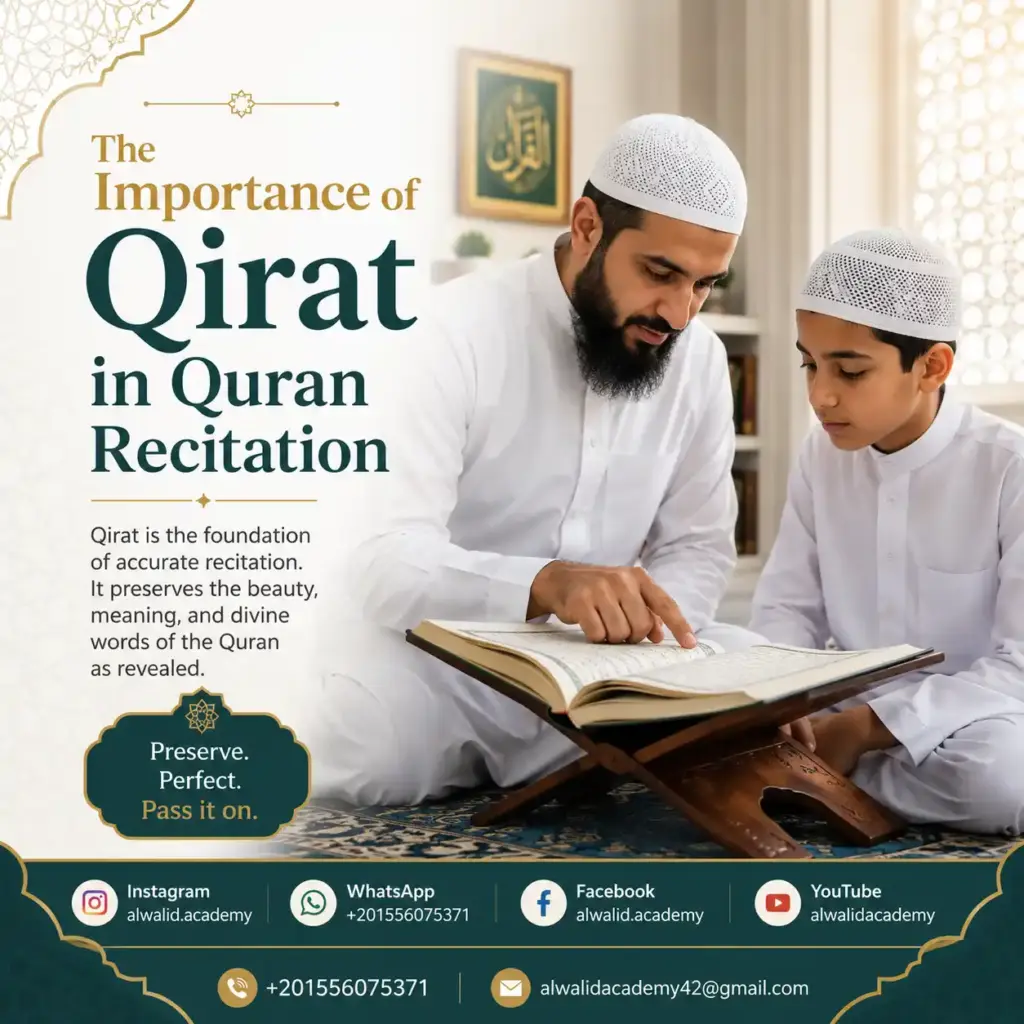
The diversity of how to learn qirat of quran has been of great importance, as evidenced by
1. Preservation of the Quran’s Authenticity
The recitations are regarded as the fundamental safeguard preserving the manner in which the Holy Qur’an was transmitted. They have been transmitted through an unbroken chain of transmission from the Prophet, peace be upon him. Although there are differences in pronunciation and delivery between the various recitations, these do not affect the clarity of the meaning, which serves to confirm the preservation of the Holy Qur’an throughout the ages.
2. Enhancement of Spiritual Experience
Mastering how to learn qirat of quran brings an indescribable sense of spirituality and peace of mind; it also helps to foster deeper reflection and reverence, and strengthens one’s faith and understanding of the verses.
3. Fulfilling a Religious Duty
The Prophet, peace be upon him, says that whoever recites the Qur’an and masters its recitation will be with the noble and righteous angels. This is why all Muslims are keen to master all aspects of memorising and reciting the Holy Qur’an, including the rules of tajweed, recitation and memorisation.
4. Facilitation of Quran Memorization
how to learn qirat of quran helps to improve the process of memorisation through the mastery of correct pronunciation and constant repetition. Furthermore, the variety of recitations provides greater scope for understanding the verses, which in turn helps to consolidate them and makes them easier to recall.
- Join Quran Memorization Course to ensure a well-planned and rewarding experience of memorising the Book of Allah.
5. Promotion of Unity Among Muslims
Muslims are united in their understanding of the Qur’an itself and in their efforts to master it, despite the different ways in which it can be recited, which in no way affect the doctrine or message of the Qur’an. This diversity demonstrates the tolerance of Islam and the unity of Muslims.
6. Educational Value
The study of recitation is a rich and comprehensive discipline that combines the study of the Arabic language, Islamic jurisprudence and the rules of recitation.
It fosters a deeper understanding of meaning and greater proficiency in the Arabic language amongst students and scholars.
7. Cultural Heritage
The Islamic acts of worship performed by Muslims form a significant part of the Islamic heritage that we have passed down since time immemorial. Scholars have contributed to documenting, teaching and transmitting them since time immemorial.
8. Encouragement of Patience and Discipline
Learning the recitations requires a great deal of time and effort, as well as sustained dedication to mastering the rules of pronunciation, the principles of tajweed and the art of recitation. This enables the learner to gradually develop qualities such as patience and commitment.
9. Improved Pronunciation and Articulation
One of the most important benefits of learning how to learn qirat of quran is that they actually help to improve the correct pronunciation of Arabic letters, which is particularly beneficial for non-native speakers or new learners seeking to improve their speaking skills.
10. Personal Satisfaction and Achievement
Learning the recitations has a profound psychological impact, as it enhances a sense of achievement and confidence when reciting correctly, and instils a desire to continue learning and constantly improving.
Read more: Importance of Memorizing the Quran
How Many Qirat Are There?

There are several methods and styles of reciting the Holy Qur’an, which originate from different cities and traditions, namely:
-
Qirat Nafi’
This recitation type originated in Madinah and is considered one of the most common ways of reciting the Holy Qur’an. It was transmitted through the narrators Warsh and Qalun.
This recitation type is characterised by its ease and melodiousness, and is widely practised in the Maghreb and West Africa.
-
Qirat Ibn Kather
This recitation originates from Makkah, which means it closely reflects the dialect of the Quraysh tribe.
It was transmitted by the narrators al-Bazzi and Qabnoul, and is characterised by its particular pronunciation of vowels and sounds.
-
Qirat Abu Amr
This recitation tradition originates in Basra and is characterised by its eloquence, the precision of its recitation and its pauses, which make it a style that demands a precise understanding of the various meanings. It is recited by al-Duri and al-Susi.
- Quran Classes For Adults: It is the ideal way for you to practise the various methods of reciting the Qur’an under the guidance of specialist teachers
-
Qirat Ibn Amir
This recitation tradition originates from Damascus. It is characterised by a unique style of recitation resulting from variations in the lengths of the vowel sounds, elongations and pauses. This tradition was transmitted by two scholars, Hisham and Ibn Dhakwan.
-
Qirat Hafs An Asim
The most widely recognised recitation in the Muslim world, particularly in the Middle East and South Asia. It was narrated and transmitted by two scholars, Hafs and Shu‘bah.
-
Qirat Hamza
These recitations originated in Kufa and were transmitted by two scholars, Khalaf and Khalad. These recitations are renowned for their exceptional clarity and distinctive pauses, which help the listener to concentrate and reflect on each verse.
-
Qirat Al-Kisai
This recitation originates from the region of Kufa and was transmitted by two narrators, al-Duri and Abu al-Harith. It is characterised by its distinctive features in terms of the rules governing elongation and pronunciation.
Look at: Warsh Tajweed
10 Tips to Improve Your Qirat
Here are the best tips from Al-Walid Academy for how to learn qirat of quran effectively
1. Find a Qualified Teacher
Enlisting the help of a specialist tutor helps you to devise the Best Way to memorise Quran approach for getting started and continuing right through to completion. Having a specialist tutor helps you to correct mistakes as they arise, whether they relate to the rules of tajweed, the articulation of letters or the memorisation itself.
Learn more: Best Online Hifz Teacher for Kids
2. Practice Regularly
Consistency is the foundation of progress in any field, particularly in the Qur’an, for the Qur’an is not like any other book or any other words: it is forgotten by those who neglect it. Therefore, consistency in memorisation and recitation, and not being lax in applying the rules of tajweed, are the foundation of achievement and progress.
3. Listen to Renowned Qaris
Listening to professional reciters on a daily basis is one of the most important factors in making progress, as it helps one to master the:
- Rules of tajweed.
- The points of pause and resumption.
- How to transition from low to high pitches.
- Of course, the correct pronunciation of the letters.
4. Understand Tajweed Rules
Tajweed is the cornerstone of any skilful recitation; without these rules, the recitation remains dry and devoid of any spiritual depth. The rules of tajweed include the correct pronunciation of each letter from its proper point of articulation, whilst adhering to the rules of elongation and other aspects of rhythmic flow, which are pleasing to the ear and preserve the correct linguistic meaning.
- Join Tajweed Course To learn the rules of tajweed in order to recite the Qur’an with greater precision and fluency
5. Record and Evaluate Yourself
Listening to a recording of your own voice is one of the most effective ways to assess your actual level; it helps you identify mistakes in pronunciation and recitation, and comparing your recitation with that of professional reciters is an ideal way to perfect your skills.
6. Join a Qirat Class
Joining a Qur’an reading class on how to learn qirat of quran a is a major positive step, as it helps to create a motivating and supportive environment with people who share your interests and goals.
7. Memorize Short Surahs First
Short surahs are considered ideal for recitation practice, given their simplicity, the brevity of the verses, and the clarity of the rules of tajweed.
Read more about: Reading The Quran For The First Time
8. Use Technology
Nowadays, technology has become an essential tool for memorisation and for helping to make progress. You can use Quran Memorization Programs Online to help with memorisation and correct your recitation; they also feature audio recordings of various professional reciters.
9. Stay Patient and Motivated
Patience and perseverance are the foundations of success and progress, particularly when it comes to memorising the Book of Allah.
You may face difficulties at first in terms of pronunciation and applying the rules of tajweed, but with perseverance and by continuing to correct your mistakes, your efforts will bear fruit, and the results will become apparent.
10. Seek Feedback
Make sure you seek feedback from professionals or those at a more advanced level; this helps to encourage you and identify the areas you really need to work on.
Benefits of Learning Qirat

- Mastering the correct recitation of the Holy Qur’an by following any method of recitation, whilst observing the rules of tajweed and the articulation points of the letters during recitation.
- Preserving the Holy Qur’an from alteration, as care was taken to pass down recitations from one generation to the next.
- Differences in certain words and methods of recitation provide an opportunity for a deeper understanding of the meanings of the Book of Allah the Almighty.
- Increased reward and merit, as striving to recite the Book of Allah correctly increases one’s reward and merit.
- Significant development of linguistic skills in terms of improving pronunciation and strengthening the articulation of letters.
- Facilitating the understanding and memorisation of the Holy Qur’an, as effective memorisation begins with a thorough and deep understanding of the meanings of the verses.
- It greatly enhances precision and discipline, as the science of recitation requires intense concentration in order to adhere correctly to the rules and traditions.
- It highlights the value of the Qur’an and the miraculous nature of its revelation; for although the recitations vary, they all converge on a single doctrinal concept.
Common Mistakes When Learning Qira’at
- Mistakes in the pronunciation of certain letters that have no equivalent in English, such as the letter ‘ضاد’, or mistakes in the pronunciation of certain letters that are pronounced in the same way, such as ‘سين’ and ‘صاد’.
- Solution: Start by learning the letters in detail and practise pronouncing them in different contexts until you have mastered them.
- Ignoring how to learn Tajweed Rules and reciting the Qur’an incorrectly, as if it were an ordinary book.
- Solution: Learn the rules of Tajweed and apply each rule correctly under the supervision of a specialist teacher.
- Reading too quickly due to nervousness or a desire to hurry and finish is a major mistake made by Qur’an readers of all levels.
- The solution: Read calmly and at a moderate pace; adhering to the rules of tajweed also helps in this regard.
- Unconsidered pauses and resumptions are regarded as one of the most serious errors and have a significant impact on the understanding of the meaning.
- Solution: Learn Quran Stop Signs and resumptions in the Holy Qur’an and adhere to them.
- A lack of consistency in practice and learning has a significant impact on progress and the quality of outcomes; sporadic learning leads to forgetting.
- Solution: Be consistent in your practice and learning, and set aside time each day for continuous training.
Ready to Start Your Journey With AL- Walid Academy?
Joining Al-Waleed Academy is not merely a standard enrolment programme for memorising the Holy Qur’an; rather, it is a comprehensive journey of faith, given that Al-Walid Academy is distinguished by:
- Teachers specialising in all aspects of Qur’anic studies and holding qualifications from accredited institutions.
- Ongoing training and support to ensure mastery.
- Flexible timetables to suit all students and their parents’ schedules.
- Regular daily, weekly and monthly assessments to monitor progress accurately.
- A trial session to help accurately assess the student’s level and select the most suitable teacher.
- Competitive prices combined with a high standard of education.
Conclusion
In conclusion, the Qur’an is part of our very being, and even though the ways in which we recite it may differ, our faith remains one and the benefits we derive from it are indisputable. Learning how to learn qirat of quran using different styles of recitation deepens our attachment to it and strengthens our connection with it.
FAQs
How Long Does It Take to Learn Quran Qira’at?
Once you have mastered tajweed, it may take between 6 and 12 months to learn a single recitation style; however, if you wish to learn all the recitation styles, it may take between 3 and 6 years with continuous diligence and training under the guidance of a highly skilled teacher.
What is the difference between the seven and the ten recitations?
The seven recitations are those compiled by Imam Ibn Mujahid, whilst the ten recitations include three additional recitations; all of them are authenticated as having been transmitted from the Prophet, peace be upon him.
Do differences in the recitation of the Qur’an alter the meaning?
Differences in recitation may arise due to variations in the pronunciation of certain letters and the rules of tajweed, but the Qur’an and its message remain constant and clear.